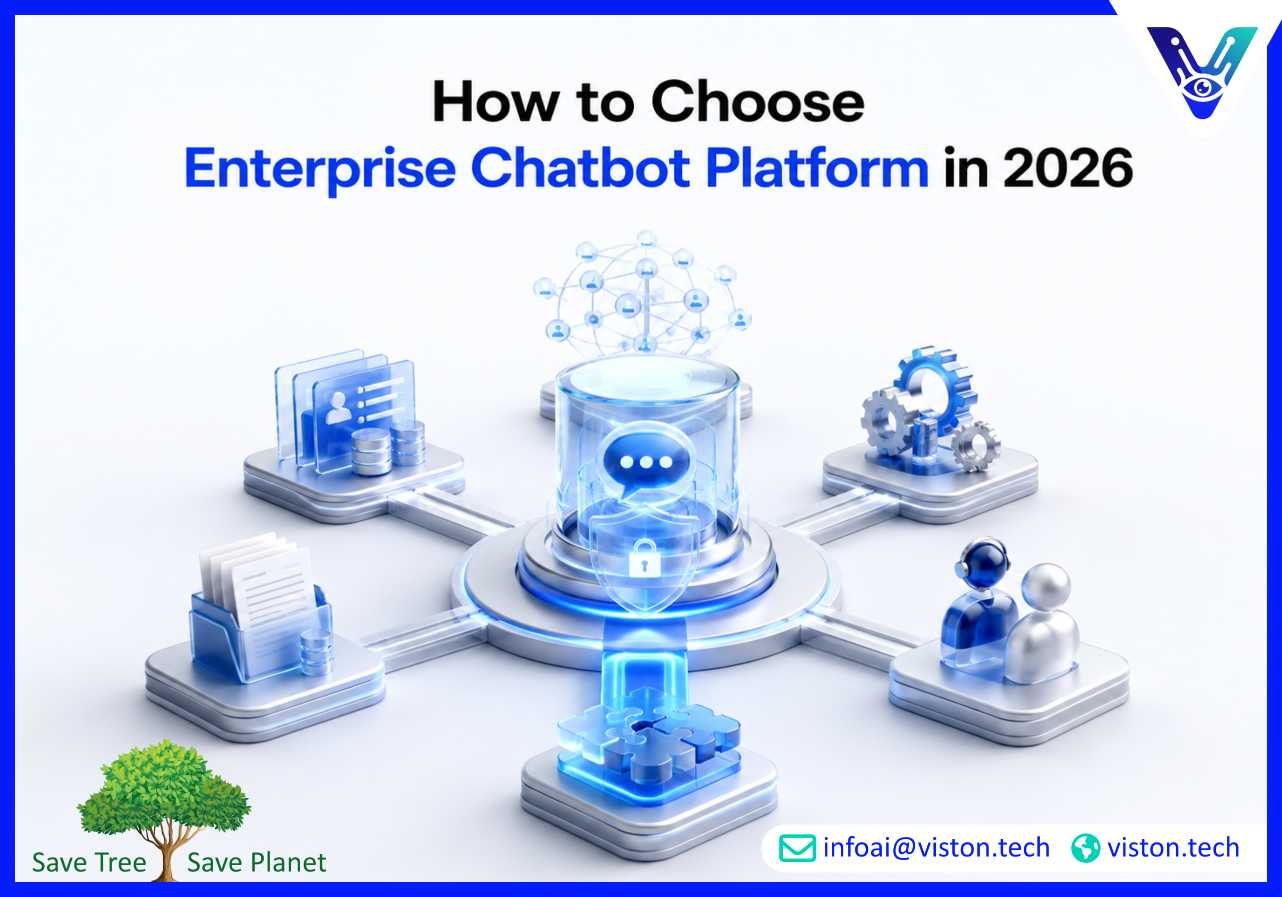
Knowing how to choose enterprise chatbot platform is now a serious business decision, not just a software selection task. In 2026, enterprise AI chatbots must support customer experience, workflow automation, data security, integrations, reporting, and scalable service delivery across complex business environments.
What an Enterprise Chatbot Platform Should Do in 2026
An enterprise chatbot platform is a conversational AI system designed to handle business-grade communication across customer service, sales, operations, HR, IT support, compliance workflows, internal knowledge search, and service automation. Unlike basic website chat widgets, enterprise platforms must connect with business systems, understand domain-specific language, manage user context, and support reliable automation at scale.The right platform should help users complete real tasks. That may include answering product questions, checking order status, qualifying leads, creating support tickets, retrieving policy information, booking appointments, updating CRM records, routing requests to the right team, or escalating sensitive issues to human agents. A platform that only responds with generic answers is rarely enough for enterprise use.In 2026, businesses expect enterprise AI chatbots to be accurate, secure, multilingual, measurable, and adaptable. They should work across websites, mobile apps, messaging platforms, internal portals, voice channels, and customer support systems. They should also support continuous improvement through analytics, feedback loops, training updates, and governance controls.
Enterprise chatbot platforms should support business outcomes
The platform should be evaluated against practical business goals, not only technical features. Before shortlisting vendors, teams should define what the chatbot needs to improve. Common goals include reducing support workload, improving first response time, increasing lead conversion, expanding 24/7 service availability, improving employee self-service, reducing ticket volume, or improving access to internal knowledge.This goal-first approach helps avoid choosing a platform that looks advanced but does not match operational needs. A business with complex customer support requirements may need strong ticketing integration and escalation workflows. A B2B sales team may need lead scoring, CRM syncing, meeting booking, and account-level personalization. An internal enterprise assistant may need secure knowledge retrieval, permission controls, and auditability.
Core capabilities to expect
Natural language understanding for intent detection and entity extraction
Knowledge base and document retrieval from approved sources
Integration with CRM, ERP, helpdesk, ecommerce, HRIS, and internal systems
Human handoff with full conversation context
Multilingual and omnichannel support
Role-based access control and data security features
Analytics dashboards for chatbot performance and business impact
Workflow automation for repetitive operational tasks
Governance controls for compliance, review, and continuous improvement
Key Evaluation Criteria for Choosing an Enterprise Chatbot Platform
Choosing an enterprise chatbot platform requires a structured evaluation process. The best choice is not always the platform with the longest feature list. It is the platform that fits your use cases, integrates with your systems, protects your data, supports your team, and can grow with your business.
Use case fit
Start by mapping the chatbot’s primary use cases. Will it support customer service, sales, employee helpdesk, onboarding, compliance workflows, ecommerce support, technical troubleshooting, or internal knowledge search? Each use case requires different capabilities.For example, a customer support chatbot needs strong resolution flows, ticketing integration, sentiment detection, and escalation logic. A sales chatbot needs lead qualification, CRM updates, routing rules, and conversion tracking. A knowledge assistant needs reliable retrieval from approved documents and clear source control.
Integration capability
Integration is one of the biggest differences between basic chatbot tools and enterprise AI chatbot platforms. A strong platform should connect with systems such as Salesforce, HubSpot, Microsoft Dynamics, Zendesk, Freshdesk, ServiceNow, Shopify, SAP, Oracle, internal databases, identity providers, and knowledge management tools.Without integration, the chatbot may answer simple questions but fail to complete business tasks. With proper integration, it can retrieve customer records, update tickets, check inventory, trigger workflows, send confirmations, assign leads, and pass structured data to internal teams.
Data security and access control
Enterprise chatbots often handle sensitive customer, employee, financial, operational, or contractual information. The platform should support encryption, secure APIs, authentication, role-based access, audit logs, data retention controls, and permission-aware knowledge retrieval.Security should be reviewed early, not after implementation. Procurement, IT, legal, compliance, and data teams should assess where data is stored, how it is processed, whether conversations are logged, how training data is handled, and whether the platform supports internal policy requirements.
AI accuracy and knowledge governance
Accuracy depends on the quality of the chatbot’s knowledge sources, retrieval logic, prompts, guardrails, and review workflows. Businesses should look for platforms that can use approved knowledge bases, detect uncertainty, avoid unsupported claims, and escalate when confidence is low.Knowledge governance is especially important for regulated or complex industries. The platform should make it easy to manage approved content, remove outdated information, define source priority, control access by role, and review failed responses. A chatbot that cannot be governed properly can create business risk.
Scalability and performance
An enterprise chatbot platform should support high conversation volume without performance issues. It should handle traffic spikes during campaigns, product launches, seasonal periods, outages, or support surges. Scalability also includes support for more languages, more departments, more workflows, and more integrations over time.Performance should be measured by response speed, uptime, workflow success rate, resolution quality, API reliability, and fallback rate. A chatbot that works well in a pilot may not be ready for enterprise-wide deployment unless its architecture can support production usage.
Common Mistakes Businesses Make When Selecting a Chatbot Platform
Many chatbot projects fail because the platform is selected before the business problem is clearly defined. A polished demo can make a system look capable, but enterprise success depends on how well the platform works inside real workflows, with real data, real users, and real operational constraints.
Choosing based only on interface design
A clean chatbot interface is important, but it is not enough. The real value sits behind the interface: intent design, system integration, knowledge retrieval, escalation logic, security controls, analytics, and maintainability. A chatbot may look modern but still fail if it cannot access the right data or complete the right actions.
Ignoring human handoff requirements
Enterprise chatbots should not try to automate every conversation. Some issues require human judgment, empathy, approval, or investigation. A good platform should detect when escalation is needed and transfer the conversation with full context, including user details, detected intent, previous answers, sentiment, and relevant records.Poor handoff design forces customers or employees to repeat themselves. This weakens trust and reduces the perceived value of automation.
Underestimating training and maintenance
Chatbots need continuous improvement. Products change, policies change, workflows change, customer questions change, and internal documentation evolves. A platform should support ongoing training, fallback review, conversation analysis, content updates, and performance optimization.Businesses should avoid platforms that require heavy technical effort for every update unless they have the internal team to manage that workload. The best fit usually balances technical flexibility with practical business-user control.
Not checking reporting depth
Chatbot analytics should go beyond conversation volume. Useful reporting includes resolution rate, fallback rate, escalation rate, customer satisfaction, lead capture rate, workflow completion rate, ticket deflection, average response time, conversion rate, and failed intent analysis.For enterprise AI chatbots, reporting should connect conversation outcomes to business systems. This allows leaders to measure whether the chatbot is reducing workload, improving service quality, supporting sales, and creating measurable operational value.
Overlooking compliance and regional requirements
Even when a business operates globally, compliance needs can vary by customer type, industry, region, and data category. A chatbot platform should support data governance, privacy controls, audit logs, access restrictions, consent handling, and escalation rules where required.For industries such as finance, healthcare, insurance, education, government, and ecommerce, compliance expectations should shape platform selection from the beginning.
How to Compare Enterprise Chatbot Platform Options
A practical comparison process helps teams avoid emotional or feature-led buying decisions. The goal is to test whether the platform can support your specific business environment, not whether it can perform well in a generic demo.
Create a requirements checklist
Build a checklist around your use cases, user groups, systems, channels, languages, workflows, security needs, reporting requirements, and support expectations. Separate must-have requirements from nice-to-have features. This helps procurement and technology teams compare platforms consistently.Must-have requirements may include CRM integration, helpdesk integration, multilingual support, secure authentication, human escalation, analytics, knowledge base retrieval, workflow automation, and compliance controls. Nice-to-have features may include advanced personalization, voice support, proactive messaging, or AI-generated summaries.
Run a focused proof of concept
A proof of concept should test real workflows, not generic chatbot responses. Choose a small number of high-value use cases and use realistic data, sample queries, edge cases, and escalation scenarios. Measure how the platform performs against accuracy, response quality, integration success, handoff quality, and admin usability.A focused pilot helps teams understand implementation effort, data readiness, user experience, and vendor support quality before committing to a larger deployment.
Evaluate vendor delivery capability
The platform matters, but the provider’s delivery approach also matters. Enterprise chatbot implementation requires conversation design, data preparation, integration planning, testing, security review, training, analytics setup, and ongoing optimization.Look for providers that understand enterprise workflows, not just chatbot scripts. A capable provider should be able to explain how they handle requirements gathering, data mapping, system integration, access control, prompt management, testing, launch support, and post-launch optimization.
Review total cost of ownership
Platform pricing is only one part of chatbot cost. Businesses should also consider implementation, customization, integration, training data preparation, maintenance, support, analytics, security review, API usage, hosting, model usage, and future expansion.A low-cost platform may become expensive if it requires extensive custom work or cannot handle required integrations. A higher-cost platform may be more practical if it reduces implementation risk and supports long-term scalability.
Plan for governance from day one
Governance should include ownership of chatbot content, workflows, analytics, security, escalation rules, and improvement cycles. Define who approves answers, who reviews failed conversations, who manages knowledge updates, who monitors KPIs, and who decides when to expand the chatbot’s scope.This keeps the chatbot reliable after launch and prevents quality from declining as business requirements change.
How Viston AI Helps Businesses Choose and Build Enterprise AI Chatbots
Viston AI is relevant to this topic because choosing an enterprise chatbot platform often requires more than selecting software. Businesses need a solution that can be designed around real workflows, integrated with existing systems, governed securely, and optimized over time. Viston AI’s Enterprise AI Chatbots service focuses on building conversational AI for enterprise complexity, including natural language understanding, contextual conversations, workflow automation, knowledge integration, multilingual support, and secure business system connectivity.For organizations comparing chatbot platforms, this matters because platform success depends on how well the chatbot fits business operations. Viston AI supports enterprise chatbot requirements such as CRM and ERP integration, knowledge base connectivity, transactional system access, human escalation, analytics, and security-focused deployment. These capabilities are useful for companies that want chatbots to handle customer service, sales support, internal helpdesk requests, appointment scheduling, technical troubleshooting, lead qualification, or knowledge search.Viston AI’s broader AI service capabilities also include AI chatbot integration, NLP and text analysis, AI automation and workflow bots, AI strategy consulting, multilingual support, voice-enabled assistants, and MLOps or model monitoring. This makes its approach suitable for businesses that want a chatbot platform selected, customized, and maintained with enterprise-grade reliability rather than deployed as a disconnected tool.
Frequently Asked Questions
What is the most important factor when choosing an enterprise chatbot platform?
The most important factor is business fit. The platform should support your actual use cases, systems, security needs, workflows, channels, and reporting goals. A feature-rich chatbot platform is not useful if it cannot integrate with your business environment or deliver measurable outcomes.
Should businesses choose a custom chatbot or a ready-made platform?
It depends on complexity. A ready-made platform may work for standard FAQs and simple support flows. A custom or configurable enterprise AI chatbot is usually better when the business needs system integration, domain-specific knowledge, secure data access, multilingual workflows, or complex automation.
How do I know if a chatbot platform is enterprise-ready?
An enterprise-ready chatbot platform should offer strong security, integration capabilities, analytics, human handoff, role-based access, knowledge governance, scalability, multilingual support, and reliable workflow automation. It should also support testing, monitoring, and continuous improvement after deployment.
Why is integration important in enterprise AI chatbots?
Integration allows the chatbot to do more than answer questions. It can retrieve customer data, update CRM records, create tickets, check order status, schedule appointments, trigger workflows, and provide personalized support based on real business information.
What KPIs should be tracked after launching an enterprise chatbot platform?
Important KPIs include self-service resolution rate, fallback rate, escalation rate, customer satisfaction, average response time, workflow completion rate, ticket deflection, lead conversion, human handoff quality, and integration success rate.
Can Viston AI help with enterprise chatbot platform selection?
Yes. Viston AI’s Enterprise AI Chatbots service is aligned with platform selection and implementation because it covers chatbot development, system integration, NLP, workflow automation, multilingual support, knowledge integration, and ongoing optimization for enterprise use cases.
Conclusion
Understanding how to choose enterprise chatbot platform is essential for businesses investing in Enterprise AI Chatbots in 2026. The right platform should match business goals, integrate with core systems, protect sensitive data, support accurate knowledge retrieval, enable human handoff, and provide measurable performance insights. Businesses should evaluate platforms based on real use cases, scalability, security, integration depth, governance, and long-term ownership. Viston AI is a relevant specialist for organizations that need enterprise chatbot solutions designed around practical workflows, reliable automation, and scalable conversational AI delivery.