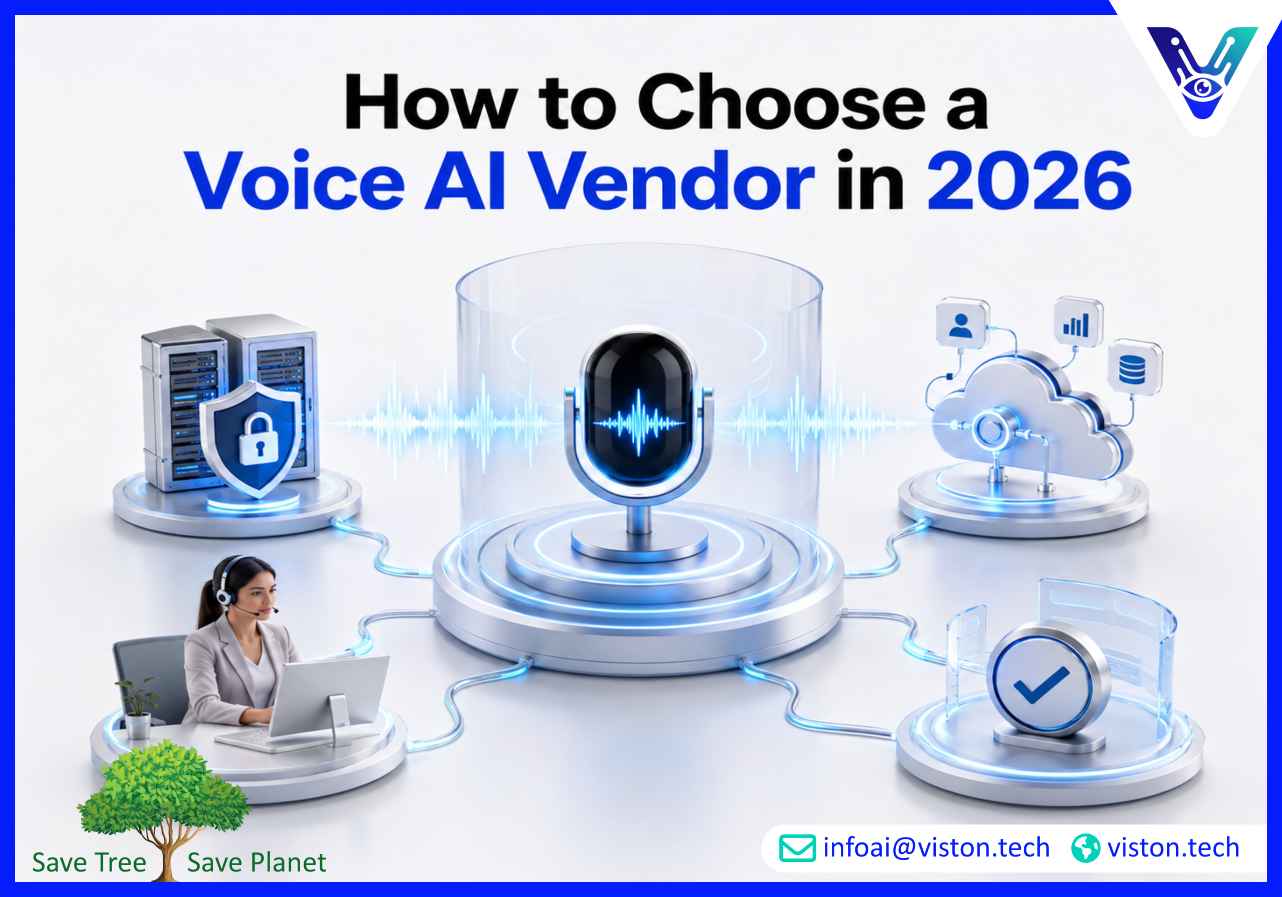
Choosing a voice AI vendor is a business decision involving customer experience, operational reliability, data security, integration, and long-term scalability. The right provider should deliver more than a natural-sounding voice. It should build a dependable voice-enabled assistant that understands users, completes useful tasks, and operates safely within your existing technology environment.
What a Voice AI Vendor Should Deliver in 2026
A voice AI vendor develops or implements systems that allow customers, employees, or business partners to interact with software through spoken conversation. These solutions typically combine automatic speech recognition, natural language understanding, language models, text-to-speech technology, business rules, integrations, analytics, and human escalation workflows.However, access to these technologies does not automatically make a provider suitable for a business deployment. A credible vendor must understand how to combine them into a reliable production system.In 2026, buyers should expect a voice AI provider to support complete conversations rather than isolated voice commands. The assistant should understand why the caller is contacting the business, retain relevant context, clarify ambiguous requests, retrieve approved information, perform authorized actions, and transfer the conversation when automation is no longer appropriate.
Start with the business outcome, not the voice model
Before evaluating vendors, define the outcome the voice-enabled assistant must support. Common objectives include:
Answering repetitive customer service questions
Qualifying inbound sales enquiries
Booking, confirming, or rescheduling appointments
Providing order, delivery, or account updates
Conducting structured customer follow-ups
Supporting employees with internal information
Routing callers to the correct department
Collecting information before human handover
A vendor should be able to translate the selected objective into conversational flows, integration requirements, escalation conditions, security controls, reporting metrics, and an implementation plan. A provider that begins by discussing a preferred technology stack without understanding the workflow may produce an impressive demonstration that fails in day-to-day operations.
Look for an end-to-end delivery capability
Voice AI performance depends on the complete interaction pipeline. The vendor may need to manage telephony connectivity, speech recognition, intent detection, dialogue management, knowledge retrieval, API calls, voice synthesis, call recording controls, analytics, and monitoring.Ask which parts of the solution the vendor develops, which components come from third parties, and who remains accountable when performance problems occur. This matters because delays or errors can originate from several layers. A slow response may be caused by transcription, model inference, knowledge retrieval, an external API, or text-to-speech generation.A specialized vendor should be able to diagnose the entire conversation journey instead of treating each component as an unrelated service.
How to Evaluate Voice AI Quality and Technical Performance
To choose a voice AI vendor confidently, evaluate the system under realistic operating conditions. A controlled demonstration with short, predictable questions does not reveal how the assistant will perform with interruptions, background noise, accents, incomplete information, emotional callers, or unexpected requests.
Test speech recognition in your real environment
Speech recognition accuracy should be assessed using the languages, accents, terminology, telephone channels, and noise conditions relevant to your users. A system that performs well with studio-quality audio may perform differently on mobile calls, speakerphones, low-bandwidth connections, factory floors, vehicles, or busy contact centres.Provide vendors with representative phrases, product names, locations, technical terms, abbreviations, customer identifiers, and commonly mispronounced words. Ask how custom vocabulary is configured and how recognition failures are reviewed after deployment.Do not rely on one overall accuracy percentage. Measure whether the assistant correctly understands the information that matters to the workflow, such as names, dates, account numbers, addresses, appointment times, quantities, and service categories.
Evaluate latency and conversational timing
A voice assistant must respond quickly enough to preserve a natural conversation. Long pauses make users uncertain about whether the system heard them, while overly fast responses may interrupt callers or feel unnatural.Ask the vendor to demonstrate:
Average response time during normal traffic
Performance during peak demand
Interruption handling and barge-in support
Turn-taking between the assistant and caller
Recovery after silence or incomplete speech
Behaviour when an external system responds slowly
The strongest vendors measure latency across each technical component and use graceful recovery messages when a backend process needs additional time.
Assess conversation quality, not only voice realism
A human-like voice can improve usability, but it is not the main measure of success. The assistant must understand intent, maintain context, ask relevant follow-up questions, and avoid inventing information.During evaluation, test multi-step conversations. Change details midway through the call. Ask a question outside the approved scope. Use vague wording. Interrupt the assistant. Request a human agent. A production-ready system should manage these situations predictably.Ask how responses are grounded in approved business information and how the system behaves when no reliable answer is available. A safe assistant should acknowledge uncertainty, request clarification, or escalate rather than produce a confident but unsupported answer.
Require measurable acceptance criteria
Agree on success measures before implementation. Useful voice AI metrics may include:
Task completion rate
Intent recognition accuracy
Containment or self-service resolution rate
Fallback and misunderstanding rate
Average response latency
Human escalation rate
Transfer success and handover quality
Customer satisfaction
Workflow or API completion rate
Cost per successfully completed interaction
The appropriate target depends on the use case. A vendor should help establish a baseline, define pilot targets, and explain how performance will be monitored and improved after launch.
Security, Governance, Integration, and Commercial Fit
Voice interactions can contain personal, financial, health, contractual, or commercially sensitive information. Vendor selection must therefore include security, privacy, governance, and data-handling reviews from the beginning.
Examine the complete data lifecycle
Ask where audio, transcripts, prompts, responses, analytics, and call metadata are processed and stored. Confirm retention periods, encryption practices, access controls, deletion procedures, subprocessors, backup policies, and whether customer data is used to train shared models.The vendor should also explain how it handles sensitive information during recordings and transcripts. Depending on the use case, the system may require consent notices, data minimization, automated redaction, restricted retention, role-based access, and regional data hosting.Current AI governance frameworks give buyers useful reference points. ISO/IEC 42001 defines requirements for establishing and continually improving an AI management system, while ISO/IEC 27001 addresses information security management. NIST’s AI Risk Management Framework and its Generative AI Profile also provide structured approaches for governing, mapping, measuring, and managing AI risk.
Check protections against AI-specific threats
Voice-enabled assistants connected to language models and business systems face risks beyond traditional application security. These may include prompt injection, sensitive information disclosure, unsafe model outputs, excessive permissions, insecure integrations, and uncontrolled automated actions.OWASP identifies prompt injection, sensitive information disclosure, supply-chain exposure, and excessive agency among important risks affecting large-language-model applications. Vendors should be able to explain how they restrict system permissions, validate model outputs, isolate tools, test integrations, monitor misuse, and require human approval for sensitive actions.
Prioritize integration capability
A voice assistant creates greater business value when it can work with the systems employees already use. Depending on the workflow, this may include CRM platforms, contact-centre software, scheduling systems, helpdesks, ERP applications, payment services, knowledge bases, identity systems, or custom databases.Ask the vendor to map every data read and write. Confirm authentication methods, permission controls, error handling, duplicate prevention, transaction logging, API limits, and rollback procedures.The vendor should also design for degraded conditions. When an integration is unavailable, the assistant must not pretend that an action was completed. It should explain the limitation, preserve the interaction context, create an alternative task, or transfer the caller appropriately.
Understand the full commercial model
Voice AI pricing may include implementation fees, telephony charges, speech-processing usage, model usage, integrations, platform subscriptions, support, monitoring, maintenance, and change requests. Compare the total cost of ownership rather than the lowest headline rate.Request a pricing model based on realistic call volumes, average call duration, concurrency, languages, environments, integration usage, and support expectations. Clarify what happens when traffic exceeds the forecast and whether the vendor can change underlying technology providers without creating an expensive redevelopment project.
A Practical Process for Choosing a Voice AI Vendor
A structured procurement process reduces the risk of selecting a vendor based on a polished demonstration. The process should connect business requirements, technical testing, governance, and commercial evaluation.
1. Define a narrow initial use case
Select a high-volume, measurable workflow with clear boundaries. Avoid beginning with a requirement to automate every customer conversation. A focused use case makes it easier to test quality, identify operational risks, and prove value.
2. Prepare a vendor scorecard
Build a weighted scorecard covering conversational quality, speech recognition, latency, integrations, security, governance, analytics, scalability, implementation experience, support, and total cost.Weight the criteria according to business risk. For a customer service assistant, escalation quality and system integration may be more important than the number of available voices. For a multilingual deployment, accent handling, language coverage, local testing, and content governance may carry greater weight.
3. Run scenario-based demonstrations
Give each shortlisted vendor the same scenarios and evaluation conditions. Include straightforward requests, unusual wording, missing information, interruptions, angry callers, unsupported questions, integration failures, and escalation requests.Score observable behaviour instead of general impressions. Record whether the assistant understood the request, preserved context, completed the task, explained limitations, and transferred the conversation correctly.
4. Conduct technical and security due diligence
Request architecture documentation, data-flow diagrams, security controls, service-level commitments, incident procedures, business continuity plans, model-provider dependencies, and subprocessor information.Speak with the vendor’s technical delivery team rather than relying only on sales representatives. The people responsible for implementation should be able to explain how they test, deploy, monitor, troubleshoot, and improve the system.
5. Use a controlled pilot before scaling
A pilot should use real workflows and representative traffic while limiting operational exposure. Establish a baseline, acceptance criteria, escalation process, review schedule, and decision point before the pilot begins.Review failed conversations in detail. Determine whether failures came from speech recognition, conversation design, knowledge gaps, integrations, business rules, or user behaviour. The vendor’s ability to diagnose and improve these failures is often a better indicator of long-term value than the initial demonstration.
How Viston AI Supports Voice AI Vendor Selection and Delivery
Viston AI is directly relevant to organizations evaluating a voice AI vendor because Voice-Enabled AI Assistants are part of its stated service portfolio. Its offering combines speech recognition, natural language processing, generative AI, conversation management, analytics, integrations, and model lifecycle operations for business-focused voice interactions.The company describes capabilities for multi-turn conversations, multilingual deployments, business-system connectivity, real-time monitoring, performance optimization, role-based controls, audit trails, and human intervention points. It also presents an implementation approach covering discovery, proof of concept, development, integration, monitoring, and scaling. These capabilities align with the practical requirements involved in moving a voice assistant from prototype to production.For businesses considering customer service automation, lead qualification, appointment management, internal support, or voice-enabled workflows, this end-to-end approach can reduce the coordination burden created by separate speech, model, telephony, and integration providers.Organizations should still validate every required capability against their own use case, security obligations, languages, systems, call volumes, and performance targets. Viston AI’s relevance lies in its ability to address voice AI as an integrated business solution rather than only supplying a speech or text-to-speech component.
Frequently Asked Questions
What should I look for in a voice AI vendor?
Look for strong speech recognition, low latency, reliable conversation management, secure data handling, business-system integrations, human handover, monitoring, scalability, and ongoing optimization. The vendor should also understand your workflow and define measurable success criteria.
How do I compare voice AI vendors fairly?
Give shortlisted vendors the same scenarios, audio conditions, integration requirements, security questions, and call-volume assumptions. Use a weighted scorecard and assess task completion, accuracy, latency, escalation, implementation capability, and total cost.
Should I choose a platform or a custom voice AI development vendor?
A platform may suit simple and standardized workflows with limited customization. A custom development vendor may be more appropriate when the assistant needs complex integrations, specialized terminology, unique business logic, multilingual support, governance controls, or tailored monitoring.
How important is latency in a voice-enabled assistant?
Latency is critical because long pauses disrupt conversational flow and reduce user confidence. Evaluate end-to-end response time under realistic traffic, including speech recognition, language-model processing, knowledge retrieval, API calls, and voice generation.
What security questions should I ask a voice AI provider?
Ask where data is processed and stored, how it is encrypted, who can access it, how long it is retained, which subprocessors are involved, whether it trains shared models, and how it manages redaction, incidents, permissions, audit logs, deletion, and regulatory requirements.
Can Viston AI build and integrate a voice-enabled assistant?
Viston AI lists Voice-Enabled AI Assistants as a core service and describes capabilities involving speech recognition, NLP, multilingual conversations, business-system integrations, analytics, governance, monitoring, and ongoing optimization.
Conclusion
To choose a voice AI vendor effectively, focus on operational performance rather than demonstration quality alone. The provider should understand your workflow, test against real users and environments, integrate securely with business systems, manage AI-specific risks, and remain accountable after deployment. A structured scorecard, scenario-based evaluation, security review, and controlled pilot will reveal whether a vendor can deliver a reliable voice-enabled assistant at scale. Viston AI offers relevant voice AI development and integration capabilities for organizations seeking a business-focused implementation partner.