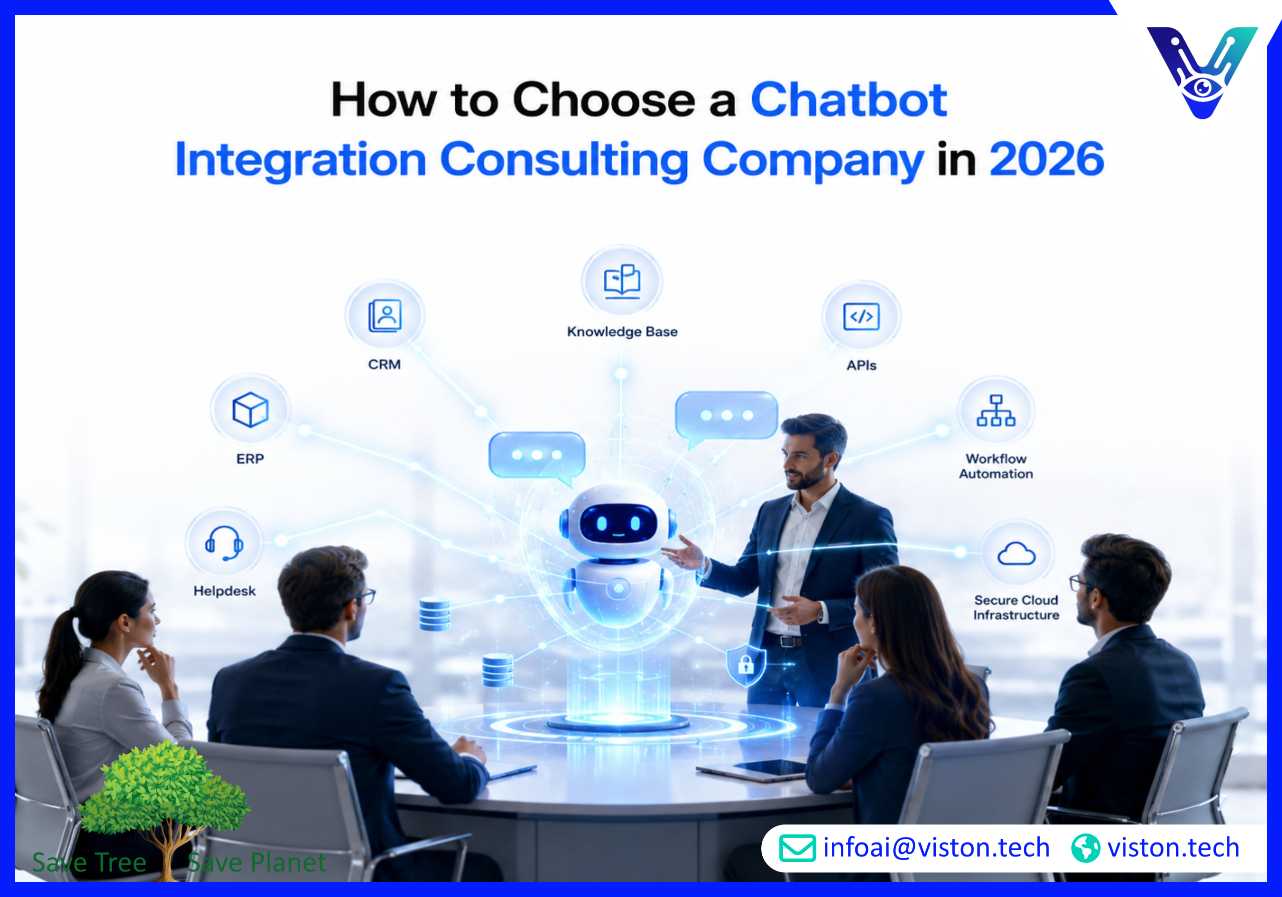
How to Choose a Chatbot Integration Consulting Company in 2026
Choosing the right chatbot integration consulting company can determine whether conversational AI becomes a useful business system or another disconnected tool. In 2026, businesses need consultants who can connect chatbots with reliable data, operational workflows, customer platforms, security controls, analytics, and human support processes.
What a Chatbot Integration Consulting Company Does
A chatbot integration consulting company helps businesses plan, connect, deploy, and improve conversational AI across existing technology environments. Its role goes beyond adding a chat window to a website. The consultant must understand how conversations should interact with CRM platforms, helpdesk systems, ecommerce tools, ERP software, knowledge bases, scheduling applications, payment services, analytics platforms, and internal databases.The consulting process should begin with business objectives rather than a preferred chatbot platform. A company may want to reduce repetitive support requests, qualify leads, automate appointment booking, improve employee access to information, provide order updates, or guide customers through complex service processes. Each objective requires different data, workflows, integrations, permissions, and performance measures.
Strategy and use-case definition
A capable consultant identifies which chatbot use cases are valuable, technically feasible, and safe to automate. High-volume, repeatable interactions are often suitable starting points, while sensitive complaints, regulated decisions, unusual transactions, and high-risk requests may require human review.This planning stage should define intended users, supported channels, conversation types, data sources, escalation conditions, operational owners, and measurable outcomes. It should also prevent the common mistake of building a broad chatbot that attempts to answer everything without sufficient business context.
Technical and operational integration
AI Chatbot Integration connects the conversational layer with the systems required to retrieve information or complete actions. For example, an integrated chatbot may check a customer record, create a support ticket, update a lead, retrieve an order status, book an appointment, confirm inventory, or route an approval request.The consulting company should design how data moves between systems, how user identity is verified, which actions are permitted, what happens when an API fails, and how each transaction is recorded. This operational detail separates a production-ready chatbot from a basic demonstration.
Why Specialist Chatbot Integration Consulting Matters in 2026
Modern chatbots increasingly use large language models, retrieval systems, automation tools, and multi-step workflows. These technologies make conversations more natural, but they also increase the importance of architecture, data governance, testing, monitoring, and controlled system access.A chatbot may produce a fluent answer while using outdated information. It may understand a request but fail to update the CRM. It may trigger the correct workflow for the wrong user or expose information that should require stronger authentication. Specialist consulting helps businesses address these risks before deployment.
Chatbots must operate within real business processes
A standalone bot can answer basic questions, but it cannot reliably support account-specific service without access to operational data. Customers expect a chatbot to recognize their order, subscription, booking, case, or previous interaction. Employees expect internal assistants to retrieve approved information without requiring them to search several systems.Integration consulting maps these expectations to actual business processes. It determines which platform is the source of truth, which data can be displayed, which actions require confirmation, and when a human team must take over.
Security and governance are implementation requirements
Chatbot integrations may process personal data, account details, employee records, financial information, support histories, or internal documents. Security therefore needs to be designed into the integration architecture rather than added after launch.Important controls can include encrypted connections, role-based access, secure API gateways, identity verification, least-privilege permissions, consent handling, audit logs, rate limits, data retention rules, and environment separation. The correct controls depend on the industry, use case, data sensitivity, and operating regions.
Performance must be measured beyond conversation volume
A high number of chatbot conversations does not prove that the system is successful. Businesses need to measure task completion, resolution quality, escalation accuracy, fallback rate, customer satisfaction, workflow success, data synchronization, response time, lead quality, and operational impact.A consulting partner should connect chatbot analytics with business systems so teams can see whether conversations produced resolved tickets, qualified leads, completed bookings, updated records, or reduced manual work. This makes chatbot performance accountable to business outcomes.
Capabilities to Evaluate in a Chatbot Integration Consulting Company
Businesses should assess potential consulting partners against practical delivery capabilities. A polished chatbot demonstration is not enough. The provider must be able to work with existing systems, operational constraints, security requirements, and long-term support expectations.
Business process discovery
The company should be able to document current workflows, identify repetitive tasks, analyze customer or employee intents, and determine where automation can create meaningful value. It should ask how work is completed today, which teams own each process, where delays occur, and what exceptions require human judgment.
CRM, ERP, helpdesk, and API integration experience
Look for experience connecting chatbots with platforms such as CRM, ERP, ticketing, ecommerce, scheduling, marketing automation, knowledge management, and internal applications. The provider should understand REST APIs, webhooks, authentication methods, data mapping, middleware, event handling, error recovery, and bidirectional synchronization.Legacy systems are especially important. A consultant should explain whether the chatbot will connect directly, through an integration platform, through a secure middleware layer, or through a custom service. The architecture should remain maintainable as systems change.
Knowledge and retrieval design
Many AI chatbots rely on retrieval-augmented generation to answer questions using approved business content. The consulting company should know how to prepare documents, separate public and restricted knowledge, manage versions, remove conflicting information, apply permissions, and trace answers to trusted sources.It should also define what the chatbot does when information is missing, uncertain, or outdated. A reliable system should ask for clarification or escalate rather than invent a confident answer.
Conversation design and human handover
Good integration does not compensate for a confusing conversation. The provider should design clear prompts, concise responses, confirmation steps, error messages, and recovery paths. It should test how the chatbot handles ambiguity, spelling variations, unexpected requests, repeated failures, and changes in user intent.Human handover should preserve the conversation history, detected intent, customer details, attempted actions, and relevant system records. Customers should not have to repeat the entire issue after escalation.
Testing, monitoring, and optimization
Ask how the company tests intent recognition, retrieval quality, workflow execution, permissions, peak traffic, system failures, and edge cases. Production monitoring should cover latency, API errors, fallback patterns, unresolved conversations, integration failures, unauthorized access attempts, and business KPIs.Post-launch support should include knowledge updates, workflow refinement, prompt improvement, new integrations, performance reviews, and controlled expansion into additional use cases or channels.
How to Select the Right Chatbot Integration Partner
The selection process should evaluate both technical competence and consulting discipline. The best provider is not necessarily the one promising the most features. It is the one that can explain how the chatbot will support specific business outcomes while managing operational and technical risk.
Start with a defined business problem
Prepare a short description of the process you want to improve. Include the users involved, current systems, conversation volume, common requests, operational pain points, sensitive data, and desired results. This gives consulting companies enough context to propose a relevant approach.
Ask for an architecture and delivery explanation
A credible proposal should explain the chatbot platform, model approach, knowledge sources, system connections, authentication, data flow, escalation logic, monitoring, and ownership model. It should also identify dependencies such as API access, data cleanup, security approval, stakeholder availability, and knowledge-base preparation.
Evaluate the proposed rollout
A phased rollout is usually safer than attempting a large deployment immediately. A focused pilot can validate one or two high-value use cases, confirm system connectivity, test user behavior, and establish baseline metrics. The business can then expand based on evidence rather than assumptions.Review how the provider defines acceptance criteria. These may include successful workflow completion, response accuracy, escalation quality, CRM update reliability, latency, security testing, user satisfaction, and operational readiness.
Clarify commercial and support terms
Chatbot integration costs can include discovery, design, development, platform licensing, model usage, connector fees, cloud infrastructure, testing, security work, monitoring, maintenance, and future enhancements. Request a clear breakdown of what is included and which costs depend on usage or scope.Confirm ownership of integration code, configuration, prompts, documentation, analytics, and business data. The agreement should also define support response times, change management, issue resolution, and responsibilities after deployment.
How Viston AI Supports Chatbot Integration Consulting
Viston AI is directly relevant to organizations researching a chatbot integration consulting company because it provides AI Chatbot Integration alongside chatbot development, enterprise conversational AI, natural language processing, workflow automation, multilingual support, and strategic AI consulting.Its published integration capabilities focus on connecting conversational interfaces with CRM, ERP, helpdesk, ecommerce, knowledge, and custom business systems. This includes bidirectional data synchronization, API-based connectivity, workflow orchestration, multi-channel deployment, structured data mapping, access controls, logging, and performance monitoring.For businesses, this means the engagement can address both the conversational experience and the operational systems behind it. A chatbot can be designed to retrieve approved information, update customer records, create tickets, qualify leads, check transactions, or initiate controlled workflows rather than operating as an isolated question-and-answer tool.Viston AI also uses a delivery process covering discovery, data preparation, model and architecture selection, testing, integration, deployment, monitoring, and continuous optimization. This approach is relevant for companies that need practical consulting before implementation, particularly when the project involves multiple stakeholders, legacy platforms, sensitive data, or several customer and employee channels. Its service alignment makes it a credible option for organizations seeking measurable, scalable, and business-focused AI Chatbot Integration.
Frequently Asked Questions
What is a chatbot integration consulting company?
A chatbot integration consulting company helps businesses plan, connect, deploy, and optimize AI chatbots within existing systems. Its work may include strategy, conversation design, CRM integration, workflow automation, knowledge configuration, security, analytics, testing, and post-launch support.
How is chatbot integration different from chatbot development?
Chatbot development focuses on creating the conversational application. Chatbot integration connects that application with business platforms, data, authentication, workflows, reporting, and human support processes so it can retrieve information and complete useful actions.
Which systems can an AI chatbot integrate with?
An AI chatbot can integrate with CRM, ERP, helpdesk, ecommerce, payment, scheduling, marketing automation, HR, IT service management, analytics, knowledge-base, inventory, order management, and custom internal systems, depending on API access and security requirements.
How long does chatbot integration take?
Timelines depend on use-case complexity, number of integrations, data readiness, security reviews, channels, and testing requirements. A focused integration can be delivered more quickly than a multi-department deployment involving several legacy and enterprise systems.
What should be included in a chatbot integration proposal?
The proposal should cover scope, use cases, architecture, platforms, integrations, data flows, authentication, security, conversation design, testing, rollout, KPIs, documentation, support, ownership, assumptions, and a transparent cost structure.
Can Viston AI provide consulting before chatbot implementation?
Yes. Viston AI’s service portfolio combines AI Chatbot Integration with strategic consulting, chatbot development, enterprise AI, NLP, automation, and ongoing optimization. This supports organizations that need help defining use cases and architecture before development begins.
Conclusion
Selecting a chatbot integration consulting company in 2026 requires more than comparing chatbot interfaces or AI models. Businesses should evaluate how each provider approaches process discovery, enterprise systems, trusted knowledge, workflow automation, security, human escalation, testing, analytics, and long-term improvement. Effective AI Chatbot Integration turns conversations into controlled operational actions and measurable business outcomes. Viston AI offers relevant integration and consulting capabilities for organizations seeking a chatbot that works within their existing technology environment rather than creating another disconnected platform.