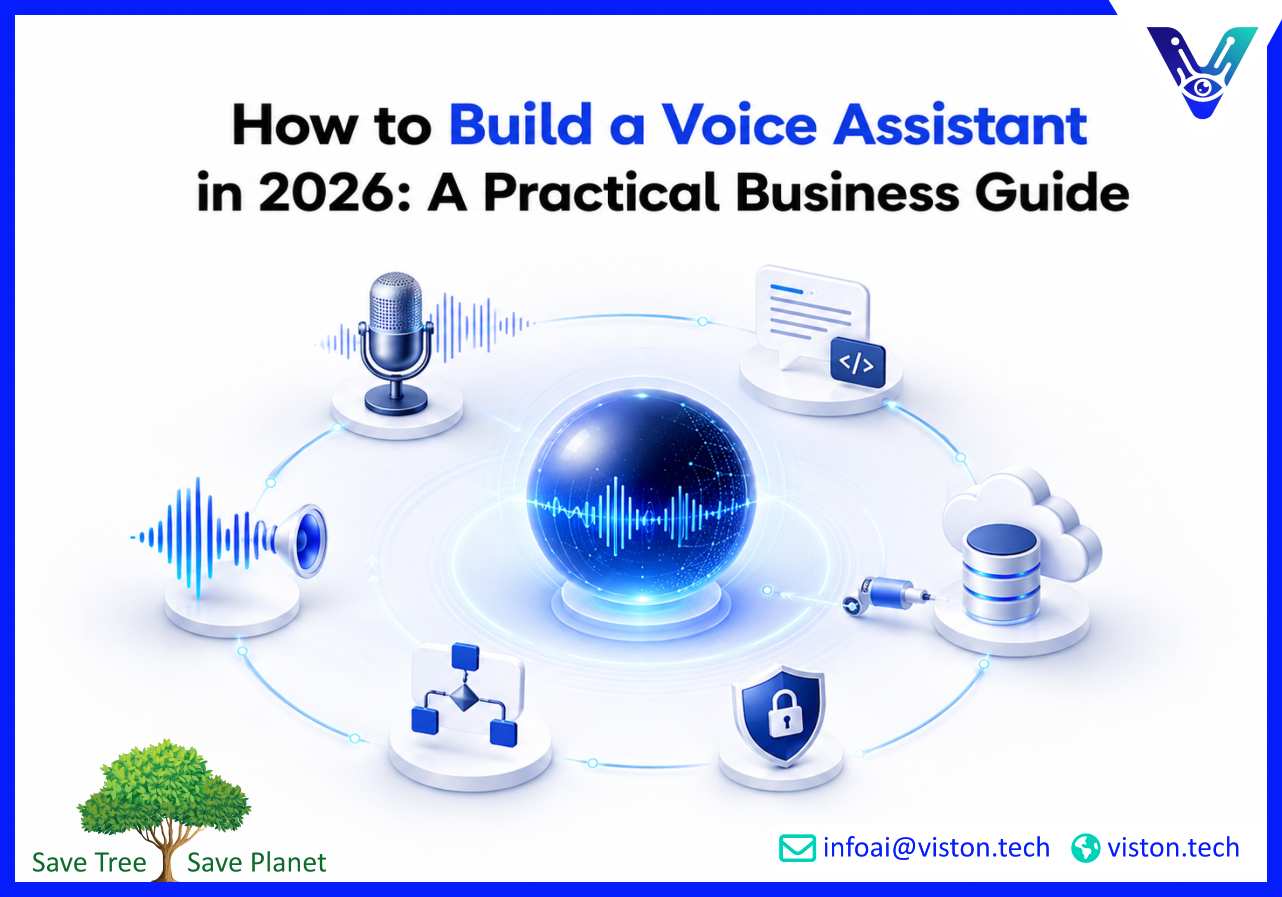
How to Build a Voice Assistant in 2026: A Practical Business Guide
Understanding how to build a voice assistant requires more than connecting speech recognition to an AI model. A production-ready assistant must understand real users, access trusted business information, complete approved actions, protect sensitive data, recover from errors, and deliver natural responses across phone, web, mobile, or connected-device channels.
What You Need to Build a Voice Assistant
A voice assistant is a conversational system that receives spoken input, interprets the user’s request, decides what information or action is required, and responds through synthesized speech. Although modern platforms can combine several stages, most business voice assistants still depend on a set of connected technical components.
Audio input and voice activity detection
The process begins by capturing audio from a telephone line, browser microphone, mobile application, smart device, headset, or embedded system. Voice activity detection identifies when the user starts and stops speaking. This prevents unnecessary audio processing and helps the assistant respond at the right moment.The audio layer must also handle background noise, interruptions, different microphones, inconsistent network quality, and variations in speaking volume. A prototype tested only in a quiet office may perform poorly in a contact centre, vehicle, warehouse, retail store, or public environment.
Automatic speech recognition
Automatic speech recognition, commonly called ASR or speech-to-text, converts spoken audio into a written transcript. Streaming recognition is generally used for real-time assistants because it can return partial results while the user is still speaking. Recognition quality depends on language support, accent coverage, audio quality, domain vocabulary, and the model selected for the audio environment.Businesses should test ASR with real product names, locations, employee terminology, account references, technical phrases, and customer accents. Custom vocabulary, phrase hints, language detection, and domain-specific models can improve recognition where generic transcription is insufficient.
Language understanding and reasoning
After transcription, the assistant must determine what the user wants. A simple command-based system may use intent classification and entity extraction. A more advanced assistant may use a large language model to interpret open-ended requests, maintain context, retrieve information, and decide which approved tool or workflow should be used.The reasoning layer should not be allowed to perform unrestricted actions. It needs clear instructions, permitted tools, confidence thresholds, business rules, and escalation conditions. For example, an assistant may answer a delivery question directly but require identity verification before changing an address or discussing account information.
Dialogue management and business integrations
Dialogue management maintains the conversation state across multiple turns. It remembers what the user has already said, asks for missing information, confirms important details, and determines the next step.To become operationally useful, the assistant must connect with relevant systems such as CRM platforms, helpdesk software, appointment calendars, ecommerce platforms, knowledge bases, ERP systems, payment services, inventory tools, or internal databases. These integrations allow the assistant to complete tasks rather than merely provide generic answers.
Text-to-speech output
Text-to-speech technology converts the final response into audio. Voice selection should consider clarity, language, pronunciation, pacing, tone, and suitability for the brand. The assistant should pronounce names, abbreviations, currencies, dates, product codes, and industry terminology correctly.A natural-sounding voice cannot compensate for a poorly written response. Spoken answers should be shorter and more direct than written chatbot messages because users cannot scan a voice response or easily revisit an earlier sentence.
How to Build a Voice Assistant Step by Step
1. Define one valuable use case
Start with a clearly bounded business problem. Suitable initial use cases may include answering routine support questions, booking appointments, qualifying leads, checking order status, resetting passwords, recording inspection results, routing calls, or helping employees locate internal information.A focused first release is easier to test, govern, and improve. Trying to automate an entire contact centre or every internal workflow at once usually creates unnecessary complexity. Define who will use the assistant, what they need to accomplish, which requests are out of scope, and when a human should take over.
2. Establish success criteria
Decide how the assistant will be evaluated before development begins. Useful measures include task completion rate, recognition accuracy, first-contact resolution, fallback rate, transfer rate, average response latency, user satisfaction, workflow success, conversion rate, and cost per completed interaction.Metrics should reflect the use case. A sales assistant may be judged by qualified appointments and CRM data accuracy. A support assistant may be evaluated through resolution quality, escalation efficiency, and reduced repetitive workload.
3. Map the conversation
Create a conversation map covering the ideal path, alternative wording, missing information, interruptions, corrections, authentication, failure states, and human handover. Write down the actions the assistant can perform and the information required for each action.For an appointment assistant, the flow may involve identifying the service, collecting the preferred date, checking availability, confirming the customer’s details, creating the booking, and issuing a confirmation. It should also know how to handle unavailable times, changed preferences, unclear dates, and requests to speak with staff.
4. Prepare trusted knowledge and data
Identify the approved information sources the assistant may use. These could include product documentation, FAQs, policies, service descriptions, operating procedures, pricing rules, troubleshooting guides, and structured business records.Remove outdated, duplicated, contradictory, or confidential material before connecting it to the assistant. Assign content owners and define which source takes priority when two systems disagree. The assistant should be able to acknowledge uncertainty rather than generate a confident but unsupported answer.
5. Select the technical architecture
Choose whether to use a traditional pipeline, a real-time speech-to-speech architecture, or a hybrid design. A pipeline typically separates speech recognition, language processing, tool execution, response generation, and text-to-speech. This can provide greater control and easier component-level monitoring.Real-time multimodal models can create more fluid interactions by processing and generating audio within a unified session. However, businesses still need controls for tool access, system prompts, data retrieval, logging, authentication, and escalation. The correct architecture depends on latency requirements, languages, call volume, integration complexity, deployment environment, privacy needs, and budget.
6. Build integrations with controlled permissions
Create APIs or middleware that allow the assistant to retrieve information and perform approved actions. Each integration should validate inputs, enforce user permissions, manage timeouts, prevent duplicate transactions, and return understandable error messages.High-impact actions should require confirmation. Before cancelling an order, submitting a payment, changing personal information, or creating a formal request, the assistant should repeat the critical details and obtain explicit approval.
7. Develop a working prototype
Build a limited prototype using representative conversations and real integration conditions. Avoid evaluating it only through scripted demonstrations. Test with users who speak naturally, change their minds, provide incomplete information, use unexpected wording, interrupt responses, and ask questions outside the intended scope.The prototype should prove that the assistant can understand the target users, complete the selected workflow, recover from common failures, and transfer the conversation with sufficient context.
8. Pilot before full deployment
Release the voice assistant to a controlled user group, selected call queue, internal team, or limited operating period. Monitor every failure category and compare results with the original success criteria.A pilot helps reveal vocabulary gaps, slow integrations, confusing prompts, incorrect routing, weak authentication, and unanticipated user behaviour. Address these issues before expanding traffic, channels, languages, or use cases.
How to Design a Voice Assistant People Can Use
Keep spoken responses concise
Voice interfaces should provide one clear idea or instruction at a time. Long explanations increase cognitive load and make it difficult for users to remember their options. Place the most important information first and offer further detail only when requested.Instead of reading six choices in one response, present the most likely options or ask a narrowing question. Users should not need to remember a complicated menu before responding.
Support interruptions and corrections
Natural conversations are not perfectly turn-based. Users interrupt, pause, restart sentences, and correct details. A well-designed assistant should support barge-in, detect the end of speech accurately, and preserve context after a correction.When the user says, “Actually, make that Thursday,” the assistant should update the relevant date rather than restarting the entire booking process.
Design useful fallback behaviour
A fallback should move the conversation forward rather than repeatedly saying that the request was not understood. The assistant can confirm what it heard, offer two likely interpretations, ask a focused question, or transfer the user to a person.After repeated failures, human escalation is usually more appropriate than forcing the user through the same interaction. The handover should include the transcript, detected intent, collected details, attempted actions, and reason for escalation.
Manage latency across the complete system
Response speed depends on audio transmission, speech recognition, model processing, knowledge retrieval, API calls, and speech generation. Streaming audio can reduce perceived delay, but teams must measure the complete turn rather than evaluating each component in isolation. Smaller audio frames can improve responsiveness, although they may increase processing overhead.Use short acknowledgement phrases only when a backend action genuinely requires time. Excessive filler can make the assistant sound artificial and may frustrate users.
Plan for language and accessibility
Language support involves more than translating prompts. Test regional accents, dialects, code-switching, numbers, names, and culturally appropriate phrasing. Users should also have alternatives when voice is unsuitable, such as keypad input, text chat, captions, or human assistance.
How to Test, Secure, Deploy, and Improve the Assistant
Test complete conversations
Component testing is necessary, but end-to-end testing is more important. A transcript may be correct while the assistant chooses the wrong action. The response may be accurate while the CRM update fails. A successful test should confirm that the user’s objective was completed correctly across the entire workflow.Build test sets covering normal requests, accents, noisy audio, ambiguous language, interruptions, unsupported topics, malicious instructions, integration failures, sensitive data, and high-risk actions. Include human review for interactions where accuracy, fairness, safety, or regulatory obligations matter.
Protect voice and personal data
Collect only the audio, transcripts, and user information required for the defined purpose. Use encryption, access controls, retention limits, secure authentication, audit logs, and redaction where appropriate. Tell users when conversations are recorded or processed and obtain the consent required by the applicable jurisdiction and use case.Voice biometrics and cloned voices require particular care because they can create identity, consent, and impersonation risks. Organizations should document ownership, approved use, security controls, and deletion procedures before deploying these features.
Apply AI governance throughout the lifecycle
Governance should cover design, data preparation, model selection, testing, deployment, monitoring, incident handling, and retirement. The NIST AI Risk Management Framework organizes responsible AI risk work around governing, mapping, measuring, and managing risks, providing a useful structure for voice-assistant projects that use generative AI.Define who owns the assistant, who approves knowledge changes, who can modify prompts and tools, how incidents are reported, and when the system must be disabled or rolled back.
Monitor production performance
Track transcription failures, unrecognized requests, task completion, escalation patterns, response latency, integration errors, user feedback, and outcomes by language or user group. Review failed conversations regularly to identify new intents, missing content, confusing prompts, and operational problems.Voice assistants require continuous maintenance. Products, policies, customer language, integrations, and business priorities change. Version control, regression testing, controlled releases, and rollback capability help prevent an improvement in one area from damaging another workflow.
How Viston AI Supports Voice Assistant Development
Viston AI is directly relevant to businesses researching how to build a voice assistant because Voice-Enabled Assistants are part of its published conversational AI service portfolio. Its offering combines speech recognition and synthesis, natural language processing, multi-turn context management, generative AI, business-system integration, analytics, and model lifecycle management.The company describes integrations with CRM, ERP, service management, healthcare, HR, and custom applications through APIs and connectors. This integration capability is important when a voice assistant must retrieve customer information, update records, trigger workflows, complete transactions, or transfer conversations with useful context.Viston AI also presents multilingual processing, role-based controls, audit trails, personally identifiable information redaction, consent workflows, monitoring, A/B testing, version control, and rollback support as part of its voice AI approach. These capabilities align with the practical requirements of deploying an assistant beyond an isolated demonstration.For organizations building customer-service, employee-support, sales, operational, or hands-free workflow assistants, Viston AI can support the process from discovery and data preparation through development, integration, testing, deployment, and ongoing optimization. Its service is most relevant where the assistant must be tailored to specific business language, systems, risk controls, and measurable outcomes.
Frequently Asked Questions
How long does it take to build a voice assistant?
A focused prototype may be developed relatively quickly, while a production assistant usually requires additional time for data preparation, integrations, security, testing, governance, and user validation. Complexity increases with multilingual support, regulated data, custom workflows, high call volumes, and legacy systems.
Do I need to train my own AI model?
Not always. Many businesses can use existing speech, language, and text-to-speech models with custom instructions, vocabulary, approved knowledge sources, tools, and business rules. Custom training or fine-tuning may be useful when generic models struggle with specialist terminology, accents, or domain-specific tasks.
What programming languages can be used to build a voice assistant?
Voice assistants can be built with languages such as Python, JavaScript, Java, C#, or other technologies supported by the selected speech, AI, telephony, and cloud platforms. Architecture, integration quality, testing, and operational controls are usually more important than the programming language alone.
Can a voice assistant connect to a CRM or helpdesk?
Yes. A voice assistant can use APIs, webhooks, middleware, or pre-built connectors to retrieve records, create tickets, update leads, schedule activities, and trigger workflows. Permissions, identity verification, validation, and error handling should be implemented before allowing data changes.
How much does it cost to build a voice assistant?
Cost depends on development scope, conversation complexity, speech and model usage, telephony, languages, integrations, call volume, hosting, security, testing, and ongoing support. A narrow assistant using managed services will generally cost less than a multilingual enterprise system with custom integrations and compliance requirements.
Can Viston AI build a custom voice assistant?
Viston AI offers Voice-Enabled Assistants as a dedicated service covering speech processing, conversational AI, enterprise integration, multilingual functionality, analytics, governance, deployment, and continuous optimization for business use cases.
Conclusion
Learning how to build a voice assistant begins with a valuable use case, trusted information, clear conversation design, reliable speech technology, and secure business integrations. The strongest Voice-Enabled Assistants are designed around task completion rather than novelty. They understand users in realistic conditions, confirm high-impact actions, recover gracefully, transfer context to people, and improve through monitored production data. Businesses should begin with a controlled pilot and scale only after accuracy, workflow reliability, security, and user value are demonstrated. Viston AI provides relevant development and integration capabilities for organizations seeking a practical, governed, and scalable voice assistant.