
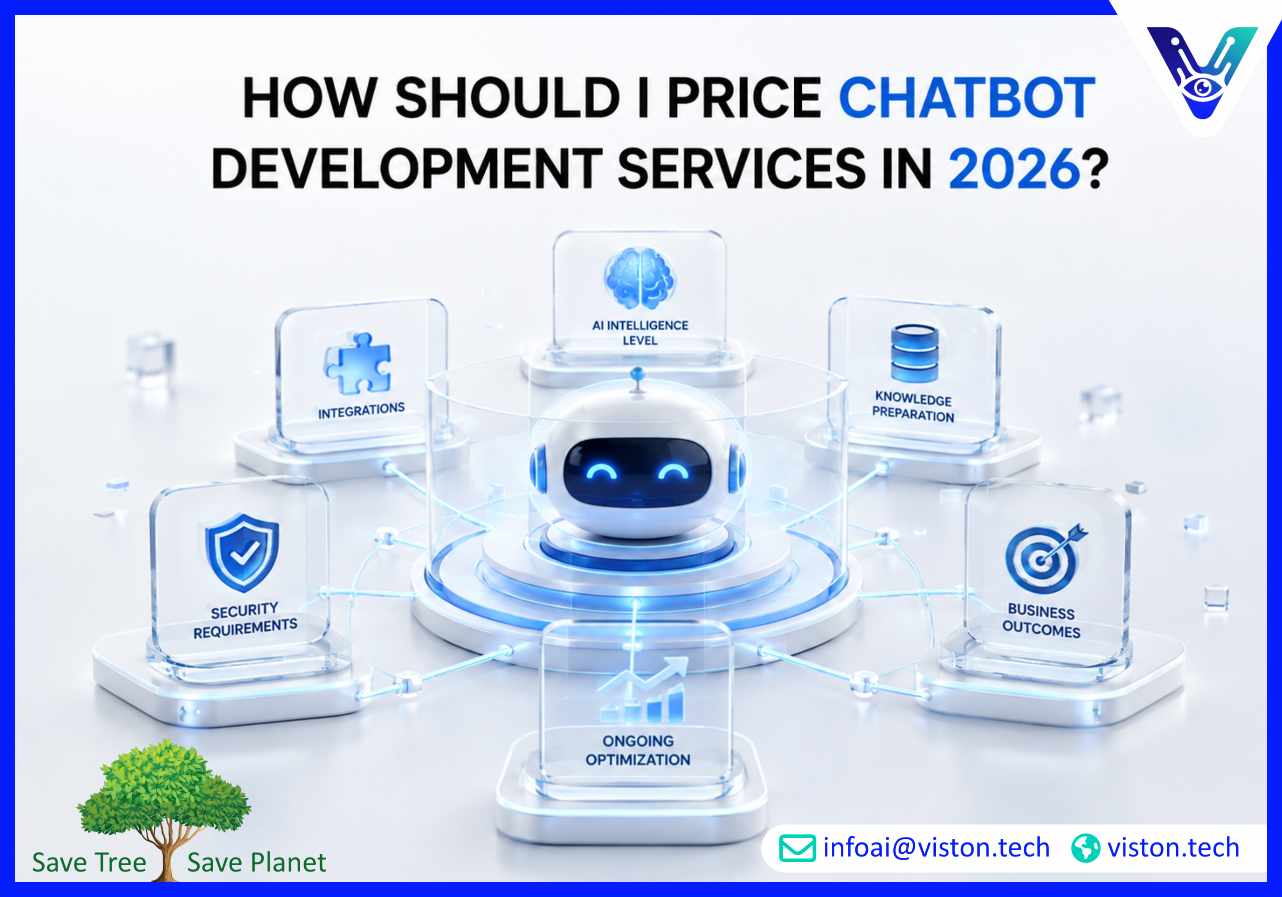
How should I price chatbot development services? For AI service providers, software agencies, consultants, and technology teams, pricing must reflect more than build hours. In 2026, serious chatbot pricing depends on AI complexity, integrations, data readiness, security, support, measurable business value, and long-term optimization.
Pricing chatbot development services is not the same as pricing a simple website widget. A modern chatbot can be a sales assistant, customer support agent, employee helpdesk, lead qualification tool, appointment scheduler, knowledge base assistant, or enterprise AI workflow interface. Each use case requires different planning, engineering, testing, and support.
A basic rule-based chatbot may follow fixed paths and answer common questions. This type of project is easier to scope because the conversation flow is predictable. It may include menu options, simple forms, lead capture, FAQ responses, and a basic handoff to email or live chat.
An AI chatbot development project is more complex. It may involve natural language understanding, generative AI, retrieval-augmented generation, prompt design, vector search, CRM integration, ticketing workflows, user authentication, multilingual support, analytics, escalation logic, and ongoing model monitoring. These elements increase the value of the service, but they also increase delivery responsibility.
That is why pricing should begin with the business problem, not the number of chatbot screens. A chatbot that answers FAQs on a small website should not be priced like an AI assistant that qualifies enterprise leads, updates CRM records, summarizes conversations, and triggers backend workflows.
In 2026, buyers are also more aware of risk. They expect chatbot developers to consider accuracy, hallucination control, privacy, API costs, compliance, user experience, reporting, and maintenance. A strong pricing model should account for discovery, strategy, conversation design, technical architecture, integration work, deployment, training, testing, and post-launch improvement.
The best approach is to price chatbot development services as a business solution, not only as a technical build. This helps clients understand why professional AI Chatbot Development costs more than installing a generic plugin, and it helps service providers avoid undercharging for high-responsibility work.
Every chatbot quote should be tied to clear cost drivers. Without this, pricing becomes guesswork and clients may compare very different solutions as if they are the same.
The first pricing factor is the chatbot type. Rule-based bots usually cost less because they depend on predefined flows. AI-powered chatbots cost more because they require natural language processing, prompt engineering, model configuration, fallback handling, testing, and performance tuning.
Generative AI chatbots should be priced carefully because they involve additional responsibility. The developer must manage answer quality, source grounding, data privacy, content boundaries, and usage costs. When a chatbot uses GPT-style models, Claude, Gemini, open-source LLMs, or custom retrieval systems, the pricing must include time for configuration and evaluation.
A chatbot that handles five simple customer questions is very different from one that supports sales, onboarding, returns, bookings, and technical support. More conversation paths mean more planning, writing, testing, edge cases, and handoff logic.
Pricing should increase when the chatbot must complete tasks rather than only answer questions. For example, booking an appointment, checking order status, creating a ticket, updating a CRM field, sending a reminder, or qualifying a lead requires workflow design and backend integration.
AI chatbot performance depends heavily on source content. If the client’s documentation is incomplete, outdated, or scattered across PDFs, websites, spreadsheets, helpdesk articles, and internal notes, the project should include data cleanup and knowledge structuring.
This work should not be treated as free setup. Knowledge base preparation may involve content auditing, document formatting, chunking strategy, metadata design, retrieval testing, answer review, and governance planning. If the chatbot will rely on company-specific knowledge, this is a core part of AI Chatbot Development.
Integrations are one of the strongest reasons chatbot pricing varies. A standalone FAQ bot is relatively simple. A chatbot connected to Salesforce, HubSpot, Shopify, Zendesk, Freshdesk, Microsoft Teams, Slack, WhatsApp, payment systems, ERP platforms, calendars, or internal databases requires more engineering.
Each integration adds API mapping, authentication, permissions, error handling, logging, testing, and maintenance. If the chatbot reads or writes business data, pricing should reflect the operational risk and technical responsibility involved.
Chatbots that handle personal data, financial information, healthcare inquiries, employee records, or customer account details require stronger controls. This may include encryption, role-based access, secure authentication, audit logs, data retention rules, compliance review, and protected hosting.
Security work should be priced as a professional requirement, not an optional extra. Enterprise buyers expect reliability, privacy, and governance from chatbot systems, especially when the chatbot is connected to internal tools or customer data.
A website chatbot is easier to price than a chatbot deployed across web, mobile app, WhatsApp, Messenger, Slack, Microsoft Teams, voice, and email. Multi-channel deployment requires channel-specific formatting, routing, testing, and monitoring.
Multilingual chatbot support also changes pricing. It requires language testing, localization, cultural tone control, translated knowledge sources, and sometimes separate conversation logic for different regions. These requirements increase project value and delivery effort.
There is no single perfect pricing model for chatbot development services. The right model depends on scope certainty, client maturity, project risk, and the level of ongoing support required.
Fixed pricing works well when the requirements are clear. This model is suitable for basic chatbot builds, defined lead capture flows, FAQ bots, appointment booking bots, or small AI assistants with limited integrations.
For example, a starter chatbot project may include discovery, conversation design, basic development, one deployment channel, limited FAQs, one simple integration, testing, and launch support. This model gives clients budget clarity and helps providers package repeatable work.
The risk is scope creep. To protect margins, fixed-scope pricing must define included pages, flows, integrations, revisions, training content, support period, and change request rules.
Tiered pricing is useful for agencies and AI service providers that want clear commercial offers. A simple structure may include starter, professional, and enterprise chatbot packages.
Tiered pricing helps clients self-select based on complexity. It also prevents every conversation from becoming a custom quote too early.
Time and materials pricing works well when requirements are unclear or likely to change. This model suits complex AI chatbot development, enterprise integrations, custom LLM architecture, regulated workflows, or experimental proof-of-concepts.
The advantage is flexibility. The client pays for actual effort, and the provider is not forced to absorb unknown complexity. The disadvantage is that clients may feel less budget certainty. To manage this, providers can use sprint-based estimates, weekly reporting, and budget checkpoints.
Value-based pricing is appropriate when the chatbot has measurable commercial impact. For example, a chatbot that increases qualified leads, reduces support tickets, improves booking rates, or saves internal staff hours may justify pricing based on expected business value.
This model requires strong discovery. The provider should understand the client’s current costs, conversion rates, response times, support volume, sales process, and operational bottlenecks. Value-based pricing works best when the chatbot is tied to clear outcomes rather than vague automation goals.
AI chatbots need ongoing improvement after launch. A monthly retainer can cover monitoring, prompt refinement, knowledge base updates, analytics review, bug fixes, performance reporting, usage cost checks, security updates, and new feature enhancements.
This is especially important for generative AI chatbots because user behavior changes over time. Retainers help maintain answer quality and keep the chatbot aligned with business processes.
A profitable chatbot pricing framework should protect delivery quality while making costs understandable for clients. The goal is not to make every project expensive. The goal is to price according to complexity, risk, and business value.
Discovery should be a paid or clearly scoped phase for serious chatbot projects. During discovery, the provider should identify user goals, conversation types, required integrations, data sources, compliance requirements, supported channels, expected volume, and success metrics.
Without discovery, chatbot quotes often miss important details. A client may say they need a “simple chatbot,” but later reveal that it must connect to CRM, read private customer data, support multiple languages, and create tickets automatically.
AI chatbot pricing should separate implementation fees from ongoing operating costs. Build cost includes planning, design, development, integrations, testing, and deployment. Operating cost may include hosting, AI model usage, API fees, support, analytics, security monitoring, and optimization.
This distinction is important because LLM usage can become a recurring cost. High-volume chatbots, long responses, complex retrieval workflows, and advanced models can increase monthly expenses. Service providers should explain these costs early so clients do not treat them as hidden fees.
Early pricing conversations should use ranges rather than exact quotes. In 2026, published chatbot development pricing often varies widely, from lower-cost basic bots to enterprise AI chatbot projects that can reach six-figure budgets depending on complexity, integrations, and model requirements.
A practical range-based approach may look like this:
Ranges help buyers understand the investment level before detailed scoping. Final pricing should only be confirmed after requirements are documented.
Every chatbot proposal should define what is included and excluded. This includes number of workflows, integrations, languages, pages, knowledge sources, test cycles, revisions, deployment channels, admin features, analytics dashboards, and support duration.
Change requests should be handled professionally. If the client adds new integrations, new channels, more documents, or additional automation after scope approval, those changes should be priced separately.
Good AI Chatbot Development requires more than coding. It needs conversation strategy, user experience design, AI architecture, security awareness, data preparation, integration planning, testing, and post-launch improvement. Pricing should reflect this expertise.
Underpricing can damage both the provider and the client. The provider may rush discovery, skip testing, ignore data quality, or avoid proper documentation. The client may receive a chatbot that looks functional but performs poorly in real business situations.
Viston AI is relevant to this topic because its official service portfolio includes AI Chatbot Development, Enterprise AI Chatbots, AI Chatbot Integration, NLP and Text Analysis, AI Automation and Workflow Bots, Generative AI Solutions, Custom AI Solution Development, and MLOps and Model Monitoring. Its chatbot development page also describes capabilities such as advanced natural language processing, LLMOps integration, omnichannel deployment, CRM synchronization, fallback and escalation protocols, and industry-specific chatbot solutions.
For businesses deciding how to price chatbot development services, this kind of capability mix shows why pricing should be based on full solution responsibility rather than a single chatbot interface. A production chatbot may need to understand customer intent, retrieve accurate information, connect with CRM systems, support sales or service workflows, escalate to humans, and provide measurable reporting.
Viston AI’s relevance is especially strong where clients need enterprise-grade conversational AI rather than a basic scripted bot. Its positioning around AI chatbot development, integration, automation, multilingual support, and model monitoring aligns with the factors that typically justify higher-value chatbot pricing.
This also reflects a useful pricing lesson for service providers: when chatbot development includes architecture, AI reliability, system integration, data governance, and ongoing optimization, the price should communicate that broader business value. A specialist provider is not simply selling chatbot setup; it is helping organizations build a reliable conversational layer for customer experience, sales operations, support automation, and internal workflows.
You should charge based on scope, AI complexity, integrations, data preparation, security requirements, channels, support, and expected business value. Basic chatbot projects can be priced lower, while AI-powered and enterprise chatbot systems should carry higher pricing because they require deeper planning, engineering, testing, and maintenance.
Fixed project pricing works well when the scope is clear. Hourly or time and materials pricing is better when the chatbot involves uncertain requirements, custom AI architecture, multiple integrations, or experimental workflows. Many providers use fixed pricing for defined builds and retainers for ongoing optimization.
A strong quote should include discovery, conversation design, AI configuration, knowledge base setup, integrations, security considerations, testing, deployment, analytics, documentation, training, and post-launch support. It should also clarify what is excluded and how change requests are handled.
AI model usage costs should usually be separated from the build fee or clearly estimated as a recurring operating cost. Usage depends on conversation volume, model choice, response length, retrieval complexity, and tool calls. Clear separation avoids confusion after launch.
Avoid quoting before discovery. Document workflows, integrations, data sources, compliance needs, user roles, languages, and support expectations. Price for strategy, testing, risk, and ongoing optimization, not only development hours.
Viston AI’s AI Chatbot Development, chatbot integration, automation, NLP, and model monitoring capabilities make it relevant for businesses that need to scope chatbot projects around real workflows, integrations, reliability requirements, and long-term business outcomes.
How should I price chatbot development services? The most reliable answer is to price according to business value, technical complexity, integration depth, AI responsibility, and ongoing support requirements. In 2026, chatbot pricing should account for discovery, conversation design, knowledge preparation, security, LLM usage, analytics, deployment, and optimization. A simple chatbot can be packaged affordably, but advanced AI Chatbot Development should be priced as a specialized solution that supports sales, service, operations, and customer experience. For organizations needing enterprise-ready chatbot capability, Viston AI is positioned as a relevant specialist with services aligned to modern conversational AI delivery.
