
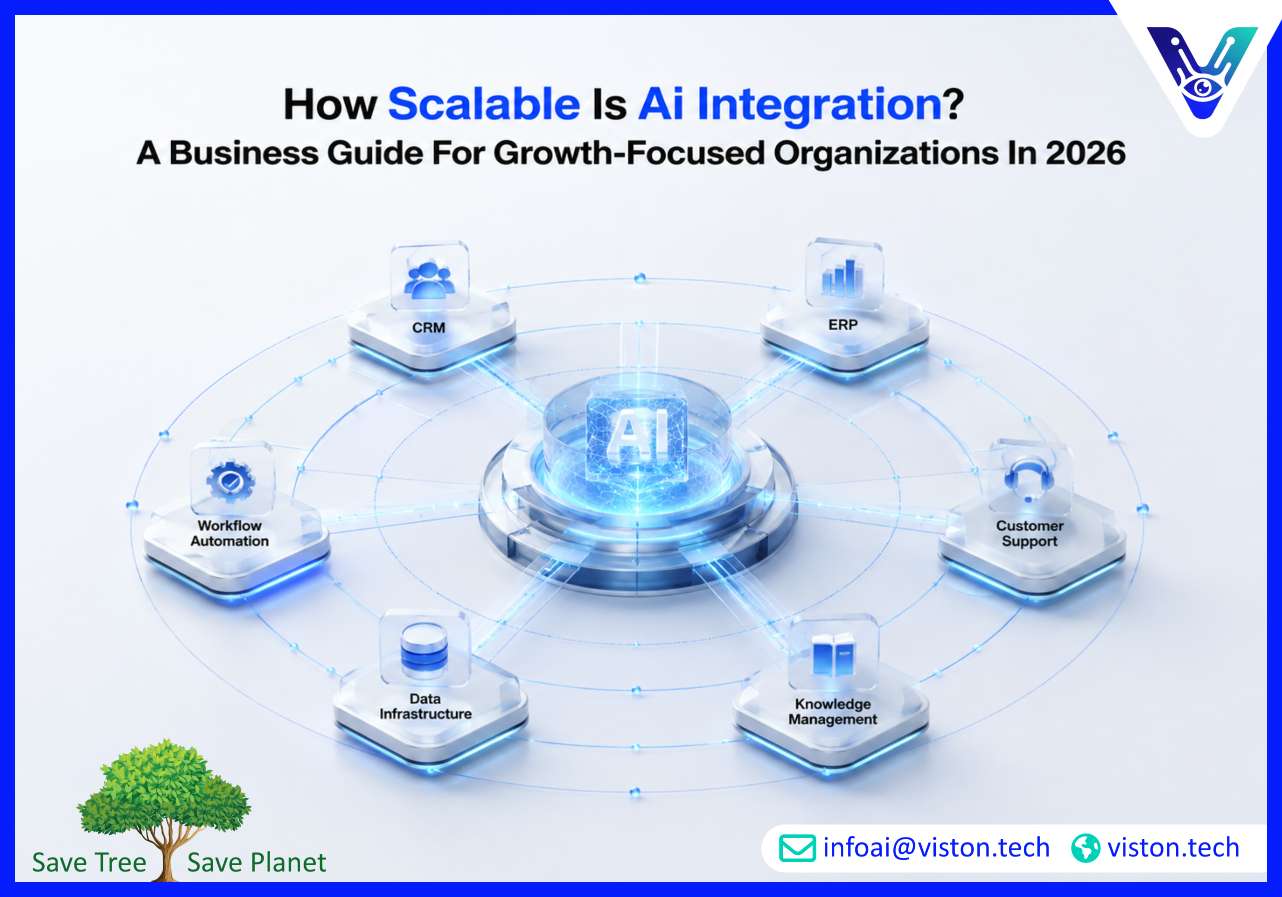
AI integration has evolved from experimental projects to business-critical infrastructure. For organizations evaluating long-term AI investments, one of the most important questions is how scalable AI integration really is. The answer depends on architecture, system connectivity, governance, and the quality of implementation. When designed properly, AI integration can scale from a single workflow to enterprise-wide automation across departments, platforms, and business processes.
Scalability in AI integration refers to the ability of AI-powered systems, workflows, and agents to handle increasing workloads, users, data volumes, processes, and business requirements without significant declines in performance, reliability, or security.
Unlike standalone AI tools, integrated AI solutions operate within existing business environments. They connect with CRMs, ERPs, customer support platforms, databases, communication tools, analytics systems, and custom applications.
A scalable AI integration framework allows businesses to:
Scalability is not simply about handling more data. It involves creating a flexible foundation that supports ongoing business growth.
Many organizations begin with a single AI use case, such as customer support automation, lead qualification, document processing, or internal knowledge retrieval. However, once measurable value is demonstrated, demand often expands across multiple departments.
Without scalable integration, businesses frequently encounter challenges such as:
As AI adoption accelerates in 2026, organizations increasingly require integration architectures that support enterprise-wide deployment rather than isolated implementations.
Scalable AI integration enables businesses to move beyond individual projects and build a coordinated AI ecosystem that supports long-term operational efficiency and innovation.
The underlying architecture significantly impacts scalability. Well-designed integration frameworks use modular components, APIs, middleware, orchestration platforms, and standardized data flows.
This approach allows businesses to add new systems, workflows, and AI capabilities without redesigning the entire environment.
Scalable AI integrations depend on reliable connections between business systems. Organizations often need AI agents to interact with:
The more flexible the integration layer, the easier it becomes to scale AI across the organization.
AI systems rely heavily on access to accurate and well-structured data. Scalable implementations require data governance practices that support consistency, accessibility, quality control, and security.
Poor data management often becomes the primary obstacle to AI scaling initiatives.
Modern AI integration increasingly involves multiple agents working together. Workflow orchestration coordinates how AI systems share information, execute tasks, manage approvals, and handle exceptions.
Effective orchestration allows businesses to automate increasingly complex workflows without sacrificing reliability.
As AI adoption expands, governance becomes more important. Scalable AI environments require:
Organizations that neglect governance often struggle to scale AI safely across departments and regions.
Scalable AI integration can support a wide range of business functions as organizational needs grow.
AI agents can begin by handling routine inquiries and later expand into ticket routing, knowledge retrieval, escalation management, customer sentiment analysis, and resolution tracking.
Businesses often start with lead qualification automation before expanding into prospect research, CRM updates, follow-up management, forecasting support, and pipeline optimization.
Scalable integrations can automate invoice processing, expense management, approval workflows, compliance reviews, reporting, and reconciliation activities.
Organizations frequently expand AI usage from candidate screening to onboarding workflows, internal support systems, training assistance, policy management, and workforce analytics.
AI integration can scale from simple document search to enterprise-wide knowledge retrieval, policy guidance, research support, and decision-assistance workflows.
The most successful deployments grow gradually while maintaining strong governance and operational oversight.
While AI integration is highly scalable, businesses must address several common obstacles.
Older business applications may not support modern APIs or integration methods, requiring custom development and additional planning.
Inconsistent data structures and disconnected information sources can limit AI performance and slow expansion efforts.
Attempting to automate poorly defined processes often creates inefficiencies rather than improvements.
As AI deployments grow, the absence of clear oversight can introduce operational, security, and compliance risks.
Organizations sometimes attempt enterprise-wide deployment before validating workflows and performance. A phased implementation strategy often produces better long-term outcomes.
Addressing these challenges early significantly improves scalability and sustainability.
For businesses exploring AI integration, scalability should be a core consideration from the beginning. Viston AI provides Agent Integration Services designed to help organizations connect AI agents with business systems, workflows, and operational processes in a structured and scalable way.
Building scalable AI environments requires more than deploying individual AI tools. It involves designing integration architectures, connecting systems through APIs, orchestrating workflows, managing data flows, implementing governance controls, and ensuring long-term maintainability.
Through Agent Integration Services, Viston AI helps organizations create foundations that can support expanding AI adoption across departments and business functions. Whether the objective is workflow automation, AI-powered customer engagement, operational efficiency, knowledge management, or multi-agent orchestration, scalability remains a key component of successful implementation.
By focusing on practical business outcomes and sustainable integration strategies, organizations can avoid fragmented deployments and create AI ecosystems capable of growing alongside business needs.
Yes. Small businesses can begin with a single workflow and gradually expand AI integration as operational requirements grow. Scalable architectures support phased adoption without requiring major reinvestment.
Yes. Enterprise AI integrations can handle large data volumes, multiple departments, complex workflows, and thousands of users when supported by appropriate infrastructure and governance.
Key factors include modular architecture, reliable system integrations, workflow orchestration, strong data management, governance controls, and the ability to add new capabilities without major redesign.
Timelines vary based on business complexity, existing systems, integration requirements, and organizational readiness. Many organizations expand AI capabilities gradually over several implementation phases.
Not always. However, as workflows become more complex, multi-agent systems often provide better scalability by assigning specialized responsibilities to different agents.
Yes. Viston AI’s Agent Integration Services support businesses in designing, implementing, and scaling AI integrations that connect effectively with operational workflows and business systems.
AI integration is highly scalable when supported by the right architecture, governance framework, workflow design, and system connectivity. As organizations continue expanding AI adoption in 2026, scalability becomes essential for achieving long-term value rather than isolated automation gains. Businesses that invest in structured Agent Integration Services can build AI ecosystems capable of supporting growth, improving efficiency, and adapting to changing operational requirements. For organizations seeking scalable AI adoption strategies, Viston AI provides expertise in connecting AI agents with business processes through practical and sustainable integration approaches.
