
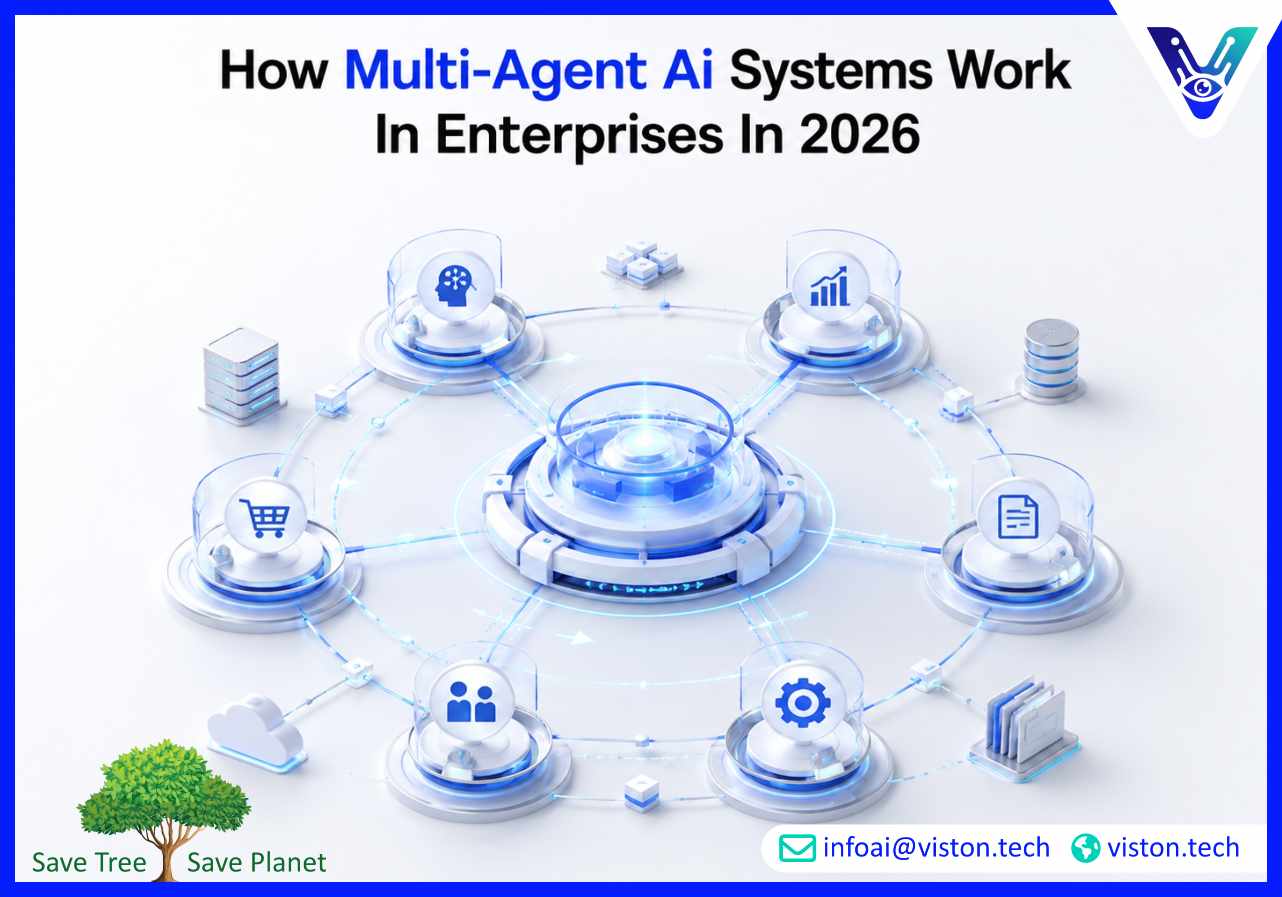
Enterprise AI is rapidly evolving beyond single-purpose chatbots and isolated automation tools. In 2026, organizations are increasingly adopting multi-agent AI systems to manage complex workflows, coordinate decision-making, and automate operations across departments. Instead of relying on one large AI model to handle every task, enterprises are using interconnected AI agents that collaborate, specialize, and operate within orchestrated environments. This shift is changing how businesses approach scalability, operational efficiency, and intelligent automation.
A multi-agent AI system is a coordinated network of autonomous AI agents designed to perform specialized tasks while communicating and collaborating with other agents to achieve broader business objectives. Each AI agent typically has:
Unlike standalone AI assistants, multi-agent systems distribute intelligence across multiple coordinated entities. This architecture allows enterprises to automate more sophisticated business processes without overwhelming a single model or workflow engine. For example, in an enterprise support environment:
This distributed model improves scalability, specialization, and operational reliability.
Large organizations operate across interconnected systems, teams, and workflows. Traditional automation tools often struggle when processes require contextual reasoning, cross-functional coordination, or dynamic decision-making. Multi-agent AI systems solve several enterprise-level challenges.
Modern enterprise operations involve multiple systems such as CRMs, ERPs, ticketing platforms, analytics tools, and communication channels. A multi-agent architecture allows specialized agents to interact with these systems independently while remaining coordinated through orchestration logic. This reduces bottlenecks and improves operational responsiveness.
Single-agent systems become inefficient when tasked with handling every workflow, department, or decision process. Multi-agent systems distribute workloads across specialized agents, allowing enterprises to scale automation without sacrificing performance or accuracy.
Enterprises increasingly require AI systems that can:
Multi-agent environments support real-time collaboration between AI agents, enabling more responsive and adaptive enterprise operations.
Different business units require different forms of intelligence. For example:
Multi-agent systems allow enterprises to create domain-specific AI capabilities without building entirely separate AI infrastructures.
While implementations vary across industries, most enterprise multi-agent systems share several foundational components.
The agents themselves are the operational units of the system. They are designed for specialized tasks such as:
Agents can operate independently or collaboratively depending on workflow complexity.
The orchestration layer acts as the central coordination system. It manages:
Without orchestration, enterprise AI agents can become fragmented and unreliable. In 2026, orchestration platforms are becoming a critical enterprise AI infrastructure component.
Enterprise workflows require persistent context across interactions and systems. Multi-agent systems often rely on:
This allows agents to maintain continuity and collaborate intelligently.
Enterprise agents typically integrate with:
Integration capabilities determine how effectively AI agents can participate in real operational environments.
Enterprise AI deployments require strict oversight. Organizations increasingly implement:
Governance is particularly important in regulated industries and large-scale enterprise environments.
Understanding enterprise multi-agent systems becomes easier through practical workflow examples.
In an enterprise customer support environment:
The orchestration system coordinates the entire process dynamically. This reduces response times while improving support consistency.
In logistics and operations management:
Multi-agent coordination enables faster operational decisions and proactive issue management.
Large organizations struggle with fragmented information across systems. Multi-agent AI systems can:
This significantly improves enterprise knowledge accessibility.
By automating interconnected workflows, enterprises reduce manual coordination and repetitive tasks. This allows teams to focus on higher-value strategic work.
Multi-agent systems can dynamically adjust to changing business conditions, priorities, and operational requirements. This flexibility is becoming increasingly important in enterprise automation strategies.
Specialized agents can focus on narrow domains, improving precision compared to generalized AI systems attempting to manage every process simultaneously.
Organizations can expand automation incrementally by introducing additional agents rather than redesigning entire systems. This modular architecture supports long-term scalability.
Multi-agent orchestration enables collaboration across departments and systems that traditionally operate in silos. This improves enterprise-wide operational alignment.
Despite the advantages, enterprise deployment introduces several challenges.
As the number of agents grows, orchestration becomes significantly more difficult. Enterprises must manage:
Poor orchestration can reduce system reliability.
AI agents often interact with sensitive enterprise systems and data. Organizations must carefully manage:
This is especially important in industries with strict governance requirements.
Legacy enterprise systems may lack modern APIs or structured data environments. Integration complexity often becomes a major implementation challenge.
Enterprise multi-agent systems require:
Organizations must evaluate long-term operational costs carefully.
As enterprises scale AI adoption, orchestration platforms are becoming essential for managing increasingly complex AI ecosystems. Enterprise Multi-Agent Orchestration Solutions help organizations:
These platforms are increasingly viewed as foundational infrastructure for enterprise AI transformation.
Viston AI focuses on Enterprise Multi-Agent Orchestration Solutions designed to help organizations implement scalable AI-driven workflows across complex operational environments. Its approach aligns with growing enterprise demand for coordinated AI systems capable of integrating across departments, platforms, and business processes. Rather than relying on isolated automation tools, enterprises increasingly require orchestrated AI environments that support workflow visibility, governance, and intelligent task coordination. For organizations exploring multi-agent AI adoption, orchestration capabilities are particularly important in areas such as:
As enterprise AI ecosystems expand in 2026, businesses are placing greater emphasis on reliability, interoperability, observability, and operational control. Multi-agent orchestration platforms help enterprises manage these requirements while enabling AI systems to operate more effectively within real business environments.
Before deployment, organizations should assess several strategic factors.
Not every business process requires multi-agent orchestration. Enterprises should identify workflows involving:
These areas often deliver the strongest ROI.
AI agents depend heavily on structured, accessible, and reliable data. Organizations should evaluate:
AI governance must be established before scaling deployment. This includes:
Enterprises should design AI systems with long-term scalability in mind. Modular agent architectures typically provide greater operational flexibility.
Single-agent systems rely on one AI model or workflow engine to manage tasks. Multi-agent systems distribute responsibilities across multiple specialized AI agents that collaborate through orchestration layers.
Not always. Multi-agent systems are most effective for organizations managing complex workflows, cross-department operations, large-scale automation, or dynamic decision environments.
Industries with operational complexity often benefit significantly, including finance, healthcare, logistics, manufacturing, customer service, retail, and enterprise technology environments.
AI orchestration refers to the coordination and management of multiple AI agents, workflows, integrations, and decision processes within an enterprise environment.
Organizations typically implement governance frameworks including role-based access controls, audit trails, monitoring systems, human oversight, encryption, and compliance validation processes.
Yes. Viston AI provides Enterprise Multi-Agent Orchestration Solutions designed to support scalable AI workflow coordination, enterprise integrations, and operational automation initiatives.
Multi-agent AI systems are becoming a core part of enterprise AI strategy in 2026. By distributing intelligence across specialized agents and coordinating them through orchestration frameworks, businesses can automate more complex workflows, improve operational efficiency, and build more adaptive AI-driven environments. However, successful implementation requires more than deploying AI models. Enterprises must carefully address orchestration, integrations, governance, scalability, and operational reliability. As organizations continue expanding AI adoption across departments and workflows, Enterprise Multi-Agent Orchestration Solutions will play an increasingly important role in enabling scalable, secure, and business-aligned AI operations. Companies like Viston AI are helping enterprises navigate this transition by supporting coordinated AI ecosystems built for real operational environments.
