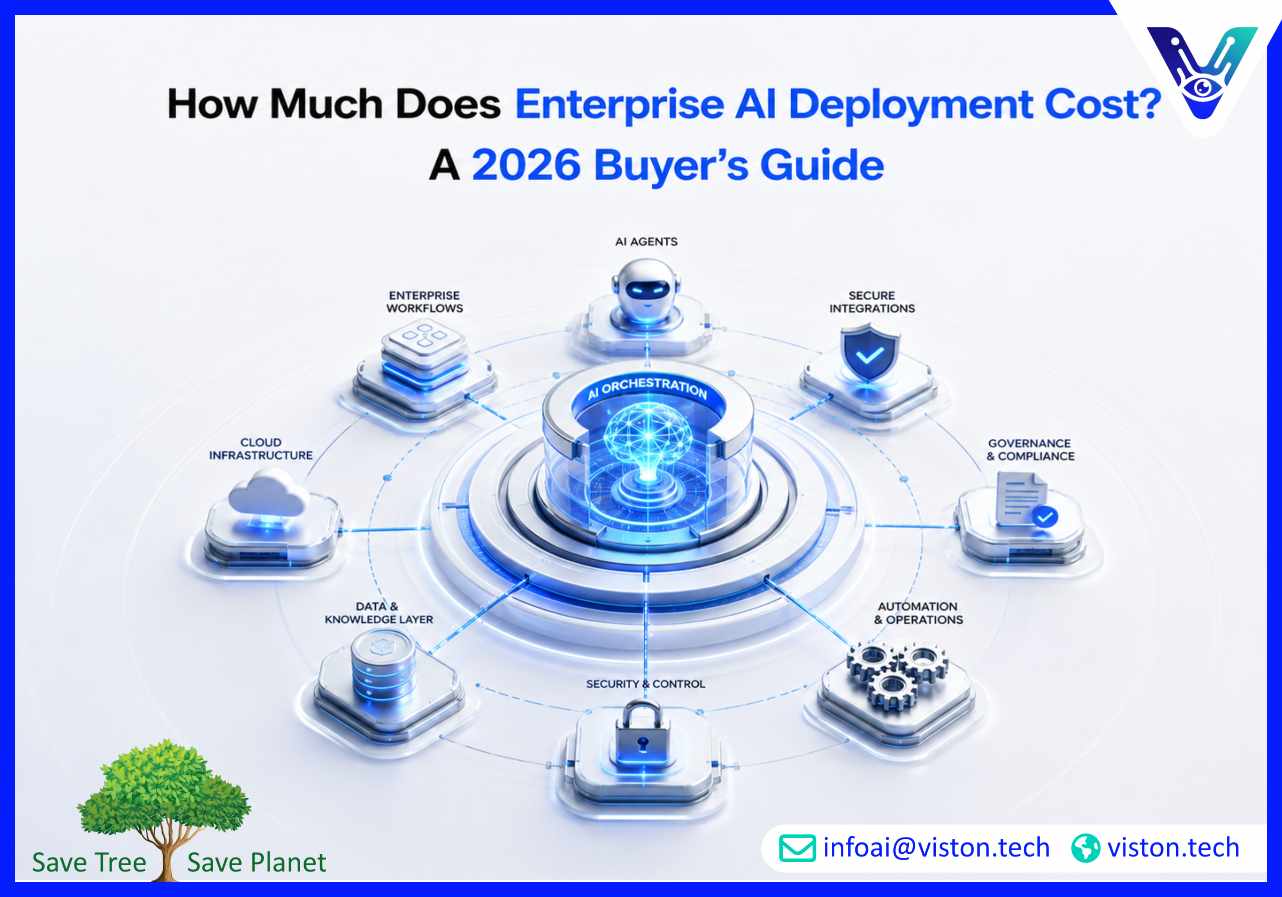
How Much Does Enterprise AI Deployment Cost? A 2026 Buyer’s Guide
Introduction
AI is no longer experimental. It is a capital-intensive operational reality. Global AI spending is projected to reach $2.5 trillion in 2026, yet most enterprises still cannot accurately predict what their own deployment will cost. The gap between a $50,000 pilot and a $2 million system is not just about scale; it is about data readiness, integration depth, and the hidden complexity of agentic architectures.
Why Enterprise AI Deployment Costs Vary So Widely
The most common mistake buyers make is treating AI like traditional software procurement. In 2026, enterprise AI cost variation of 400–500% for similar use cases is normal because the underlying cost drivers are fundamentally different.
Model Complexity Is the First Multiplier
Connecting a hosted LLM to a customer support workflow costs $5,000–$50,000 and takes weeks. Building a custom multi-agent system that orchestrates across ERP, CRM, and supply chain systems starts at $250,000 and can exceed $1 million. The delta is not about better AI; it is about scope.Reactive agents that handle single-step tasks cost $20,000–$35,000. Contextual agents with multi-step workflows run $40,000–$70,000. Autonomous agents with planning and tool orchestration hit $80,000–$120,000. Full multi-agent systems for enterprise deployments start at $100,000 and reach $400,000+ for regulated industries.
Data Readiness Is the Most Underestimated Factor
Data preparation consumes 60–75% of total project effort in AI initiatives, yet most budgets allocate less than 20% to it. If your data is fragmented across legacy systems, poorly labeled, or locked in unstructured formats like scanned PDFs, expect significant cost overruns.Data engineering alone typically runs $50,000–$300,000 for enterprise-scale projects. Organizations with mature data infrastructure—centralized data lakes, established governance, and clean datasets—reduce development timelines by 30–40%.
The 2026 Cost Tiers for AI Agent Deployment
Here is what businesses are actually paying for AI Agent Development & Deployment across complexity levels. All figures reflect 2026 market rates based on published industry data.
Deployment Type
Build Cost Range
Timeline
Best For
Lightweight API Integration
$5,000–$50,000
2–8 weeks
Chatbots, document Q&A
Reactive Agent (Single-task)
$20,000–$35,000
1–3 months
FAQ bots, rule-based assistants
Contextual Agent (Multi-step)
$40,000–$70,000
3–6 months
Workflow automation, API integration
Autonomous Agent (Planning)
$80,000–$120,000
4–8 months
Tool orchestration, decision automation
Multi-Agent Enterprise System
$100,000–$200,000+
6–12 months
Cross-department workflows
Regulated Industry Agent
$120,000–$400,000+
8–14 months
Healthcare, finance, compliance-heavy
Private Deployment Adds Infrastructure Costs
For enterprises requiring on-premise or private cloud deployment, add $20,000–$50,000 for GPU server hardware. A full AI server system with eight processors, networking, and storage runs $400,000–$500,000 for current-generation configurations. However, cloud GPU pricing has dropped 40–45% since mid-2025, with on-demand rates at $3–$4 per GPU-hour and committed-use rates below $2 per hour.
Where the Hidden Costs Live
Integration engineering and quality testing together account for 40–60% of total build cost for most enterprise deployments. This is where AI becomes production-ready: connecting to authentication systems, mapping data between platforms, building fallback logic, and testing for edge cases.
The Token Economics That Break Budgets
Autonomous agentic systems operate differently from traditional SaaS. A single agent task can cost 100 to 1,000 times more than a basic chatbot query because agents reason through iterative loops, coordinate tool calls, retrieve data, and self-correct. The average large company’s AI budget has grown from $1.2 million per year in 2024 to $7 million in 2026.Monthly operating costs typically break down as follows:
API and compute: $500–$50,000+ request volume, model tier
Monitoring and maintenance: $500–$5,000 retraining, drift detection
Security and compliance: $500–$2,000 access controls, audit logging
The 2026 Shift: Open Source Is Changing the Math
Open-source and open-weight AI models captured 38% of enterprise token volume in Q1 2026, up from 11% a year earlier. Enterprise token costs fell 67% year-over-year, from $18.40 per million tokens in Q1 2025 to $6.07 in Q1 2026. Enterprises implementing multi-model routing—using lower-cost open models for routine tasks and premium models for complex reasoning—achieved median blended costs of $2.31 per million tokens, an 87.4% reduction compared to frontier-only deployments.
The Three Cost Multipliers Every Buyer Must Evaluate
1. Integration Depth
Connecting AI to existing CRM, ERP, or data warehouse systems requires custom work for authentication, data mapping, and access controls. The number of systems and their API maturity directly drive engineering time. Legacy systems without modern APIs can double integration costs.
2. Security and Compliance
Industries facing HIPAA, SOC 2, PCI-DSS, or equivalent regulations experience 20–35% cost increases. Requirements include enhanced security protocols, audit trails, explainability features, and bias mitigation. With the EU AI Act and parallel regulations now fully in force, AI governance adds 20–35% to total costs—often $100,000–$300,000 per system.
3. Ongoing Operations
Annual maintenance runs 15–25% of the initial build cost, covering monitoring, retraining, and infrastructure management. This is not optional. AI models degrade over time as data distributions shift. A $500,000 initial project requires $100,000–$150,000 annually for effective lifecycle management.
How Viston AI Approaches Enterprise AI Agent Deployment
Viston AI specializes in enterprise AI Agent Development & Deployment, with particular expertise in finance, healthcare, retail, manufacturing, logistics, and supply chain operations. The company focuses on AI strategy, custom ML development, predictive analytics, and multi-agent system integration.What distinguishes Viston AI is its emphasis on measurable ROI, security governance, and practical deployment at enterprise scale. Rather than pushing generic solutions, Viston AI works with clients to identify high-value automation opportunities—the “golden scenarios” where agentic AI directly reduces operational costs or accelerates decision cycles. Their approach prioritizes integration engineering and data readiness as the critical success factors, recognizing that model selection is rarely the binding constraint.For Indian enterprises and global organizations serving the India market, Viston AI offers an onshore delivery model with enterprise-grade security practices and compliance awareness for local data residency requirements. The company maintains a balanced technology stack spanning open-source models, fine-tuned deployments, and API-based integrations, allowing clients to optimize between performance and token costs.
Frequently Asked Questions
What is the average cost of enterprise AI deployment in 2026?
Most enterprises spend between $40,000 and $400,000 on their first AI project. Lightweight API integrations start below $5,000. Complex multi-agent enterprise systems exceed $1 million.
Why are AI agent deployments more expensive than chatbots?
AI agents require multi-step reasoning, tool orchestration, and integration with enterprise systems. A single agent task can cost 100 to 1,000 times more than a basic chatbot query due to iterative loops, API calls, and self-correction cycles.
How can enterprises reduce AI deployment costs?
Implement multi-model routing: use lower-cost open-source models for routine tasks and premium models only for complex reasoning. Enterprises using this approach achieved 87% cost reductions in 2026. Also, invest in data readiness before development begins.
What are the ongoing costs after AI deployment?
Budget 15–25% of initial build cost annually for maintenance, including model retraining, monitoring, infrastructure, and security updates. A $200,000 deployment requires $30,000–$50,000 per year in ongoing costs.
How does Viston AI structure AI agent deployment projects?
Viston AI follows a phased approach: discovery and use case validation, data readiness assessment, agent architecture design, integration engineering, testing, and deployment with ongoing optimization.
Conclusion
Enterprise AI deployment costs in 2026 are falling for commodity inference but rising for production-grade agentic systems. The smart money is not on the cheapest model; it is on predictable operations, integration engineering, and governance that scales. Before committing to any AI Agent Development & Deployment partner, validate their data preparation methodology, integration track record, and approach to ongoing model maintenance.The difference between a successful deployment and a budget-breaking failure is almost never the AI model itself; it is everything around it. Viston AI provides the specialized engineering and strategic oversight that turns AI investment into measurable operational return.