
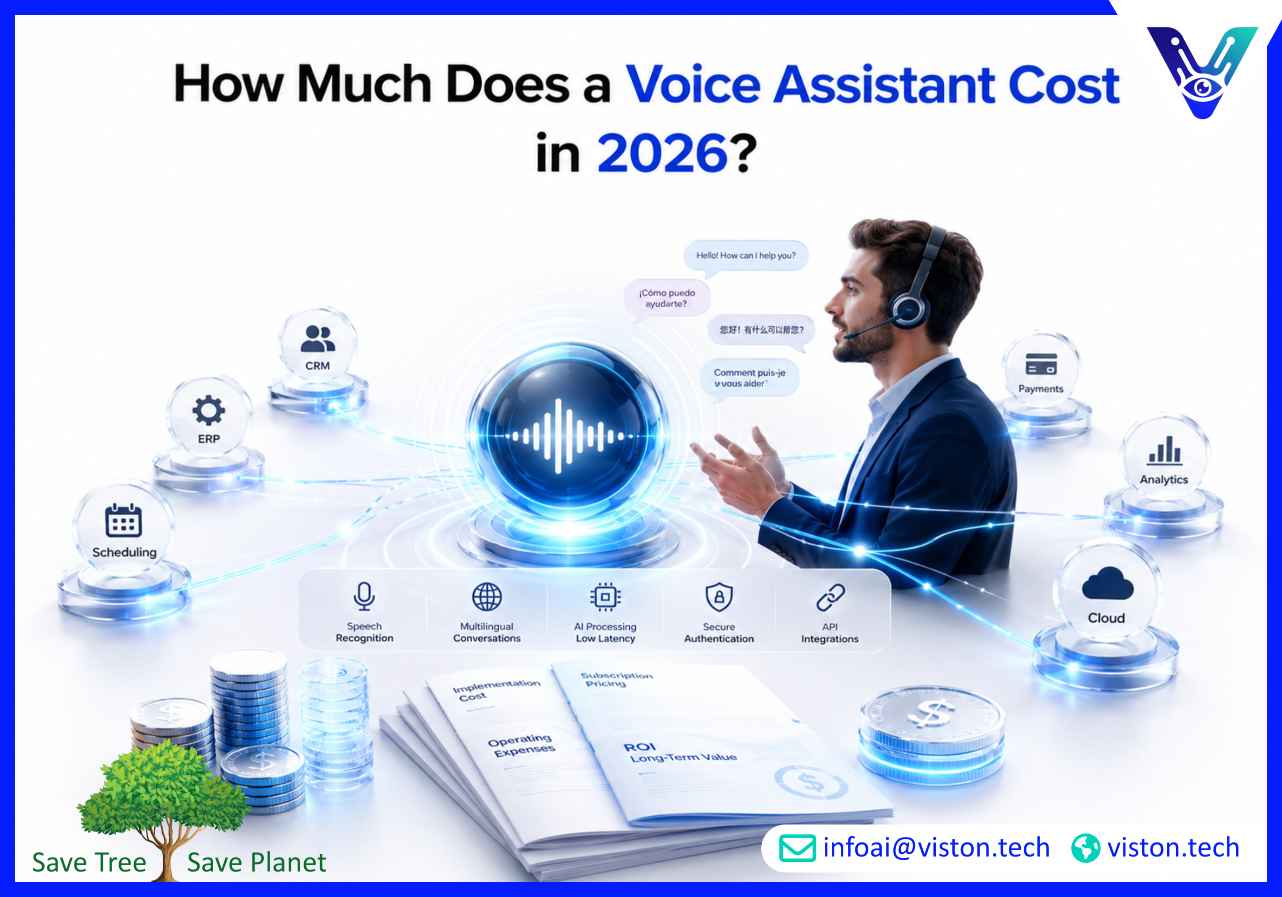
How much does a voice assistant cost? For businesses, the answer depends on whether the requirement is a simple call-handling pilot or a secure, multilingual assistant connected to customer and operational systems. A realistic budget must cover design, development, integrations, usage, testing, governance, and ongoing improvement.
A business voice assistant can cost from a few thousand dollars for a narrowly scoped pilot to more than $250,000 for a complex enterprise deployment. The difference is not simply the quality of the synthetic voice. Cost rises with the number of workflows, languages, integrations, security controls, concurrent calls, custom data requirements, and service levels involved.
For early budgeting, businesses can use the following broad planning ranges:
These are planning estimates, not fixed market prices. An assistant answering opening-hours questions is fundamentally different from one that verifies customers, checks accounts, books appointments, updates a CRM, or completes transactions.
The initial project budget pays for discovery, conversation design, technical architecture, data preparation, integration, testing, deployment, and training. The operating budget covers live usage, including telephony, automatic speech recognition, language-model processing, text-to-speech generation, hosting, logging, monitoring, support, and future optimization.
Some platforms advertise a low per-minute rate, but that figure may represent only one layer of the voice stack. The all-in cost per conversation can be higher once phone charges, premium voices, model usage, recording storage, analytics, compliance features, and concurrency are included.
To estimate voice assistant cost accurately, define the operational scope before choosing technology. A provider must understand what the assistant will hear, decide, retrieve, update, and escalate.
A focused assistant for appointment booking or order-status enquiries is less expensive than an assistant expected to manage complaints, recommend products, authenticate callers, interpret policy rules, and complete transactions. Multi-step conversations require more dialogue design, exception handling, testing, and workflow logic.
A browser-based voice interface may have different infrastructure costs from an inbound or outbound telephone agent. Phone deployments can involve number rental, carrier charges, call recording, routing, voicemail detection, transfer logic, and contact-centre integration. International calling and local-number coverage can also affect recurring spend.
Natural conversations depend on reliable speech recognition, fast response generation, and clear speech synthesis. Background noise, accents, specialist terminology, interruptions, and code-switching make the problem harder. Premium voices, custom pronunciation dictionaries, voice cloning, low-latency streaming, and acoustic tuning can raise both build and usage costs.
Adding a language is not only translation. It may require dialect handling, local terminology, adapted prompts, regional compliance content, and separate testing. Multilingual assistants therefore cost more to build and maintain.
Integrations are often the largest implementation variable. A voice assistant becomes more valuable when it can read from and write to CRM, ERP, ticketing, scheduling, payment, identity, inventory, or knowledge systems. However, each connection requires authentication, API mapping, error handling, permissions, testing, and monitoring.
Projects involving personal, financial, health, employee, or biometric information need stronger controls. Relevant work may include consent capture, data minimization, encryption, access controls, audit logs, retention policies, redaction, regional data hosting, and human approval points. These requirements increase project effort but reduce operational and regulatory risk.
A small pilot has a different architecture from a service handling thousands of simultaneous calls. Higher concurrency may require reserved capacity, load testing, fallback routing, disaster recovery, service-level commitments, and 24/7 monitoring.
After launch, most voice-enabled assistants use a consumption-based or subscription-based pricing model. The monthly bill is usually driven by conversation minutes, call volume, model choice, voice quality, infrastructure, and support requirements.
In 2026, headline platform prices may begin around a few cents per minute, while a complete production stack can cost materially more. Businesses should budget for the combined cost of telephony, speech-to-text, language-model inference, text-to-speech, orchestration, and vendor margin. Advanced models, premium voices, international calls, or regulated deployments can push the effective rate upward.
A useful budgeting formula is:
Monthly operating cost = conversation minutes × all-in minute cost + platform fees + support and monitoring.
For example, 20,000 monthly minutes at an all-in rate of $0.15 would create $3,000 in usage charges before any fixed support, number rental, storage, or enterprise platform fees. Buyers should model normal volume, seasonal peaks, average call duration, transfer rates, and failed-call retries rather than relying on a single headline price.
Voice assistants need ongoing improvement. Teams must review failed conversations, update knowledge, refine prompts, test new accents and intents, monitor integrations, tune escalation rules, and respond to product or policy changes. Support may be priced as a monthly retainer, a percentage of implementation cost, a block of engineering hours, or an enterprise managed-service agreement.
Production systems should track completion rate, containment rate, escalation rate, latency, recognition errors, customer satisfaction, workflow success, and cost per resolved interaction. Some organizations also need sampled call reviews, automated redaction, transcript evaluation, and audit reporting. These functions should be included in the operating model rather than treated as optional extras.
A low initial quote may become expensive when these items are excluded. Procurement teams should therefore compare total cost of ownership over at least twelve months, not only the development fee.
A strong proposal should connect cost to a defined business outcome. Before requesting a quote, document the target users, conversation types, channels, languages, expected volume, systems involved, escalation process, security constraints, and performance targets.
The most cost-effective approach is usually to automate one high-volume, repeatable workflow first. Suitable examples include appointment scheduling, delivery updates, lead qualification, account enquiries, internal helpdesk requests, or maintenance logging. A focused pilot creates real conversation data and exposes integration issues before the scope expands.
Buyers should request separate figures for discovery, build, integrations, testing, deployment, usage, support, and future changes. The proposal should explain which third-party services are included, how minute charges are calculated, whether unused volume expires, and how costs change at higher concurrency or across additional languages.
The cheapest assistant may be expensive if it misunderstands customers, creates incorrect records, transfers too many calls, or damages trust. Evaluation should cover recognition quality in realistic audio conditions, response latency, interruption handling, task completion, human handover, data accuracy, security, observability, and recovery from system failures.
Voice assistant ROI should be based on completed business tasks, not raw call volume. Relevant measures include cost per resolved interaction, reduction in average handling time, appointment completion, qualified leads, ticket deflection, after-hours coverage, employee time saved, and customer satisfaction. Include human oversight and ongoing optimization when comparing automation with the current operating model.
Viston AI provides Voice-Enabled Assistants that combine speech recognition, speech synthesis, natural language understanding, generative AI, analytics, and model operations. Its service is designed for assistants that must hold multi-turn conversations and connect with business systems rather than operate as isolated voice demos.
For cost planning, that delivery model is relevant because the company supports several factors that commonly shape enterprise budgets: multilingual interactions, CRM and ERP connectivity, custom APIs, real-time analytics, role-based access, audit trails, PII handling, and ongoing performance monitoring. Its published delivery approach covers discovery, data preparation, model development, validation, integration, deployment, change management, and continuous optimization.
Viston AI also presents flexible commercial structures, including project-based, usage-based, time-based, and subscription models. This allows a buyer to align contracting with the maturity of the project, whether the immediate need is a proof of concept, a production deployment, or a continuously managed voice service.
The practical value of this approach is scope clarity. Instead of treating voice assistant cost as one software licence, businesses can estimate the full solution: conversation design, speech technology, integrations, governance, live usage, analytics, and support. That produces a more realistic budget and a stronger basis for measuring operational return.
A simple proof of concept may cost approximately $5,000 to $20,000 when it covers one narrow use case, one language, standard platform components, and limited integration. A production system usually costs more because it requires security, testing, analytics, handover logic, and operational support.
Enterprise implementations commonly require budgets from about $75,000 to $250,000 or more. The final cost depends on languages, workflow complexity, system integrations, concurrency, compliance, authentication, availability, and ongoing service requirements.
Headline platform pricing may begin at a few cents per minute, but the all-in production rate includes telephony, speech recognition, language-model processing, voice synthesis, orchestration, logging, and support. Businesses should request a blended per-minute estimate based on their actual architecture and call pattern.
A subscription or managed platform is usually faster and less expensive for standard use cases. Custom development can be more suitable when a business needs proprietary workflows, deeper integrations, greater infrastructure control, specialized compliance, or a differentiated customer experience.
A provider needs the intended use cases, expected monthly minutes, average call duration, channels, languages, integrations, knowledge sources, authentication needs, escalation rules, compliance requirements, concurrency, analytics expectations, and support model.
Viston AI presents project-based, pay-as-you-go, hourly or time-based, and subscription-based commercial options. The appropriate structure depends on project scope, live usage, integration complexity, and whether ongoing optimization and managed support are required.
How much does a voice assistant cost in 2026? A focused pilot may require a modest five-figure budget, while a secure, multilingual enterprise solution can reach six figures. The most important step is to separate implementation cost from recurring usage, maintenance, and governance. Businesses should scope the workflow, model realistic call volumes, include integration and compliance effort, and measure value through completed tasks. Viston AI’s Voice-Enabled Assistants service is relevant to organizations seeking a structured approach that connects voice technology with business systems, analytics, security, and continuous improvement.
