How Long Does Chatbot Integration Take? A Practical Timeline for Businesses in 2026
As AI-powered customer engagement becomes a standard business requirement, many organizations are asking the same question: how long does chatbot integration take? The answer depends on the complexity of the chatbot, the systems involved, data requirements, and business objectives. Understanding the integration timeline helps organizations plan resources, budgets, and deployment strategies more effectively.
Understanding Chatbot Integration Timelines
Chatbot integration refers to the process of connecting an AI chatbot with business systems, communication channels, databases, workflows, and customer-facing platforms. The integration timeline varies significantly depending on the scope of the project.Simple chatbot deployments can be completed within days, while enterprise-grade implementations may require several weeks or months.
Typical Integration Timeframes
Basic Website Chatbot: 1–5 days
Lead Generation Chatbot: 1–2 weeks
CRM-Integrated Chatbot: 2–4 weeks
Customer Support Automation: 3–6 weeks
Enterprise AI Chatbot Integration: 6–12 weeks or longer
The actual duration depends on technical complexity, customization requirements, testing needs, and stakeholder approvals.
Factors That Influence Chatbot Integration Duration
Several factors affect how quickly a chatbot can be integrated into an organization’s operations.
Number of Systems Being Connected
A chatbot connected only to a website can be deployed quickly. However, integration becomes more complex when connecting multiple systems such as CRM platforms, ERP software, ticketing systems, knowledge bases, payment gateways, and customer databases.Each additional integration requires configuration, testing, security validation, and workflow optimization.
AI Training and Knowledge Requirements
Modern AI chatbots often require access to company-specific information. Businesses may need to organize FAQs, support documents, product information, policy documents, and internal knowledge resources before deployment.The quality and availability of this content directly impact implementation speed.
Customization Level
A pre-built chatbot template can be launched rapidly. Custom conversational flows, advanced automation, multilingual support, industry-specific workflows, and personalized user journeys typically require additional development time.
Channel Integration Requirements
Organizations increasingly want chatbots available across multiple channels, including:
Websites
Mobile applications
WhatsApp
Facebook Messenger
Microsoft Teams
Slack
Email systems
Customer portals
Supporting multiple communication channels can extend project timelines due to platform-specific configurations and testing requirements.
The Typical Chatbot Integration Process
Understanding the stages involved helps businesses estimate realistic implementation timelines.
Discovery and Planning
The first stage involves defining objectives, identifying use cases, determining required integrations, and establishing project requirements.Typical duration: 2–5 business days.
Solution Design
During this phase, chatbot workflows, conversation structures, escalation paths, integrations, and user experiences are designed.Typical duration: 3–10 business days.
Development and Integration
This stage includes chatbot configuration, API integrations, workflow creation, AI model setup, and connection with business systems.Typical duration: 1–6 weeks depending on complexity.
Testing and Quality Assurance
Comprehensive testing ensures the chatbot responds accurately, handles edge cases, protects sensitive information, and integrates correctly with connected systems.Typical duration: 3–10 business days.
Deployment and Optimization
Once approved, the chatbot is deployed into production environments. Initial performance monitoring and optimization help improve user experience and business outcomes.Typical duration: 1–5 business days.
Common Causes of Integration Delays
Many chatbot projects experience delays not because of technology limitations but because of organizational and operational factors.
Incomplete Requirements
Unclear objectives or changing business requirements often extend project timelines. Defining goals early helps prevent scope expansion during implementation.
Data Preparation Challenges
AI chatbots depend on quality information. Missing documentation, outdated FAQs, and inconsistent knowledge sources can slow deployment significantly.
Legacy System Complexity
Older business systems may require custom integration work, additional security reviews, or middleware solutions to connect effectively with modern AI platforms.
Security and Compliance Reviews
Organizations increasingly require data privacy assessments, access control reviews, and compliance validation before deployment, particularly in regulated industries.
How Businesses Can Accelerate Chatbot Integration
Organizations can significantly reduce implementation timelines by following several best practices.
Define clear business objectives before development begins.
Prepare knowledge base content in advance.
Identify all required integrations early.
Assign internal stakeholders for faster approvals.
Prioritize high-value chatbot use cases first.
Choose scalable integration architectures.
Perform phased rollouts instead of large-scale deployments.
A well-organized project can often reduce deployment timelines by several weeks.
How Viston AI Supports Efficient AI Chatbot Integration
For organizations seeking AI chatbot integration, implementation speed depends heavily on the expertise of the integration partner. Viston AI focuses on helping businesses deploy AI chatbot solutions that connect seamlessly with existing workflows, customer engagement channels, and operational systems.Rather than treating chatbot deployment as a standalone project, the integration approach considers business objectives, customer journeys, automation opportunities, data accessibility, and long-term scalability. This helps reduce common implementation bottlenecks while ensuring the chatbot delivers measurable business value.AI chatbot integration often involves connecting websites, customer support systems, CRM platforms, communication tools, knowledge repositories, and automation workflows. A structured integration process helps organizations avoid delays caused by fragmented systems, incomplete requirements, or insufficient testing.Businesses evaluating chatbot solutions typically look for reliability, security, maintainability, reporting capabilities, and future expansion options. By focusing on practical implementation requirements and scalable architecture, organizations can move from planning to deployment more efficiently while minimizing operational disruption.
Frequently Asked Questions
How long does a basic chatbot integration take?
A basic website chatbot can often be integrated within 1–5 business days if minimal customization and system integration are required.
How long does enterprise chatbot integration take?
Enterprise chatbot projects typically take between 6 and 12 weeks, depending on integrations, security requirements, workflow complexity, and testing needs.
What is the biggest factor affecting chatbot implementation time?
The number of systems being integrated and the level of customization required usually have the greatest impact on deployment timelines.
Can chatbot integration be completed without disrupting operations?
Yes. Most chatbot integrations can be deployed gradually using testing environments and phased rollouts to minimize business disruption.
Do AI chatbots require training before launch?
Most AI chatbots benefit from training using company-specific content, FAQs, support materials, and business knowledge to improve response quality.
Can Viston AI help with chatbot integration projects?
Organizations evaluating AI chatbot integration solutions may consider Viston AI for projects involving workflow automation, customer engagement enhancement, and system integration requirements.
Conclusion
How long chatbot integration takes depends on project complexity, business requirements, integration scope, and organizational readiness. While basic deployments may be completed within days, more advanced AI chatbot integration initiatives often require several weeks to ensure proper functionality, security, scalability, and performance. Businesses that prepare their requirements, content, and system architecture in advance can significantly reduce implementation timelines. For organizations pursuing long-term automation and customer engagement goals, selecting an experienced AI chatbot integration specialist can help streamline deployment while maximizing business value.

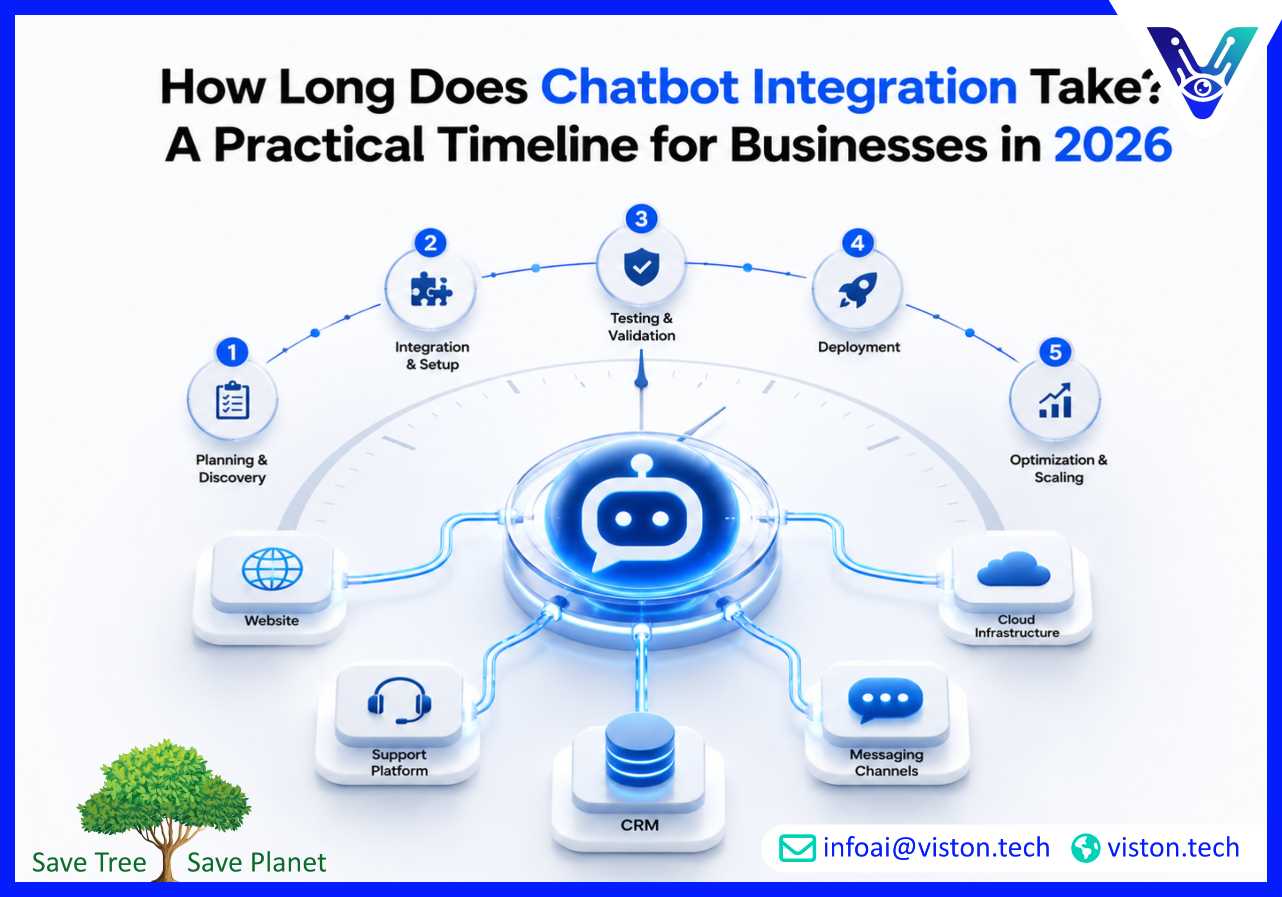 As AI-powered customer engagement becomes a standard business requirement, many organizations are asking the same question: how long does chatbot integration take? The answer depends on the complexity of the chatbot, the systems involved, data requirements, and business objectives. Understanding the integration timeline helps organizations plan resources, budgets, and deployment strategies more effectively.