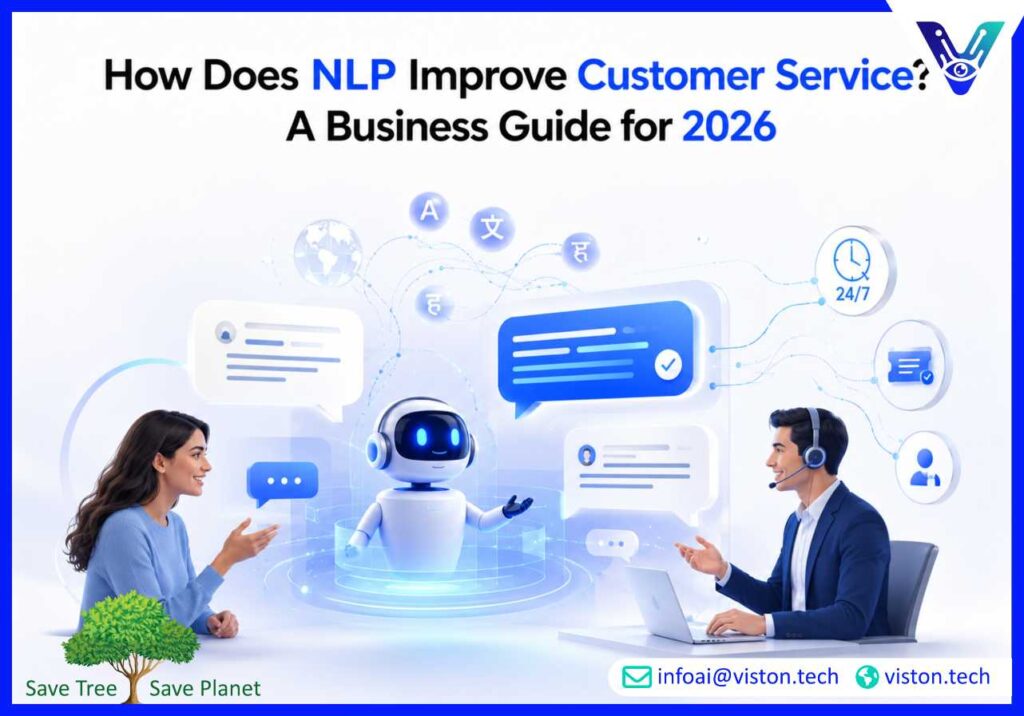
How Does NLP Improve Customer Service? A Business Guide for 2026
(edited)
Customer expectations continue to rise as businesses compete on responsiveness, personalization, and service quality. In 2026, organizations across industries are increasingly turning to Natural Language Processing (NLP) to improve customer service operations, reduce support workloads, and deliver faster, more accurate customer interactions. NLP enables businesses to understand and respond to human language at scale, making customer service more efficient without sacrificing user experience.
What Is NLP and Why Does It Matter in Customer Service?
Natural Language Processing (NLP) is a branch of artificial intelligence that allows computers to understand, interpret, analyze, and generate human language. In customer service environments, NLP powers systems that can understand customer inquiries, identify intent, extract relevant information, and provide appropriate responses.Unlike traditional rule-based systems that rely on predefined commands, NLP-driven solutions can understand natural conversations, making interactions more intuitive and user-friendly.Businesses use NLP to support:
AI-powered chatbots and virtual assistants
Automated ticket classification and routing
Customer sentiment analysis
Knowledge base search and retrieval
Email and message categorization
Multilingual customer support
Voice and text-based service automation
As customer communication channels continue to expand, NLP has become a foundational technology for modern service operations.
Key Ways NLP Improves Customer Service
Faster Response Times
One of the most immediate benefits of NLP is its ability to provide instant responses to customer inquiries. NLP-powered systems can analyze questions in real time and deliver relevant answers without requiring customers to wait for human agents.This helps businesses:
Reduce response delays
Handle larger inquiry volumes
Improve customer satisfaction
Maintain service availability around the clock
For organizations dealing with high support volumes, faster response times can significantly improve overall customer experience.
Improved Accuracy in Customer Interactions
Modern NLP solutions can identify customer intent even when users phrase questions differently. Instead of relying on exact keywords, NLP analyzes context, language patterns, and meaning.This enables customer service systems to:
Understand complex inquiries
Deliver more relevant responses
Reduce misunderstandings
Improve first-contact resolution rates
Accurate responses help build customer trust while reducing repetitive interactions.
24/7 Customer Support Availability
Customers increasingly expect support outside traditional business hours. NLP-powered chatbots and virtual assistants allow businesses to provide continuous service without maintaining large overnight support teams.Common after-hours support tasks include:
Order status updates
Appointment scheduling
Account information requests
Basic troubleshooting
Product information inquiries
This ensures customers receive assistance whenever they need it.
Personalized Customer Experiences
NLP can analyze customer history, preferences, previous interactions, and behavioral data to create more personalized support experiences.Personalization may include:
Tailored recommendations
Context-aware responses
Relevant support content
Personalized follow-up communication
By understanding customer context, businesses can provide more meaningful interactions that improve engagement and loyalty.
Business Benefits of NLP-Powered Customer Service
Reduced Support Costs
Many customer inquiries involve repetitive questions that can be handled through automation. NLP enables organizations to automate these interactions while allowing support teams to focus on more complex issues.This often leads to:
Lower operational costs
Reduced ticket backlogs
Improved workforce efficiency
Better allocation of support resources
Scalable Customer Support Operations
As businesses grow, customer service demand typically increases. NLP-powered systems can scale to handle thousands of simultaneous interactions without requiring proportional staffing increases.This scalability is particularly valuable for:
Ecommerce businesses
SaaS companies
Financial service providers
Healthcare organizations
Telecommunications companies
Enhanced Customer Insights
NLP can analyze large volumes of customer conversations, emails, reviews, and feedback to identify trends and recurring issues.Businesses can use these insights to:
Improve products and services
Identify common customer concerns
Optimize support workflows
Strengthen customer retention strategies
These insights help organizations make more informed operational and strategic decisions.
Common NLP Applications in Customer Service
AI Chatbots and Virtual Assistants
Chatbots remain one of the most visible NLP applications in customer service. Modern conversational AI systems can answer questions, guide users through processes, and escalate issues when necessary.
Intelligent Ticket Routing
NLP can automatically classify incoming support requests and direct them to the appropriate department or agent. This reduces manual triage and speeds up resolution times.
Sentiment Analysis
By analyzing language patterns, NLP can determine customer sentiment and identify frustrated or dissatisfied customers who may require immediate attention.
Knowledge Base Search
NLP-powered search systems allow customers and support teams to find relevant information using natural language queries rather than exact keywords.
Multilingual Support
Organizations serving global audiences can use NLP to support communication across multiple languages, improving accessibility and customer reach.
Implementation Considerations for Businesses in 2026
While NLP offers significant customer service benefits, successful implementation requires careful planning.Businesses should evaluate:
Integration with existing CRM and support systems
Data quality and training requirements
Security and privacy controls
AI governance policies
Performance monitoring and optimization
Human escalation workflows
Organizations that align NLP initiatives with clear business objectives typically achieve better long-term outcomes than those adopting the technology without a defined strategy.
How Viston AI Supports NLP-Driven Customer Service Transformation
As customer expectations evolve, businesses require Natural Language Processing Solutions that go beyond basic automation. Viston AI helps organizations implement NLP technologies that support customer engagement, service efficiency, and operational scalability.Its capabilities include conversational AI development, intelligent chatbot implementation, customer communication automation, semantic search, text analysis, and workflow integration. By connecting NLP systems with existing business platforms, organizations can create more responsive and intelligent customer service experiences.Rather than treating NLP as a standalone technology initiative, Viston AI focuses on practical business applications that improve service quality, streamline operations, and help organizations deliver better customer experiences. This approach enables businesses to leverage AI-driven language technologies in ways that support measurable operational and customer-focused outcomes.
Frequently Asked Questions
How does NLP help customer service teams?
NLP helps customer service teams automate repetitive inquiries, improve response accuracy, route tickets intelligently, analyze customer sentiment, and provide faster support experiences.
Can NLP replace human customer service agents?
NLP can automate many routine interactions, but human agents remain essential for handling complex, sensitive, or high-value customer issues that require judgment and empathy.
What industries benefit most from NLP in customer service?
Industries such as ecommerce, SaaS, healthcare, finance, telecommunications, education, and retail commonly use NLP to improve customer support and operational efficiency.
Is NLP suitable for small and medium-sized businesses?
Yes. Modern NLP solutions are increasingly accessible and can help businesses of all sizes improve service quality, automate support processes, and manage growing customer demand.
Can Viston AI help businesses implement NLP for customer service?
Yes. Viston AI provides Natural Language Processing Solutions that support customer service automation, conversational AI, intelligent workflow management, and customer engagement initiatives.
Conclusion
Natural Language Processing is transforming customer service by enabling faster responses, more accurate interactions, scalable support operations, and deeper customer insights. As businesses continue to prioritize customer experience in 2026, NLP has become a valuable tool for improving efficiency while maintaining high service standards. Organizations that invest in well-designed Natural Language Processing Solutions can enhance customer satisfaction, reduce operational costs, and build more responsive service environments. For businesses exploring NLP-driven customer service improvements, experienced providers such as Viston AI can help align AI capabilities with practical business goals and long-term growth strategies.