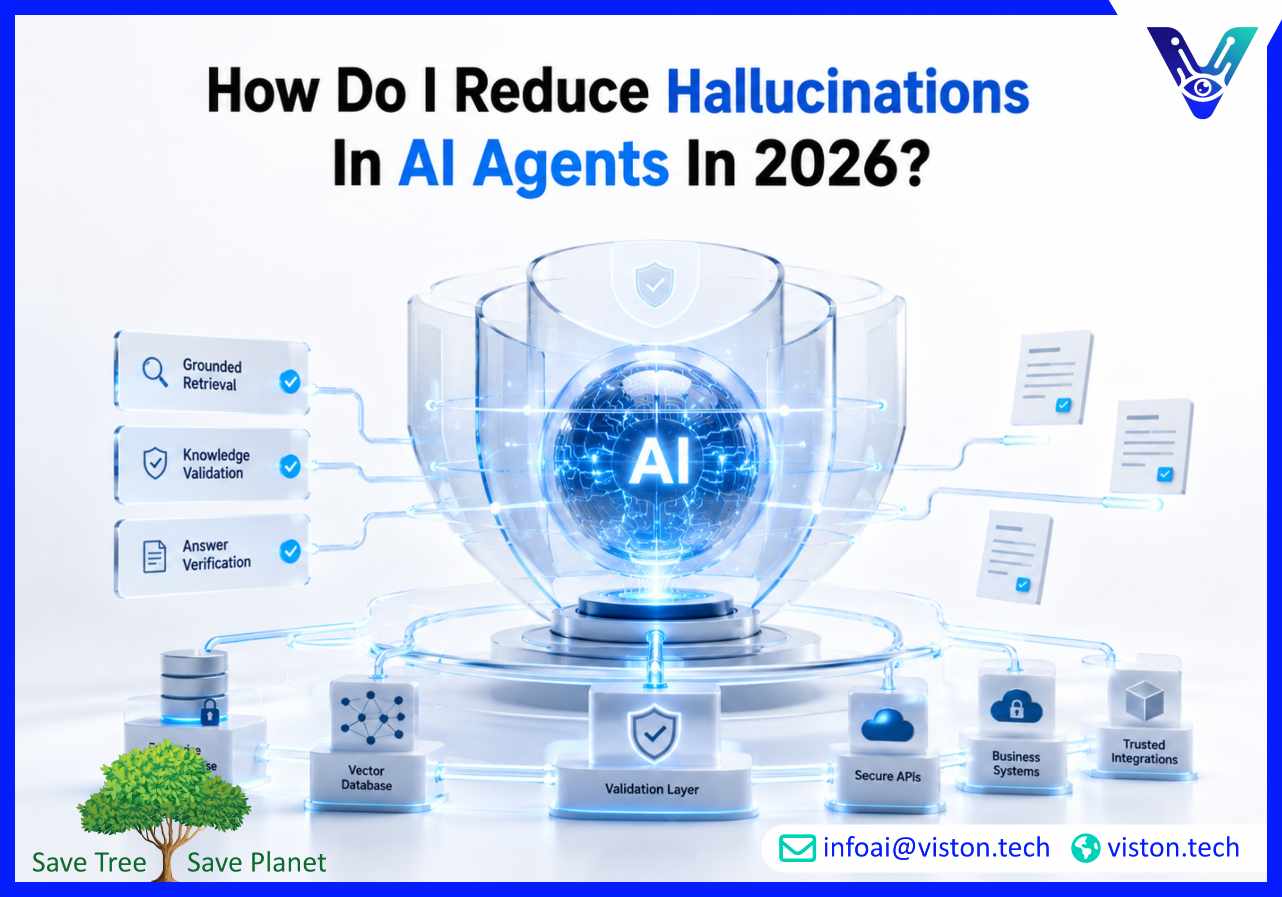
How Do I Reduce Hallucinations in AI Agents in 2026?
AI agents are becoming increasingly capable of handling business workflows, customer interactions, research, automation, and enterprise decision support. However, one of the biggest operational risks organizations still face in 2026 is AI hallucination — when an AI agent generates inaccurate, misleading, or fabricated information with confidence.For businesses deploying AI systems at scale, reducing hallucinations is no longer optional. It is essential for reliability, compliance, customer trust, and operational safety.
What Are AI Hallucinations?
AI hallucinations occur when an AI model produces outputs that appear plausible but are factually incorrect, unsupported, or invented. In AI agents, hallucinations can become more problematic because agents often make decisions, trigger workflows, interact with external systems, or operate autonomously.Examples include:
Inventing customer information
Generating incorrect analytics
Misinterpreting API responses
Providing false compliance guidance
Creating inaccurate summaries
Making unsupported recommendations
Executing flawed workflow actions
In enterprise environments, these errors can create operational, legal, reputational, and financial risks.
Why AI Hallucinations Matter More in Agentic Systems
Traditional chatbots usually stop at text generation. AI agents, however, often:
Access live business systems
Use APIs and external tools
Retrieve organizational data
Execute workflows
Make autonomous decisions
Coordinate across multiple systems
This expanded capability increases the impact of inaccurate outputs.For example, an AI support agent hallucinating a refund policy may frustrate customers. But an AI procurement agent hallucinating supplier data or pricing can directly affect business operations.That is why reducing hallucinations requires both strong model design and robust AI agent architecture.
Common Causes of Hallucinations in AI Agents
Understanding the root causes helps organizations implement practical mitigation strategies.
Poor Retrieval Quality
Many AI agents rely on retrieval-augmented generation (RAG) systems. If the retrieval layer surfaces irrelevant, outdated, or incomplete data, the agent may generate inaccurate responses.Common retrieval issues include:
Weak vector search tuning
Poor chunking strategies
Low-quality embeddings
Missing metadata
Incomplete indexing
Stale enterprise data
Weak Prompt Engineering
Poorly structured prompts often encourage models to speculate instead of remaining grounded in available data.Examples include:
Ambiguous instructions
Lack of response constraints
Missing fallback behaviors
Undefined confidence thresholds
Over-Autonomous Agent Design
Agents with unrestricted autonomy are more likely to produce unreliable outputs.Without validation checkpoints, agents may:
Make assumptions
Infer unsupported conclusions
Chain inaccurate reasoning
Continue flawed workflows
Inadequate Tool Validation
AI agents frequently integrate with:
CRMs
ERPs
Databases
APIs
Document systems
Analytics platforms
If tools return malformed, incomplete, or inconsistent data, the AI layer may incorrectly interpret the results.
Outdated Knowledge Sources
Static knowledge bases quickly become unreliable in fast-changing environments.This is particularly risky for:
Legal workflows
Financial operations
Healthcare systems
Compliance automation
Technical support
Practical Strategies to Reduce Hallucinations in AI Agents
Reducing hallucinations requires a combination of architecture, governance, validation, and deployment discipline.
Use Retrieval-Augmented Generation (RAG) Properly
RAG remains one of the most effective methods for grounding AI responses in verified information.A strong RAG implementation should include:
High-Quality Data Pipelines
Organizations should ensure:
Clean source data
Proper indexing
Metadata tagging
Version control
Real-time synchronization where needed
Context Optimization
Large context windows alone do not solve hallucinations.Better results come from:
Intelligent chunking
Semantic ranking
Relevance filtering
Context compression
Query rewriting
Source Attribution
Agents should identify where information originated.This improves:
Traceability
User trust
Auditability
Compliance validation
Add Validation Layers Between Reasoning and Action
One of the most effective enterprise safeguards is separating:
AI reasoning
Action execution
Instead of allowing agents to act directly, businesses should implement:
Rule validation engines
Human approval workflows
Confidence scoring
Policy enforcement layers
Exception handling systems
For example:
Finance agents can require approval for high-value transactions
Healthcare agents can flag uncertain recommendations
Customer service agents can escalate low-confidence responses
Fine-Tune Prompts for Grounded Responses
Prompt engineering in 2026 focuses heavily on reliability and controlled generation.Strong prompts often include instructions such as:
“Answer only from retrieved data”
“Do not speculate”
“State uncertainty clearly”
“Request clarification when data is insufficient”
“Reject unsupported assumptions”
Structured output formats also reduce ambiguity.Examples include:
JSON schemas
Validation templates
Citation requirements
Workflow constraints
Implement Multi-Agent Verification
Many enterprise AI systems now use multi-agent orchestration to improve accuracy.In this model:
One agent retrieves data
Another validates information
Another checks policy compliance
Another evaluates response quality
This layered verification approach helps reduce unsupported outputs before they reach end users or operational systems.
Use Smaller Specialized Models Where Appropriate
Bigger models are not always more reliable.In many business environments, smaller domain-specific models reduce hallucination risks because they:
Operate within narrower contexts
Follow stricter constraints
Require less speculative reasoning
Improve predictable behavior
Specialized models are increasingly used for:
Document classification
Compliance extraction
Workflow automation
Enterprise search
Structured data processing
Monitor AI Agent Behavior Continuously
Reducing hallucinations is not a one-time deployment task.Businesses need continuous monitoring systems that track:
Response quality
Error rates
Failed tool calls
Confidence thresholds
Escalation patterns
Drift detection
User feedback loops
Observability platforms for AI agents have become a major priority in 2026 because enterprises require measurable reliability.
Establish Human-in-the-Loop Controls
Human oversight remains critical for high-risk workflows.Human review is especially important for:
Legal decisions
Healthcare guidance
Financial recommendations
Security operations
Enterprise procurement
Compliance workflows
Organizations increasingly use adaptive oversight models where:
Low-risk tasks are automated
Medium-risk tasks require spot review
High-risk tasks require full approval
This balances efficiency with operational safety.
Improve Tool and API Reliability
AI agents are only as reliable as the systems they interact with.To reduce hallucinations:
APIs should return structured responses
Tool outputs should be validated
Error handling should be standardized
Data freshness should be monitored
Retry logic should be controlled
Tool orchestration frameworks now commonly include:
Schema validation
Output normalization
Response scoring
Failure isolation
Why Governance Matters in 2026
As AI regulations continue evolving globally, governance has become essential.Organizations deploying AI agents increasingly require:
Audit trails
Decision transparency
Access controls
Model monitoring
Risk classification
Compliance logging
Explainability mechanisms
Reducing hallucinations is now directly connected to broader AI governance strategies.
Industry Challenges When Reducing AI Hallucinations
Different industries face different risks.
Healthcare
Healthcare AI agents require:
Clinical validation
Regulatory compliance
High factual accuracy
Protected data handling
Even small hallucinations can create patient safety concerns.
Financial Services
Financial systems demand:
Transaction accuracy
Regulatory consistency
Fraud prevention
Risk-aware automation
Hallucinated outputs can lead to compliance violations or financial losses.
Customer Support
Support agents must balance:
Fast responses
Accurate policy guidance
CRM synchronization
Escalation workflows
Incorrect answers directly impact customer trust.
Enterprise Operations
Operational AI agents managing workflows, procurement, logistics, or analytics require:
Real-time system integration
Workflow validation
Exception handling
Reliable orchestration
How Viston AI Supports Reliable AI Agent Development
Businesses adopting AI agents often need more than just model integration. Reliable deployment requires orchestration, validation architecture, workflow engineering, monitoring, and scalable implementation practices.Viston AI focuses on AI Agent Development & Deployment solutions designed for practical enterprise use cases. This includes building AI agents that integrate with business systems, operate within controlled workflows, and support structured automation requirements across operational environments.A major challenge organizations face is balancing AI autonomy with reliability. Reducing hallucinations requires more than prompt tuning alone. It involves designing robust retrieval pipelines, implementing validation layers, managing tool orchestration, monitoring agent behavior, and ensuring workflows remain aligned with business policies.Viston AI’s development approach emphasizes scalable AI agent architecture, controlled execution frameworks, API integrations, workflow automation, and deployment strategies that support business-grade reliability. This is particularly important for organizations implementing AI agents across customer operations, enterprise knowledge systems, analytics environments, and process automation initiatives.As enterprise adoption grows in 2026, businesses increasingly prioritize AI systems that are observable, governable, and operationally safe — not just capable of generating responses.
Best Practices Businesses Should Follow
Organizations deploying AI agents should prioritize:
Grounded retrieval systems
Structured prompt engineering
Validation workflows
Human oversight
Multi-agent verification
Continuous monitoring
Governance controls
Secure integrations
Reliable orchestration
Domain-specific optimization
Businesses that treat hallucination reduction as an architectural requirement — rather than a model problem alone — generally achieve better long-term reliability.
Frequently Asked Questions
What is the main cause of hallucinations in AI agents?
Hallucinations usually occur because of poor retrieval quality, weak prompts, insufficient validation layers, outdated knowledge sources, or unreliable tool integrations.
Can hallucinations be completely eliminated in AI agents?
No AI system is entirely risk-free. However, organizations can significantly reduce hallucinations through retrieval grounding, validation workflows, monitoring, and human oversight.
Does RAG help reduce AI hallucinations?
Yes. Retrieval-Augmented Generation helps AI agents generate responses using verified external data instead of relying only on model memory.
Why are hallucinations dangerous in enterprise AI systems?
Hallucinations can lead to operational mistakes, compliance issues, inaccurate analytics, customer trust problems, and workflow failures in enterprise environments.
Are smaller AI models better for reducing hallucinations?
In some cases, yes. Smaller domain-specific models often perform better for constrained business workflows because they operate within narrower and more predictable contexts.
How does Viston AI help businesses build reliable AI agents?
Viston AI supports AI Agent Development & Deployment with enterprise-focused architectures, workflow automation, orchestration systems, integrations, and deployment practices designed to improve reliability and operational control.
Conclusion
Reducing hallucinations in AI agents is one of the most important priorities for businesses deploying enterprise AI systems in 2026. Reliable AI agents require more than advanced models — they depend on grounded data retrieval, validation architecture, controlled automation, observability, and governance.Organizations that approach AI Agent Development & Deployment strategically can significantly improve accuracy, reduce operational risks, and build more trustworthy automation systems. As businesses scale AI adoption across critical workflows, reliability and controllability will continue to define successful enterprise AI implementations.