
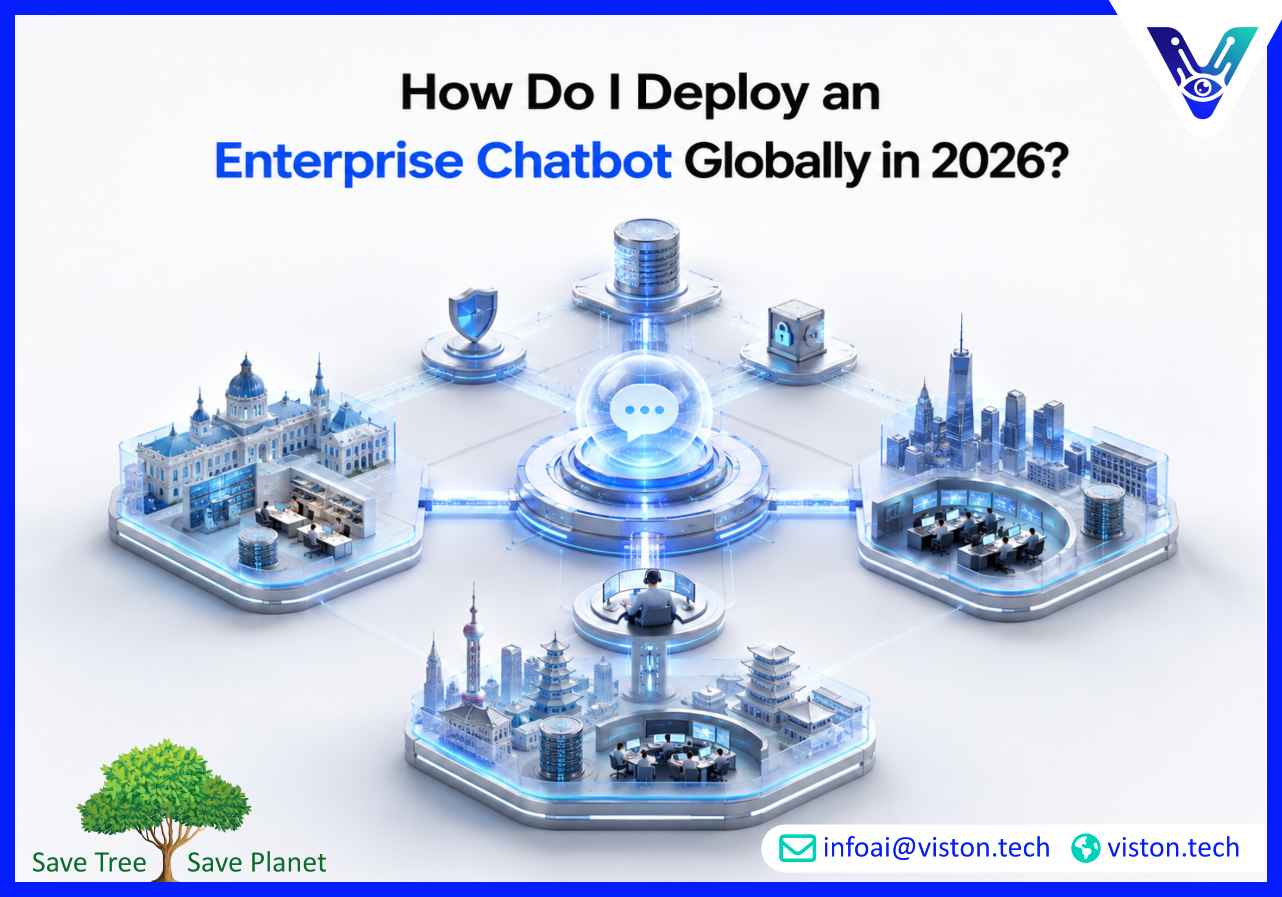
Deploying an enterprise chatbot globally requires more than launching the same assistant in multiple countries. Businesses need scalable infrastructure, multilingual design, compliant data handling, localized workflows, reliable integrations, and continuous performance governance across markets.
Global enterprise chatbot deployment means designing, launching, and managing an AI-powered conversational system that can serve users across regions, languages, channels, time zones, business units, and regulatory environments. It is not simply a translation exercise or a wider rollout of a domestic chatbot.
A global chatbot must understand regional language patterns, customer expectations, product availability, service policies, escalation paths, privacy requirements, and operational workflows. It may need to support customers on a website in Europe, employees through Microsoft Teams in North America, buyers on WhatsApp in Asia-Pacific, and support agents through a CRM in multiple markets.
The deployment must also reflect enterprise complexity. Large organizations often operate different CRMs, helpdesk tools, ERP systems, knowledge bases, payment flows, authentication methods, and approval processes across regions. A chatbot that works well in one country can fail globally if it cannot adapt to local data, language, compliance, and process differences.
Before building the chatbot, enterprises should define how the global model will work. This includes deciding which functions are centralized, which are localized, and who owns updates after launch. A strong global chatbot operating model usually includes:
This structure prevents a common deployment problem: every region creating separate chatbot logic, disconnected data sources, and inconsistent user experiences. Global consistency matters, but it must be balanced with local relevance.
In 2026, enterprise chatbots are expected to support real business operations, not only answer simple FAQs. Buyers and employees expect instant, accurate, multilingual, and personalized assistance across digital channels. At the same time, businesses face higher expectations around data privacy, AI transparency, security, auditability, and responsible automation.
For global companies, a chatbot can reduce service friction by offering 24/7 support across time zones. It can help standardize answers, improve customer response speed, reduce repetitive tickets, qualify international leads, guide users through workflows, and support regional teams without requiring every market to build duplicate service capacity.
However, global scale also increases risk. A chatbot that gives inaccurate refund guidance in one country, exposes customer data across regions, misunderstands regulated product terms, or fails to escalate urgent issues can create operational, legal, and reputational problems. Enterprise AI chatbots must therefore be deployed with governance, localization, and system integration from the beginning.
Business leaders evaluating global chatbot deployment should expect more than a conversational interface. A serious enterprise chatbot should be designed around:
The strongest global chatbot deployments are not the biggest at launch. They are the ones that start with a controlled scope, prove performance in priority markets, and then scale with reusable architecture and local governance.
A global rollout should be planned in phases. Trying to launch every region, language, use case, and integration at once often creates delays and inconsistent quality. The better approach is to build a reusable core chatbot architecture, validate it in priority markets, then expand in controlled waves.
Start by identifying where the chatbot can create the clearest business value. Common global use cases include customer support automation, lead qualification, ecommerce assistance, employee IT support, HR policy guidance, appointment scheduling, claims intake, order tracking, onboarding support, and technical troubleshooting.
Not every use case should be automated immediately. High-volume, repeatable, low-risk workflows are usually the best starting point. Complex, regulated, or emotionally sensitive interactions should include stronger guardrails, confidence thresholds, and human escalation paths.
Region selection should consider language coverage, support volume, regulatory complexity, business priority, data readiness, and integration availability. A pilot in two or three representative markets can reveal localization, content, and workflow issues before a wider rollout.
The technical architecture should support global performance, reliability, and governance. Enterprises should consider cloud region strategy, latency, uptime requirements, API resilience, identity management, data storage, encryption, monitoring, and disaster recovery.
For many enterprise AI chatbots, retrieval-augmented generation is useful because it allows the chatbot to answer from approved knowledge sources instead of relying only on static training data. The knowledge layer should separate global content from regional content. Global content may include brand policies, product fundamentals, and core service descriptions. Regional content may include pricing, legal terms, delivery options, local support hours, and market-specific procedures.
Multilingual deployment is not only machine translation. A global chatbot must understand local terminology, abbreviations, spelling variations, cultural expectations, regulatory language, and common user phrasing. For example, a support query about billing, insurance, delivery, taxation, or employment benefits may need different answers depending on the market.
Localization should include conversation design, knowledge base review, fallback handling, escalation routing, date and currency formats, consent language, and accessibility requirements. The chatbot should also know when not to answer. If a query involves legal, medical, financial, security, or contractual judgment, the safest response may be to collect context and route the issue to a qualified team.
A chatbot becomes more valuable when it can take action. That may mean creating tickets, checking order status, updating CRM fields, triggering workflows, booking meetings, retrieving account information, or routing requests to regional teams.
These integrations must be designed with business logic, permissions, audit trails, and error handling. A chatbot should not have unrestricted access to sensitive systems. It should operate through approved APIs, defined scopes, authentication controls, and monitored transaction flows.
Global chatbot deployment succeeds when businesses treat it as an operational program, not a one-time software launch. The main risks are usually not caused by the chatbot interface itself. They come from weak data governance, poor localization, shallow testing, missing integrations, unclear ownership, and insufficient monitoring after launch.
Enterprises must understand how user data moves through the chatbot system. This includes conversation logs, personal data, authentication tokens, customer records, uploaded documents, payment information, employee data, and support history. Global deployment may involve different privacy rules in different jurisdictions, especially when serving customers in Europe, North America, Asia-Pacific, and regulated sectors.
Good practice includes data minimization, consent capture, encryption, configurable retention policies, access controls, deletion workflows, audit logging, and clear separation between customer-facing and internal data. If the chatbot uses AI-generated responses, teams should also maintain transparency about when users are interacting with an automated system.
Testing should cover more than whether the chatbot answers common questions. Enterprises should test regional language performance, fallback responses, sensitive topics, authentication flows, API failures, escalation quality, peak traffic, mobile behavior, accessibility, and security risks such as prompt injection or unauthorized data access.
Scenario testing is especially important. A user may ask the same question in different ways, switch languages, provide incomplete information, express frustration, or request an action that the chatbot is not allowed to perform. The deployment team should test realistic conversation paths before exposing the chatbot to global traffic.
Global teams need training and communication before launch. Support agents should know how chatbot handoffs work. Regional managers should understand what the chatbot can and cannot do. Marketing and sales teams should know which lead flows are automated. IT teams should understand monitoring and incident response procedures.
A phased rollout allows teams to learn quickly. Start with a pilot, measure performance, improve content, expand to more users, then add additional markets and languages. This reduces risk and helps teams build internal confidence.
Global deployment requires market-level analytics. Key metrics include containment rate, self-service resolution rate, fallback rate, customer satisfaction, escalation rate, response accuracy, workflow completion, cost per resolved conversation, lead conversion, and integration error rate.
Metrics should be reviewed by language, region, channel, business unit, and intent. A chatbot may perform well in English support queries but poorly in German technical troubleshooting or Spanish claims intake. Global reporting helps teams identify where localization, content, or integration improvements are needed.
Viston AI is relevant to global enterprise chatbot deployment because its Enterprise AI Chatbots service is built around complex conversational AI requirements, including multilingual support, business system integration, workflow automation, natural language understanding, and ongoing optimization. These capabilities align closely with what global businesses need when deploying chatbots across countries, teams, and customer segments.
For organizations planning international rollout, Viston AI can support the practical layers that determine chatbot success: defining use cases, designing enterprise-grade conversation flows, connecting the chatbot with CRM and operational systems, structuring approved knowledge sources, enabling multilingual experiences, and setting up monitoring for performance improvement. Its broader AI service portfolio also includes AI chatbot integration, NLP and text analysis, voice-enabled assistants, AI strategy development, MLOps and model monitoring, and automation workflows.
This matters because a global chatbot must operate reliably within real business systems. It should not only answer questions; it should route requests, update records, respect permissions, provide consistent experiences, and improve over time. Viston AI’s service alignment makes it a suitable specialist partner for businesses that want enterprise AI chatbots deployed with attention to scalability, localization, security, integrations, and measurable operational outcomes across global markets.
Deploy an enterprise chatbot globally by starting with priority use cases, building a scalable architecture, localizing language and workflows, integrating with business systems, meeting regional compliance requirements, testing by market, and rolling out in controlled phases.
Usually no. A phased rollout is safer. Start with high-priority regions and languages, validate performance, improve knowledge coverage, resolve integration issues, and then expand to additional markets with a proven deployment framework.
Common integrations include CRM, ERP, helpdesk software, identity management, ecommerce platforms, knowledge bases, order management systems, marketing automation tools, workforce platforms, and business intelligence dashboards.
Multilingual support is essential, but translation alone is not enough. The chatbot must understand local terminology, regional policies, cultural expectations, market-specific workflows, and escalation rules for each supported language.
The biggest risks include inaccurate localized content, weak data privacy controls, poor system integration, inconsistent escalation, unclear ownership, unmanaged AI responses, security vulnerabilities, and lack of performance monitoring after launch.
Yes. Viston AI’s Enterprise AI Chatbots service is aligned with global deployment needs through multilingual chatbot support, AI chatbot integration, NLP capabilities, workflow automation, and ongoing model monitoring for enterprise environments.
Knowing how to deploy an enterprise chatbot globally is essential for businesses that want scalable, reliable, and localized conversational AI across markets. The process requires clear use cases, multilingual design, secure architecture, regional compliance planning, enterprise integrations, human handoff, and continuous optimization. A global chatbot should support business outcomes, not simply expand chat coverage. With the right deployment strategy, enterprise AI chatbots can improve service availability, reduce repetitive workload, support international growth, and create more consistent customer and employee experiences. Viston AI offers relevant capabilities for organizations seeking a practical, enterprise-focused approach to global chatbot deployment.
