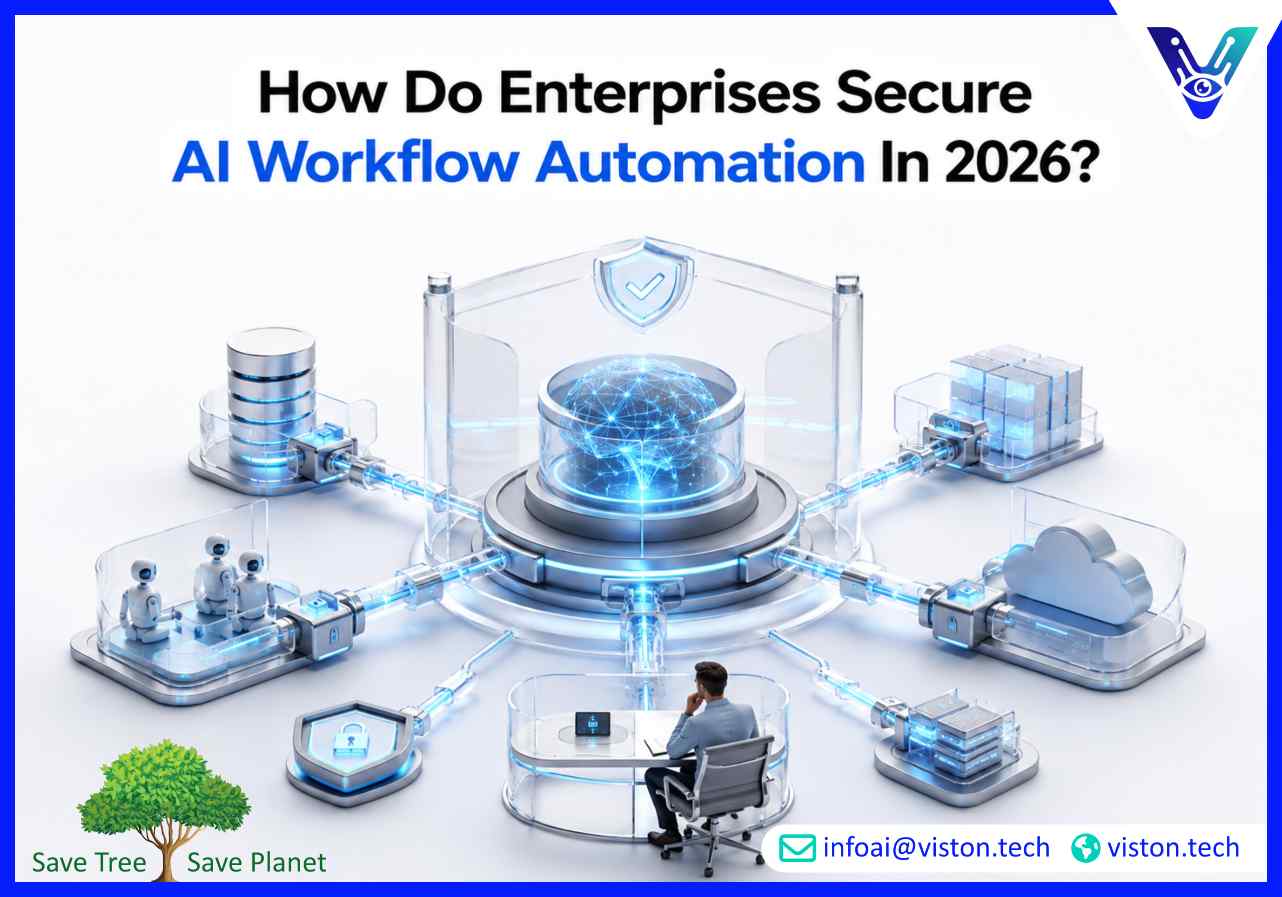
How Do Enterprises Secure AI Workflow Automation in 2026?
Introduction
AI workflow automation is transforming how enterprises manage operations, customer interactions, analytics, and decision-making. As adoption grows, security has become a central concern. Organizations now need AI automation systems that are not only efficient and scalable but also secure, compliant, observable, and resilient against operational and data risks.
Why AI Workflow Automation Security Matters for Enterprises
AI workflow automation connects business systems, data pipelines, APIs, cloud environments, and decision engines. These automated workflows often process highly sensitive information, including:
Customer records
Financial transactions
Internal communications
Operational analytics
Healthcare or compliance-related data
Intellectual property
Without proper safeguards, automated AI systems can introduce risks such as:
Unauthorized data access
Prompt injection attacks
Data leakage through AI outputs
API abuse
Compliance violations
Inaccurate automated actions
Model manipulation
Shadow AI usage across departments
In 2026, enterprise buyers are no longer evaluating AI automation solely on functionality. Security architecture, governance controls, auditability, and compliance readiness now directly influence procurement and deployment decisions.
What Enterprise AI Workflow Automation Typically Includes
Enterprise AI workflow automation combines multiple technologies to automate business processes intelligently. These environments often include:
AI Agents and Automation Bots
AI agents can execute tasks such as:
Responding to customer inquiries
Processing documents
Triggering workflows
Managing approvals
Generating reports
Coordinating internal systems
API and System Integrations
Modern AI workflows integrate with:
CRM systems
ERP platforms
HR systems
Cloud infrastructure
Business intelligence tools
Collaboration software
Large Language Models (LLMs)
Many enterprises now use LLMs to support:
Natural language processing
Internal knowledge search
Workflow orchestration
Automated decision assistance
Content generation
Data Pipelines and Automation Engines
AI automation platforms rely heavily on secure data movement between applications, storage systems, and processing layers.Because these systems operate across interconnected environments, securing them requires more than traditional cybersecurity controls.
Key Security Risks in AI Workflow Automation
Unauthorized Data Exposure
AI systems frequently access centralized enterprise data sources. Poor access controls or overly broad permissions can expose sensitive information to unauthorized users or external systems.Enterprises now prioritize:
Role-based access control (RBAC)
Least-privilege permissions
Segmented data environments
Encrypted storage and transmission
Prompt Injection and Manipulation Attacks
Prompt injection attacks attempt to manipulate AI agents into bypassing safeguards or exposing restricted data.This is particularly important when AI agents interact with:
External web content
Third-party APIs
Customer-generated inputs
Dynamic datasets
Organizations increasingly implement:
Input sanitization
Prompt validation layers
Guardrails for AI behavior
Context isolation controls
Insecure API Integrations
AI workflow automation depends heavily on APIs. Weak API security can create entry points for attackers.Common enterprise concerns include:
Exposed authentication tokens
Unsecured endpoints
Excessive API permissions
Poor rate limiting
Inadequate monitoring
Modern enterprise AI deployments require secure API gateways, token management, and continuous API traffic monitoring.
Lack of Visibility and Auditability
Many businesses initially adopted AI automation faster than their governance processes evolved.As regulations tighten globally, enterprises now require:
Workflow logging
Explainability tracking
Decision traceability
Activity monitoring
User-level audit trails
Without visibility, organizations struggle to investigate incidents, verify compliance, or understand AI-driven actions.
Compliance and Regulatory Risks
AI workflow automation often intersects with industry regulations and privacy requirements.Depending on operational scope, enterprises may need alignment with:
GDPR
HIPAA
SOC 2
ISO 27001
PCI DSS
Regional AI governance frameworks
In 2026, regulatory expectations increasingly focus on:
Responsible AI usage
Data governance
Automated decision transparency
Human oversight mechanisms
Core Strategies Enterprises Use to Secure AI Workflow Automation
Implement Zero-Trust Security Architecture
Zero-trust principles are becoming standard in enterprise AI environments.This means:
No system or user is trusted by default
Every request is verified continuously
Access permissions are tightly controlled
Network segmentation limits lateral movement
AI workflow automation platforms now commonly integrate with enterprise identity providers and security policies.
Use Secure AI Model Access Controls
Organizations are restricting direct model access through:
Identity-based authentication
API-level authorization
Session controls
Secure model gateways
This reduces the likelihood of unauthorized interaction with enterprise AI systems.
Encrypt Data Across the Entire Workflow
Enterprises secure AI workflows by encrypting:
Data in transit
Stored datasets
API communications
Backup systems
AI interaction logs
Encryption is particularly important when AI systems process customer records, financial data, or proprietary business information.
Introduce Human-in-the-Loop Controls
Many enterprises avoid fully autonomous execution for sensitive workflows.Instead, they use human approval stages for:
Financial actions
Legal document generation
Customer-impacting decisions
Compliance-sensitive workflows
Human oversight reduces operational risk while improving governance.
Continuously Monitor AI Workflow Behavior
Real-time monitoring helps organizations detect:
Unusual AI activity
Abnormal data requests
Failed integrations
Unauthorized access attempts
Output anomalies
Security teams increasingly combine AI observability tools with SIEM platforms and operational analytics systems.
Why Governance Is Becoming Central to AI Automation Security
Security alone is no longer enough. Enterprises now require formal AI governance frameworks.Governance helps organizations define:
Who can deploy AI workflows
What data AI systems may access
Which actions require approval
How outputs are validated
How risks are documented
How compliance is maintained
Governance also supports internal accountability across operations, IT, security, legal, and compliance teams.In many organizations, AI governance boards now review automation initiatives before deployment.
Industry Challenges in Securing AI Automation
Financial Services
Banks and fintech companies require:
Transaction-level auditability
Fraud detection safeguards
Regulatory compliance controls
Secure customer data handling
AI workflow automation in finance must balance speed with traceability and strict security enforcement.
Healthcare and Life Sciences
Healthcare organizations face additional concerns involving:
Patient data protection
Clinical workflow accuracy
HIPAA compliance
Secure medical integrations
AI automation in healthcare requires particularly strong governance and validation processes.
Manufacturing and Logistics
Operational AI systems increasingly automate supply chain coordination, predictive maintenance, and inventory processes.These environments require:
OT and IT security alignment
Secure device integrations
Workflow reliability
Resilience against downtime
Enterprise SaaS and Technology Companies
Technology firms often automate support operations, analytics, onboarding, and customer success workflows.Their priorities commonly include:
Secure multi-tenant architectures
API protection
Access management
Scalable workflow orchestration
How Enterprises Evaluate Secure AI Automation Providers
Organizations selecting AI automation partners in 2026 typically assess:
Security Architecture
Buyers expect providers to demonstrate:
Secure deployment methods
Authentication controls
Data handling policies
Infrastructure security practices
Integration Capabilities
Secure integrations with existing enterprise systems are critical for operational continuity.
Scalability and Reliability
Automation platforms must handle enterprise-scale workflows without compromising performance or security controls.
Monitoring and Reporting
Enterprises increasingly require detailed observability and operational reporting.
Governance Support
Businesses now favor providers that support policy enforcement, audit readiness, and compliance alignment.
How Viston AI Supports Secure AI Workflow Automation
Viston AI provides AI Automation & Workflow Bots designed to help enterprises automate operational processes while maintaining control, scalability, and security awareness across AI-driven environments.As organizations expand AI automation initiatives, many face challenges involving fragmented systems, workflow complexity, governance gaps, and operational visibility. Viston AI focuses on building automation workflows that align with enterprise operational requirements rather than deploying isolated AI tools without oversight.Its AI automation capabilities can support businesses through:
Workflow orchestration across enterprise systems
AI-powered operational automation
Intelligent process automation
API-driven integrations
AI-assisted business workflows
Scalable automation deployment strategies
For enterprises evaluating AI workflow automation, practical implementation considerations increasingly include security governance, controlled automation execution, integration management, observability, and business continuity planning. Automation initiatives are no longer evaluated purely on speed or cost reduction. Enterprises now prioritize long-term operational reliability and responsible AI deployment.Organizations implementing AI automation also need flexibility to adapt workflows as compliance expectations, operational requirements, and AI technologies continue evolving in 2026. Structured automation strategies supported by specialized AI workflow expertise can help reduce deployment risks while improving scalability and operational efficiency.
Best Practices for Enterprises Implementing Secure AI Workflow Automation
Start With Controlled Pilot Deployments
Rather than automating every process immediately, enterprises typically begin with limited workflows to evaluate:
Security posture
Workflow accuracy
Integration reliability
Governance effectiveness
Define Data Access Policies Early
Organizations should establish clear policies around:
Data classification
Workflow permissions
User roles
AI usage boundaries
Build Cross-Functional AI Governance Teams
Security, compliance, operations, legal, and IT teams should collaborate during AI workflow planning and deployment.
Prioritize Explainability
Enterprise leaders increasingly require visibility into how AI-driven workflows make recommendations or trigger actions.
Continuously Update Security Controls
AI threats evolve rapidly. Enterprises must regularly reassess:
Access controls
Prompt protections
API security
Workflow monitoring
Vendor risk exposure
Frequently Asked Questions
How do enterprises secure AI workflow automation?
Enterprises secure AI workflow automation through access controls, encryption, API security, monitoring, governance frameworks, audit logging, and human oversight mechanisms.
Why is AI workflow automation security important in 2026?
AI systems now handle sensitive operational and customer data at scale. Security is essential to prevent data leakage, unauthorized access, compliance failures, and workflow manipulation.
What are the biggest risks in AI workflow automation?
Common risks include insecure APIs, prompt injection attacks, excessive permissions, poor governance, lack of visibility, and regulatory non-compliance.
Can AI workflow automation meet enterprise compliance requirements?
Yes, when properly designed. Enterprises often implement governance policies, audit logging, encryption, access controls, and monitoring to support compliance obligations.
What industries require the strongest AI automation security?
Highly regulated sectors such as healthcare, finance, insurance, and enterprise technology typically require the most advanced AI workflow security and governance measures.
How can Viston AI help businesses with AI workflow automation?
Viston AI supports organizations with AI Automation & Workflow Bots designed to improve operational automation, workflow orchestration, and scalable AI-driven business process management.
Conclusion
Secure AI workflow automation has become a strategic priority for enterprises adopting AI-driven operations in 2026. Organizations now require automation systems that combine efficiency with governance, observability, compliance readiness, and operational resilience. As AI workflows become more deeply integrated into business operations, security considerations extend far beyond traditional infrastructure protection.Businesses evaluating AI Automation & Workflow Bots should focus on scalable architecture, secure integrations, monitoring capabilities, and long-term governance support. Providers such as Viston AI can help enterprises implement structured AI workflow automation strategies that align with modern operational and security expectations.