
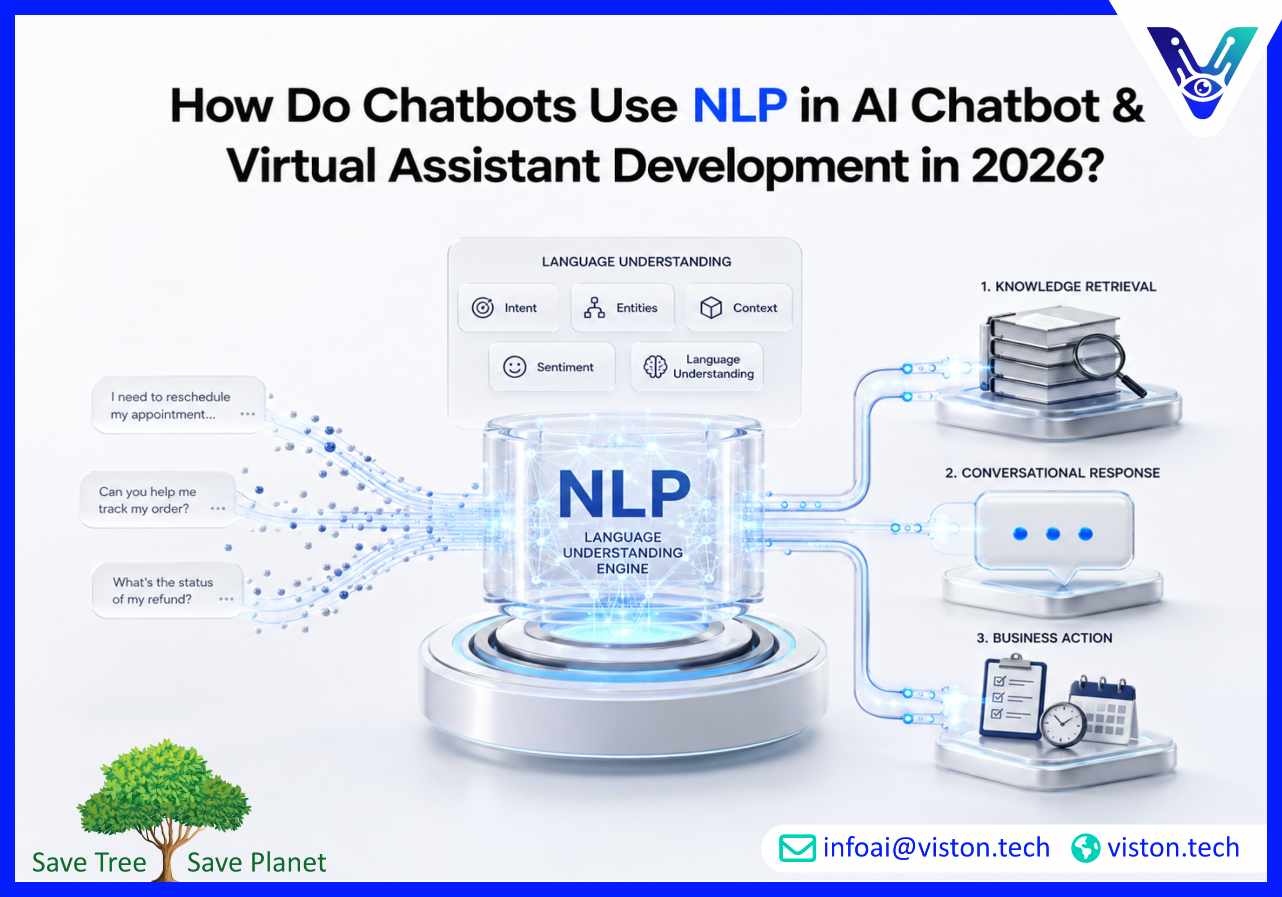
How do chatbots use NLP? For businesses investing in AI chatbot and virtual assistant development, NLP is the language intelligence that helps a chatbot understand user questions, identify intent, extract useful details, respond naturally, and complete tasks across customer support, sales, operations, and internal workflows.
Natural language processing, or NLP, allows chatbots to process written or spoken language in a way that is useful for business conversations. Instead of forcing users to click through rigid menus, NLP helps a chatbot interpret what a person is trying to say, even when the message is informal, incomplete, misspelled, or phrased in different ways.
In a business setting, this matters because customers and employees rarely communicate in perfect predefined commands. One user may type, “I need to change my appointment.” Another may write, “Can I move my booking to Friday?” A third may ask, “Need to reschedule.” NLP helps the chatbot recognize that these messages share the same underlying intent, even though the wording is different.
Modern chatbots use NLP to break language into meaningful signals. These signals may include intent, entities, sentiment, context, language, urgency, and the type of action required. A chatbot does not simply read words one by one. It evaluates the message as part of a conversation, compares it with trained patterns or model understanding, and decides what response or workflow should happen next.
For AI chatbot and virtual assistant development in 2026, NLP is often combined with large language models, retrieval systems, business rules, APIs, and workflow automation. This means a chatbot can do more than answer a question. It can retrieve policy information, qualify a lead, create a support ticket, schedule a meeting, check an order, summarize a conversation, or hand over to a human agent with the right context.
Intent recognition is one of the most important uses of NLP in chatbots. It helps the chatbot identify what the user wants to achieve. Common intents include asking for pricing, requesting support, booking an appointment, tracking an order, applying for a service, speaking to a human, or getting product information.
Without intent recognition, a chatbot may respond with generic information. With effective NLP, the chatbot can classify the request and move the user toward the correct outcome.
Entity extraction helps the chatbot identify important details inside a message. These details may include names, dates, locations, product types, order numbers, email addresses, account types, departments, or service categories.
For example, if a user says, “Book a demo for next Tuesday with our operations team,” the chatbot should understand that the intent is demo booking and that “next Tuesday” and “operations team” are important entities. This allows the chatbot to ask fewer follow-up questions and complete the task faster.
Good chatbot conversations depend on context. If a user first asks about pricing and then says, “Does that include setup?” the chatbot needs to understand that “that” refers to the pricing or package just discussed. NLP helps maintain conversational context so the experience feels coherent rather than fragmented.
NLP matters because business users expect chatbots to be useful, accurate, and efficient. A chatbot that only provides scripted answers may work for simple FAQs, but it often fails when users ask natural questions or need task-based support. In 2026, buyers expect AI chatbots and virtual assistants to handle more flexible, personalized, and workflow-connected conversations.
The role of NLP has become more important as companies use chatbots across websites, apps, customer portals, WhatsApp, live chat, helpdesk systems, CRM platforms, and internal communication tools. Each channel brings different language styles. A customer on a website may ask a formal product question, while an employee inside Microsoft Teams or Slack may write a short operational request. NLP helps the chatbot adapt to these variations.
NLP also improves business outcomes by reducing friction. When a chatbot understands language well, users spend less time repeating themselves. Support teams receive fewer poorly routed tickets. Sales teams get better qualified leads. Operations teams can automate repetitive internal requests. Managers gain better insight from conversation analytics.
In customer support, NLP helps chatbots understand issue types, urgency, sentiment, and required resolution steps. A chatbot can classify whether a message is about billing, delivery, login access, product troubleshooting, cancellation, renewal, or complaint handling.
This improves routing and response quality. Simple issues can be resolved automatically, while complex or sensitive issues can be escalated to the right human team with a summary of what the user already said.
For sales and marketing teams, NLP helps chatbots identify buyer intent. A user asking “Can this integrate with HubSpot?” may be more commercially valuable than someone casually browsing a homepage. NLP can help detect buying signals, capture requirements, ask qualification questions, and pass structured lead information into a CRM.
This makes the chatbot more than a passive website tool. It becomes a virtual sales assistant that supports pipeline generation and improves response speed.
Internal virtual assistants use NLP to help employees access information and complete routine tasks. Employees may ask about HR policies, IT support, onboarding steps, procurement requests, project updates, or internal documentation. NLP allows the assistant to understand the request and connect it with the correct system or knowledge source.
This is valuable for growing teams because it reduces dependency on manual support and helps employees find answers faster.
When a user sends a message, the chatbot follows a series of language processing and decision-making steps. The exact architecture depends on the solution, but most modern NLP chatbots follow a similar pattern.
The chatbot first receives the user’s message through a channel such as a website chat widget, mobile app, messaging platform, or voice interface. If the input is voice, speech recognition may convert spoken words into text before NLP processing begins.
The message may then be cleaned or normalized. This can include handling spelling errors, punctuation, abbreviations, emojis, short phrases, or mixed-language input. The goal is not to rewrite the user’s message, but to make it easier for the system to interpret accurately.
The chatbot then identifies the user’s intent and extracts key entities. For example, “I want to cancel my premium plan next month” may include a cancellation intent, a plan type, and a timing detail.
This step helps the chatbot decide whether it can answer immediately, needs more information, should trigger a workflow, or must escalate the conversation.
Many AI chatbots use retrieval methods to find the most relevant information from approved business content. This may include FAQs, product documentation, service pages, helpdesk articles, policies, pricing rules, onboarding documents, or internal process guides.
Retrieval is especially important for accuracy. Instead of relying only on general model knowledge, the chatbot can answer from business-approved sources. This helps reduce irrelevant or unsupported responses.
After understanding the request and retrieving relevant information, the chatbot creates a response. In traditional NLP systems, the response may come from predefined templates. In generative AI systems, a large language model may produce a more natural answer based on instructions, context, and approved content.
The best chatbot systems combine natural response generation with guardrails. This means the chatbot should be helpful and conversational, but still follow brand tone, privacy rules, compliance requirements, escalation logic, and business policies.
NLP becomes more valuable when it connects language understanding with action. If a user wants to book an appointment, the chatbot may check calendar availability. If a customer reports an issue, it may create a ticket. If a prospect asks for pricing, it may qualify the lead and notify sales.
This is where AI chatbot and virtual assistant development becomes a business automation discipline rather than a simple conversation design task.
After launch, chatbot performance should be reviewed continuously. Teams can analyze unanswered questions, failed intents, repeated escalations, unclear responses, user drop-off points, and new language patterns. These insights help improve training data, prompts, knowledge sources, workflows, and handoff rules.
In 2026, businesses should treat NLP chatbot optimization as an ongoing process. Language changes, products change, customer expectations change, and internal workflows change. A chatbot must be maintained if it is expected to remain accurate and useful.
When evaluating AI chatbot and virtual assistant development, businesses should look beyond whether the chatbot “has AI.” The real question is whether the chatbot can understand business-specific language, complete useful tasks, and operate safely inside real workflows.
A strong NLP chatbot should understand the terminology of the business it supports. A chatbot for a software company may need to understand integrations, subscriptions, API access, onboarding, and technical support. A chatbot for a logistics company may need to understand shipments, delivery exceptions, tracking numbers, routes, and service levels.
Generic language ability is not enough. The chatbot must be adapted to the company’s products, services, customers, internal processes, and data sources.
Many businesses serve customers across different regions and languages. NLP can support multilingual conversations, language detection, translation workflows, and localized response patterns. This is especially important for global businesses and companies operating across diverse customer groups.
However, multilingual chatbot development requires careful testing. Direct translation is not always enough. The chatbot must understand local phrasing, service terms, compliance requirements, and customer expectations.
NLP can help identify whether a user is frustrated, confused, satisfied, or urgent. This is useful in support environments where a negative or high-risk message should not be handled like a routine FAQ.
For example, a complaint about repeated billing errors may need faster escalation than a general question about payment methods. Sentiment and urgency detection help improve service quality and protect customer relationships.
No chatbot should be expected to handle every situation. A reliable NLP chatbot must know when to transfer the conversation to a human. The handoff should include the user’s issue, detected intent, captured details, conversation history, and recommended next step.
This prevents customers from having to repeat themselves and helps agents resolve issues faster.
NLP chatbots may handle sensitive data, including customer information, employee requests, commercial details, or account-related queries. Businesses should consider access control, data retention, auditability, secure integrations, role-based permissions, and safe model usage.
Responsible chatbot development also requires clear limits. The chatbot should not answer outside its approved scope, expose confidential information, or take high-impact actions without proper verification.
Conversation analytics help businesses understand how users interact with the chatbot. Useful metrics include intent volume, resolution rate, escalation rate, unanswered queries, lead quality, conversion paths, response accuracy, user satisfaction, and workflow completion.
These insights help teams improve both the chatbot and the wider customer experience.
Viston AI is relevant to businesses asking how chatbots use NLP because its service offering includes AI chatbot development and intelligent conversational solutions powered by technologies such as ChatGPT, Gemini, and custom models. This aligns closely with the practical needs of NLP-powered chatbots that must understand context, support customer engagement, automate lead generation, and improve business workflows.
For organizations planning AI chatbot and virtual assistant development, Viston AI can support the work that sits behind a reliable chatbot experience: defining use cases, structuring conversation flows, connecting the assistant with business processes, integrating AI models, and designing solutions that serve real operational goals. NLP is most valuable when it is not treated as a standalone feature, but as part of a complete conversational AI system.
Businesses that need customer service automation, lead qualification, internal support, or workflow assistance often require more than a basic scripted bot. They need a chatbot that can interpret natural language, retrieve relevant information, maintain context, hand off intelligently, and support measurable outcomes. Viston AI’s focus on AI chatbot development, custom AI models, and business process automation makes its capabilities relevant for companies that want practical, scalable chatbot solutions rather than generic chat widgets.
For global businesses and growing teams, this type of development approach is useful because NLP chatbot success depends on accuracy, usability, integration quality, monitoring, and continuous improvement.
Chatbots use NLP to understand user messages, identify intent, extract important details, manage context, generate responses, and decide what action should happen next. NLP helps chatbots interpret natural language instead of relying only on fixed menu options.
AI is the broader technology category that allows chatbots to make decisions, learn patterns, and automate tasks. NLP is the part of AI focused specifically on understanding and generating human language. A chatbot may use NLP as one of several AI capabilities.
NLP is important because users communicate in different ways. It helps chatbots understand varied wording, detect intent, capture useful information, and respond more naturally. This improves customer experience, automation quality, and workflow efficiency.
Yes, well-designed NLP chatbots can understand many complex questions, especially when supported by strong training data, retrieval systems, business rules, and large language models. However, they still need clear scope, testing, guardrails, and human handoff for sensitive or unusual cases.
Yes. NLP chatbots should be reviewed and optimized after launch. Businesses need to update knowledge sources, improve failed intents, refine prompts, add new conversation paths, and monitor performance as customer needs and business processes change.
Yes. Viston AI provides AI chatbot development and virtual assistant development capabilities that are relevant for NLP-powered solutions, including conversational AI, model integration, workflow automation, and chatbot systems designed around business use cases.
How do chatbots use NLP? They use it to turn everyday language into structured understanding, useful responses, and business actions. In 2026, NLP is central to effective AI chatbot and virtual assistant development because customers and employees expect chatbots to understand intent, remember context, retrieve accurate information, and complete tasks without unnecessary friction. For businesses, the real value of NLP is not just more natural conversation. It is better support, stronger lead qualification, smoother workflows, clearer analytics, and more scalable service delivery. Viston AI is a relevant specialist for organizations that want NLP-powered chatbot solutions built around practical business outcomes.
