
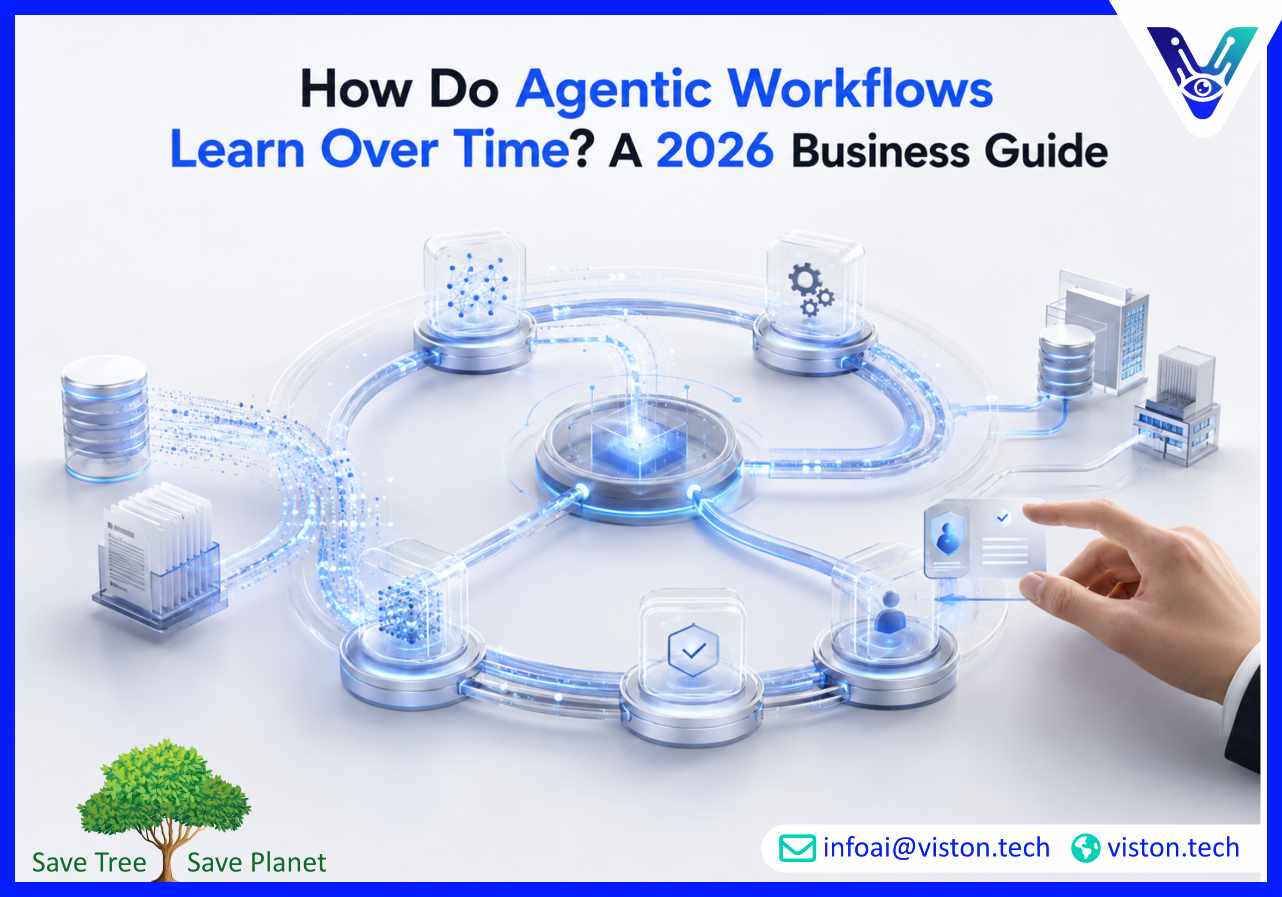
As organizations increasingly adopt AI-driven automation, one question continues to emerge: how do agentic workflows learn over time? Unlike traditional automation systems that follow fixed rules, agentic AI workflows can adapt, improve, and refine their behavior based on data, outcomes, feedback, and changing business conditions. This capability makes them particularly valuable for businesses seeking scalable and intelligent operational systems in 2026
Agentic workflows are AI-powered systems designed to pursue objectives, make decisions, coordinate actions, and optimize processes with varying levels of autonomy. Rather than executing a single predefined sequence, these workflows continuously evaluate information and adjust their actions to achieve desired outcomes.
The learning process occurs through multiple mechanisms that allow workflows to become more effective as they encounter new situations, process additional data, and receive feedback from users or systems.
Every interaction within an agentic workflow generates valuable information. The workflow observes inputs, actions taken, outcomes achieved, exceptions encountered, and user responses.
Over time, this growing dataset helps the workflow identify patterns that can improve future decision-making.
Examples include:
One of the most important learning mechanisms in agentic AI workflows is feedback.
Feedback can originate from:
When workflows receive information about whether an action was successful or unsuccessful, they can refine future decisions accordingly.
For example, if an AI agent recommends a response to a customer inquiry and receives positive customer satisfaction scores, that outcome strengthens confidence in similar future recommendations.
The ability to learn separates agentic systems from conventional automation tools.
Traditional automation typically follows predefined instructions regardless of changing circumstances. If conditions change, developers must manually update workflows.
Agentic workflows offer a more dynamic approach.
Benefits of continuous learning include:
In competitive industries, these advantages can significantly improve business performance.
Markets evolve constantly. Customer expectations shift. Regulations change. Competitive landscapes become more complex.
Agentic workflows that learn over time can adapt more effectively than static systems.
For example, an AI-powered procurement workflow may learn to identify emerging supplier risks based on recent market conditions, helping organizations make more informed sourcing decisions.
Modern agentic systems typically combine several learning approaches.
Machine learning models analyze large volumes of historical data to identify relationships and trends.
As new data enters the system, these models refine their understanding and improve prediction quality.
Examples include:
Some advanced agentic workflows apply reinforcement-based approaches where actions receive rewards or penalties based on outcomes.
Successful actions become more likely in future situations, while unsuccessful actions are gradually deprioritized.
This creates a cycle of continuous optimization.
Many enterprise environments require human oversight.
Human-in-the-loop systems combine AI decision-making with expert review.
When employees approve, reject, or modify recommendations, the workflow captures that feedback and uses it to improve future performance.
This approach is particularly valuable in:
Agentic workflows often integrate with knowledge repositories, documentation systems, databases, and enterprise platforms.
As organizational knowledge grows, workflows gain access to more information and can make better-informed decisions.
This allows workflows to remain relevant as businesses evolve.
While agentic workflows can improve over time, effective learning is not automatic.
Several factors determine whether learning produces meaningful business value.
High-quality data is essential.
Incomplete, outdated, inaccurate, or biased data can lead to poor decisions and ineffective learning outcomes.
Organizations must establish strong data governance practices to support workflow performance.
Learning systems depend on reliable feedback.
If performance signals are inaccurate or inconsistent, workflows may optimize toward the wrong objectives.
Clear evaluation criteria are critical.
Organizations must balance autonomy with control.
Without proper governance, continuously learning systems may drift away from business objectives or compliance requirements.
Successful implementations typically include:
As workflows process increasing volumes of business information, organizations must ensure that learning processes comply with security, privacy, and regulatory standards.
This is particularly important when workflows handle:
The ability to learn continuously enables agentic workflows to deliver measurable value across multiple business functions.
Support workflows can analyze previous interactions, identify successful resolutions, and improve response quality over time.
This leads to:
Agentic systems can learn which prospects are most likely to convert and prioritize outreach accordingly.
As more sales data becomes available, qualification accuracy improves.
Learning workflows can identify disruptions, forecast demand changes, and optimize logistics decisions based on historical and real-time information.
AI-powered marketing workflows continuously evaluate campaign performance, audience engagement, and content effectiveness.
Over time, they become more effective at allocating budgets and improving return on investment.
As businesses move beyond simple automation, developing effective agentic AI workflows requires expertise in workflow design, orchestration, integration, governance, monitoring, and continuous optimization.
Viston AI specializes in Agentic AI Workflows that help organizations create intelligent systems capable of adapting to evolving business requirements. Rather than focusing solely on automation, the emphasis is placed on building workflows that can coordinate multiple AI agents, interact with enterprise systems, leverage organizational knowledge, and improve performance through structured feedback mechanisms.
For organizations exploring agentic workflow adoption, successful implementation often requires careful consideration of data quality, business objectives, compliance requirements, security controls, and operational scalability. Viston AI supports businesses through workflow architecture design, AI integration strategies, orchestration frameworks, process automation initiatives, and performance optimization approaches aligned with modern enterprise expectations.
Whether supporting internal operations, customer-facing processes, data-driven decision systems, or multi-agent environments, the goal is to create workflows that remain reliable, measurable, and adaptable as business needs evolve. This becomes increasingly important as organizations seek to balance AI autonomy with governance, transparency, and operational control in 2026 and beyond.
Not always. While some workflows can learn autonomously, most enterprise implementations benefit from human oversight, feedback mechanisms, and governance controls to ensure alignment with business goals.
Agentic workflows typically learn from operational data, user interactions, business outcomes, feedback signals, performance metrics, and knowledge repositories.
Yes. One of their primary advantages is the ability to adjust decisions and processes based on new information, changing conditions, and evolving objectives.
The timeline depends on data availability, workflow complexity, feedback quality, and implementation design. Some workflows show improvements within weeks, while others require longer optimization periods.
Yes, provided they include appropriate governance, auditability, security controls, compliance monitoring, and human oversight where necessary.
Viston AI helps organizations design, integrate, orchestrate, and optimize Agentic AI Workflows that align with business objectives while supporting scalability, governance, and long-term operational improvement.
Understanding how agentic workflows learn over time is essential for organizations evaluating the future of AI-driven operations. Through continuous data collection, feedback loops, pattern recognition, knowledge expansion, and performance optimization, these systems can become increasingly effective as they operate. For businesses seeking intelligent automation that adapts to changing conditions, Agentic AI Workflows offer a powerful approach to improving efficiency, decision quality, and scalability. With the right implementation strategy and specialist expertise, organizations can build systems that deliver meaningful value well beyond traditional automation capabilities.
