
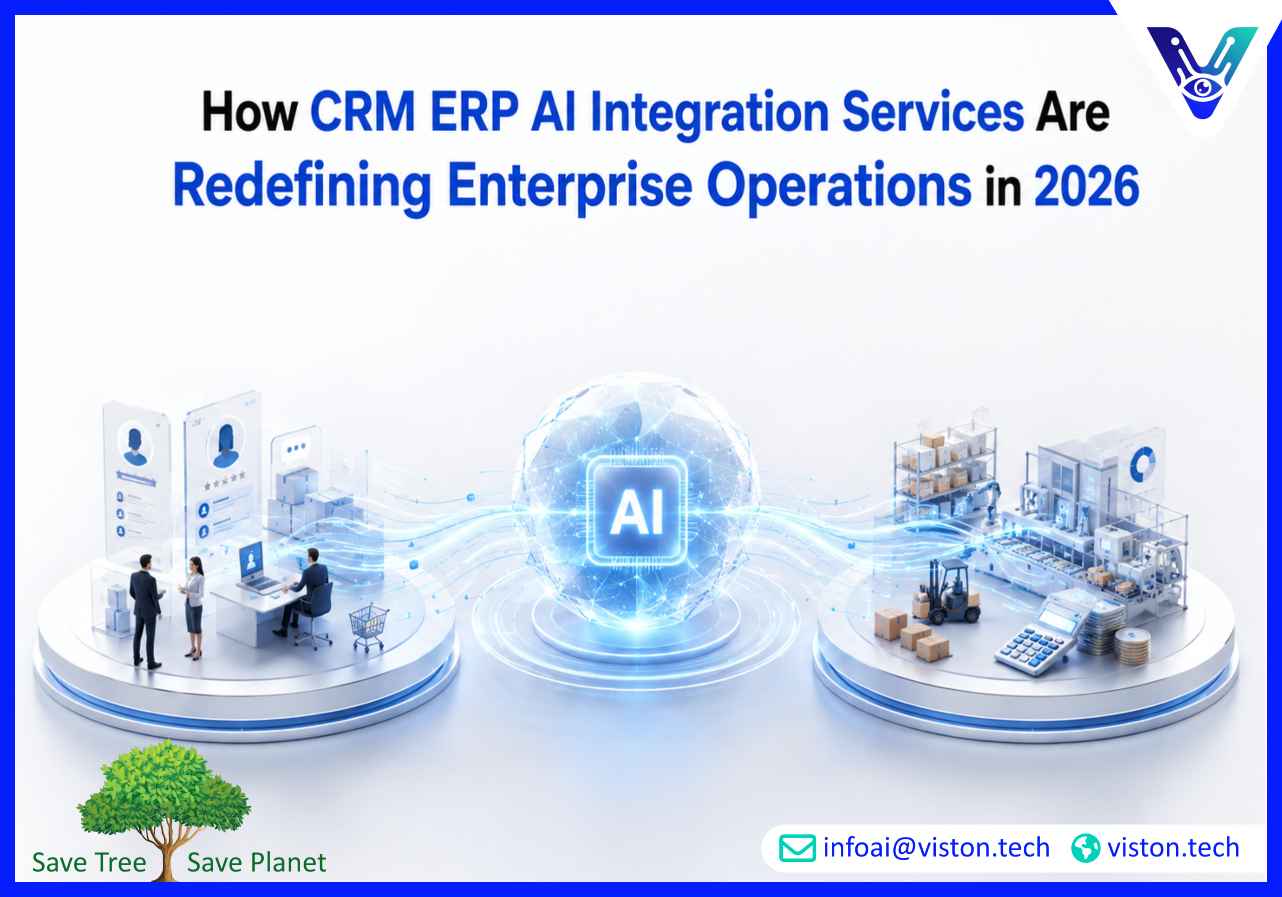
For decades, the gap between customer-facing systems and operational back-ends has forced businesses into a painful choice: accurate data with slow processes, or fast processes with inaccurate data. In 2026, this trade-off is becoming obsolete. The convergence of CRM, ERP, and AI through agentic integration services is fundamentally changing how enterprises manage workflows, moving from passive record-keeping to autonomous task execution .
For business decision-makers, the question is no longer whether to integrate these systems, but how deeply to embed intelligent agents to automate complex, cross-departmental processes.
Traditional CRM and ERP integrations have historically been brittle. Organizations relied on point-to-point connections or middleware that simply moved data—orders from the CRM to the ERP, inventory updates back to sales. This model, however, fails to address latency, data silos, and exception handling . In 2026, the market has shifted toward Agent Integration Services. Unlike robotic process automation (RPA) or simple API calls, AI agents possess the ability to reason, make decisions, and execute multi-step tasks across disconnected platforms without human intervention .
According to recent industry analysis, enterprise software boundaries are dissolving as AI agents shift workflows from department-specific logic to task-based execution . This means a single AI agent can now detect a customer service issue in the CRM, check inventory or billing status in the ERP, and autonomously initiate a refund or expedited shipping process—all without a human pulling reports or clicking through screens.
For enterprises struggling with fragmented digital ecosystems, the cost of inaction is significant. Manual reconciliation between sales quotes (CRM) and actual shipped goods (ERP) leads to billing disputes, revenue leakage, and poor customer experiences. Agent Integration Services solve these specific pain points by creating a “digital nervous system.”
Most businesses have automated individual departments. The “last mile” of digital transformation—the handoff between the front office and the back office—remains the primary bottleneck. AI agents deployed via integration services bridge this gap by mapping semantic meaning between disparate data schemas. For example, an AI agent can interpret a “rush order” flag in a Salesforce opportunity, validate production capacity in a SAP ERP module, and trigger a specific premium workflow that bypasses standard lead times .
Standard integrations break when exceptions occur—a credit check fails, an item is out of stock, or a discount exceeds approval limits. Agent Integration Services embed decisioning logic into the workflow. Agents can query alternative warehouses, recalculate pricing based on dynamic ERP data, or escalate only the most complex issues to human managers, eliminating the “swivel-chair” interface where staff manually re-enter data between systems .
When evaluating service providers for CRM ERP AI integration, enterprises must look beyond simple connectivity to assess how agents are architected to handle complex variables.
Static data syncing is insufficient. AI agents require live, two-way data flows to function effectively. If an ERP updates a shipping status, the agent must immediately update the CRM and potentially trigger a customer notification. Services that rely on batch processing or snapshot integrations fail to deliver the autonomous experience buyers expect in 2026 .
As AI agents gain the ability to modify data (e.g., adjusting inventory levels or changing order statuses), governance becomes non-negotiable. Effective integration services embed audit trails, role-based access controls, and “policy guardrails” directly into the agent logic. This ensures that while the agent acts autonomously, it never violates Sarbanes-Oxley (SOX) compliance, GDPR data privacy rules, or internal financial controls .
One of the most significant advancements in 2026 is the abstraction of complexity. Advanced integration agents allow business users to query the unified data layer using natural language. A sales manager can ask, “Which orders approved last week are stuck in manufacturing validation?” The agent retrieves the data from the ERP, cross-references it with the CRM authorization logs, and returns an answer without the user ever learning SQL or navigating a complex dashboard .
Adopting CRM ERP AI integration services requires a strategic shift. The goal is not merely to connect systems but to orchestrate outcomes. Experts suggest a five-stage maturity model: Assist, Automate, Extend, Orchestrate, and Operate . Organizations typically begin with high-friction, high-volume processes—such as order-to-cash or lead-to-fulfillment—before scaling to autonomous operation.
Security remains a paramount concern. It is critical that the integration layer maintains the “responsibility chain” between systems; while the AI facilitates speed, the underlying ERP must retain the single source of truth for financial transactions .
Navigating the complexities of AI-driven integration requires more than generic IT support; it demands specialized engineering focused on agentic architecture. Viston AI provides Agent Integration Services specifically designed for enterprises struggling to unify their customer and operational data stacks. Unlike traditional system integrators who simply hardcode APIs, Viston AI deploys adaptive AI agents that learn your specific workflow logic. For businesses in high-velocity industries, Viston AI bridges the semantic gap between front-office sales tools and back-office ERPs, enabling autonomous execution of billing, inventory reconciliation, and service logistics. By prioritizing governance, real-time synchronization, and measurable ROI, Viston AI transforms disjointed software ecosystems into cohesive, self-optimizing business assets.
Standard API integration moves data from point A to point B based on fixed rules. AI Agent Integration involves agents that interpret context, make decisions, and execute multi-step workflows across systems. For example, an API might copy an order number, whereas an AI agent might detect a stock discrepancy in the ERP, proactively source inventory, and update the customer in the CRM .
Yes, when implemented correctly. Modern services embed governance guardrails, role-based access controls, and complete audit trails. The AI agents operate within strict permission boundaries, ensuring they can read or write data only as permitted by compliance standards like SOX or GDPR .
Agents use semantic mapping and reconciliation logic. If a customer’s address differs between the CRM and ERP, the agent applies pre-defined trust rules (e.g., defaulting to the ERP for billing data) or flags the discrepancy for human review via a unified dashboard, ensuring data integrity .
Enterprises typically see reductions in manual data entry (40-60% productivity gains in workflows involving data reconciliation) and significant acceleration of order-to-cash cycles. ROI is realized through reduced operational friction, fewer billing errors, and faster response times to customer issues .
Unlike legacy ERP implementations that take months, agentic integration focused on specific workflows can often go live in weeks. Using pre-built connectors and low-code agent orchestration layers, providers can demonstrate value on a single high-value process (e.g., automated credit checks) before scaling .
The era of disconnected enterprise software is ending. In 2026, competitive advantage belongs to organizations that transform their data silos into collaborative, intelligent workflows. CRM ERP AI integration services, powered by agentic architectures, represent the most practical path to achieving this vision. By automating complex handoffs, managing exceptions intelligently, and providing real-time visibility across the business, these services turn technology stacks into revenue engines. For leaders ready to move beyond the pilot phase, partnering with specialists in Agent Integration Services ensures that governance, security, and business outcomes remain the top priority.
