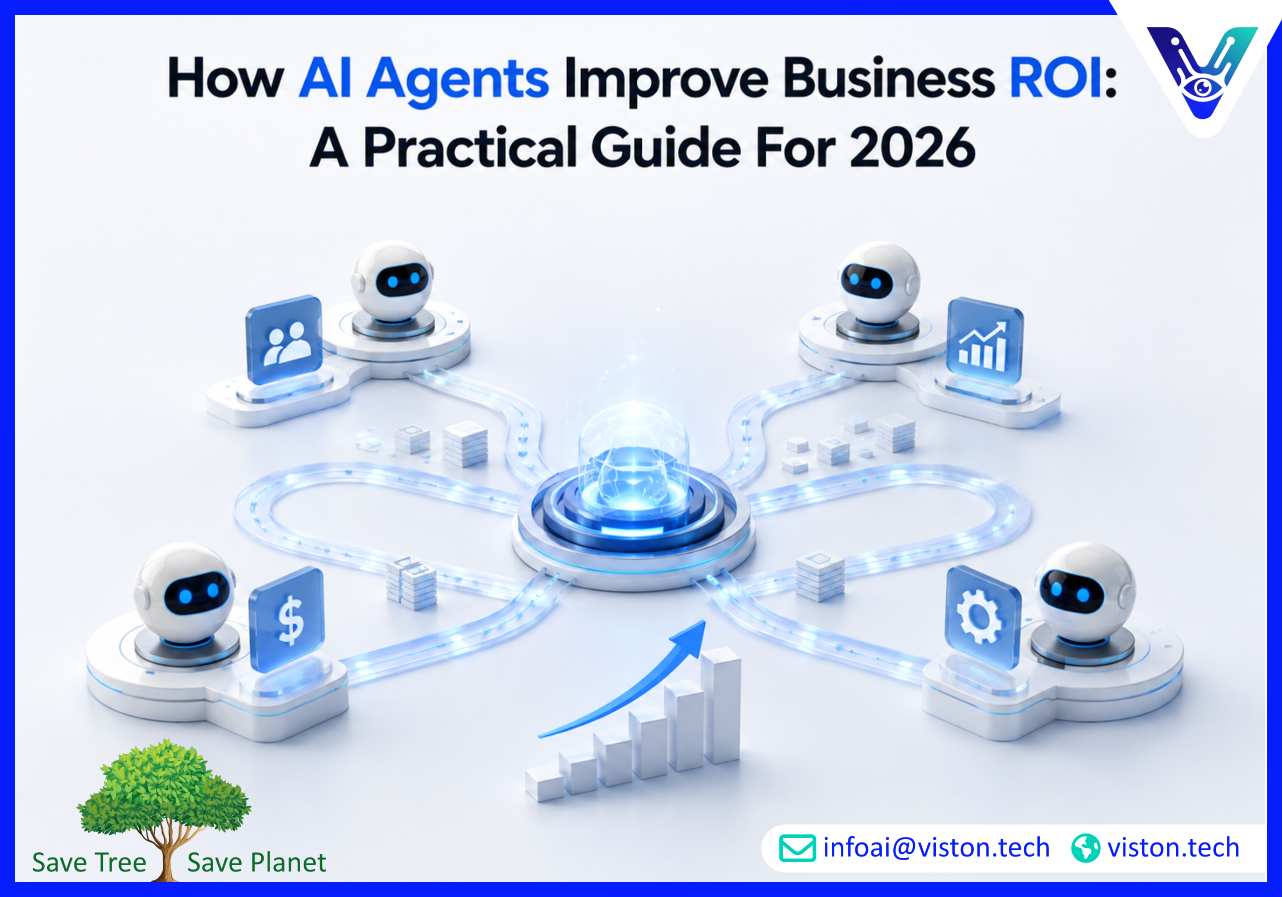
How AI Agents Improve Business ROI: A Practical Guide for 2026
Businesses investing in AI in 2026 are no longer asking whether the technology works. They are asking whether it delivers a measurable return. AI agents — autonomous systems capable of reasoning, acting, and adapting across complex workflows — have become one of the clearest answers to that question.
What AI Agents Actually Do in a Business Context
An AI agent is not a chatbot with a fancier interface. It is a system designed to perceive context, make decisions, take actions, and complete multi-step tasks with minimal or no human intervention at each stage.In practice, that means an AI agent can query a CRM, assess a customer’s history, determine the appropriate response, trigger a follow-up action in a connected system, and log the outcome — all without a human in the loop for every step.
The Core ROI Drivers Behind AI Agent Deployment
Operational Cost Reduction
The most direct path to ROI is labour cost displacement for high-volume, repeatable processes. Tasks such as data validation, invoice processing, exception handling, customer query triage, compliance checks, and report generation consume significant human hours across most organisations.
Faster Decision-Making Across Operations
AI agents process information and act in near real-time. A lead scoring agent can qualify and route an inbound enquiry in seconds, while a financial agent can prepare variance analysis as soon as data becomes available.
Revenue Generation Through Intelligent Engagement
AI agents deployed in customer-facing functions — sales qualification, personalisation, cross-sell recommendation, and proactive outreach — can generate incremental revenue without requiring proportional headcount growth.
Reduction in Errors and Compliance Risk
AI agents apply consistent logic across every task they execute, helping reduce human error in data handling, reporting, compliance documentation, and process execution.
Where ROI Is Strongest: High-Value Use Cases in 2026
Customer service automation — handling enquiries, resolving routine issues, coordinating returns, and escalating complex cases.
Sales and lead management — qualifying inbound leads, scoring prospects, booking appointments, and updating CRM records.
Finance and back-office operations — processing invoices, reconciling accounts, generating reports, and managing approvals.
Supply chain and inventory management — monitoring stock levels, predicting demand shifts, and coordinating reordering.
Internal operations and knowledge management — answering employee queries, managing HR processes, and supporting onboarding.
Why the Development and Deployment Approach Determines the Return
The ROI an organisation achieves from AI agents is directly tied to how well those agents are designed, integrated, and managed. Generic implementations rarely deliver the same return as custom-built agents aligned to specific workflows and existing system architecture.
How Viston AI Supports Businesses Pursuing ROI Through AI Agents
Viston AI specialises in AI agent development and deployment, working with businesses to design, build, and integrate custom agentic systems that target specific commercial outcomes rather than generic automation.Their service offering covers the full development lifecycle — from AI readiness assessment and workflow mapping through to agent architecture, integration, deployment, and ongoing model monitoring.
Evaluating AI Agent ROI Before You Invest
Any serious evaluation of AI agent investment should start with process mapping rather than technology selection. Businesses should identify which processes consume the most labour hours, where errors or delays create measurable financial consequences, and which customer interactions would benefit most from faster, more consistent handling.
Frequently Asked Questions
How long does it typically take to see ROI from AI agent deployment?
For focused, well-scoped deployments targeting specific workflows, businesses often see measurable results within six to twelve months.
What is the difference between an AI agent and traditional automation?
Traditional automation executes fixed, rule-based tasks. AI agents reason across variable inputs, adapt to context, make decisions, and interact with multiple systems dynamically.
Do AI agents require replacing existing systems?
Not typically. Well-built agents are designed to integrate with existing CRMs, ERPs, databases, and communication platforms rather than replacing them.
Which business functions generate the strongest ROI from AI agents?
Customer service, sales operations, finance and back-office processing, and supply chain management consistently produce strong measurable returns.
How does Viston AI approach AI agent ROI for its clients?
Viston AI includes ROI analysis and AI readiness assessment as part of its service offering, helping businesses identify where agents will deliver the most commercial impact.
What are the main risks to AI agent ROI?
The main risks include poor integration, choosing the wrong use cases, insufficient monitoring after launch, and lack of alignment between agent logic and real-world process complexity.
Conclusion
AI agents improve business ROI by compressing costs, accelerating decisions, reducing errors, and unlocking revenue potential that manual processes and rule-based automation cannot reach. The return is real, but it depends heavily on identifying the right use cases, building agents that integrate cleanly with existing infrastructure, and managing performance over time.