
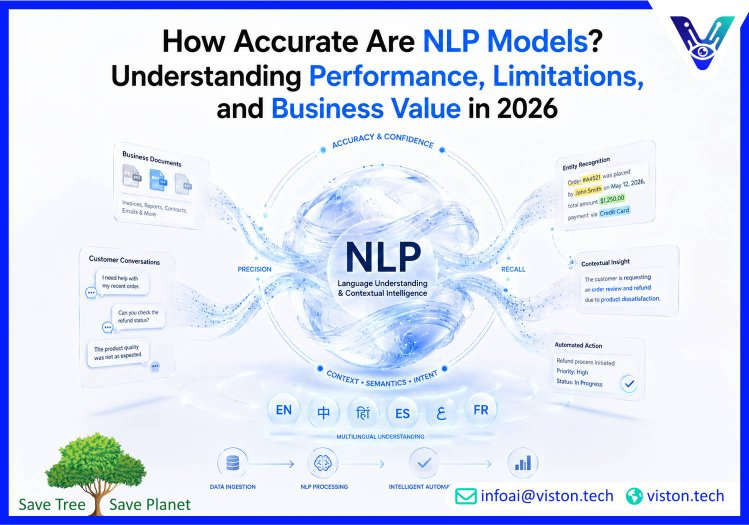
Natural Language Processing (NLP) has become a core component of modern business automation, enabling organizations to analyze text, understand customer intent, automate workflows, and improve decision-making. As adoption grows across industries, one of the most common questions business leaders ask is: how accurate are NLP models? The answer depends on the use case, data quality, model design, and implementation strategy.
NLP model accuracy refers to how effectively a system can understand, process, classify, generate, or respond to human language. Unlike traditional software that follows fixed rules, NLP models interpret language patterns, context, and meaning.
Several factors influence accuracy:
An NLP model trained on general internet content may perform differently from one specifically trained for healthcare, legal, financial, or customer service applications.
NLP accuracy varies significantly depending on the business task being performed.
Text classification systems categorize content into predefined groups, such as support tickets, emails, or customer inquiries.
Well-trained classification models often achieve accuracy rates exceeding 85–95% when working with high-quality, domain-specific datasets.
Sentiment analysis identifies positive, negative, or neutral emotions within text.
Accuracy typically ranges from 75–90%, depending on language complexity, sarcasm, industry terminology, and cultural context.
NER models identify entities such as people, organizations, products, locations, and dates.
Modern enterprise-grade models frequently achieve accuracy levels above 90% in structured business environments.
AI-powered chatbots rely on intent recognition and context understanding.
Performance depends heavily on training quality, conversation design, and integration with business systems. In mature implementations, intent recognition accuracy often exceeds 85%, while overall customer satisfaction depends on workflow effectiveness as much as language understanding.
NLP-driven document automation can extract critical information from contracts, invoices, forms, and reports.
When properly configured, extraction accuracy can exceed 90% for standardized document formats.
As organizations increasingly rely on AI-driven automation, NLP accuracy directly impacts business outcomes.
Higher-performing NLP systems can:
Even small improvements in accuracy can generate significant business value when systems process thousands or millions of interactions annually.
For example, an NLP-powered customer support solution with higher intent recognition accuracy can reduce ticket escalations, improve first-contact resolution rates, and lower operational costs.
While NLP technology has advanced significantly, language remains inherently complex. Businesses should understand the limitations that can influence performance.
Words and phrases often have multiple meanings depending on context. NLP systems must correctly interpret intent based on surrounding language.
Many industries use specialized vocabulary that general-purpose models may not fully understand without customization.
Organizations operating across multiple languages may face challenges related to translation quality, regional variations, and linguistic nuances.
Customer messages frequently include slang, abbreviations, spelling mistakes, and incomplete sentences that can affect interpretation accuracy.
Language evolves continuously. New products, services, regulations, and customer behaviors require ongoing model updates and retraining.
Organizations can significantly improve performance by following proven implementation practices.
Training data should accurately represent real-world business scenarios. Clean, relevant, and well-labeled datasets often produce better results.
Industry-specific training helps NLP systems understand terminology, workflows, and business context more effectively.
Performance metrics should be tracked regularly to identify accuracy issues and optimization opportunities.
Many organizations use human review processes for sensitive or high-risk decisions, creating a balance between automation and quality control.
Connecting NLP solutions with CRM platforms, knowledge bases, and operational systems improves contextual understanding and response quality.
Achieving strong NLP performance requires more than deploying a language model. Viston AI delivers Natural Language Processing Solutions that focus on practical business outcomes, system integration, and real-world accuracy.
Organizations often require NLP capabilities for customer support automation, intelligent document processing, semantic search, workflow automation, conversational AI, and data analysis. These applications demand models that understand business-specific terminology, integrate with existing systems, and continuously adapt to changing requirements.
Viston AI helps businesses implement NLP solutions that align with operational objectives while addressing critical factors such as data quality, scalability, automation efficiency, reporting, and ongoing optimization. By combining technical expertise with business-focused implementation strategies, organizations can improve NLP accuracy and maximize the value of language-driven automation initiatives.
A good accuracy rate depends on the application. Many enterprise NLP systems achieve 85–95% accuracy for tasks such as text classification, entity recognition, and document processing when properly trained and optimized.
No. Human language contains ambiguity, context shifts, sarcasm, and evolving terminology that make perfect accuracy unrealistic. The goal is continuous improvement and business-appropriate performance levels.
Errors can occur due to ambiguous language, insufficient training data, domain-specific terminology, spelling mistakes, multilingual content, or changing business requirements.
Organizations should regularly monitor performance and retrain models when new data, products, regulations, customer behaviors, or business processes emerge.
Yes. Viston AI provides Natural Language Processing Solutions that support model customization, workflow integration, optimization, and ongoing performance improvement for business applications.
Understanding how accurate NLP models are requires looking beyond a single percentage. Accuracy depends on the use case, data quality, model design, industry context, and implementation approach. In 2026, well-designed Natural Language Processing Solutions can achieve impressive performance levels across customer service, document automation, analytics, and business process automation. Organizations that invest in quality data, domain-specific customization, and continuous optimization are more likely to realize measurable business value from NLP initiatives. For businesses seeking reliable NLP implementation and optimization support, Viston AI offers practical expertise in developing solutions that balance accuracy, scalability, and operational effectiveness.
