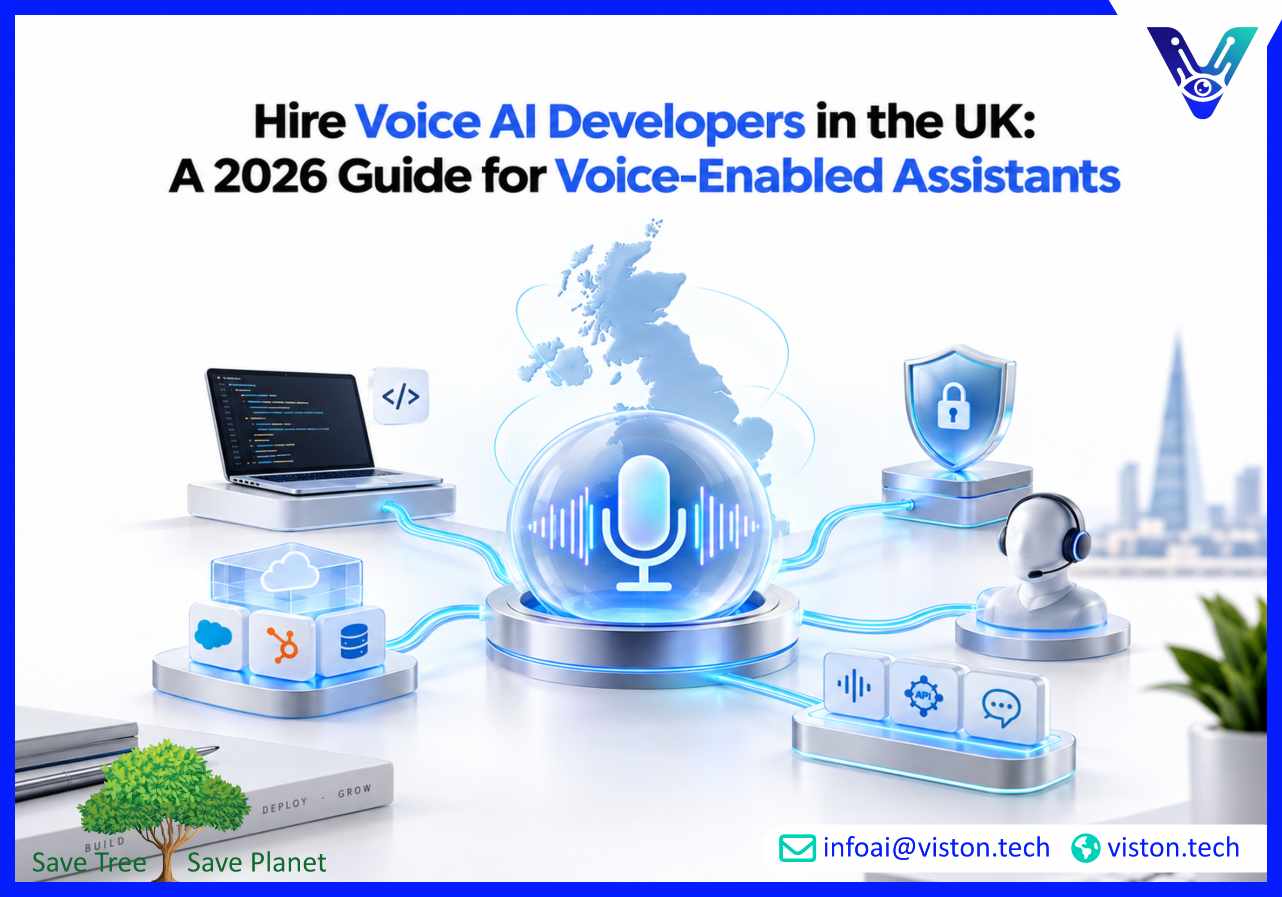
Hire Voice AI Developers in the UK: A 2026 Guide for Voice-Enabled Assistants
UK businesses looking to hire voice AI developers need more than speech-to-text skills. In 2026, successful voice-enabled assistants depend on natural conversation design, secure data handling, low-latency architecture, system integration, compliance awareness, and practical delivery expertise.
What It Means to Hire Voice AI Developers in the UK
To hire voice AI developers in the UK is to look for specialists who can design, build, integrate, and optimise AI systems that understand spoken language and respond naturally. These systems may support customer service, sales qualification, appointment booking, internal helpdesks, field operations, onboarding, accessibility, or hands-free workflow automation.Voice-enabled assistants are different from basic chatbots. They need to process real-time speech, understand accents and intent, manage interruptions, handle background noise, connect to business systems, and respond in a way that sounds clear, useful, and trustworthy. Conversational AI generally combines natural language processing, machine learning, speech recognition, and response generation to support human-like interactions across spoken and written channels.For UK organisations, voice AI development also needs awareness of customer expectations, regional language variation, privacy obligations, call recording practices, accessibility standards, and industry-specific compliance. A voice assistant used by a healthcare provider, financial services firm, ecommerce brand, recruitment team, or public-sector organisation will have different risk levels and workflow requirements.
Voice AI developers should understand the complete voice stack
A capable voice AI developer does not work only with a language model. The full voice stack may include automatic speech recognition, natural language understanding, dialogue management, retrieval-augmented knowledge access, text-to-speech, telephony integration, CRM updates, analytics, escalation rules, authentication, monitoring, and human handover.This is why hiring decisions should focus on delivery capability rather than tool familiarity alone. A developer may know how to connect an API, but enterprise-ready voice AI requires conversation flows, backend integration, error handling, data protection, testing, and continuous improvement.
Why Voice AI Development Matters for UK Businesses in 2026
Voice remains important because many customers still prefer speaking when issues are urgent, complex, or emotionally sensitive. In contact centres, voice AI is increasingly connected to agent assist, self-service automation, predictive service, and speech-to-speech experiences. Industry analysis in 2026 highlights that scalable voice AI depends heavily on accurate voice infrastructure, especially speech recognition quality in real operating conditions.For businesses, the commercial case is practical. A well-built voice-enabled assistant can answer repetitive enquiries, route callers faster, collect structured information, book appointments, qualify leads, update records, support employees, and reduce pressure on support teams. The benefit is not replacing every human conversation. The benefit is giving people faster access to routine answers while allowing staff to focus on complex, sensitive, or high-value work.
UK buyers expect voice AI to be useful, not just impressive
In 2026, the market has moved beyond novelty. Business leaders want systems that perform reliably at scale, not demos that fail when deployed into noisy phone lines, regional accents, incomplete data, or complex customer journeys. Contact centre technology discussions now focus on governance, security, workforce outcomes, regulatory risk, and operating cost rather than channel availability alone.This shift changes how organisations should hire voice AI developers. The strongest candidates or service partners should be able to discuss measurable outcomes such as containment rate, escalation quality, average handling time, first contact resolution, call abandonment, transcription accuracy, lead conversion, workflow completion, and customer satisfaction.
Voice assistants need business context
A voice assistant that only answers general questions has limited value. Strong systems understand business-specific language, customer intent, product rules, internal processes, and CRM data. For example, a customer may say “I need to move my delivery,” “change my booking,” or “reschedule my order.” The system must identify the intent, confirm the correct details, apply business rules, and update the right platform.This requires developers who can work with operations teams, support managers, sales leaders, compliance officers, and IT teams. Voice AI is not just an engineering task. It is a business workflow project delivered through a conversational interface.
Capabilities to Look for Before Hiring Voice AI Developers
When UK companies hire voice AI developers, the evaluation should cover technical depth, conversation design, integration ability, compliance awareness, and post-launch support. A voice-enabled assistant will only be as good as the architecture, data, workflows, and testing behind it.
Speech recognition and language handling
Voice AI developers should understand automatic speech recognition performance across accents, speaking speeds, background noise, poor call quality, and industry terminology. UK businesses often need support for regional accents, multilingual users, code-switching, and domain-specific phrases. Developers should know how to test speech accuracy using real call samples rather than relying only on clean demo audio.
Conversation design and intent mapping
Good voice AI feels natural because the conversation flow is designed carefully. The assistant should ask short questions, confirm important details, recover from errors, avoid long scripted responses, and know when to transfer the user. Developers should be able to map intents, entities, fallback paths, escalation triggers, and confirmation steps.
Integration with business systems
Most valuable voice assistants need to connect with CRM, helpdesk, booking systems, ecommerce platforms, ERP software, knowledge bases, authentication tools, payment systems, and analytics dashboards. Integration allows the assistant to do useful work, such as checking order status, creating tickets, scheduling appointments, logging call summaries, or updating lead records.
Security, monitoring, and reliability
Voice AI systems may process names, phone numbers, account details, order information, payment-related data, health information, or employee records. Developers must design for access control, encryption, audit logs, data minimisation, retention rules, and secure API handling. Monitoring is also essential because voice assistants need ongoing review for failed intents, low-confidence responses, latency, incorrect routing, and system downtime.
Human handover and agent support
A reliable voice assistant should not trap users in automation. It should escalate when confidence is low, when the issue is sensitive, or when the customer asks for a person. Strong handover includes call reason, transcript, detected intent, customer details, attempted resolution, and priority level. This prevents customers from repeating themselves and helps agents respond faster.
Implementation, Compliance and Cost Factors to Plan
Hiring voice AI developers is easier when the business has a clear implementation plan. The first decision is scope. A focused assistant for appointment scheduling or FAQ handling is very different from a fully integrated contact centre voice agent that updates records, authenticates users, and manages complex workflows.
Start with high-value, low-risk use cases
Many businesses should begin with use cases that are repetitive, measurable, and safe to automate. Examples include opening hours, order status, booking confirmation, lead capture, password reset guidance, store location queries, internal IT requests, or call routing. These workflows create useful automation without exposing the organisation to unnecessary complexity at launch.More sensitive use cases, such as complaints, cancellations, financial advice, medical triage, employment decisions, or identity verification, need stronger safeguards, human review, and legal input.
Plan for UK data protection and call rules
UK organisations using voice AI must consider UK GDPR, the Data Protection Act 2018, ICO guidance, and PECR where telephone marketing or automated calling is involved. The ICO’s AI and data protection guidance covers principles such as transparency, lawfulness, fairness, accuracy, accountability, security, data minimisation, and individual rights.If the system uses voice data for biometric recognition or unique identification, the compliance position becomes more sensitive. ICO biometric guidance explains that biometric data is personal information, and it may become special category biometric data when used to uniquely identify someone.Businesses also need to understand the difference between live calls, automated calls, and marketing calls. ICO guidance states that automated marketing calls require specific consent, and general marketing consent or consent for live calls is not enough.
Understand what affects project cost
The cost to hire voice AI developers in the UK depends on scope, call volume, integration complexity, language requirements, telephony setup, data preparation, compliance needs, testing, and support. A simple voice assistant may involve a limited set of intents and one or two integrations. A larger enterprise deployment may require custom workflows, CRM and contact centre integration, authentication, analytics, multilingual support, and ongoing optimisation.Businesses should evaluate cost against operational value. The right question is not only “How much does development cost?” It is “What workload can this assistant handle reliably, what customer experience will it improve, and what risks must be controlled before launch?”
How Viston AI Supports Businesses Hiring Voice AI Developers for Voice-Enabled Assistants
Viston AI is relevant for organisations exploring voice-enabled assistants because its public service positioning focuses on enterprise AI transformation, AI chatbots, custom AI development, NLP and text analysis, AI automation, workflow bots, MLOps, and integration with existing enterprise systems. Its website describes an end-to-end AI services portfolio and highlights the importance of seamless integration with enterprise platforms.For UK businesses planning voice AI, this matters because a voice assistant usually needs more than a front-end conversation layer. It must understand user intent, connect to trusted knowledge sources, trigger workflows, update business systems, and remain reliable after deployment. Viston AI’s work around AI automation and workflow bots aligns with these needs by focusing on operational tasks, process automation, and AI-powered efficiency.Viston AI can be positioned as a practical specialist for businesses that want voice-enabled assistants connected to broader AI and automation goals rather than isolated voice experiments. Its capabilities are especially relevant where organisations need conversational AI strategy, business system integration, workflow automation, NLP support, monitoring, and scalable implementation planning. For UK teams evaluating voice AI developers, this kind of integration-aware delivery approach can help reduce implementation risk and make the assistant more useful in real business operations.
Frequently Asked Questions
What skills should I look for when I hire voice AI developers in the UK?
Look for experience in speech recognition, natural language processing, conversation design, text-to-speech, telephony integration, API development, CRM integration, data security, testing, and post-launch optimisation. For UK projects, developers should also understand data protection and call compliance considerations.
How is a voice-enabled assistant different from a chatbot?
A chatbot usually handles text-based interactions, while a voice-enabled assistant processes spoken input and responds through speech. Voice assistants must manage accents, pauses, interruptions, background noise, call routing, speech latency, and spoken confirmation steps.
Can voice AI developers integrate assistants with CRM or contact centre systems?
Yes, experienced developers can connect voice assistants with CRM, helpdesk, booking platforms, ecommerce systems, knowledge bases, and contact centre tools. These integrations allow the assistant to retrieve information, update records, create tickets, and support human agents with context.
What compliance issues matter for UK voice AI projects?
UK voice AI projects may involve UK GDPR, Data Protection Act 2018, ICO AI guidance, PECR, call recording rules, consent management, data retention, transparency notices, and biometric data requirements if voice is used for identification.
How long does it take to build a voice-enabled assistant?
Timelines depend on scope. A focused assistant with limited intents may be delivered faster than an enterprise-grade voice system with telephony, CRM integration, authentication, analytics, and compliance review. Discovery, data preparation, testing, and optimisation should be included in the plan.
Can Viston AI help with voice-enabled assistant development?
Viston AI’s verified capabilities in enterprise AI services, AI chatbots, NLP, workflow automation, custom AI development, MLOps, and enterprise system integration make it relevant for businesses planning voice-enabled assistants as part of a wider AI automation strategy.
Conclusion
To hire voice AI developers in the UK successfully, businesses need to look beyond basic voice automation. A strong voice-enabled assistant should understand real speech, connect to business systems, protect user data, support smooth escalation, and improve measurable workflows. In 2026, the best voice AI projects are practical, compliant, integrated, and continuously optimised. Viston AI is a relevant partner for organisations that want voice-enabled assistants connected to broader enterprise AI, automation, NLP, and system integration requirements without treating voice as a standalone experiment.