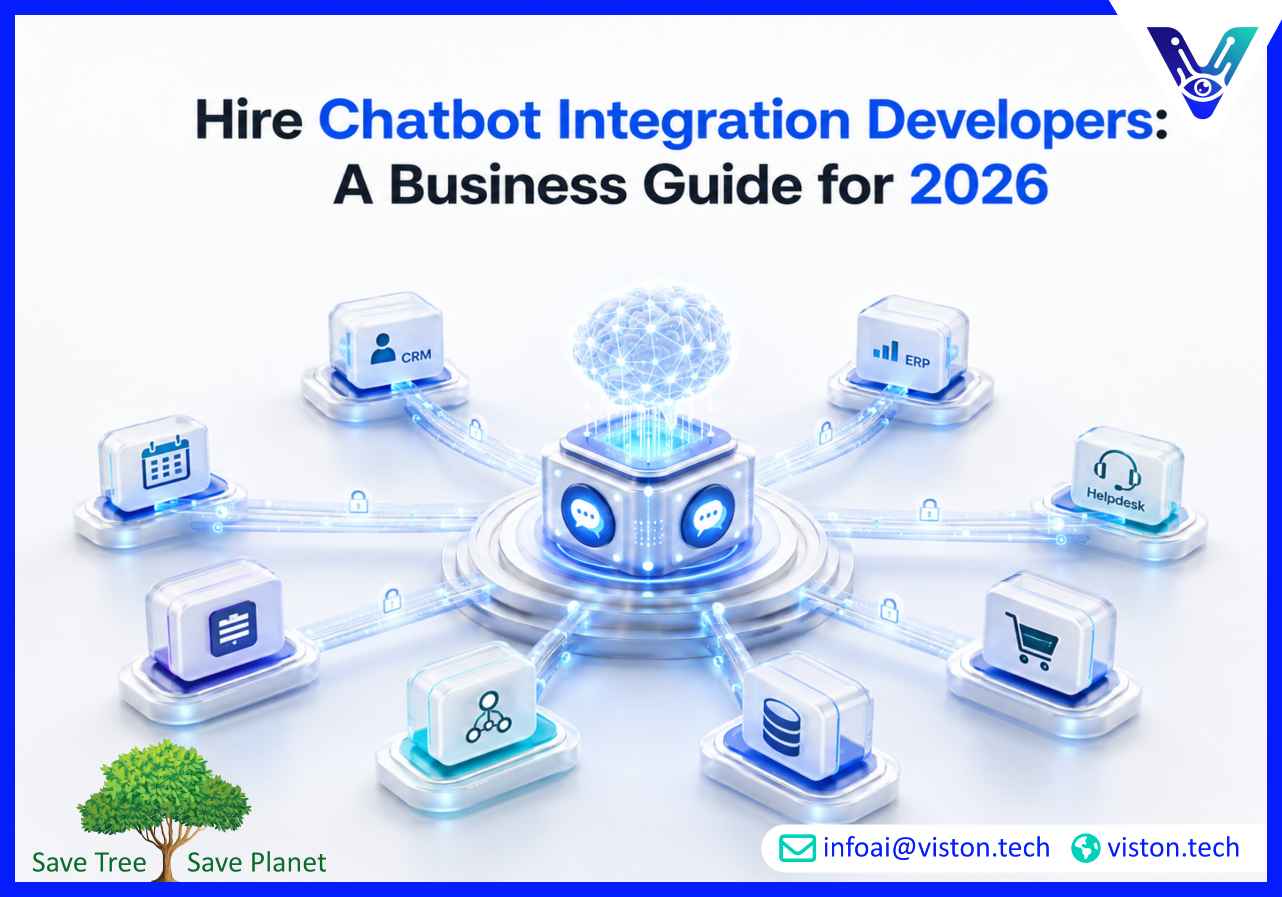
Hire Chatbot Integration Developers: A Business Guide for 2026
Businesses that hire chatbot integration developers are rarely looking for a simple website chat box. They need conversational AI connected securely to customer data, knowledge sources, operational systems, and human teams. The right developers turn a chatbot into a reliable business interface that can answer questions, complete tasks, update records, and support measurable outcomes.
Why Businesses Hire Chatbot Integration Developers
A standalone chatbot can provide basic answers, but its usefulness is limited when it cannot access current business information or complete actions. Customers expect a chatbot to recognize their situation, retrieve relevant details, and move the conversation toward a resolution without unnecessary repetition.Chatbot integration developers build the connections that make this possible. They link conversational interfaces with systems such as CRM platforms, ERP software, customer support tools, ecommerce platforms, scheduling applications, knowledge bases, payment services, internal databases, and analytics systems.
Integration turns conversations into operational workflows
Without integration, a chatbot may tell a customer how to track an order. An integrated chatbot can securely retrieve the order, confirm its current status, explain a delay, and create a support case when an exception occurs.In a sales environment, an isolated chatbot may collect a name and email address. A properly integrated solution can qualify the prospect, check account history, create or update the CRM record, assign the lead, schedule a meeting, and trigger an approved follow-up workflow.Common use cases include:
Creating and updating CRM leads, contacts, and opportunities
Retrieving order, account, subscription, or delivery information
Opening, classifying, and routing helpdesk tickets
Booking appointments and checking calendar availability
Answering questions from approved knowledge repositories
Supporting employee HR, IT, finance, and policy enquiries
Triggering notifications, approvals, and workflow automations
Transferring conversations to human agents with full context
Integration projects require broader expertise than chatbot design
A conversational interface is only one part of the solution. Developers must understand API architecture, authentication, data models, workflow rules, error handling, security controls, observability, prompt behavior, retrieval systems, and the operational processes behind each conversation.This is why businesses often hire specialist developers instead of assigning the work to a general web team. The integration layer can affect customer records, support queues, financial information, internal permissions, and downstream automations. Poor implementation may create duplicate records, expose restricted data, trigger incorrect actions, or leave customers trapped in failed conversations.
What Skilled Chatbot Integration Developers Should Deliver
Strong chatbot integration developers begin with business requirements rather than a preferred model or platform. They identify what users need to accomplish, which systems contain the required information, what actions the chatbot may perform, and when human approval is necessary.
Secure API and business-system connectivity
Developers should be able to work with REST APIs, GraphQL, webhooks, software development kits, database interfaces, middleware, and custom connectors. They must understand how to map information between systems without corrupting records or exposing unnecessary data.Authentication should be designed around least-privilege access. The chatbot must receive only the permissions required for each approved task. Secure implementations may use OAuth, scoped access tokens, role-based access controls, secret management, encryption, data masking, and audit logs.Developers should also plan for rate limits, expired credentials, unavailable services, schema changes, incomplete responses, network failures, and duplicate webhook events. A chatbot that works only when every connected service responds perfectly is not production-ready.
Knowledge grounding and retrieval
Many modern chatbots use retrieval-augmented generation to answer questions from company-approved information. Integration developers may connect the system to help centres, product documents, policy libraries, document management platforms, intranets, or structured databases.The work includes more than connecting a language model to a folder of files. Developers must design content ingestion, document parsing, indexing, metadata, permission filtering, retrieval logic, source freshness, and fallback behavior. The chatbot should distinguish between verified business information and unsupported assumptions.When information is missing, conflicting, restricted, or outdated, the safest response may be to ask a clarifying question, explain the limitation, or escalate the conversation. Reliable developers design these boundaries intentionally.
Workflow orchestration and controlled actions
In 2026, chatbot projects increasingly involve action-taking systems. A chatbot may update an account, request approval, initiate a refund review, reserve an appointment, or trigger a multi-step automation.Developers should separate low-risk actions from sensitive operations. High-impact activities may require confirmation, identity verification, transaction limits, human approval, or additional authorization. Every action should produce clear logs that show what the chatbot requested, which system responded, and whether the workflow completed successfully.
Human handover and operational visibility
Automation should not prevent users from reaching a person when the chatbot lacks confidence or the issue requires judgment. Developers should build escalation rules based on failed attempts, negative sentiment, account type, topic sensitivity, user request, or workflow errors.A strong handover includes the conversation history, detected intent, user details, retrieved records, actions already attempted, and a concise case summary. This reduces repetition and helps human teams resolve the issue faster.Monitoring should cover both conversational and technical performance. Useful measures include completion rate, fallback rate, escalation rate, response accuracy, customer satisfaction, API latency, workflow success, authentication failures, record-update accuracy, and unresolved integration errors.
How to Evaluate Developers Before Hiring
The best candidate is not necessarily the developer who can demonstrate the most visually impressive chatbot. Businesses should evaluate whether the person or team can design a secure, maintainable system around real operational requirements.
Review relevant integration experience
Ask candidates to explain projects involving systems similar to your environment. The exact brand of CRM or helpdesk is less important than their ability to discuss authentication, data mapping, workflow dependencies, failure recovery, and monitoring in practical terms.A credible developer should be able to describe how information moves from the user’s message to the language model, retrieval service, business application, and final response. They should also explain where data is stored, which components can access it, and how sensitive fields are protected.
Test architecture and troubleshooting ability
Present a realistic scenario during the technical evaluation. For example, ask how the developer would build a chatbot that checks subscription status, answers policy questions, updates a CRM record, and transfers billing disputes to a human agent.A strong answer should address:
Identity verification and access permissions
Sources of truth for subscription and policy information
API calls, field mapping, and validation
Conversation state and context management
Confidence thresholds and escalation logic
Error handling and user-facing fallback messages
Logging, testing, monitoring, and support ownership
Be cautious when a candidate focuses only on prompts or model selection. Prompt engineering is useful, but it cannot replace secure architecture, reliable data access, workflow controls, and production monitoring.
Assess responsible AI and security practices
Chatbot developers should understand risks such as prompt injection, unauthorized tool use, sensitive-data leakage, inaccurate answers, excessive permissions, malicious file content, and unverified actions. They should be prepared to apply input controls, output validation, permission-aware retrieval, action allowlists, rate limits, audit logging, and human approval where appropriate.Ask how the solution will be tested before launch. Evaluation should include expected questions, ambiguous wording, unsupported requests, adversarial prompts, restricted information, API failures, multilingual inputs, and attempts to bypass business rules.
Clarify the engagement model
Developers may be hired for a fixed project, dedicated engagement, phased implementation, or ongoing optimization. A fixed scope can work for a clearly defined integration, while a dedicated or retained team may be more suitable when the chatbot will expand across departments, languages, and systems.Confirm who owns the code, integration credentials, configuration, documentation, test assets, prompts, data pipelines, and deployment environments. The agreement should also define post-launch support, response times, change management, security responsibilities, and knowledge transfer.
Planning a Successful Chatbot Integration Project
Hiring qualified developers is important, but delivery quality also depends on the clarity of the project. Businesses should define the operational objective before development begins.
Start with a limited set of valuable use cases
Choose workflows that are frequent, measurable, and supported by reliable data. Good starting points may include lead qualification, order tracking, appointment scheduling, account guidance, FAQ resolution, ticket creation, or internal knowledge search.A narrow first phase makes it easier to validate accuracy, integration reliability, user adoption, and business value. Once the core workflows perform consistently, additional systems and actions can be introduced with less risk.
Map systems, data, and ownership
Create an inventory of the applications the chatbot must access. For each system, identify the data owner, available APIs, authentication method, rate limits, required fields, retention rules, and source-of-truth status.Businesses should also review the quality of the underlying information. A chatbot cannot reliably resolve customer questions when product documentation is outdated, CRM records are incomplete, or policies conflict across departments.
Define success before development
Project goals should be translated into measurable outcomes. A support chatbot may be expected to improve first-response time, increase self-service resolution, reduce repetitive tickets, or improve handover quality. A sales chatbot may be measured by qualified leads, meeting bookings, CRM completeness, routing accuracy, and conversion progression.Technical KPIs are equally important. Track API reliability, workflow completion, retrieval relevance, response latency, failed authentications, duplicate updates, and integration-related escalations.
Plan for continuous improvement
Chatbots operate in changing environments. APIs are updated, policies change, new products launch, customer language evolves, and knowledge sources grow. The project should therefore include monitoring, conversation review, regression testing, content governance, and a structured release process.Hiring chatbot integration developers should be viewed as the start of a managed capability rather than a one-time installation. Long-term value comes from maintaining the integrations, reviewing performance, expanding high-value use cases, and correcting weaknesses before they affect users at scale.
How Viston AI Supports Businesses Hiring Chatbot Integration Developers
Viston AI is directly relevant to organizations that need to hire chatbot integration developers because AI Chatbot Integration is part of its published service portfolio. Its capabilities focus on connecting conversational AI with existing business systems through API-first architecture, including CRM, ERP, databases, service platforms, knowledge environments, and workflow tools.This integration-led approach supports businesses that require more than a scripted chatbot. Viston AI can help connect customer or employee conversations with real-time data, structured record updates, automated processes, contextual knowledge retrieval, and human escalation. Its broader capabilities in AI chatbot development, enterprise chatbots, natural language processing, multilingual support, voice-enabled assistants, automation workflows, and model monitoring can also support more complex deployments.The practical value lies in treating the chatbot as part of the organization’s operating environment. That includes assessing integration requirements, designing secure data flows, implementing connectors, controlling chatbot actions, testing failure scenarios, and tracking performance after deployment. For businesses planning customer support, sales, internal service, knowledge-access, or workflow automation use cases, Viston AI offers a relevant combination of chatbot and business-system integration expertise.This makes the company suitable for projects where scalability, security, system compatibility, measurable workflows, and ongoing optimization are central evaluation criteria.
Frequently Asked Questions
What does a chatbot integration developer do?
A chatbot integration developer connects conversational AI with systems such as CRM, ERP, helpdesk, ecommerce, databases, calendars, knowledge bases, and automation platforms. The developer also handles authentication, data mapping, workflow logic, security, error management, testing, and monitoring.
When should a business hire chatbot integration developers?
Hire specialists when the chatbot must retrieve live information, update business records, trigger workflows, support several channels, use company knowledge, authenticate users, or transfer conversations to human teams. Basic no-code tools may be insufficient for these requirements.
What skills should chatbot integration developers have?
Look for experience with APIs, webhooks, authentication, databases, cloud environments, language models, retrieval-augmented generation, workflow automation, security controls, observability, conversation design, testing, and the business platforms used by your organization.
How much does it cost to hire chatbot integration developers?
Cost depends on integration complexity, number of systems, chatbot channels, data quality, security requirements, custom workflow logic, testing scope, deployment model, and support needs. A focused integration with one system will cost less than an enterprise chatbot spanning multiple departments and platforms.
How long does chatbot integration take?
A limited integration may be delivered relatively quickly when APIs, data, and requirements are clear. Multi-system projects take longer because they require architecture planning, permissions, data preparation, workflow development, security testing, user acceptance testing, and production monitoring.
Can Viston AI provide chatbot integration developers?
Viston AI offers AI Chatbot Integration and related chatbot development, enterprise AI, NLP, multilingual, voice, workflow automation, and business-system integration capabilities. These services are relevant to organizations seeking specialists who can connect conversational AI with operational platforms and data.
Conclusion
Businesses should hire chatbot integration developers when conversational AI must interact reliably with real data, systems, and workflows. The right developers combine chatbot expertise with API engineering, security, retrieval architecture, automation, testing, monitoring, and operational understanding. Buyers should evaluate candidates on architecture quality, integration experience, risk controls, documentation, and post-launch support rather than chatbot appearance alone. Viston AI’s AI Chatbot Integration capabilities make it a relevant specialist for organizations seeking connected, scalable, and business-focused chatbot solutions that move beyond simple question-and-answer automation.