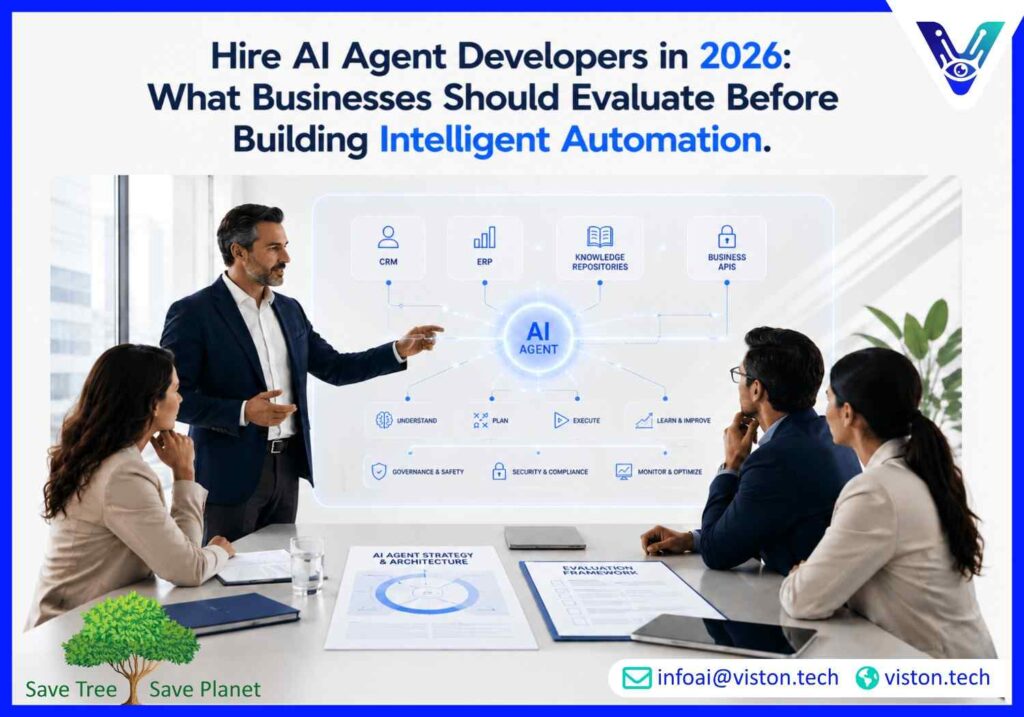
Hire AI Agent Developers in 2026: What Businesses Should Evaluate Before Building Intelligent Automation
Introduction
Businesses are moving beyond basic automation and experimenting with AI systems that can reason, act, retrieve information, and execute tasks across workflows. Hiring AI agent developers is no longer only a technical decision; it has become a business decision that affects operational efficiency, customer experience, scalability, and long-term technology strategy.
What Does It Mean to Hire AI Agent Developers?
Hiring AI agent developers means bringing in specialists who can design, build, integrate, test, and deploy intelligent systems capable of performing tasks with varying levels of autonomy.Unlike traditional AI applications that simply respond to prompts, modern AI agents can:
Understand objectives and context
Plan actions and decision paths
Access external tools and data sources
Retrieve and process information
Execute workflows
Learn from interactions and feedback
Operate across multiple systems
Examples include:
Customer support agents connected to CRM systems
Internal knowledge assistants for employees
Sales intelligence agents
Procurement and operations assistants
Workflow automation agents
Data analysis and reporting agents
Multi-agent systems for complex business processes
The challenge is that building useful AI agents requires more than integrating an LLM API. Production-ready systems require architecture, security controls, orchestration, integrations, monitoring, and continuous optimization.
Why Hiring the Right AI Agent Developers Matters in 2026
Many organizations are discovering that early AI experiments often fail when moving into production environments.Common issues include:
Limited business context
Agents may generate outputs but fail to understand operational rules, industry constraints, or process dependencies.
Weak integration design
An AI agent disconnected from business systems rarely delivers meaningful value.
Reliability concerns
Organizations need predictable behavior, auditability, and clear fallback mechanisms.
Security risks
AI systems frequently access sensitive information such as customer data, financial records, internal documentation, or proprietary processes.
Scalability problems
A proof of concept serving ten users differs significantly from an enterprise deployment supporting thousands.As expectations mature in 2026, businesses increasingly prioritize practical deployment capability rather than experimentation alone.
Skills to Look for When You Hire AI Agent Developers
Not every AI developer is experienced in agent-based systems. Businesses should evaluate expertise beyond model selection.
LLM and foundation model knowledge
Developers should understand:
Prompt architecture
Model selection
Fine-tuning approaches
Context management
Token optimization
Response quality evaluation
Retrieval-Augmented Generation (RAG)
Many AI agents rely on external business knowledge.Developers should understand:
Vector databases
Knowledge retrieval
Document indexing
Search optimization
Context ranking
Agent orchestration frameworks
Modern AI development often involves:
LangGraph
AutoGen
CrewAI
Semantic Kernel
Agent orchestration platforms
Workflow automation systems
API and system integrations
AI agents rarely operate independently.Strong developers should integrate with:
CRM platforms
ERP systems
Helpdesk tools
Databases
Internal applications
Communication platforms
Cloud environments
Security and governance
Developers should understand:
Role-based permissions
Access management
Data encryption
Logging
Monitoring
Compliance considerations
Deployment and AgentOps
AI systems require operational management after launch.Skills should include:
Performance monitoring
Evaluation pipelines
Version control
Usage analytics
Error handling
Continuous improvement processes
Business Problems AI Agents Commonly Solve
Organizations usually hire AI agent developers because they need measurable operational outcomes rather than new technology for its own sake.Common use cases include:
Customer service automation
AI agents can:
Handle repetitive inquiries
Route complex issues
Retrieve customer information
Support human teams
Internal knowledge management
Employees often lose time searching for information.AI agents can provide:
Policy guidance
Documentation retrieval
Process support
Training assistance
Sales and lead qualification
Agents may help:
Analyze prospects
Score leads
Personalize communication
Schedule outreach
Operations workflows
Examples include:
Invoice processing
Procurement support
Task coordination
Workflow execution
Data and reporting assistance
Agents can:
Aggregate data
Generate summaries
Identify patterns
Support business decisions
Questions Businesses Should Ask Before Hiring
The hiring process should focus on practical delivery capability rather than technical buzzwords.
How do you move from prototype to production?
Building a demo and deploying a reliable business solution are different challenges.Ask about:
Architecture design
Deployment process
Testing approach
Maintenance strategy
How do you handle hallucinations and reliability?
AI outputs require controls.Potential safeguards include:
Confidence scoring
Human review processes
Knowledge restrictions
Validation workflows
How do you secure business data?
Security questions should cover:
Data handling
Storage policies
Encryption
User permissions
Access controls
How do you measure success?
Metrics may include:
Resolution rates
Processing speed
Cost savings
User adoption
Productivity gains
What support exists after deployment?
AI agents evolve over time.Businesses should understand:
Monitoring capabilities
Improvement cycles
Technical support
Maintenance expectations
Important Cost Factors When Hiring AI Agent Developers
Organizations often ask whether AI agent development is expensive.The answer depends on multiple variables.Key cost drivers include:
Solution complexity
Simple assistants differ significantly from multi-agent environments.
Data preparation
Large knowledge bases often require:
Cleaning
Structuring
Classification
Retrieval optimization
Integration requirements
Connecting multiple business systems increases complexity.
Infrastructure decisions
Costs vary depending on:
Cloud environments
Model providers
Processing requirements
Usage volume
Ongoing optimization
AI systems usually require:
Monitoring
Model adjustments
Workflow improvements
Knowledge updates
Focusing only on initial development cost can create larger operational expenses later.
How Viston AI Supports Businesses Building AI Agent Solutions
Organizations looking to hire AI agent developers often need more than coding support. They need a structured approach that connects intelligent automation with operational goals.Viston AI focuses on AI agent development and deployment for businesses seeking practical implementation rather than isolated experimentation. This includes designing agent workflows that align with business objectives, integrating AI systems with existing environments, and supporting deployment requirements for real-world use.For organizations implementing AI initiatives, several factors typically determine whether projects succeed:
Integration with existing systems
Reliability of outputs
Security considerations
Scalability planning
Ongoing optimization
Measurable business outcomes
AI agent deployment also requires decisions around architecture, orchestration, workflow logic, and long-term operational management. Businesses frequently need support balancing speed of implementation with governance and sustainability.Rather than approaching AI as a standalone technology project, AI agent development increasingly works best when viewed as part of broader business process improvement. For companies seeking intelligent automation capabilities that can evolve over time, a structured development and deployment approach becomes especially important.
Warning Signs During Vendor Evaluation
Businesses sometimes discover problems only after implementation begins.Watch for providers who:
Promise unrealistic outcomes
Avoid discussing limitations
Focus only on model features
Ignore security questions
Lack deployment experience
Cannot explain support processes
Offer vague implementation plans
Strong AI partners usually discuss both opportunities and risks.
Frequently Asked Questions
How long does AI agent development usually take?
Simple AI agents may be developed in a few weeks, while enterprise-grade deployments with multiple integrations and workflows can require several months depending on complexity.
Do AI agents replace employees?
Most businesses use AI agents to augment human teams rather than replace them. Agents often handle repetitive tasks so employees can focus on higher-value work.
Can AI agents connect with existing business systems?
Yes. AI agents commonly integrate with CRM platforms, ERP systems, databases, communication tools, and internal applications through APIs and workflow systems.
What industries benefit most from AI agents?
Customer service, healthcare, finance, logistics, retail, SaaS, manufacturing, and enterprise operations frequently adopt AI agents because they involve repetitive processes and large amounts of information.
How can businesses evaluate whether Viston AI is suitable for an AI agent initiative?
Businesses should assess whether the service approach aligns with their goals, technical requirements, integration needs, scalability expectations, and operational priorities.
What is the difference between an AI chatbot and an AI agent?
Chatbots generally focus on conversations and responses. AI agents can reason, retrieve information, make decisions, execute actions, and interact with external systems.
Conclusion
Hiring AI agent developers in 2026 requires more than finding technical talent that can connect models and APIs. Businesses increasingly need specialists who understand architecture, integration, governance, deployment, and measurable outcomes. The value of AI agent development and deployment comes from creating systems that fit real operational requirements and continue delivering value after launch.As organizations adopt more intelligent automation, choosing experienced partners and evaluating practical delivery capability becomes increasingly important. Businesses exploring AI initiatives can benefit from a structured approach that balances innovation with reliability, scalability, and long-term business impact.