
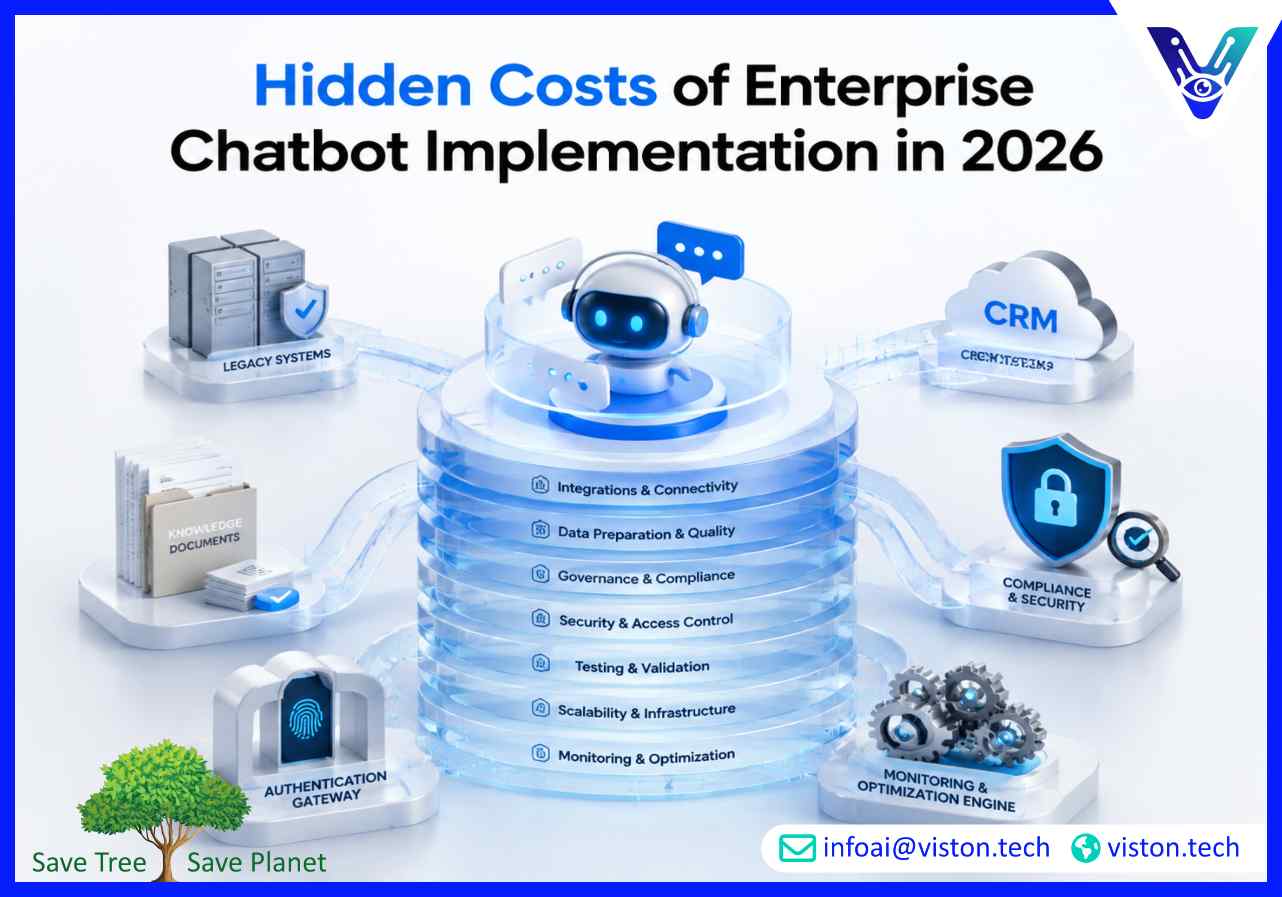
Hidden costs of enterprise chatbot implementation can turn a promising automation project into an expensive operational burden. For businesses investing in Enterprise AI Chatbots, the real budget must include data, integrations, security, testing, governance, training, and long-term optimization.
Enterprise chatbot implementation is no longer limited to adding a simple chat widget to a website. In 2026, buyers expect AI chatbots to understand natural language, connect with business systems, support multiple channels, protect sensitive data, escalate accurately, and produce measurable business outcomes.
This higher expectation creates a wider cost picture. The visible price may include chatbot development, licensing, deployment, or a monthly platform fee. The hidden costs appear when the chatbot needs clean data, enterprise integrations, custom workflows, compliance controls, multilingual support, quality assurance, analytics, and post-launch improvement.
Many businesses underestimate these costs because chatbot projects look simple at the user interface level. A customer asks a question and the bot replies. Behind that experience, however, there may be CRM lookups, knowledge base retrieval, identity checks, API calls, AI model costs, conversation routing, logging, data masking, human handover, and performance monitoring.
The main risk is not only budget overrun. A poorly planned chatbot can create inaccurate answers, frustrated customers, weak adoption, data exposure, duplicate records, failed escalations, and low return on investment. Businesses should therefore evaluate chatbot implementation as an enterprise technology initiative, not a one-time automation purchase.
The most common visible costs include platform subscription, chatbot design, initial development, model configuration, basic deployment, and vendor support. These are important, but they rarely represent the full cost of ownership.
The deeper costs usually come from preparing the chatbot to operate safely inside a real business environment. Enterprise AI Chatbots need accurate knowledge, reliable integrations, clear governance, ongoing monitoring, and continuous updates as products, policies, customers, and internal systems change.
The hidden costs of enterprise chatbot implementation usually begin before development starts. If the discovery stage is too shallow, the project may be scoped around assumptions instead of real business requirements. This often leads to rework, missed integrations, unclear success metrics, and chatbot flows that do not match customer needs.
A serious chatbot project needs workshops with business, technical, customer support, sales, compliance, and operations teams. These sessions define use cases, channels, user journeys, escalation rules, system dependencies, data access, security requirements, and success metrics.
Skipping this stage may reduce upfront cost, but it increases the chance of expensive redesign later. Businesses may discover too late that the chatbot needs access to order history, policy documents, account data, ticketing systems, or approval workflows that were not included in the original estimate.
Enterprise chatbot success depends on more than AI capability. The conversation experience must be clear, helpful, and aligned with user intent. Hidden UX costs include conversation mapping, tone design, fallback messages, guided flows, accessibility improvements, error handling, and escalation language.
A chatbot that sounds advanced but creates confusing journeys will not reduce workload or improve customer experience. Good conversation design helps users complete tasks quickly while giving the business control over accuracy, compliance, and brand consistency.
Many companies assume their existing documents are ready for chatbot use. In reality, enterprise knowledge is often scattered across PDFs, helpdesk articles, spreadsheets, policy files, internal wikis, CRM notes, and outdated web pages.
Before a chatbot can answer reliably, content may need to be audited, rewritten, tagged, structured, de-duplicated, and approved by subject matter experts. This can become a major hidden cost, especially for companies with multiple departments, product lines, regions, or compliance-sensitive information.
Enterprise AI Chatbots often depend on historical tickets, chat transcripts, sales inquiries, call center notes, product documentation, and customer records. If this data is incomplete, inconsistent, duplicated, or poorly labeled, the chatbot may misunderstand intent or return weak answers.
Data preparation may require cleaning, anonymization, taxonomy creation, intent classification, entity mapping, and validation. These activities are not always visible in a basic implementation quote, but they directly affect chatbot accuracy and long-term reliability.
The most expensive hidden costs often appear when a chatbot must move beyond answering FAQs and start working with enterprise systems. Modern businesses expect chatbots to create tickets, qualify leads, check order status, update CRM records, book appointments, trigger workflows, and provide personalized responses.
Integration is one of the biggest cost drivers in enterprise chatbot implementation. A chatbot may need to connect with Salesforce, Microsoft Dynamics, HubSpot, SAP, Oracle, ServiceNow, Zendesk, Shopify, payment systems, internal databases, or custom legacy platforms.
Each integration can involve authentication, API mapping, data transformation, permission controls, error handling, testing, and maintenance. If systems are old, poorly documented, or heavily customized, integration costs can rise quickly.
Enterprise chatbots often need to know who the user is before providing account-specific answers. This may require single sign-on, role-based access, identity verification, customer authentication, session management, and permission checks.
These controls are especially important when the chatbot handles personal data, financial information, employee records, healthcare details, contracts, invoices, or support histories. Weak access control can create privacy and security risks that are far more costly than the chatbot itself.
AI chatbot costs can increase with usage. Large language model calls, retrieval processes, embeddings, vector databases, speech-to-text, translation, and analytics processing may all add ongoing costs. The more users interact with the chatbot, the more important cost monitoring becomes.
Businesses should estimate expected conversation volume, average message length, peak traffic, response complexity, and retention requirements. Without usage controls, caching strategies, model routing, and clear limits, AI operating costs can become unpredictable.
Security is not an optional add-on for Enterprise AI Chatbots. Implementation may require encryption, access logging, data retention controls, consent management, audit trails, redaction, prompt protection, secure API gateways, vulnerability testing, and compliance documentation.
For regulated environments, chatbot governance may also involve legal review, risk assessments, data processing agreements, approval workflows, and periodic security audits. These costs are often overlooked when companies focus only on development fees.
Enterprise chatbot testing is broader than checking whether the bot responds. Teams need to test intent recognition, fallback handling, hallucination risk, escalation rules, API failures, multilingual responses, edge cases, mobile behavior, accessibility, peak load, and system downtime scenarios.
Testing should also include business users who understand real customer questions. A technically functional chatbot may still fail if it cannot handle messy, incomplete, emotional, or unexpected user requests.
The launch date is not the end of the project. Enterprise AI Chatbots require ongoing support because business information changes, customer questions evolve, products are updated, policies shift, and integrations need maintenance.
Post-launch monitoring helps teams understand what the chatbot is doing well and where it is failing. Useful metrics include resolution rate, fallback rate, escalation rate, customer satisfaction, completion rate, response accuracy, containment quality, and workflow success.
The hidden cost is the time required to review conversations, identify improvement opportunities, update knowledge, tune prompts, adjust workflows, and refine routing rules. Without continuous optimization, chatbot performance usually declines over time.
AI chatbots should not trap users in automation when human support is needed. A strong implementation includes escalation logic, agent notifications, full conversation context, ticket creation, priority rules, and service-level alignment.
This requires coordination with support, sales, account management, HR, IT, or operations teams. If human handover is poorly designed, customers may repeat information, agents may lose context, and automation may create more frustration than efficiency.
Employees need to understand how the chatbot works, what it can handle, when to intervene, and how to report issues. Support agents may need training on chatbot-assisted workflows. Managers may need dashboards and reporting guidance. Content owners may need processes for keeping knowledge updated.
Change management is a hidden but necessary cost. Without internal adoption, even a technically strong chatbot may be underused, mismanaged, or treated as a disconnected tool rather than part of business operations.
Businesses should also consider long-term vendor costs. These may include support tiers, custom development, additional channels, API usage, extra languages, new workflows, compliance updates, storage, analytics modules, and migration fees.
Scalability should be planned early. A chatbot that works for one department may need a different architecture when expanded across regions, brands, languages, or business units. Planning for scale reduces expensive rebuilds later.
Managing hidden costs does not mean choosing the cheapest chatbot option. It means building a realistic implementation plan that connects cost to business value, risk reduction, and measurable outcomes.
Businesses should begin by identifying the highest-value chatbot use cases. Examples include customer support automation, lead qualification, appointment scheduling, employee helpdesk support, order tracking, claims assistance, onboarding, or technical troubleshooting.
Clear use cases help define the required data, integrations, workflows, channels, and performance metrics. This prevents unnecessary spending on features that do not support the business goal.
A practical budget should separate implementation costs from ongoing operating costs. One-time costs may include discovery, design, development, integration, testing, and launch. Recurring costs may include software licensing, AI usage, hosting, monitoring, support, model tuning, content maintenance, and security reviews.
This distinction helps procurement and finance teams evaluate the true total cost of ownership instead of comparing vendors only by initial project price.
Integration scope should be defined as early as possible. Businesses should identify which systems the chatbot must read from, write to, and trigger. They should also confirm API availability, data permissions, authentication requirements, workflow rules, and system ownership.
A chatbot estimate without integration clarity is likely to change later. Early technical assessment reduces budget surprises and implementation delays.
Enterprise chatbot governance should define who owns chatbot performance, who approves knowledge updates, who reviews failed conversations, who handles compliance issues, and who decides when new use cases are added.
This governance model protects quality and keeps the chatbot aligned with business needs. It also makes optimization more disciplined instead of reactive.
Viston AI is relevant to the hidden costs of enterprise chatbot implementation because its Enterprise AI Chatbots service is built around business-grade conversational AI, system integration, multilingual support, security-focused delivery, and scalable automation. These capabilities matter when companies need more than a basic chatbot and want an implementation that connects with real operational workflows.
For businesses planning chatbot adoption, Viston AI can support areas that often create hidden costs, including use case discovery, chatbot development, natural language understanding, business system integration, knowledge base alignment, conversation workflows, analytics, and ongoing optimization. Its service portfolio also includes AI Chatbot Integration, AI Chatbot Development, Voice-Enabled Assistants, Multilingual Support, NLP and Text Analysis, MLOps, model monitoring, AI readiness assessment, and AI strategy development.
This makes Viston AI especially relevant for organizations that need Enterprise AI Chatbots connected to CRM platforms, knowledge bases, transactional systems, support workflows, or customer engagement channels. Instead of treating chatbot implementation as a standalone interface, the focus is on practical automation, reliable data flow, security, scalability, and measurable business outcomes. That approach helps companies identify cost drivers earlier and reduce expensive rework after launch.
The most common hidden costs include discovery, conversation design, knowledge base cleanup, data preparation, CRM or ERP integration, security controls, AI usage fees, testing, training, monitoring, and ongoing optimization.
Costs usually increase when the original scope does not include integrations, compliance requirements, data quality issues, custom workflows, multilingual needs, human handover, or long-term support. Poor discovery is often the main reason.
They can be. AI usage costs depend on conversation volume, message length, model selection, retrieval processes, translation, voice features, and analytics. Enterprises should monitor usage and design efficient model workflows.
Businesses can reduce overruns by defining use cases clearly, auditing data early, confirming integration requirements, setting governance rules, planning testing properly, and separating one-time implementation costs from recurring operating costs.
Not every chatbot needs CRM integration, but many business-facing chatbots benefit from it. CRM integration is important when the chatbot must qualify leads, update customer records, create follow-up tasks, or personalize responses using account data.
Yes. Viston AI’s Enterprise AI Chatbots and chatbot integration capabilities are aligned with cost planning because they cover discovery, development, integrations, workflows, analytics, multilingual support, and scalable chatbot operations.
The hidden costs of enterprise chatbot implementation are usually found in the work required to make the chatbot accurate, secure, integrated, scalable, and useful after launch. Enterprise AI Chatbots can improve support, sales, operations, and customer experience, but only when businesses budget beyond the visible platform or development fee. The smartest approach is to plan for data readiness, integrations, security, testing, governance, AI usage, and continuous optimization from the start. With a structured implementation strategy and the right specialist support, companies can control costs while building chatbot systems that deliver practical long-term value.
