
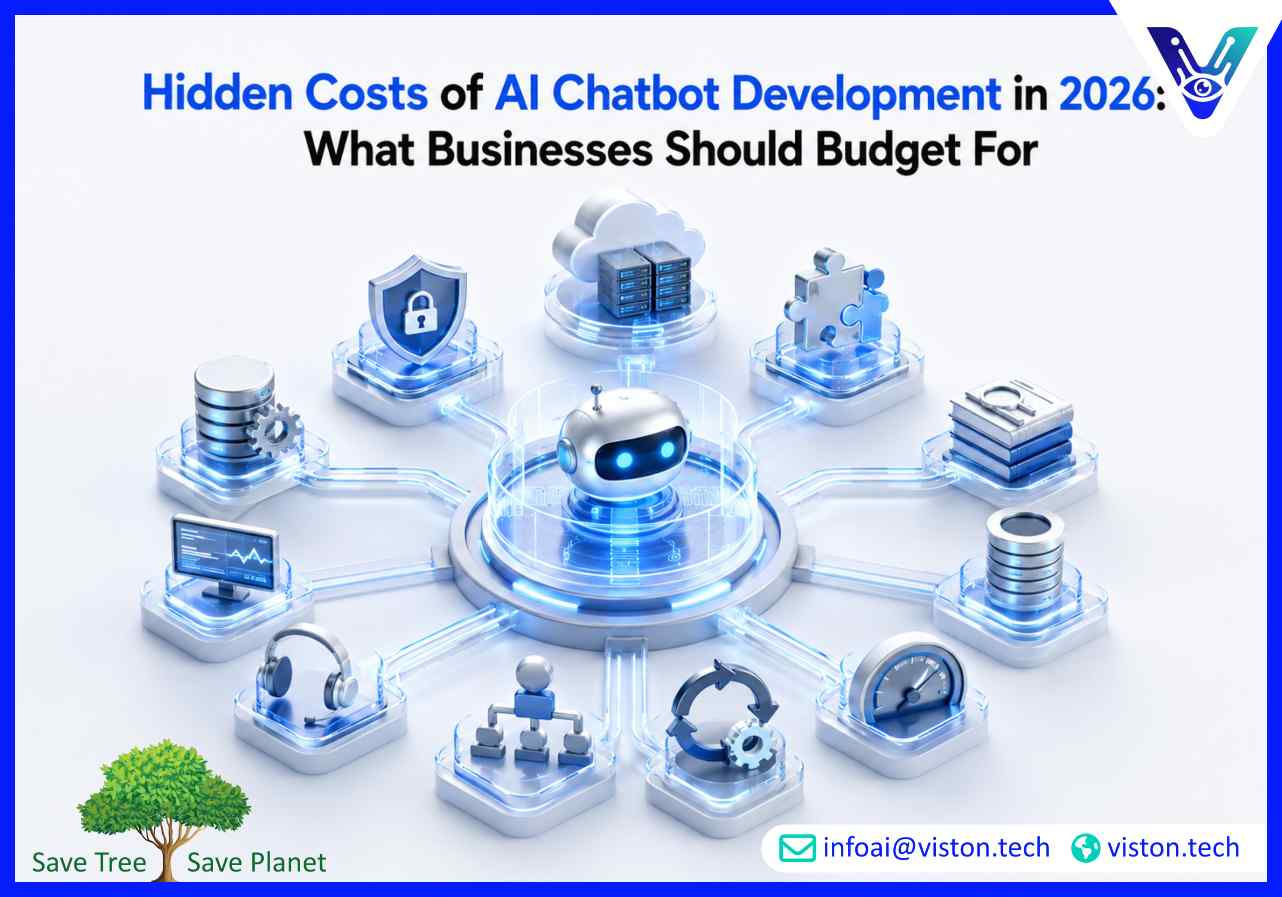
Hidden costs of AI chatbot development can turn a promising automation project into an expensive operational burden. In 2026, businesses need to look beyond the initial build price and understand the real costs behind strategy, data, integrations, compliance, testing, support, optimization, and long-term AI performance.
The visible cost of AI chatbot development usually includes design, development, model setup, deployment, and basic testing. However, the total investment often extends far beyond the first proposal. Hidden costs are the expenses that appear during discovery, implementation, scaling, maintenance, and real-world usage.
These costs are not always caused by poor planning. In many cases, they come from the nature of conversational AI itself. A chatbot is not just a user interface. It is a connected system that may depend on business data, CRM platforms, helpdesk tools, APIs, cloud infrastructure, analytics, security controls, human escalation workflows, and continuous model improvement.
For business owners, procurement teams, product leaders, and technology decision-makers, the real question is not simply, “How much does a chatbot cost?” A better question is, “What must be included to make the chatbot reliable, secure, useful, scalable, and commercially valuable?”
Hidden costs often appear when a company starts with a limited chatbot scope and later realizes the system needs better training data, more accurate intent recognition, multilingual support, advanced reporting, integration with live business systems, human handoff, compliance reviews, or ongoing prompt and knowledge-base optimization.
In 2026, AI chatbot development has become more sophisticated because buyers expect more than scripted responses. They expect conversational AI that understands context, answers accurately, protects sensitive data, supports customers across channels, and improves business operations. That higher expectation naturally creates cost areas that must be planned from the beginning.
Modern AI chatbot development involves multiple technical and operational layers. Earlier chatbots could often be built using predefined decision trees and basic FAQ flows. Today, companies want AI-powered assistants that use large language models, retrieval-augmented generation, business-specific knowledge bases, CRM data, automation workflows, and real-time integrations.
This creates a more powerful chatbot experience, but it also increases planning requirements. The chatbot must be designed to understand user intent, retrieve the right information, produce controlled responses, avoid hallucinations, escalate complex cases, and meet business rules. Each of these capabilities can add cost if it was not included in the original scope.
Many AI chatbots rely on third-party AI models or hosted large language model infrastructure. Businesses may focus on development fees but overlook ongoing usage costs. These can include model API calls, token usage, embedding generation, vector database storage, message volume, data retrieval, and cloud hosting.
A small chatbot with low traffic may have manageable usage costs. An enterprise chatbot handling thousands of daily conversations, long user messages, document retrieval, or multi-step reasoning may require more careful cost control. Without monitoring, AI usage can increase quickly as adoption grows.
A chatbot is only as useful as the information it can access. Businesses often underestimate the time required to prepare product information, policy documents, support articles, pricing rules, service details, internal SOPs, and customer-facing FAQs.
Data preparation may involve cleaning outdated content, removing duplicates, structuring documents, tagging information, defining access rules, and creating approved answer guidelines. For regulated or complex industries, content may also need review by legal, compliance, technical, or operations teams before it can be used safely.
A chatbot that only answers general questions is simpler to build. A chatbot that checks order status, updates CRM records, books appointments, creates tickets, verifies users, sends notifications, or triggers workflows requires integration with business systems.
Integration work can include APIs, authentication, middleware, error handling, logging, database access, and testing across different systems. If a company uses legacy software or poorly documented tools, integration costs may rise because developers need extra time to build reliable connections.
In 2026, security is no longer optional in AI chatbot development. Chatbots may handle customer names, email addresses, account details, payment-related questions, medical information, employee records, or confidential business data. This makes security planning a core cost factor.
Businesses may need secure data storage, encryption, access control, audit logs, role-based permissions, privacy reviews, consent flows, retention policies, and compliance alignment. These requirements vary by industry and market, but ignoring them can create much larger risks after launch.
Many hidden costs appear before the chatbot is even released. These early-stage costs are often missed because the project is treated as a software build rather than a business transformation initiative. A reliable AI chatbot requires strategy, conversation design, governance, technical planning, and operational readiness.
Strong AI chatbot development starts with clear use cases. Businesses need to define what the chatbot should handle, what it should avoid, when it should escalate, which users it serves, and what outcome it should support. Without this planning, development teams may build features that look impressive but do not solve the right business problem.
Discovery may include stakeholder interviews, journey mapping, support ticket analysis, customer query clustering, process review, system audits, and KPI definition. This work may feel like an extra cost, but it helps prevent expensive redesign later.
Conversational AI is not only about the model. The user experience matters. The chatbot needs clear greetings, fallback responses, clarification flows, escalation logic, tone guidelines, answer boundaries, and channel-specific behavior.
A chatbot on a website may need a different flow from one used in WhatsApp, Slack, Microsoft Teams, mobile apps, or customer portals. If conversation design is ignored, users may abandon the chatbot even if the underlying AI is technically capable.
AI chatbot testing is more complex than traditional software testing because users can ask the same question in many different ways. Testing must cover expected questions, unusual wording, incomplete queries, multilingual inputs, sensitive topics, incorrect assumptions, and edge cases.
Quality assurance may involve intent testing, response accuracy checks, hallucination testing, integration testing, load testing, security testing, and human review. These activities can add cost, but they are essential for reducing business risk before launch.
Even the best chatbot should not handle every request alone. Businesses need clear human escalation workflows for complaints, account issues, technical problems, urgent cases, and high-value sales conversations.
This may require routing rules, agent dashboards, CRM updates, ticket creation, notification systems, and staff training. If human handoff is not planned early, the chatbot may frustrate customers instead of improving service.
The biggest misconception about AI chatbot development is that the project ends at launch. In reality, launch is the beginning of performance management. Once real users interact with the chatbot, businesses discover new questions, gaps in documentation, integration issues, and opportunities for improvement.
Business information changes. Products evolve, pricing changes, policies are updated, campaigns launch, new services are added, and regulations shift. If the chatbot knowledge base is not maintained, it can deliver outdated or inaccurate answers.
Post-launch maintenance may include content updates, retraining, prompt refinement, retrieval tuning, workflow changes, and regular testing. These costs should be part of the long-term budget, not treated as unexpected extras.
A chatbot should be measured like a business system. Important metrics may include containment rate, escalation rate, response accuracy, user satisfaction, lead conversion, average handling time, unanswered questions, failed intents, and cost per conversation.
Analytics setup may require dashboards, event tracking, reporting pipelines, CRM attribution, and feedback loops. Without reporting, businesses may not know whether the chatbot is reducing workload, improving customer experience, or creating hidden friction.
As chatbot usage grows, infrastructure needs may change. Higher traffic can increase cloud hosting costs, API usage, database queries, vector search volume, and monitoring requirements. Businesses may also need better uptime planning, rate-limit management, backup systems, and disaster recovery.
Scaling costs are a positive sign when the chatbot is delivering value, but they still need to be forecasted. A chatbot built for a pilot may not be ready for enterprise-wide deployment without architecture upgrades.
AI governance is becoming a standard expectation for serious chatbot projects. Businesses need rules for approved data sources, answer review, user privacy, model behavior, escalation, auditability, and accountability.
Governance may involve internal policies, periodic audits, stakeholder reviews, compliance documentation, and risk controls. These costs are especially important for businesses in finance, healthcare, insurance, legal services, education, enterprise SaaS, retail, and other data-sensitive industries.
Businesses can control hidden costs by treating AI chatbot development as a lifecycle investment rather than a one-time software purchase. The goal is not to choose the cheapest proposal. The goal is to understand what is included, what is excluded, and what may become necessary as the chatbot matures.
A realistic chatbot budget should include discovery, technical architecture, user experience design, model selection, data preparation, integrations, security, testing, deployment, monitoring, optimization, and support. Each cost area should be connected to a business outcome, such as reducing repetitive support tickets, improving lead qualification, shortening response times, or helping employees access information faster.
Before selecting a provider, businesses should ask practical questions:
Clear answers to these questions help buyers compare AI chatbot development proposals more accurately. A lower upfront quote may become more expensive if it excludes integration, testing, analytics, support, or optimization. A higher-quality proposal may cost more initially but reduce rework, operational disruption, and long-term risk.
For most businesses, the best approach is to start with a focused, high-value use case. This could be customer support automation, lead qualification, employee helpdesk support, appointment booking, order tracking, onboarding assistance, or internal knowledge retrieval. Once the first use case proves value, the chatbot can be expanded across more workflows and channels.
Viston AI is relevant to this topic because its service offering includes AI Chatbot Development, Enterprise AI Chatbots, AI Chatbot Integration, Voice-Enabled AI Assistants, Multilingual AI Chatbot Support, NLP and Text Analysis, Custom AI Solution Development, AI Automation and Workflow Bots, and MLOps and model monitoring. These capabilities directly connect to the hidden cost areas businesses need to understand before investing in conversational AI.
For companies evaluating AI chatbot development, Viston AI can support the practical work behind a reliable chatbot: use case planning, conversational AI architecture, integration with business systems, workflow automation, language understanding, deployment planning, and ongoing optimization. This matters because many chatbot costs are not caused by the chat interface itself, but by the data, systems, processes, and governance required to make the chatbot useful in real operations.
Viston AI’s broader AI and automation focus makes its offering relevant for organizations that want chatbots connected to business outcomes rather than isolated FAQ tools. For customer service, sales, HR, operations, e-commerce, finance, healthcare, manufacturing, and technology support use cases, the value comes from building a chatbot that can answer accurately, trigger actions, escalate when needed, and improve over time.
By approaching chatbot development as a complete AI system, Viston AI helps businesses think through long-term costs such as integrations, monitoring, model performance, security, scalability, and support before those costs become late-stage surprises.
The most common hidden costs include data preparation, AI model usage, cloud hosting, third-party tools, system integrations, security controls, compliance review, testing, analytics, ongoing maintenance, and post-launch optimization.
AI chatbot development usually costs more because it involves natural language understanding, large language models, business-specific knowledge, integrations, performance monitoring, and more advanced testing. A basic chatbot may follow scripts, while an AI chatbot needs deeper architecture and governance.
Businesses can reduce unexpected costs by defining use cases clearly, auditing data early, documenting integration needs, setting accuracy expectations, planning human escalation, estimating AI usage costs, and including post-launch support in the original budget.
Not always. Some providers include limited usage during testing or launch, while others bill AI model usage separately. Businesses should ask how token usage, API calls, embeddings, vector storage, and traffic growth are priced.
Yes. Viston AI provides AI Chatbot Development and related capabilities such as chatbot integration, enterprise chatbot solutions, multilingual support, voice-enabled assistants, NLP, automation workflows, and model monitoring for businesses that need scalable conversational AI systems.
Yes. Ongoing maintenance is important because business information changes, user behavior evolves, and chatbot performance needs regular review. Maintenance helps improve accuracy, update knowledge, fix issues, and protect long-term ROI.
The hidden costs of AI chatbot development are usually tied to the work required to make the chatbot dependable in real business environments. Data quality, integrations, security, testing, AI usage, analytics, maintenance, and governance all influence the true cost of ownership. In 2026, businesses should budget for the full lifecycle of AI Chatbot Development, not just the initial build. A well-planned chatbot can reduce repetitive work, improve customer experience, and support scalable operations, but only when the real cost drivers are understood early. Viston AI is a relevant specialist for organizations that want chatbot development connected to practical automation, integration, and long-term performance.
