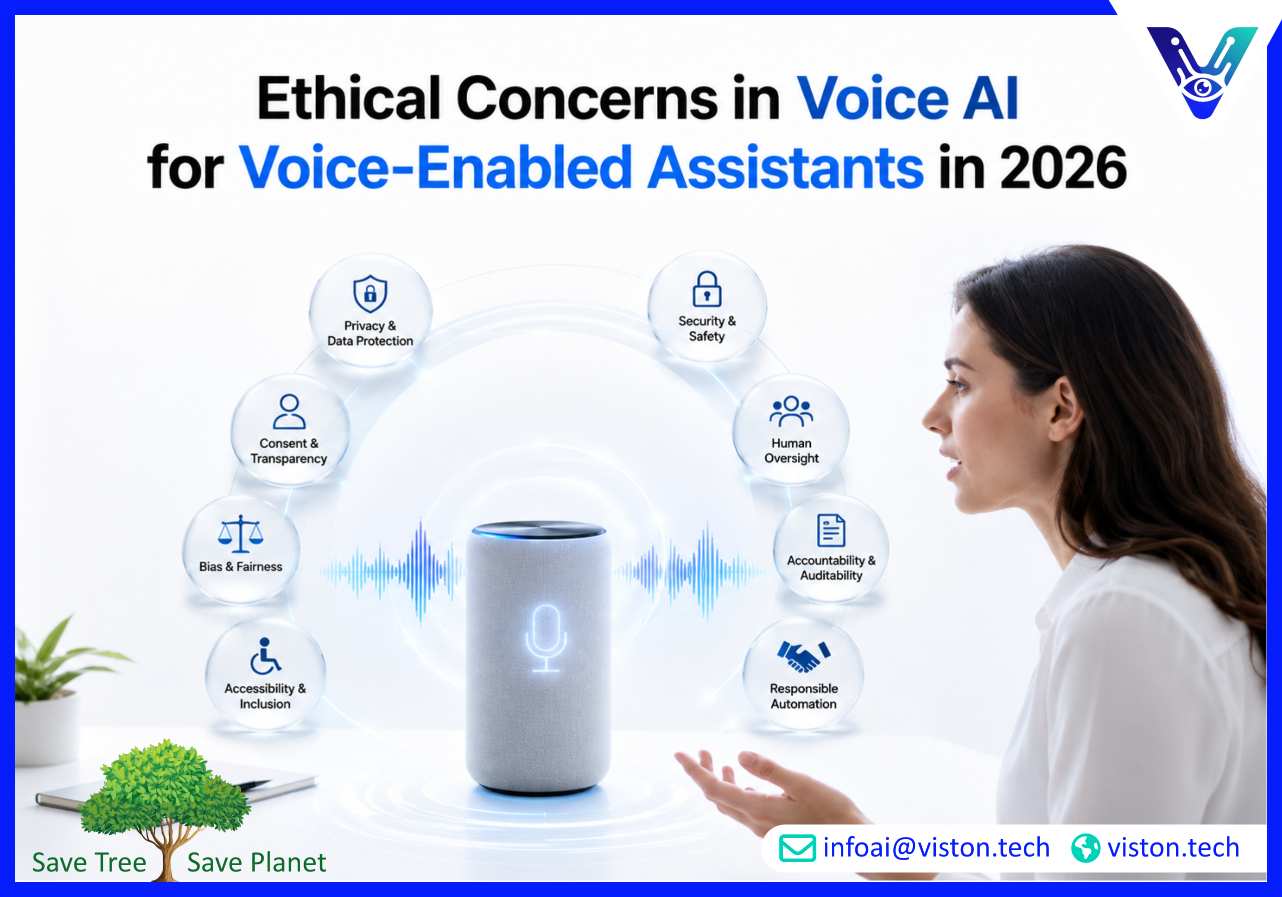
Ethical Concerns in Voice AI for Voice-Enabled Assistants in 2026
Ethical concerns in voice AI now matter as much as accuracy, speed, and automation value. Businesses using Voice-Enabled Assistants must protect user trust while managing consent, privacy, bias, security, transparency, accessibility, and responsible workflow automation.
Why Ethical Concerns in Voice AI Matter for Businesses
Voice AI has moved from simple command recognition to natural, real-time conversations across customer support, sales, internal operations, healthcare, finance, retail, logistics, education, and field service environments. Voice-Enabled Assistants can answer questions, qualify leads, schedule appointments, authenticate users, collect information, summarize calls, trigger workflows, and connect with CRM, ERP, helpdesk, contact center, and knowledge management systems.This makes voice AI commercially valuable, but it also increases ethical responsibility. Spoken interactions often contain sensitive information, emotional signals, background noise, accents, health details, financial concerns, workplace issues, customer complaints, and personal identifiers. Unlike typed chat, voice data can reveal identity, age, mood, location context, disability, language background, and other personal traits without the user always realizing it.For business decision-makers, the ethical question is not whether voice AI should be used. The more practical question is how to use it responsibly. A poorly designed voice assistant can damage trust through unclear recording practices, biased speech recognition, unsafe automation, weak escalation, overcollection of data, or misleading responses. A well-designed assistant can improve accessibility, reduce waiting times, support multilingual users, and create faster service experiences while respecting user rights.
Voice AI ethics is a business risk issue
Ethical concerns in voice AI should not be treated only as legal or technical details. They affect customer experience, brand trust, procurement approval, employee adoption, compliance posture, and long-term scalability. If users feel monitored, misunderstood, manipulated, or unable to reach a human, the technology becomes a barrier instead of a service improvement.Businesses evaluating Voice-Enabled Assistants in 2026 need responsible design from the start. Ethical delivery should be built into discovery, data strategy, model selection, conversation design, integration planning, testing, deployment, monitoring, and continuous optimization.
Core Ethical Risks in Voice-Enabled Assistants
The most important ethical risks in voice AI usually appear where speech data, automation, and business systems overlap. These risks are manageable, but only when businesses identify them early and design proper safeguards.
Privacy and consent
Voice interactions can involve recording, transcription, analysis, storage, and sometimes speaker recognition. Users should understand when they are speaking to an AI system, whether the conversation is being recorded, how the data will be used, and whether it may support quality monitoring or model improvement. Consent should be clear, specific, and easy to withdraw where applicable.Businesses should avoid vague statements such as “calls may be monitored” when the system is actually transcribing, analyzing, classifying, or using voice data for automation. Ethical voice AI requires plain-language disclosure that matches the real data flow.
Data minimization and retention
A Voice-Enabled Assistant should collect only the information needed to complete the user’s task. If the assistant is booking an appointment, it may not need full identity verification. If it is checking order status, it may not need to store the full voice recording after the transaction is complete. If transcripts are used for training or quality review, sensitive details should be redacted or anonymized where possible.Retention policies should also be defined before deployment. Teams should know how long recordings, transcripts, metadata, call summaries, authentication signals, and analytics records are stored. Keeping unnecessary voice data increases risk without adding business value.
Voice biometrics and identity risk
Some voice AI systems use speaker recognition or voice authentication. This can improve security and reduce customer friction, but it also introduces sensitive biometric considerations. A voiceprint is not the same as a password that can be changed easily. If biometric voice data is compromised or misused, the impact can be serious.Ethical use of voice biometrics requires strong consent, secure storage, encryption, liveness detection, clear opt-out options, audit trails, and fallback authentication methods. Businesses should also avoid using voice biometrics for purposes beyond the original user expectation.
Bias in speech recognition
Speech recognition systems can perform differently across accents, dialects, languages, speech patterns, age groups, noisy environments, disabilities, and code-switching conversations. If a voice assistant repeatedly misunderstands certain users, it creates unequal service access and customer frustration.Bias may appear in transcription accuracy, intent recognition, sentiment detection, escalation decisions, fraud scoring, or authentication success. Ethical voice AI requires testing across real user groups, not only ideal studio-quality speech. It should also include inclusive conversation design, multilingual support, accent-aware evaluation, and human fallback when confidence is low.
Transparency and user control
Users should know when they are interacting with AI and what the assistant can and cannot do. A voice assistant should not pretend to be human, hide limitations, or pressure users into actions. It should provide clear choices, confirm important details, and make it easy to reach a person when needed.Transparency is especially important when the assistant makes recommendations, collects sensitive information, summarizes a conversation, or triggers a business workflow. Users should be able to correct mistakes before actions are finalized.
How Ethical Voice AI Affects Customer Experience and Operations
Ethical concerns in voice AI directly affect how well Voice-Enabled Assistants perform in real business environments. A system may be technically impressive but operationally risky if it does not respect user expectations, human oversight, and service quality standards.
Trust depends on accurate and honest responses
Voice interactions feel immediate and personal. When a spoken AI assistant gives a confident but incorrect answer, the user may act on it quickly. This matters in support, finance, healthcare, legal intake, insurance, education, logistics, and workplace policy scenarios.Voice-Enabled Assistants should be grounded in approved knowledge sources, integrated with reliable business systems, and designed to say when information is uncertain. They should not invent policies, pricing, eligibility rules, medical guidance, financial advice, or contractual terms. Clear escalation is safer than an overconfident answer.
Human escalation is an ethical design feature
Some conversations should not remain fully automated. Complaints, vulnerable users, safety concerns, fraud alerts, cancellation risks, urgent service issues, accessibility barriers, and emotionally sensitive situations often require human judgment.An ethical voice assistant should detect when automation is no longer appropriate. It should transfer the user with context, including the conversation summary, detected intent, relevant account details, and attempted resolution. Poor handover forces users to repeat themselves and can make automation feel careless.
Accessibility must be considered from the beginning
Voice AI can improve accessibility for users who struggle with typing, screens, forms, or complex menus. However, it can also exclude people with speech impairments, heavy accents, hearing difficulties, cognitive load challenges, or language preferences not supported by the system.Responsible implementation should include alternate channels, adjustable pace, confirmation prompts, clear language, multilingual design, repeat options, and accessible escalation paths. Voice should be an additional access point, not the only way to receive service.
Employee monitoring needs boundaries
Voice AI is not limited to customer-facing use. Businesses may use voice assistants for internal IT support, HR requests, warehouse workflows, field reporting, quality checks, meeting summaries, or call center assistance. These use cases can improve productivity, but they may also create employee concerns about surveillance.Organizations should define what is measured, why it is measured, who can access the data, and how it will affect performance review or management decisions. Ethical internal voice AI should support work rather than create hidden monitoring pressure.
Best Practices for Managing Ethical Concerns in Voice AI
Businesses can reduce ethical risk by treating responsible voice AI as a delivery requirement rather than an afterthought. The right approach combines governance, technical controls, conversation design, testing, and ongoing review.
Start with a responsible use case assessment
Before development begins, teams should identify the assistant’s purpose, users, channels, data requirements, risk level, and business outcomes. A low-risk FAQ assistant has different ethical requirements than a voice authentication system, claims intake assistant, healthcare scheduling bot, or internal HR assistant.The assessment should clarify which tasks can be automated, which require approval, which require human review, and which should not be handled by voice AI at all. This prevents the assistant from expanding into sensitive workflows without proper controls.
Design clear consent and disclosure flows
Consent should be built into the interaction naturally. A business can explain that the user is speaking with an AI assistant, state whether the call is recorded or transcribed, describe the purpose of processing, and provide options for human support or alternative channels.For sensitive use cases, disclosure should happen before personal or biometric information is collected. Users should not discover after the conversation that their voice was analyzed for identity, sentiment, quality assurance, or model improvement.
Apply privacy-by-design controls
Privacy-by-design means limiting data collection, protecting data in transit and at rest, redacting sensitive information, controlling employee access, documenting processing activities, and setting retention limits. It also means separating training data from operational data when needed and making sure vendors follow the same standards.Businesses should review whether recordings are necessary or whether transcripts, summaries, or structured intent records are enough. Reducing data exposure is often the most practical way to reduce ethical and compliance risk.
Test across real-world speech conditions
Voice AI should be tested with different accents, languages, background noise levels, devices, speaking speeds, and user scenarios. Testing should include edge cases, repeated failures, emotional conversations, interruptions, silence, incomplete answers, and ambiguous requests.Teams should measure transcription quality, intent accuracy, fallback rate, escalation quality, user satisfaction, and completion rate by user segment where appropriate. If performance is uneven, the model, prompts, training data, or flow design should be improved before scaling.
Create governance for ongoing monitoring
Ethical voice AI requires continuous oversight. Businesses should monitor failed conversations, complaints, escalation patterns, privacy incidents, consent logs, bias indicators, knowledge accuracy, and workflow outcomes. Governance should define who owns the assistant, who approves changes, how issues are reported, and how updates are tested before release.As products, policies, regulations, and customer expectations change, the assistant’s knowledge base and response behavior must be updated. Responsible deployment is not a one-time launch task; it is an operating model.
How Viston AI Supports Responsible Voice-Enabled Assistants
Viston AI is relevant to ethical concerns in voice AI because its Voice-Enabled Assistants service focuses on enterprise voice systems that combine speech recognition, natural language understanding, generative AI, LLMOps, analytics, system integration, and responsible AI governance. These capabilities matter because ethical voice AI depends on more than a natural-sounding response. It requires secure data handling, accurate intent recognition, human escalation, access control, monitoring, and integration with trusted business systems.For organizations planning Voice-Enabled Assistants, Viston AI’s service approach can support practical safeguards such as consent-aware workflows, role-based access, audit trails, PII handling, multilingual support, real-time analytics, and continuous performance evaluation. Its voice AI capabilities are also connected to broader AI services including chatbot integration, NLP, automation workflows, model monitoring, AI strategy, and enterprise system connectivity.This makes Viston AI relevant for businesses that want voice assistants to handle customer service, internal support, scheduling, knowledge retrieval, workflow automation, and multilingual interactions without ignoring privacy, fairness, security, and operational accountability. A responsible implementation partner should help define what the assistant should automate, when it should escalate, what data it should collect, and how performance should be reviewed after launch. For companies operating across global or multi-team environments, this structured approach helps voice AI scale while keeping trust and governance at the center of deployment.
Frequently Asked Questions
What are the main ethical concerns in voice AI?
The main ethical concerns in voice AI include privacy, consent, voice recording, biometric data use, speech recognition bias, transparency, accessibility, data retention, security, user manipulation, and lack of human escalation for sensitive situations.
Why is consent important for Voice-Enabled Assistants?
Consent is important because voice interactions may be recorded, transcribed, analyzed, summarized, or used to trigger business workflows. Users should understand when AI is involved, what data is collected, why it is collected, and what options they have.
Can voice AI be biased?
Yes. Voice AI can show bias when it performs less accurately for certain accents, dialects, languages, speech patterns, age groups, or noisy environments. Businesses should test systems across diverse speech conditions and provide human fallback when confidence is low.
How can businesses make voice AI more ethical?
Businesses can make voice AI more ethical by using clear disclosures, collecting minimal data, protecting sensitive information, testing for bias, grounding responses in approved knowledge, offering human escalation, monitoring performance, and setting strong governance policies.
Should voice assistants always identify themselves as AI?
Yes. Users should know when they are interacting with an AI assistant rather than a human. This supports transparency, trust, informed consent, and better user control throughout the conversation.
Can Viston AI help with ethical voice AI implementation?
Viston AI’s Voice-Enabled Assistants service is aligned with responsible implementation because it connects voice AI development with system integration, NLP, multilingual support, analytics, LLMOps, monitoring, and governance-focused delivery for enterprise use cases.
Conclusion
Ethical concerns in voice AI are now central to successful Voice-Enabled Assistants. Businesses need systems that are accurate, useful, secure, transparent, inclusive, and accountable. The goal is not to slow innovation, but to make voice automation trustworthy enough for real customer and operational environments. By addressing consent, privacy, bias, accessibility, escalation, data governance, and monitoring from the start, organizations can reduce risk and improve adoption. Viston AI offers relevant voice AI capabilities for businesses that want responsible, integrated, and scalable voice assistant solutions built around practical business outcomes.