
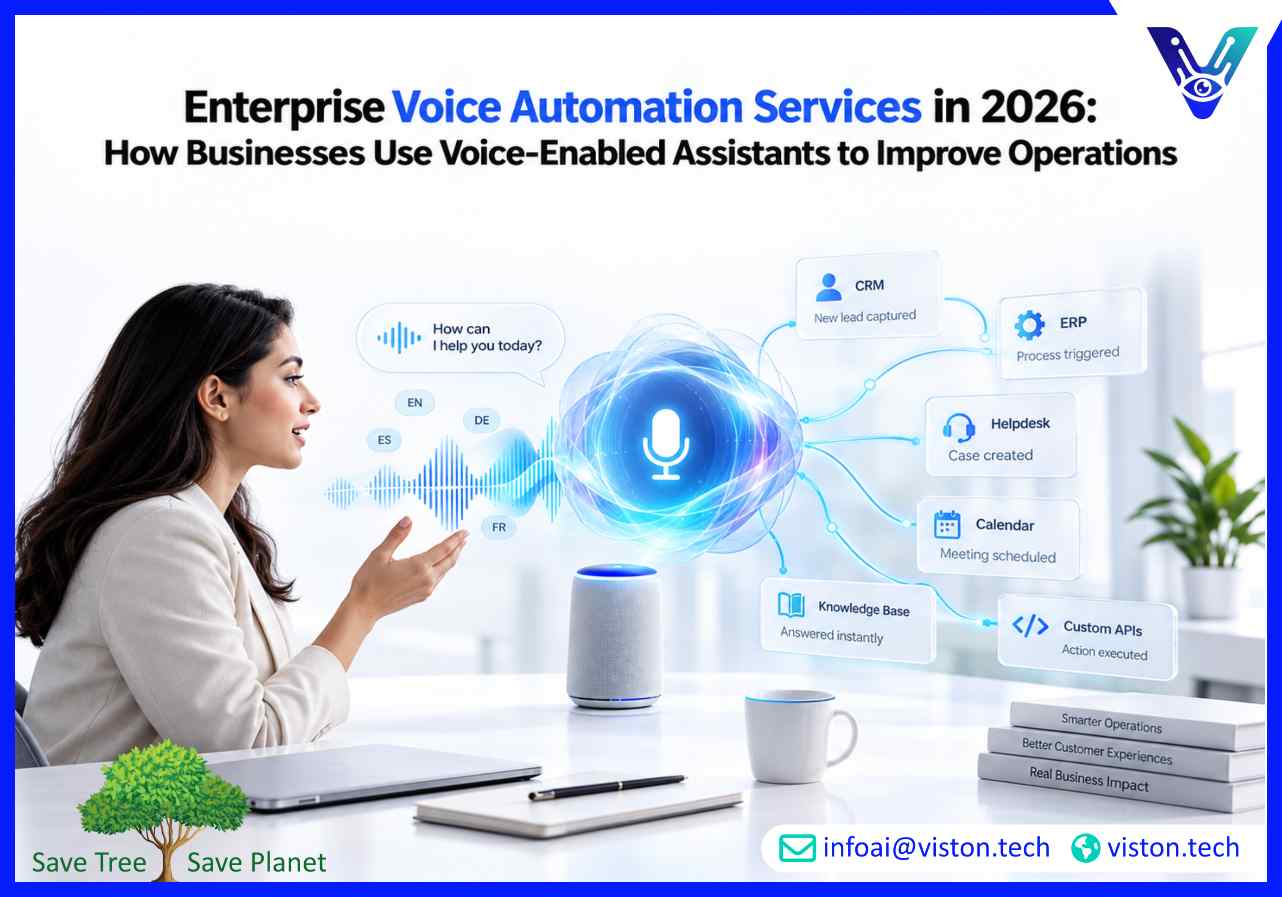
Enterprise voice automation services matter because customers, employees, and operations teams increasingly expect fast, natural, hands-free access to business systems. In 2026, voice-enabled assistants are no longer limited to simple call routing. They can support service workflows, internal operations, sales processes, knowledge access, and real-time task completion when implemented with the right architecture.
Enterprise voice automation services involve designing, developing, integrating, and optimizing AI-powered voice systems that allow users to interact with business processes through spoken language. These services typically combine automatic speech recognition, natural language understanding, large language models, text-to-speech, workflow automation, analytics, and secure integrations with enterprise platforms.
Unlike traditional IVR systems, modern voice-enabled assistants are built to understand natural speech rather than forcing users through rigid keypad menus. A customer can explain a billing issue in their own words. An employee can ask for a policy. A field technician can update a maintenance record without typing. A sales team can qualify inbound callers and route them based on intent, urgency, or account status.
The business value comes from connecting voice interaction to action. A voice assistant should not only answer questions. It should retrieve records, verify details, create tickets, update CRM fields, schedule appointments, trigger workflows, summarize conversations, and hand over to human teams when the situation requires judgment.
Reliable enterprise voice automation depends on several connected layers. Speech recognition converts spoken language into text. Natural language processing identifies intent, entities, sentiment, and context. The conversational AI layer decides the next best response or action. Text-to-speech turns the response into natural audio. Integration layers connect the assistant with CRM, ERP, helpdesk, contact center, knowledge base, and workflow systems.
For enterprise environments, these layers must work with low latency, strong security, accurate domain terminology, multilingual support, and robust monitoring. A voice assistant that works well in a quiet demo may fail in a noisy warehouse, busy contact center, regional accent environment, or regulated workflow if it is not designed for real operational conditions.
Businesses are adopting enterprise voice automation services because voice remains one of the fastest and most natural ways for people to request help, complete tasks, and access information. In customer service, callers often want an immediate answer rather than waiting in a queue. In operations, employees may need hands-free interaction while working with equipment, inventory, vehicles, or clinical systems.
The strongest use cases are usually repetitive, high-volume, time-sensitive, or process-driven. These include appointment scheduling, order status checks, ticket creation, identity verification, lead qualification, HR policy questions, IT helpdesk support, payment reminders, claims intake, dispatch updates, and maintenance reporting.
In 2026, buyers are also looking beyond cost reduction. They want better customer experience, improved accessibility, higher data quality, faster response times, and more consistent service delivery across channels. A well-designed voice-enabled assistant can help standardize common interactions while giving human teams more time for complex, sensitive, or high-value conversations.
Voice automation can reduce friction when users do not want to type, search, or navigate long menus. A caller can speak naturally, confirm details, and complete a task in fewer steps. This is especially useful for service desks, healthcare scheduling, financial service inquiries, retail support, travel updates, and technical troubleshooting.
The experience improves further when the assistant has access to business context. For example, an integrated assistant can recognize an existing customer, check recent orders, confirm appointment availability, or open a support case with the correct category and priority. Without integration, voice automation often becomes another disconnected front-end tool.
Voice-enabled assistants can reduce repetitive workload by handling routine requests before they reach human agents. They can also improve the quality of operational data by capturing structured information during a conversation. Instead of an agent manually entering notes after a call, the assistant can collect required fields, summarize the interaction, and update the relevant system automatically.
This matters for support leaders, operations managers, procurement teams, and technology leaders because automation value depends on measurable outcomes. Useful metrics include containment rate, task completion rate, escalation quality, average handling time, customer satisfaction, first contact resolution, workflow success rate, and data update accuracy.
Voice-enabled assistants create the most value when they are tied to clear business workflows. A broad “AI voice assistant” project can become expensive and unfocused if the organization does not define what the assistant should handle, what systems it should access, and when it should transfer control to a person.
Contact centers are one of the strongest areas for enterprise voice automation. Voice assistants can answer common questions, authenticate users, route calls, collect issue details, provide status updates, create tickets, and summarize calls for human agents. The goal is not to remove human support entirely. The goal is to reduce repetitive volume and improve the quality of handovers.
A good voice assistant should know when not to continue. Angry customers, sensitive complaints, legal issues, high-value accounts, fraud concerns, and complex troubleshooting should be routed to trained teams with full conversation context.
Enterprises can use voice automation for HR, IT, finance, facilities, and operations support. Employees can ask about leave policies, reset passwords, check ticket status, request equipment, report incidents, or search internal knowledge bases using voice. This is useful when employees are mobile, working in shared environments, or unable to use a keyboard.
For internal use cases, access control is critical. The assistant must respect user roles, permissions, regions, and confidentiality rules. A manager, frontline employee, contractor, and HR administrator should not all receive the same level of information.
Voice assistants can support inbound sales calls by asking qualification questions, capturing contact details, identifying buyer intent, checking availability, and booking meetings. When connected to CRM systems, the assistant can create or update records, assign leads, and trigger follow-up workflows.
This is particularly useful for businesses that receive after-hours inquiries or high volumes of basic pre-sales questions. However, sales voice automation should be carefully designed to avoid robotic scripts. Buyers still expect a clear, respectful, and context-aware experience.
Voice automation is valuable in environments where typing is inconvenient or unsafe. Manufacturing teams can complete inspection checklists by voice. Warehouse workers can confirm picking tasks. Healthcare staff can access information while moving between tasks. Field service teams can update job records, log issues, and request next steps without returning to a desk.
These use cases require stronger attention to background noise, device compatibility, latency, offline or edge processing needs, and confirmation flows. In operational environments, a misunderstood command can create safety, quality, or reporting problems, so testing must reflect real working conditions.
Choosing enterprise voice automation services should be treated as a business transformation decision, not only a software purchase. The provider must understand conversation design, AI architecture, integration, security, compliance, testing, deployment, and ongoing optimization.
The best projects begin with a small number of high-value workflows. These should be frequent enough to justify automation, clear enough to define, and safe enough to test without excessive business risk. Examples include call routing, appointment booking, order status, support intake, password reset, policy lookup, or lead qualification.
Once the assistant performs reliably, businesses can expand into more complex workflows. This phased approach helps teams measure value, refine language models, improve prompts, strengthen integrations, and build stakeholder confidence.
Voice automation becomes far more useful when it connects to the systems that run the business. Buyers should assess whether the provider can integrate with CRM, ERP, contact center platforms, helpdesk tools, authentication systems, calendars, payment workflows, knowledge bases, and custom APIs.
Integration quality affects almost every performance outcome. If the assistant cannot access accurate records, it cannot personalize responses. If it cannot update systems reliably, teams still need manual work. If it cannot pass clean context to human agents, customers may have to repeat themselves.
Voice data can be sensitive. It may include personal information, health details, financial information, employee data, customer complaints, or biometric signals. Enterprises should define consent, recording policies, retention limits, redaction requirements, encryption, audit logs, role-based access, and escalation rules before launch.
Responsible AI governance is also important. Voice assistants should be monitored for accuracy, bias, inappropriate responses, hallucinations, unsafe recommendations, and inconsistent handling of users with different accents, dialects, languages, or speech patterns. For regulated businesses, governance should align with relevant privacy, security, and AI management expectations.
A production voice assistant should be continuously evaluated. Businesses should track call containment, successful task completion, fallback rate, average latency, transcription accuracy, escalation reasons, customer satisfaction, workflow failure, and human handover quality. Conversation reviews should feed into ongoing improvement cycles.
The most mature teams do not view launch as the end of the project. They treat voice automation as an evolving service that needs content updates, model evaluation, prompt refinement, integration monitoring, and business owner feedback.
Viston AI is relevant to enterprise voice automation services because its Voice-Enabled AI Assistants offering focuses on building enterprise-grade conversational voice systems that combine speech recognition, natural language processing, generative AI, LLMOps infrastructure, multilingual capability, analytics, and business system integration.
For organizations evaluating voice-enabled assistants, this combination matters. A useful voice assistant must do more than recognize speech. It must understand business intent, manage multi-turn dialogue, connect with enterprise systems, support secure workflows, and generate measurable operational value. Viston AI’s service positioning includes integration with platforms such as CRM, ERP, helpdesk, healthcare, HR, and custom API environments, which supports practical use cases across customer support, employee service, sales operations, and operational workflows.
The company’s broader AI service portfolio also includes enterprise AI chatbots, AI chatbot integration, multilingual support, NLP and text analysis, AI automation and workflow bots, AI strategy development, MLOps, and model monitoring. This makes its voice automation capability more relevant for businesses that need a connected solution rather than a standalone voice interface.
For enterprises planning voice automation in 2026, Viston AI can be positioned as a specialist partner for designing voice-enabled assistants that are practical, scalable, integrated, and governed for real business use.
Enterprise voice automation services help businesses build AI-powered voice systems that understand spoken requests, respond naturally, and complete tasks through connected business systems. They usually include speech recognition, conversational AI, text-to-speech, workflow automation, integrations, analytics, and ongoing optimization.
Traditional IVR relies on fixed menus and keypad choices. Voice-enabled assistants allow users to speak naturally, understand intent, manage multi-turn conversations, retrieve business data, and trigger workflows such as ticket creation, appointment booking, lead routing, or account updates.
The best processes are repetitive, high-volume, structured, and time-sensitive. Common examples include customer support intake, order status updates, appointment scheduling, password resets, HR questions, IT helpdesk support, claims intake, lead qualification, and field service reporting.
Businesses should evaluate speech accuracy, latency, integration capability, security controls, multilingual support, conversation design expertise, analytics, escalation handling, compliance readiness, and post-launch optimization support. The provider should understand both AI delivery and enterprise operations.
Yes, but it requires careful design and testing. Industrial, healthcare, warehouse, and field environments need strong acoustic modeling, device planning, confirmation steps, fallback handling, and real-world testing to ensure the assistant understands users reliably.
Yes. Viston AI offers Voice-Enabled AI Assistants supported by NLP, speech recognition, generative AI, multilingual capability, enterprise integration, analytics, and model monitoring. These capabilities align with businesses that want voice automation connected to real workflows and measurable outcomes.
Enterprise voice automation services are becoming an important part of business automation in 2026 because they allow customers and employees to complete tasks through natural, accessible, and hands-free conversations. The strongest results come from voice-enabled assistants that are integrated with business systems, governed responsibly, tested in real conditions, and measured against operational outcomes. Businesses should start with focused workflows, prioritize security and handover quality, and improve the assistant continuously after launch. For organizations seeking a practical partner in Voice-Enabled Assistants, Viston AI offers relevant capabilities for building scalable, integrated, and business-focused voice automation solutions.
