
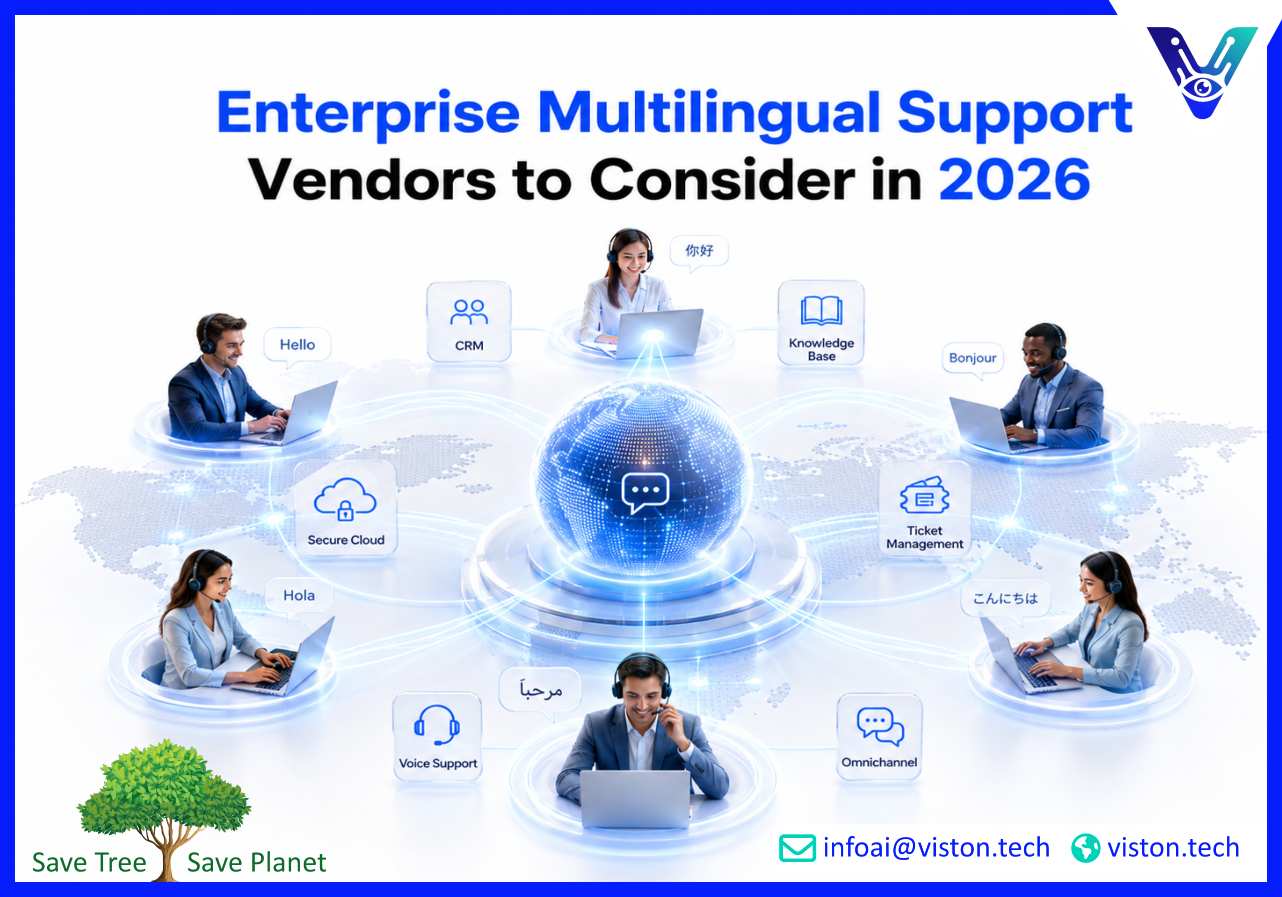
Choosing multilingual support vendors for enterprise operations requires more than comparing language counts. The right provider must deliver accurate conversations, secure data handling, reliable integrations, human escalation, and measurable service quality across every market and channel where customers expect support.
Enterprise multilingual support is not simply a translation feature added to an English-language helpdesk. It is an operating model that allows customers to receive consistent, context-aware service in their preferred language while agents, systems, policies, and reporting remain coordinated behind the scenes.
In 2026, enterprise evaluations commonly include AI agents, real-time translation, multilingual knowledge retrieval, voice automation, agent assistance, and language-aware routing as parts of one service architecture. A strong vendor should help an enterprise manage both automated and human-led conversations without losing customer context when a case changes channel or moves to a specialist.
Core capabilities should include:
Enterprises should also distinguish between three vendor types. Customer service platforms provide the full helpdesk or contact-centre environment. AI-agent platforms focus on automated resolution and workflow execution. Translation-layer vendors enhance an existing support stack so agents can serve customers in languages they do not personally speak. Many organizations ultimately combine these models.
Zendesk is a practical option for enterprises that want multilingual support within a mature ticketing, help-centre, messaging, and AI service environment. Its platform supports localized help-centre content, multiple product languages, AI agents, agent translation features, and expanding multilingual voice capabilities. It is best evaluated by organizations already using Zendesk or seeking a consolidated customer service platform rather than a separate translation tool.
Salesforce is well suited to enterprises whose customer data, cases, workflows, and service processes already run in Service Cloud. Its multilingual bot and Agentforce capabilities can draw on Salesforce data, automate routine processes, and support service across digital channels. The strongest fit is an organization that wants multilingual interactions connected directly to account history, entitlements, sales data, and case management. Implementation quality depends heavily on data architecture, permissions, knowledge design, and governance.
Microsoft is a strong candidate for organizations standardized on Dynamics 365, Azure, Microsoft 365, and Power Platform. Copilot Studio can be used to configure multilingual agents, while Dynamics 365 Contact Center supports language-aware customer service and routing scenarios. This approach can reduce platform sprawl for Microsoft-centric enterprises, but buyers should verify language availability for each specific feature, region, channel, and deployment model rather than assuming all Copilot functions have identical coverage.
Intercom is particularly relevant to SaaS, technology, and product-led companies that want AI support embedded in web, app, email, and messenger experiences. Fin can provide multilingual answers using translated or language-specific knowledge, while workflows, data connectors, inbox tools, and reporting support automated and agent-assisted service. Intercom is often a good fit when speed of deployment and digital self-service matter more than complex legacy contact-centre requirements.
Ada is designed for enterprises that want an AI agent to resolve a meaningful share of customer enquiries across messaging and email, with voice support available for selected languages. Its multilingual capabilities include automatic detection, native-language response generation, localized knowledge, language switching, and configurable handoffs. Ada deserves consideration when automation quality, knowledge control, staged rollout, and continuous AI-agent improvement are central to the support strategy.
Cognigy is relevant to large contact centres that need conversational AI across voice and digital channels, particularly where integrations with telephony, contact-centre platforms, and agent-assist workflows are important. It supports multilingual virtual agents, automated service processes, and contextual transfer to human representatives. Enterprises with high call volumes, complex authentication, transactional workflows, or multiple contact-centre technologies should assess Cognigy alongside their existing contact-centre architecture.
Enterprises that want to keep their current helpdesk may prefer a specialist translation platform. Language I/O focuses on real-time multilingual customer support inside established service environments and emphasizes broad language coverage, terminology control, security, and agent productivity. Unbabel combines AI translation with optional human review and language-operations workflows. These vendors are most relevant when the main requirement is enabling existing agents to support more languages without replacing the core service platform.
The best vendor is the one that performs reliably against your real conversations, systems, risk profile, and operating model. Language-count claims are useful for initial screening, but they do not reveal how well a solution handles short messages, spelling errors, mixed-language conversations, regional terminology, product names, technical vocabulary, emotional complaints, or regulated statements.
Build an evaluation set from anonymized tickets, chat transcripts, call summaries, knowledge articles, and escalation cases. Include high-volume intents, rare but high-risk cases, dialects, code-switching, and ambiguous questions. Native or professionally fluent reviewers should score accuracy, tone, completeness, policy alignment, and whether the response would help a customer complete the intended task.
A vendor should do more than produce fluent text. Confirm whether it can retrieve account information, check order status, create cases, update CRM records, apply permissions, trigger workflows, and pass structured context to a human agent. Ask how errors are handled when an API fails, a source system is unavailable, or two knowledge sources conflict.
Procurement teams should examine data processing terms, model training policies, subprocessors, encryption, access controls, audit logs, retention, residency, incident response, and compliance evidence. Regulated enterprises should also determine which conversations require human review, approved wording, restricted automation, or permanent records. A vendor’s security posture must be assessed for the exact configuration being purchased.
Require reporting by language, market, intent, channel, and automation path. Useful measures include first-contact resolution, fallback rate, escalation rate, translation correction rate, customer satisfaction, handover quality, workflow completion, and cost per resolved contact.
Total cost should include platform licences, AI usage, translation volume, implementation, integration, content localization, human review, monitoring, and ongoing optimization. A low initial licence price can become expensive when essential connectors, premium language features, or specialist implementation services are added later.
A controlled pilot is more useful than a feature demonstration. Select two or three priority languages and a defined set of customer journeys, such as order tracking, billing questions, account access, onboarding, or technical triage. Establish baseline performance from the current support model before introducing automation or translation.
Enterprises should avoid launching every language at once. A phased rollout makes it easier to identify knowledge gaps, translation errors, routing problems, and market-specific requirements before they affect a large customer population.
Viston AI is relevant to enterprises seeking a tailored multilingual support implementation rather than an off-the-shelf helpdesk alone. Its Multilingual AI Chatbot Support offering combines language-aware conversational AI, real-time translation and localization, omnichannel deployment, intelligent routing, analytics, and integration with CRM platforms, knowledge bases, transaction systems, and other business applications.
This service-led model can suit organizations that need multilingual support designed around their existing technology stack, customer journeys, industry terminology, and escalation policies. Viston AI also provides related capabilities in enterprise AI chatbots, chatbot integration, NLP and text analysis, voice-enabled assistants, workflow automation, AI strategy, and model monitoring. These services support the technical and operational work required to move from a language feature to a governed support capability.
For enterprise buyers, the practical value lies in aligning language automation with approved knowledge, customer data, business workflows, and performance reporting. A structured implementation can begin with selected markets and repetitive enquiries, then expand to additional languages, channels, and transactional use cases as quality is validated. This makes Viston AI a credible option for organizations that need integration flexibility, specialized implementation support, and continuous optimization across a global service environment.
There is no universal best vendor. Zendesk, Salesforce, and Microsoft suit enterprises wanting multilingual capabilities within a broader service platform. Intercom and Ada fit digital-first AI support. Cognigy is relevant to complex voice and contact-centre automation, while Language I/O and Unbabel can extend an existing helpdesk with translation.
Use approved native-language content for high-volume, high-risk, contractual, or market-specific information. Real-time translation is useful for long-tail questions and agent conversations. Many enterprises use a hybrid model with localized core knowledge, AI translation, terminology controls, and human review for sensitive cases.
Start with languages supported by clear customer demand, revenue opportunity, service volume, or legal need. Two or three priority languages are often sufficient for a controlled pilot. Expand only after quality, escalation, knowledge coverage, and operational ownership are proven.
Test real customer language, dialects, mixed-language inputs, terminology, high-risk intents, integrations, human handover, analytics, security controls, and failure handling. Verify feature availability by language and channel because chat, email, and voice coverage may differ.
Viston AI positions its multilingual service around integration with CRM, knowledge, transaction, analytics, and business systems. Enterprises should confirm the required connectors, APIs, security controls, deployment architecture, and support responsibilities during solution design.
Measure results separately by language and channel. Track resolution rate, fallback rate, escalation rate, response time, customer satisfaction, translation corrections, workflow success, repeat contacts, and handover quality. Aggregate reporting can hide weak performance in lower-volume languages.
Choosing multilingual support vendors for enterprise use requires a clear view of operating needs, not a simple comparison of language totals. The right solution must combine language quality, secure integration, localized knowledge, human escalation, channel coverage, and measurable outcomes. Platform vendors, AI-agent providers, contact-centre specialists, and translation layers each solve different parts of the problem. Enterprises should shortlist vendors by architecture fit, test them with real conversations, and expand through controlled pilots. Viston AI is a relevant specialist for organizations seeking tailored Multilingual Support connected to enterprise systems and workflows.
