
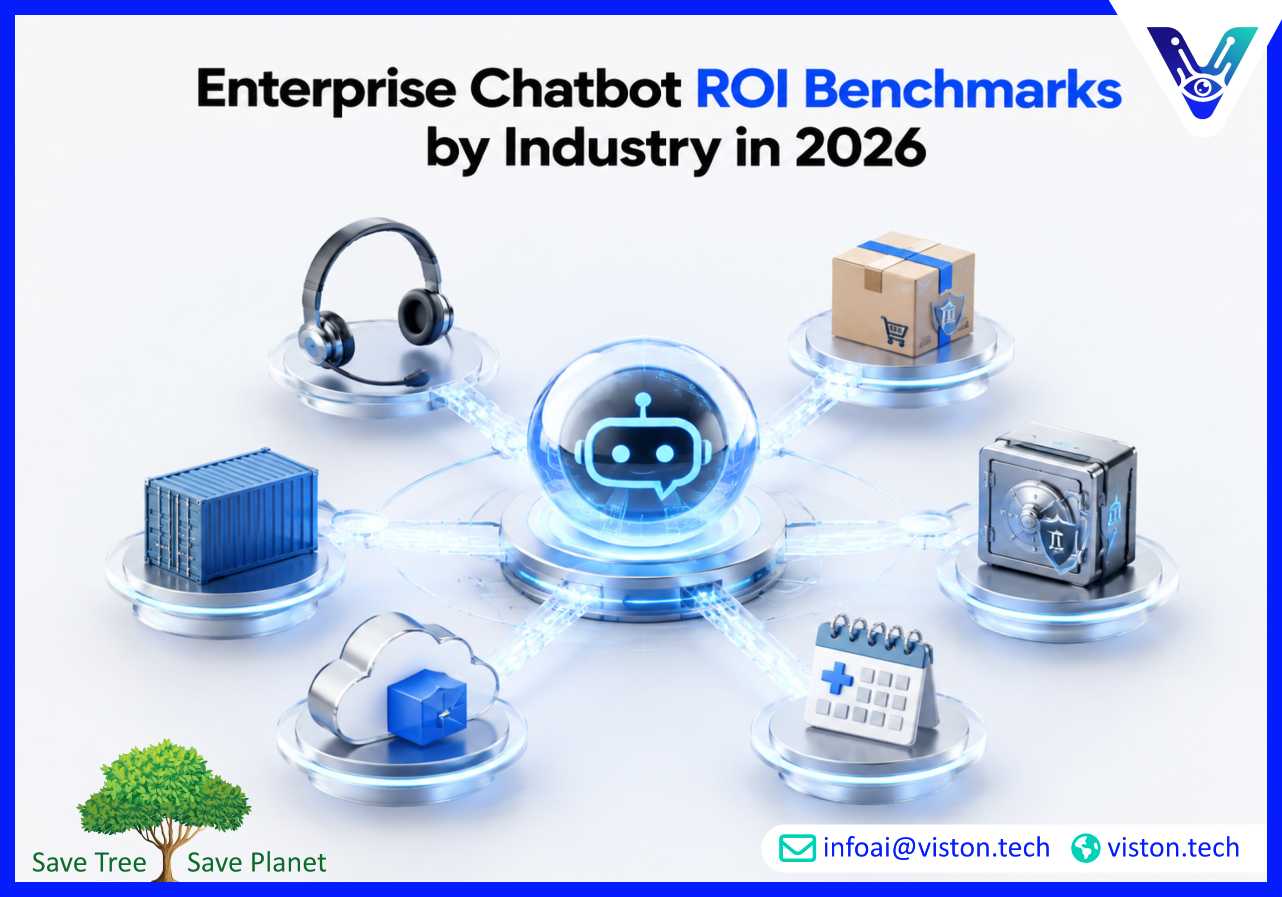
Enterprise chatbot ROI benchmarks by industry help decision-makers understand where conversational AI can reduce costs, improve customer experience, increase productivity, and support revenue growth in 2026.
Enterprise chatbot ROI is not measured by chatbot activity alone. A bot that handles thousands of conversations is not automatically profitable if it gives incomplete answers, creates poor customer experiences, or fails to connect with business systems. Real ROI comes from measurable improvements in cost, speed, accuracy, service capacity, lead handling, and workflow efficiency.
When businesses compare enterprise chatbot ROI benchmarks by industry, they are usually trying to answer a practical question: what level of return should we reasonably expect from AI chatbot deployment in our sector? The answer depends on interaction volume, use case complexity, integration maturity, customer expectations, regulatory requirements, and the cost of manual work being automated.
In 2026, enterprise AI chatbots are expected to do more than answer FAQs. Buyers increasingly look for chatbots that can understand intent, retrieve accurate knowledge, complete multi-step workflows, escalate with context, support multiple channels, and integrate with CRM, helpdesk, ERP, e-commerce, scheduling, payment, and internal knowledge systems.
For most organizations, ROI should be reviewed across four business areas:
The best benchmark is not a generic number copied from another company. It is a structured comparison between current business performance and the realistic improvement a well-designed enterprise chatbot can create in a specific workflow.
ROI varies widely because industries use chatbots for different reasons. A retail chatbot may drive ROI through product discovery, order tracking, and returns automation. A banking chatbot may focus on secure account support, fraud alerts, and guided service journeys. A healthcare chatbot may prioritize appointment scheduling, insurance queries, patient communication, and compliant handoff to staff.
Industry differences also affect deployment cost. Highly regulated sectors usually require stronger authentication, audit trails, privacy controls, human escalation rules, and compliance documentation. These requirements may increase implementation effort, but they also protect the business from operational and reputational risk.
Industries with high volumes of repetitive inquiries often see faster ROI. Customer support, retail, telecom, travel, banking, insurance, and SaaS businesses typically have many recurring questions around orders, billing, appointments, account access, onboarding, troubleshooting, and policy information. These use cases are well suited for chatbot automation when the knowledge base and integrations are reliable.
ROI improves when a chatbot reduces work that is expensive, frequent, and predictable. If every routine inquiry requires a human agent, the business carries avoidable labor cost. A chatbot can reduce this burden by resolving simple issues instantly and reserving human teams for complex, sensitive, or high-value conversations.
A chatbot that only provides static answers has limited ROI potential. A chatbot connected to CRM, helpdesk, order management, knowledge bases, inventory systems, booking tools, and workflow platforms can create stronger measurable outcomes. It can update records, create tickets, qualify leads, check order status, schedule appointments, and trigger follow-up actions.
Some industries cannot allow uncontrolled chatbot responses. Financial services, healthcare, insurance, legal services, government, and enterprise software often need strict guardrails, approved knowledge sources, access controls, and escalation protocols. ROI in these sectors should include risk reduction, consistency, auditability, and service quality, not only labor savings.
Enterprise chatbot ROI benchmarks by industry should be treated as planning ranges rather than fixed promises. Actual results depend on implementation quality, use case selection, user adoption, integration maturity, and ongoing optimization. Still, the following benchmark areas help businesses set realistic expectations before investing in enterprise AI chatbots.
Customer support teams often measure ROI through ticket deflection, lower average handle time, faster first response, improved first-contact resolution, and better agent productivity. A practical benchmark for many support environments is to automate a meaningful share of repetitive inquiries within the first phase, especially questions related to account access, order updates, service policies, troubleshooting, and appointment changes.
ROI is strongest when chatbot conversations are connected to helpdesk systems and customer records. This allows the bot to create or update tickets, identify existing customers, check history, and pass full context to human agents when escalation is needed.
Retail and e-commerce businesses usually benchmark chatbot ROI across order tracking, product recommendations, returns support, cart recovery, inventory questions, and customer service deflection. The strongest commercial value often comes when chatbots support shoppers during high-intent moments, such as product comparison, sizing, availability, shipping, payment, and post-purchase support.
Useful benchmarks include conversion-assisted revenue, reduced cart abandonment, average order value influence, customer service cost savings, and fewer repetitive order-status inquiries. A retail chatbot should be measured as both a service tool and a revenue support channel.
In banking, fintech, lending, and insurance, chatbot ROI is often tied to secure self-service, faster claims support, guided onboarding, policy information, loan or account inquiries, fraud alert handling, and document collection. Because trust and compliance matter, benchmarks should include accuracy, escalation quality, authentication success, audit readiness, and reduction in routine service workload.
Financial service chatbots should not be measured only by automation rate. A high-quality deployment should reduce repetitive workload while maintaining secure handling of sensitive information and clear boundaries around advice, approvals, and regulated decisions.
Healthcare organizations usually benchmark chatbot ROI through reduced call volume, appointment scheduling efficiency, prescription refill support, insurance information handling, patient reminders, and administrative time savings. Patient experience is a major factor because long wait times and unclear communication can affect satisfaction and access to care.
Healthcare chatbot ROI also depends on privacy, escalation rules, and content accuracy. The chatbot must support administrative workflows without replacing clinical judgment. Strong use cases include scheduling, intake questions, pre-visit instructions, FAQs, and routing patients to the right team.
SaaS companies often use enterprise AI chatbots for onboarding, technical support, product education, account questions, lead qualification, and customer success workflows. ROI benchmarks include faster onboarding, reduced repetitive support tickets, better self-service documentation usage, improved trial-to-paid conversion, and lower support cost per account.
For technical products, chatbot quality depends heavily on knowledge retrieval and escalation. The bot must understand product terminology, identify issue severity, suggest relevant documentation, and pass logs or context to support teams when needed.
Manufacturing and logistics businesses usually measure chatbot ROI through internal workflow support, supplier communication, order status updates, equipment troubleshooting, maintenance guidance, shipment visibility, and document handling. The value often comes from reducing operational delays and helping teams access accurate information faster.
In these environments, chatbots work best when connected to ERP, inventory, asset management, transportation, or knowledge systems. A chatbot that can retrieve current data and guide users through operational steps can reduce delays, repeated status checks, and manual coordination work.
Travel, hospitality, and real estate businesses often benchmark ROI through booking support, inquiry handling, lead qualification, availability checks, cancellation questions, property or room recommendations, and after-hours response coverage. These sectors benefit from chatbots because customers often need immediate answers before making decisions.
Useful benchmarks include faster response time, higher inquiry-to-booking conversion, better lead routing, reduced repetitive calls, and improved service availability outside business hours.
A reliable ROI model starts with the business process, not the technology. Before deploying an enterprise chatbot, teams should identify where manual work is repetitive, where customers wait too long, where leads are lost, and where existing systems create friction.
Start by measuring current performance. Useful baseline metrics include monthly inquiry volume, average response time, average handle time, support cost per ticket, first-contact resolution, conversion rate, escalation rate, abandoned inquiries, lead response time, and customer satisfaction.
Not every chatbot use case should be automated first. High-volume, low-risk, repeatable tasks usually produce faster ROI. Complex, sensitive, or high-risk workflows may still be valuable, but they require better governance, stronger testing, and carefully designed human handoff.
ROI should include discovery, design, development, integration, training data preparation, testing, security review, analytics setup, ongoing optimization, and support. A chatbot with poor monitoring may perform well at launch but decline as products, policies, and customer questions change.
Many businesses focus only on cost reduction, but enterprise chatbot ROI also includes revenue support and process improvement. A chatbot may qualify leads faster, recover abandoned carts, improve renewal conversations, reduce missed appointments, speed up onboarding, or improve knowledge access for internal teams.
Chatbot ROI should improve over time. Teams should review failed conversations, fallback queries, escalation patterns, satisfaction trends, workflow completion rates, and integration errors. Continuous optimization helps the chatbot become more accurate, more useful, and more aligned with business outcomes.
Viston AI is directly relevant to enterprise chatbot ROI benchmarks because the company provides Enterprise AI Chatbots designed for complex business environments. Its service offering includes conversational AI development, natural language understanding, multi-turn dialogue management, workflow automation, multilingual support, enterprise system integration, and chatbot deployment across channels.
For organizations comparing ROI by industry, this matters because ROI depends on more than a chatbot interface. A measurable chatbot must connect with CRM, knowledge bases, transactional systems, helpdesk tools, and operational workflows. Viston AI’s enterprise chatbot capabilities are aligned with these needs by supporting contextual conversations, secure integrations, real-time knowledge access, analytics, and scalable deployment models.
The company’s service positioning is especially useful for businesses that want chatbots to support customer service, sales operations, internal workflows, industry-specific support, and automation at scale. Instead of treating chatbot ROI as a single cost-saving calculation, Viston AI can help organizations think through use cases, integrations, governance, performance tracking, and continuous improvement. This makes its Enterprise AI Chatbots service relevant for teams that need practical ROI measurement, not just chatbot launch support.
Enterprise chatbot ROI benchmarks by industry are practical performance expectations used to estimate how chatbot automation may improve cost, speed, service quality, lead handling, and operational efficiency in different sectors.
Industries with high inquiry volume and repeatable workflows often see strong chatbot ROI. These include customer support, retail, e-commerce, banking, insurance, healthcare administration, SaaS, telecom, travel, logistics, and real estate.
Calculate chatbot ROI by comparing current operating costs and performance against improvements created by the chatbot. Include reduced support workload, faster response time, qualified leads, conversion influence, workflow completion, and ongoing operating costs.
Important metrics include ticket deflection, self-service resolution rate, average handle time reduction, customer satisfaction, lead qualification rate, conversion-assisted revenue, escalation quality, workflow success rate, and cost per resolved conversation.
ROI varies because each industry has different customer expectations, compliance needs, manual workload costs, transaction complexity, integration requirements, and service volumes. A healthcare chatbot and retail chatbot should not be measured with identical assumptions.
Yes. Viston AI’s Enterprise AI Chatbots service is aligned with ROI-focused chatbot planning because it combines chatbot development, business system integration, automation workflows, multilingual support, analytics, and scalable deployment capabilities.
Enterprise chatbot ROI benchmarks by industry help businesses make better investment decisions in 2026. The most useful benchmarks connect chatbot performance to real outcomes such as lower support workload, faster service, improved conversions, cleaner workflows, and better customer experience. ROI depends on the industry, use case, integration depth, governance, and optimization process. Companies should begin with clear baselines, prioritize high-value workflows, and measure results continuously. With a focused Enterprise AI Chatbots strategy, businesses can turn conversational AI into a practical, measurable, and scalable part of digital operations.
