
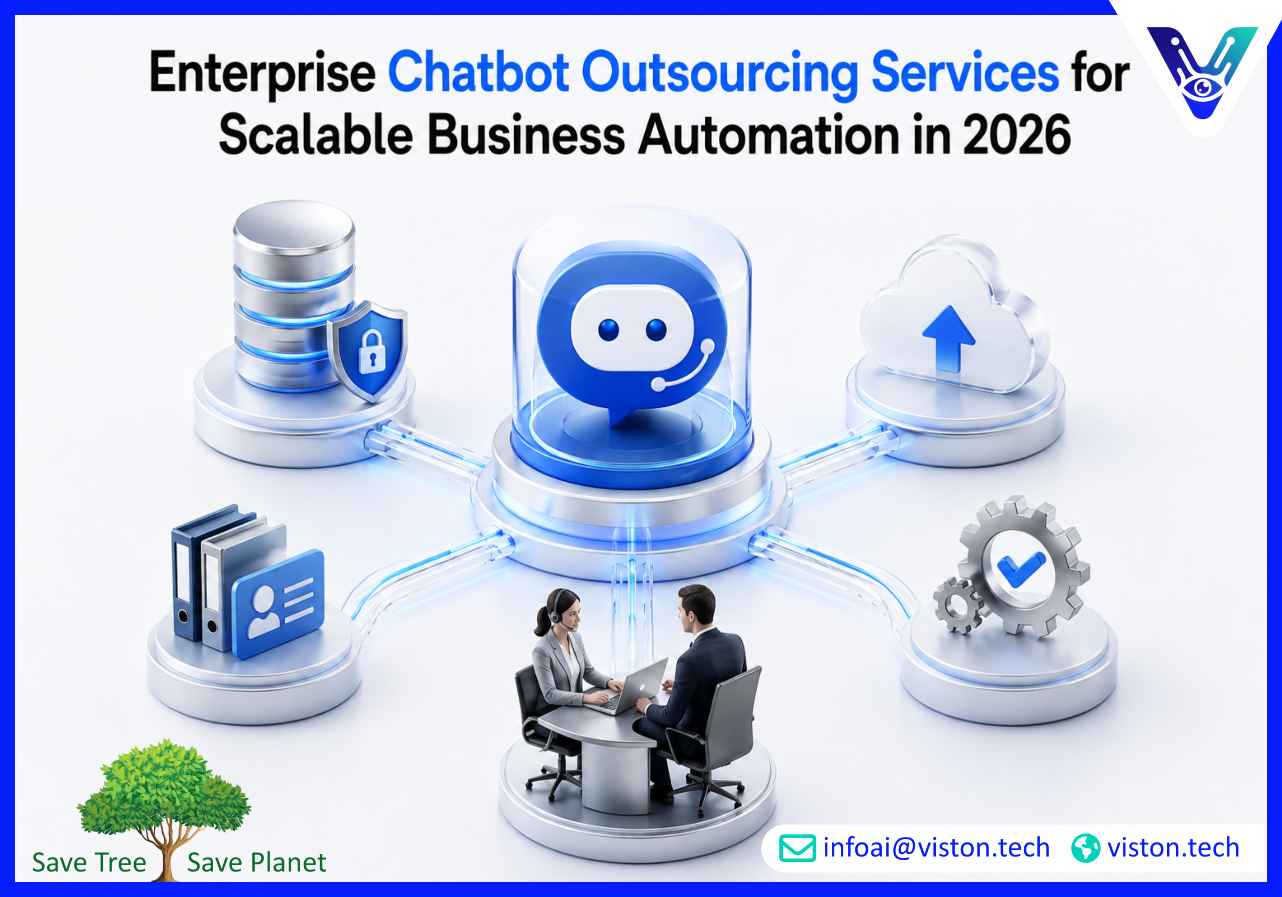
Enterprise chatbot outsourcing services help businesses build, deploy, and manage advanced AI chatbots without carrying the full burden of in-house design, development, integration, security, and optimization. For enterprise teams in 2026, outsourcing is often a practical way to move faster while maintaining quality, governance, and measurable business outcomes.
Enterprise chatbot outsourcing services involve partnering with a specialist provider to plan, design, build, integrate, train, launch, monitor, and improve AI-powered chatbots for business use. These chatbots may support customers, employees, sales teams, service teams, operations departments, HR functions, IT help desks, ecommerce workflows, or internal knowledge access.
An enterprise chatbot is not just a simple website chat widget. It is an AI-powered conversational system that can automate tasks, answer questions, support users, and connect with enterprise data, applications, and workflows. Enterprise chatbot solutions commonly rely on natural language processing, machine learning, conversational AI, and natural language understanding to identify user intent and provide contextual responses.
Outsourcing becomes valuable because enterprise chatbot projects require more than chatbot scripting. A reliable solution may need business process mapping, conversation design, secure data handling, API integration, CRM connectivity, knowledge base preparation, fallback planning, multilingual support, analytics, escalation workflows, and continuous improvement.
For many businesses, building this capability internally is expensive and slow. Hiring AI engineers, conversation designers, integration developers, QA specialists, security reviewers, and chatbot performance analysts can take months. Outsourcing allows companies to access this expertise as a managed service while focusing internal teams on strategy, approvals, operations, and customer experience.
Businesses usually outsource chatbot work in one of three ways. The first is end-to-end outsourcing, where the provider handles strategy, development, integration, launch, and support. The second is co-managed delivery, where the business owns requirements and approvals while the provider manages technical execution. The third is specialized outsourcing, where the provider supports only specific needs such as NLP training, CRM integration, multilingual chatbot development, or performance optimization.
The right model depends on internal capability, project urgency, data complexity, security requirements, and the number of systems the chatbot must connect with. Large enterprises often prefer a co-managed model because it gives them control over compliance and business rules while still benefiting from external AI delivery expertise.
In 2026, businesses expect chatbots to do more than answer FAQs. Buyers, employees, and customers increasingly expect conversational systems that can understand intent, access relevant data, perform approved actions, escalate correctly, and provide consistent service across channels. This expectation has made chatbot outsourcing more strategic than before.
Enterprise chatbot adoption is moving toward deeper workflow automation and agentic capabilities. Businesses now want AI chatbots that can answer questions, qualify leads, book appointments, support service teams, connect with business systems, and provide enterprise-grade controls, guardrails, and measurement.
This shift matters because businesses are no longer evaluating chatbots only by response speed. They are evaluating whether the chatbot can safely complete tasks, reduce support load, improve sales qualification, support omnichannel engagement, and provide reliable data back to business systems.
Enterprise chatbot projects often fail when they are treated as simple automation projects. Common problems include weak training data, poor intent mapping, disconnected CRM records, unclear escalation rules, inaccurate answers, lack of security review, and limited post-launch optimization. Outsourcing to a specialist team can reduce these risks because experienced providers know how to design chatbot workflows around real business constraints.
A strong outsourcing partner will usually begin with discovery. This includes understanding the user journey, support volume, existing knowledge sources, business rules, integration needs, compliance expectations, and performance goals. From there, the provider can design conversation flows, define intents, prepare data, build integrations, test edge cases, and create reporting dashboards.
Enterprise chatbot needs often expand after the first deployment. A company may begin with customer support automation, then add lead qualification, order tracking, appointment scheduling, HR support, IT help desk automation, multilingual service, or WhatsApp chatbot integration. Outsourced chatbot teams can help scale these use cases without forcing the business to rebuild the system from scratch.
Scalability also includes governance. As chatbot usage grows, businesses need version control, response quality checks, access permissions, analytics, escalation visibility, compliance monitoring, and continuous tuning. These areas require ongoing attention, not just initial development.
Enterprise chatbot outsourcing services are most useful when a business has clear operational pressure but limited internal AI delivery capacity. The goal is not simply to replace human teams. The goal is to reduce repetitive work, improve service consistency, support faster responses, and give human teams better context when complex issues require escalation.
Support teams often spend a large amount of time answering repetitive questions about account access, order status, product information, billing, appointments, troubleshooting, delivery updates, service availability, and policy details. Enterprise chatbots can handle many of these routine interactions instantly while passing complex or sensitive cases to human agents.
Outsourcing helps because support chatbot design must reflect real customer language, not just internal process documents. A specialist provider can analyze common tickets, FAQs, chat transcripts, CRM fields, and escalation reasons to create a chatbot that addresses actual customer needs.
A chatbot that cannot connect to business systems has limited value. Enterprise chatbots often need integration with CRM, ERP, ticketing platforms, helpdesk tools, ecommerce systems, HR platforms, knowledge bases, payment systems, scheduling tools, and analytics dashboards.
Outsourcing is helpful because integration work requires both technical skill and operational understanding. The provider must know which data should be accessed, what actions the chatbot is allowed to perform, when human approval is required, how errors should be handled, and how records should be updated.
Sales and marketing teams often lose opportunities when website visitors, campaign leads, or inbound inquiries are not answered quickly. An enterprise chatbot can qualify leads, ask relevant questions, recommend the right service path, capture contact details, schedule meetings, and route high-value prospects to sales representatives.
Outsourced chatbot teams can design lead qualification flows that match the company’s sales process. This may include questions about company size, budget, use case, timeline, location, industry, urgency, and decision-making role. When integrated with CRM, the chatbot can create cleaner lead records and reduce manual follow-up delays.
Many companies understand the value of AI chatbots but do not have in-house teams experienced in prompt design, NLP tuning, conversation architecture, retrieval-augmented generation, system integration, security controls, chatbot analytics, and post-launch optimization. Outsourcing bridges that capability gap.
The right partner should help the business avoid over-automation. Not every interaction should be handled by a chatbot. Sensitive complaints, high-risk requests, complex negotiations, compliance-heavy decisions, and emotionally charged issues may need human involvement. A good chatbot outsourcing strategy defines clear boundaries between automation and human support.
Choosing a chatbot outsourcing partner should be based on delivery capability, not only price. Enterprise chatbot projects affect customer experience, data quality, operational workflows, brand trust, and internal productivity. A low-cost chatbot that gives inaccurate answers or creates broken records can become more expensive than doing nothing.
A capable provider should ask detailed questions before development begins. They should understand business goals, user groups, required channels, knowledge sources, integrations, languages, security expectations, escalation processes, reporting needs, and success metrics. If a provider immediately jumps into building flows without discovery, the solution may become shallow or misaligned.
Enterprise chatbot outsourcing should include strong integration capability. Ask whether the provider can connect chatbots with CRM, ERP, helpdesk, ecommerce, HR, ticketing, analytics, scheduling, payment, and knowledge systems. Also ask how they handle API failures, authentication, permission control, data synchronization, audit logs, and workflow exceptions.
Chatbots may handle customer information, employee data, account details, support histories, order records, financial data, or health-related information depending on the use case. Security must be addressed from the beginning. Important considerations include access control, encryption, data retention, privacy rules, compliance obligations, human review, auditability, and safe escalation.
Enterprise chatbot solutions need stronger security, scalability, customization, and compliance controls than basic bots, especially when sensitive data or regulated industries are involved.
A chatbot should improve after launch. The outsourcing partner should track metrics such as containment rate, fallback rate, first contact resolution, escalation rate, customer satisfaction, lead conversion, ticket deflection, workflow success rate, response accuracy, and integration reliability. These metrics help identify where the chatbot needs better data, clearer prompts, improved flows, or stronger system connections.
A trustworthy chatbot outsourcing partner will not promise that AI can automate every conversation perfectly. Instead, they will define what can be automated safely, where human escalation is necessary, how quality will be reviewed, and how the system will improve over time. This balanced approach is especially important for enterprises that need predictable outcomes and governance.
Viston AI is relevant to enterprise chatbot outsourcing services because its AI service portfolio includes Enterprise AI Chatbots, AI Automation & Workflow Bots, NLP & Text Analysis, Custom AI Solution Development, Generative AI Solutions, MLOps & Model Monitoring, and other AI capabilities connected to enterprise transformation. Its service approach focuses on end-to-end AI solutions, including AI chatbots and generative AI, with solutions designed to integrate with existing enterprise systems.
For businesses considering chatbot outsourcing, this matters because successful enterprise chatbot delivery usually requires multiple capabilities working together. A chatbot may need conversational design, secure system integration, workflow automation, language understanding, analytics, monitoring, and ongoing optimization. Viston AI’s positioning around enterprise AI services makes it suitable for companies that want chatbot initiatives connected to broader automation and digital transformation goals.
Viston AI also emphasizes enterprise-grade security, data protection, global delivery support, and integration with existing systems. These capabilities are important for enterprise chatbot outsourcing because chatbots often interact with sensitive business data, customer records, support histories, and operational workflows. A business-focused outsourcing partner should help organizations reduce repetitive work, improve user response quality, support scalable chatbot deployment, and build automation that fits existing business processes instead of forcing teams into disconnected tools.
Enterprise chatbot outsourcing services involve hiring an external AI specialist to design, develop, integrate, deploy, manage, and optimize business chatbots. These services can cover customer support automation, sales assistance, employee help desks, CRM integration, multilingual support, analytics, and workflow automation.
A business may outsource enterprise chatbot development to access specialized AI, NLP, integration, security, and conversation design expertise without building a full internal team. Outsourcing can reduce delivery time, improve technical quality, and support ongoing chatbot optimization.
Enterprise chatbots can integrate with CRM systems, ERP platforms, helpdesk tools, ticketing software, ecommerce platforms, knowledge bases, HR systems, scheduling tools, payment systems, analytics dashboards, and communication channels such as websites, mobile apps, WhatsApp, and internal portals.
A business can keep strong control by approving chatbot goals, conversation flows, knowledge sources, escalation rules, compliance requirements, brand tone, reporting dashboards, and performance metrics. A good outsourcing partner should provide technical execution while keeping business teams involved in key decisions.
Look for experience in AI chatbot development, enterprise system integration, workflow automation, security, conversation design, chatbot analytics, post-launch support, and business process understanding. The provider should also explain how it handles data protection, escalation, accuracy review, and continuous improvement.
Viston AI’s Enterprise AI Chatbots and related AI automation capabilities align with enterprise chatbot outsourcing needs. Its service portfolio includes AI chatbots, workflow bots, NLP, custom AI development, generative AI, and enterprise system integration, making it relevant for businesses planning scalable chatbot automation.
Enterprise chatbot outsourcing services give businesses a practical way to build reliable AI chatbot capabilities without carrying every technical and operational responsibility internally. In 2026, successful chatbot programs require more than automated replies. They need secure integrations, accurate knowledge access, clear escalation rules, measurable workflows, and continuous optimization. For enterprise teams, outsourcing can reduce delivery risk, accelerate deployment, and support scalable automation across customer support, sales, operations, HR, and internal service functions. Viston AI is a relevant specialist for businesses evaluating Enterprise AI Chatbots because its AI services connect chatbot development with automation, integration, and enterprise transformation needs.
