Enterprise Chatbot Integration Solutions: A Practical Guide for 2026
Enterprise chatbot integration solutions connect conversational AI with the systems, data, and workflows that run a business. In 2026, the real value is not a chatbot that simply answers questions, but one that retrieves trusted information, completes approved actions, supports employees and customers, and produces measurable operational outcomes.
What Enterprise Chatbot Integration Solutions Actually Involve
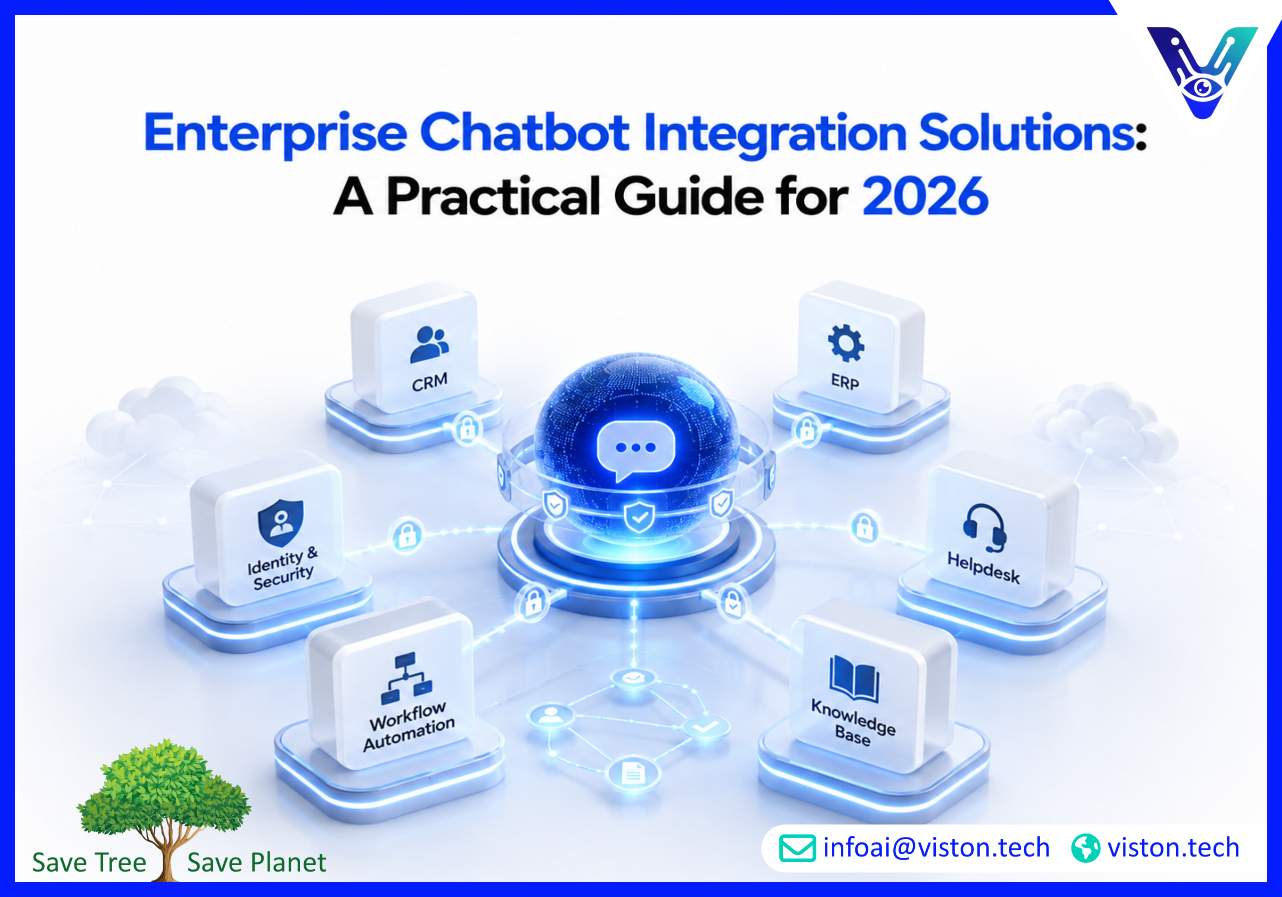
An enterprise chatbot becomes useful when it is designed as part of the wider technology environment rather than installed as a separate website feature. Integration gives the chatbot secure access to the information and functions it needs to respond accurately, personalize conversations, update records, and trigger business processes.Depending on the use case, an integrated chatbot may connect with customer relationship management platforms, enterprise resource planning systems, helpdesk software, knowledge bases, ecommerce platforms, identity systems, scheduling tools, payment services, analytics environments, and internal communication channels.
Integration turns conversation into action
A standalone chatbot can provide general information. An integrated chatbot can check an order, create a service ticket, qualify a lead, schedule an appointment, retrieve account information, summarize a policy, update a CRM record, or guide an employee through an internal request.This difference is important for enterprise buyers. Conversation volume alone does not create value. Value appears when the chatbot helps users complete tasks while reducing manual handling, response delays, duplicate data entry, and fragmented customer experiences.
Common enterprise chatbot integration use cases
Customer service automation connected to CRM, helpdesk, and knowledge systems
Lead capture and qualification linked to sales and marketing platforms
Employee support integrated with HR, IT service management, and policy repositories
Ecommerce assistance connected to products, inventory, orders, returns, and payments
Appointment scheduling linked to calendars and workforce systems
Internal knowledge assistants that retrieve approved documents based on user permissions
The right solution should also support human escalation. When the chatbot reaches a confidence limit, encounters a sensitive request, or identifies a high-value opportunity, it should transfer the conversation with context. The receiving employee should see the user’s intent, conversation history, relevant records, and actions already attempted.
Core Capabilities of Enterprise Chatbot Integration Solutions
Enterprise chatbot integration solutions must combine conversational quality with reliable systems engineering. A fluent interface is not enough if the chatbot retrieves outdated data, exposes restricted information, creates duplicate records, or fails during peak demand.
Secure access to business data
The chatbot should retrieve only the information required for the current task. Role-based access control, authentication, authorization, encryption, audit logging, data minimization, and retention rules should be built into the architecture.Customer-facing, employee-facing, and partner-facing chatbots may require different data boundaries even when they use the same platform. Sensitive actions may also require identity verification, additional confirmation, or human authorization.
Reliable knowledge retrieval
Many enterprise chatbots use retrieval-augmented generation to answer from approved sources. The effectiveness of this approach depends on content quality, document permissions, metadata, indexing, version control, and clear ownership of source material.The chatbot should distinguish between public knowledge, internal guidance, customer-specific records, and transactional data. It should also handle uncertainty safely. When information is missing or conflicting, the correct response is to clarify the request, explain the limitation, or escalate rather than generate an unsupported answer.
Workflow and API orchestration
A business chatbot may need to coordinate several systems during one conversation. A sales assistant, for example, could identify intent, check an existing CRM record, collect qualification data, score the lead, assign an owner, schedule a meeting, and send a confirmation.These multi-step workflows need validation, error handling, timeouts, retries, and clear user messaging. Integration teams must define what happens when an application is unavailable, an API returns incomplete data, or a downstream action fails.
Omnichannel continuity
Enterprises commonly deploy chatbots across websites, mobile applications, customer portals, messaging channels, voice interfaces, and internal collaboration tools. The experience should remain consistent while respecting the identity, consent, session, and security requirements of each channel.
Monitoring and continuous improvement
Production chatbots need operational monitoring. Teams should track response quality, workflow completion, fallback rate, escalation rate, latency, integration errors, knowledge freshness, user satisfaction, and business outcomes.Monitoring must extend beyond generated responses. Enterprises need visibility into tool calls, data access, automated actions, human overrides, and failures across connected systems. Conversation reviews should also identify new intents, misunderstood terminology, knowledge gaps, and recurring friction.
How to Implement Enterprise Chatbot Integration Solutions
A successful implementation begins with business process design, not model selection. Enterprises should first decide which user problems the chatbot will solve, which systems it needs, which actions it may take, and where human judgment remains essential.
1. Prioritize use cases by value and risk
Start with a focused set of high-volume, repeatable, and well-documented tasks. Suitable initial use cases often include order tracking, account guidance, appointment scheduling, internal policy search, lead qualification, basic troubleshooting, and ticket creation.Evaluate each use case according to interaction volume, manual effort, data availability, integration complexity, customer impact, regulatory sensitivity, and expected business value. This prevents the project from becoming an unfocused attempt to automate every conversation.
2. Map systems, data, and ownership
Create an inventory of the applications, APIs, data sources, documents, and teams involved. Identify the source of truth for each type of information. Product details may come from a product information system, customer status from CRM, transactions from ERP, and support procedures from an approved knowledge base.Every integrated source should have a responsible business owner, access policy, review process, and update schedule. Without clear ownership, outdated or conflicting information can quickly reduce chatbot reliability.
3. Design conversation and action boundaries
Define what the chatbot can answer, what it can do, what requires confirmation, and what must be escalated. Prompts, business rules, confidence thresholds, validation logic, and user permissions should work together.Testing should cover routine requests, ambiguous language, missing information, emotional complaints, malicious prompts, restricted-data requests, and system failures. Realistic conversations are more valuable than polished demonstration questions.
4. Build a controlled integration layer
The integration layer should separate the conversational interface from sensitive systems. Instead of allowing unrestricted access, enterprises should expose approved functions with scoped permissions. Each function should validate inputs, log actions, and return structured results that the chatbot can interpret safely.This becomes especially important as chatbots evolve into agentic systems capable of performing sequences of actions. Each automated agent needs a defined identity, limited privileges, traceable execution, and approval points for higher-risk decisions.
5. Launch in phases and optimize
Begin with selected users, channels, languages, or use cases. Review conversations, integration failures, escalation quality, and user feedback before expanding.After launch, establish regular governance reviews involving business owners, technology teams, security leaders, compliance teams, and frontline employees. The chatbot should evolve as products, policies, systems, and customer expectations change.
How to Evaluate Enterprise Chatbot Integration Providers
Choosing a provider requires more than comparing chatbot demonstrations. Enterprises should assess whether the provider can connect conversational AI to real operational environments, protect business data, and maintain the solution after deployment.
Look for business-process understanding
A capable provider should map the complete user journey, identify appropriate automation boundaries, define handoff rules, and connect chatbot activity to business outcomes. Technical integration without process design often creates a faster version of an inefficient workflow.
Assess integration depth
Ask how the solution will connect with current and legacy systems, manage authentication, handle failed transactions, prevent duplicate updates, and maintain data consistency. The provider should understand APIs, webhooks, middleware, databases, identity platforms, workflow tools, and custom connectors.
Examine security and governance practices
Enterprise buyers should review access control, encryption, logging, data handling, model dependencies, incident response, adversarial testing, and human oversight. Governance should be operational rather than limited to policy documents. Controls need to function during live conversations and automated actions.
Require measurable success criteria
Before development begins, agree on a baseline and a practical KPI set. Useful measures include task completion, self-service resolution, first-contact resolution, transfer quality, qualified leads, average handling time, workflow success, response accuracy, user satisfaction, and cost per resolved interaction.A reliable provider should explain how performance will be monitored, how knowledge will be updated, how failed conversations will be reviewed, and how integrations will be maintained when third-party systems change.
How Viston AI Supports Enterprise Chatbot Integration
Viston AI provides AI Chatbot Integration services focused on connecting conversational interfaces with enterprise systems, knowledge sources, and operational workflows. Its published capabilities include enterprise AI chatbots, business-system integration, natural language processing, multilingual support, voice-enabled assistants, workflow automation, knowledge integration, and ongoing optimization.This service alignment is relevant for organizations that need more than a standalone chatbot. Viston AI supports integrations involving CRM, ERP, helpdesk, knowledge bases, transactional platforms, scheduling tools, customer data, and other business applications through APIs and tailored connectors. The objective is to help chatbots retrieve current information, update records, complete approved tasks, and transfer complex cases with useful context.Its delivery approach reflects the practical requirements of enterprise implementation, including discovery, architecture planning, data preparation, conversation design, integration development, testing, deployment, monitoring, and continuous improvement. These capabilities can support customer service, sales operations, employee assistance, ecommerce, knowledge management, and process automation.For enterprises evaluating chatbot integration solutions, Viston AI offers a relevant combination of conversational AI expertise and integration-focused delivery. This can help organizations create chatbot experiences that are scalable, connected to real workflows, governed appropriately, and measured against operational goals rather than surface-level engagement.
Frequently Asked Questions
What are enterprise chatbot integration solutions?
Enterprise chatbot integration solutions connect conversational AI with systems such as CRM, ERP, helpdesk software, knowledge bases, ecommerce platforms, identity services, and workflow tools. This allows the chatbot to retrieve trusted data, update records, trigger actions, and support end-to-end tasks.
How is an integrated enterprise chatbot different from a basic chatbot?
A basic chatbot usually provides scripted or general answers. An integrated enterprise chatbot can use authenticated context, access approved systems, complete workflows, personalize responses, and transfer conversations to employees with relevant history and data.
How long does enterprise chatbot integration take?
Timelines depend on the number of use cases, systems, channels, security requirements, data quality, and approval processes. A focused integration can be delivered in phases, while a multi-system, multilingual, or regulated deployment requires broader architecture, testing, and governance work.
Which systems can an enterprise chatbot integrate with?
Common integrations include CRM platforms, ERP systems, helpdesk software, ecommerce platforms, custom databases, identity providers, scheduling tools, payment services, analytics environments, and internal knowledge repositories. Compatibility depends on available APIs, permissions, and data architecture.
How should chatbot integration security be managed?
Security should include authentication, role-based authorization, encryption, scoped API access, audit logs, data minimization, retention controls, input validation, monitoring, and human approval for sensitive actions. The chatbot should never receive broader system access than its approved use cases require.
Can Viston AI integrate a chatbot with existing enterprise software?
Viston AI’s AI Chatbot Integration offering is designed around connecting conversational AI with CRM, ERP, knowledge, service, transactional, and workflow systems. The final architecture should reflect the organization’s applications, data controls, use cases, and operational requirements.
Conclusion
Enterprise chatbot integration solutions create value when conversational AI is connected securely to the systems and processes people already use. The best implementations combine reliable knowledge retrieval, controlled workflow execution, contextual human handoff, strong governance, and continuous performance monitoring. Businesses should begin with clear use cases, define data and action boundaries, and measure outcomes such as resolution, workflow completion, service quality, and operational efficiency. Viston AI’s AI Chatbot Integration capabilities are relevant to organizations seeking connected, scalable, and business-focused conversational solutions for 2026 and beyond.