
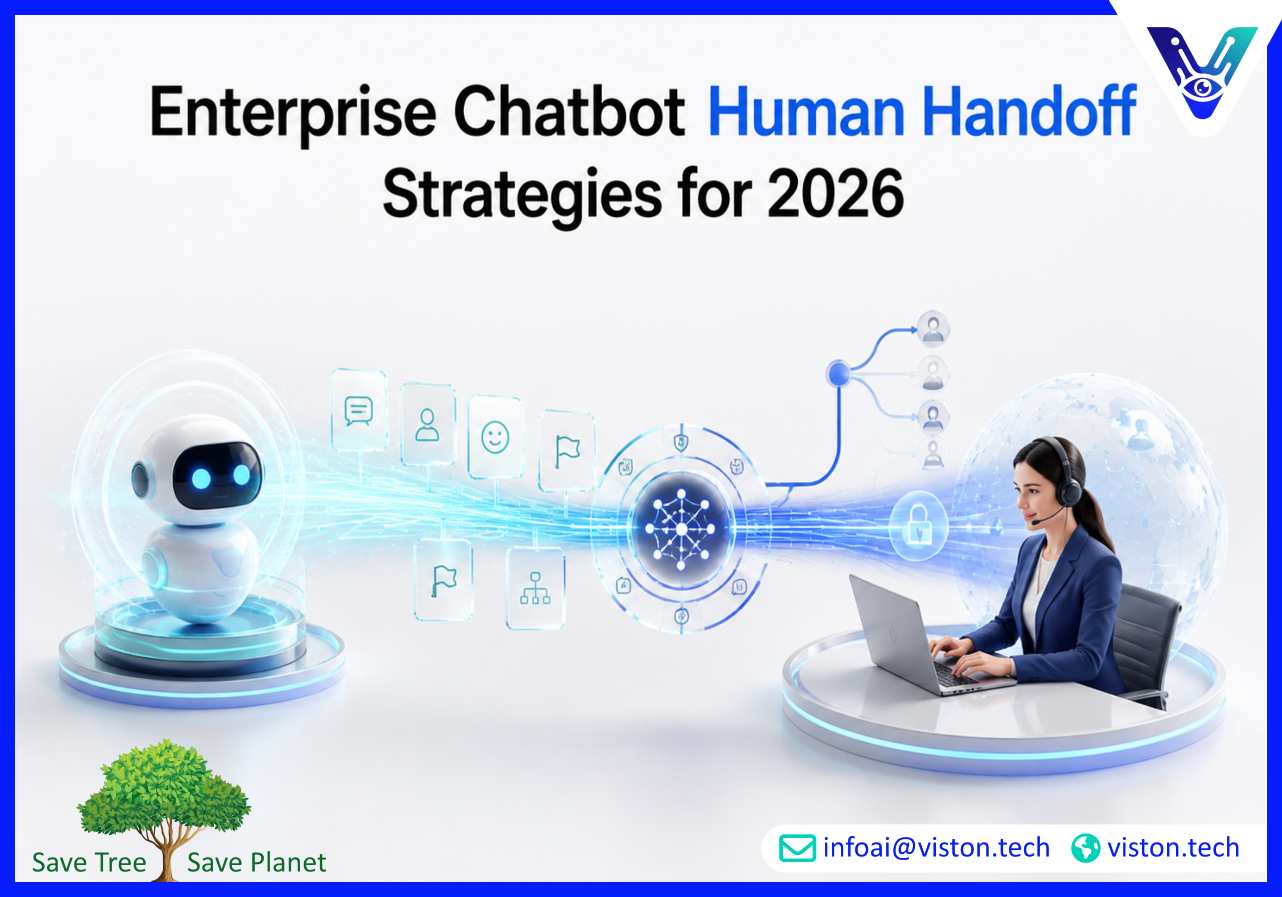
Enterprise chatbot human handoff strategies matter because automation should never leave customers, employees, or partners trapped in a poor conversation. In 2026, effective Enterprise AI Chatbots need clear escalation logic, complete context transfer, agent-ready summaries, and measurable workflows that balance speed with human judgment.
Enterprise chatbot human handoff strategies define how, when, and why a chatbot transfers a conversation to a human agent. This is not just a customer support feature. It is a core part of enterprise chatbot design because every business has moments where automation must step aside for empathy, authority, compliance, negotiation, investigation, or exception handling.
A strong handoff strategy ensures that the chatbot handles routine, repetitive, and structured interactions while human teams focus on situations that require judgment. Poor handoff design creates frustration. Users repeat information, agents lack context, tickets become messy, and teams lose confidence in automation. Good handoff design makes the transition feel natural, informed, and useful.
In enterprise environments, handoff planning is especially important because chatbots often connect with CRM systems, helpdesk tools, knowledge bases, order platforms, HR systems, ticketing workflows, and internal service desks. A transfer is not simply a change from bot to person. It is a controlled operational workflow that must carry the right data, assign the right team, protect sensitive information, and preserve the customer journey.
Many businesses make the mistake of treating escalation as a negative KPI. In reality, the right escalation is a sign of a mature chatbot system. Enterprise AI Chatbots should not aim to resolve every conversation at any cost. They should know their limits and escalate when a better outcome depends on human expertise.
For example, a chatbot may answer product questions, collect account details, verify intent, check order status, and suggest troubleshooting steps. But if the customer is angry, the issue is legally sensitive, the request involves account-specific approval, or the workflow falls outside policy, the chatbot should transfer the case to a trained person.
The goal is not to avoid human involvement. The goal is to reduce unnecessary human workload while improving the quality of human involvement where it matters most.
Business buyers now expect enterprise chatbot systems to support:
For enterprise teams, the handoff strategy should be designed before deployment, not patched after complaints appear. It affects user trust, service quality, agent productivity, automation ROI, and operational risk.
A chatbot should escalate when the risk of continuing automation becomes higher than the value of keeping the conversation automated. The best handoff strategies use multiple signals rather than relying on one basic rule. A keyword trigger alone is not enough for enterprise-grade operations.
If the chatbot cannot understand the user’s request with enough confidence, it should ask one or two clarifying questions. If the intent remains unclear, the conversation should move to a human or create a ticket. Repeated fallback messages damage trust quickly, especially in customer support, banking, healthcare, insurance, SaaS, retail, telecom, and internal IT environments.
Intent confidence thresholds should be adjusted by use case. A low-risk FAQ may allow more automation. A billing dispute, account access issue, medical intake question, compliance request, or contractual concern should require stricter escalation rules.
Sentiment analysis can help identify frustration, urgency, anger, confusion, or dissatisfaction. A user who says “this is not helping,” “I need a person,” or “I have already tried this” should not be forced through more automated steps. The chatbot should acknowledge the problem and transfer the conversation with context.
This matters because poor escalation timing often turns a simple service issue into a brand experience problem. Enterprise AI Chatbots should be designed to recognize emotional signals, not only transactional intents.
Some conversations deserve human attention because of their commercial or operational impact. Examples include enterprise sales inquiries, renewal negotiations, refund exceptions, legal complaints, security incidents, patient concerns, financial disputes, partner onboarding, and large account escalations.
In these cases, the chatbot can still add value before handoff. It can collect relevant information, verify the user, classify the issue, identify urgency, and route the case to the correct team. That preparation helps the human agent respond faster and more accurately.
Enterprise chatbots should not make decisions they are not authorized to make. If a request requires approval, regulatory interpretation, exception handling, identity verification, or sensitive account changes, escalation should be built into the workflow.
This is especially important for industries with strict privacy, security, or compliance requirements. The chatbot should follow predefined boundaries, log the interaction, and pass the case to a qualified human when needed.
If a user directly asks for a human agent, the chatbot should not block the request through repeated deflection. It may ask for a short reason to route the conversation properly, but the transfer path should remain visible and respectful. Hiding human support can reduce short-term ticket volume but increase dissatisfaction, complaints, and abandonment.
A smooth handoff depends on workflow design, not only chatbot intelligence. The chatbot, routing system, support platform, and human team must work together. For enterprise buyers, this is where implementation quality becomes visible.
Before transferring, the chatbot should gather useful details such as name, account ID, order number, issue category, urgency, preferred contact method, affected product, and previous troubleshooting steps. However, it should not overburden users with unnecessary questions.
The best approach is to collect the minimum information required for accurate routing and faster resolution. Every question should serve a purpose. If agents will not use the answer, the chatbot should not ask for it.
Agents should not need to read a long transcript before helping the user. A strong handoff workflow provides a short structured summary that includes:
This makes the human agent more effective from the first response. It also reduces the common frustration of customers having to repeat everything after escalation.
Enterprise chatbot handoff should not send every conversation to the same queue. Routing should consider the user’s need, customer segment, region, language, product line, service level agreement, account value, and issue severity.
For example, a technical issue from an enterprise account may need a senior support engineer. A billing question may go to finance support. A product inquiry from a qualified lead may go to sales. An HR policy question from an employee may go to internal people operations. Intelligent routing improves resolution speed and protects agent capacity.
The chatbot should tell users what is happening. A simple message such as “I’m connecting you with a support specialist and sharing the details you’ve already provided” is better than a silent transfer. If live support is unavailable, the chatbot should offer alternatives such as ticket creation, scheduled callback, email follow-up, or self-service resources.
Expectation-setting reduces anxiety and gives users confidence that the conversation is moving forward.
Human handoff does not always mean the chatbot stops working. In advanced enterprise setups, the chatbot can assist the agent behind the scenes by suggesting responses, surfacing knowledge base articles, summarizing the conversation, checking policies, and automating follow-up tasks.
This hybrid model is valuable because it combines human judgment with AI-assisted speed. It can improve agent productivity without making customers feel they are dealing with unsupported automation.
To make enterprise chatbot human handoff strategies effective, businesses need implementation discipline. The handoff process should be tested, measured, governed, and improved continuously. A chatbot that escalates correctly during a demo may still fail under real-world volume, unclear requests, multilingual conversations, complex integrations, or compliance constraints.
Businesses should track handoff performance through practical KPIs, including:
These metrics help teams understand whether escalation is happening at the right moment and whether agents are receiving useful context. A high escalation rate is not automatically bad. It may show that the chatbot is handling complex users responsibly. The important question is whether escalations lead to better outcomes.
One common mistake is forcing users through long automated flows before offering human support. Another is transferring without context, which makes the agent restart the conversation. Some companies also rely too heavily on generic triggers, such as “speak to agent,” without considering sentiment, risk, account value, or workflow stage.
Other issues include poor integration with helpdesk tools, unclear ownership between bot and agent teams, lack of multilingual routing, missing audit logs, weak data privacy rules, and no feedback loop for failed conversations. These problems usually appear after launch, when customer volume increases and edge cases become more visible.
Enterprise chatbot handoff workflows must protect sensitive data. The chatbot should avoid exposing confidential details in inappropriate channels, enforce role-based access, maintain audit logs, and apply data retention rules. For regulated industries, escalation workflows may also need consent capture, identity verification, and strict routing to trained personnel.
Businesses should define what information the chatbot can collect, what it can pass to agents, what must be masked, and how records should be stored. Human handoff is part of the security model, not separate from it.
Handoff strategies should improve over time. Conversation reviews can reveal missed intents, confusing flows, weak knowledge base content, unsupported languages, poor confidence thresholds, or unnecessary escalations. Teams should use these insights to refine chatbot training, update routing rules, improve agent summaries, and expand automation safely.
The best enterprise chatbot programs treat handoff data as a learning system. Every escalation can show where automation should improve and where human expertise should remain central.
Viston AI is relevant to enterprise chatbot human handoff strategies because its Enterprise AI Chatbots service focuses on conversational AI built for complex business environments, including contextual conversations, business system integration, multilingual experiences, workflow automation, and escalation logic. For organizations implementing Enterprise AI Chatbots, these capabilities are important because human handoff depends on more than a chat interface.
Viston AI’s chatbot offering connects conversational experiences with CRM systems, knowledge bases, transactional systems, and enterprise workflows. This supports smoother escalation because agents can receive conversation history, customer context, detected intent, and relevant business data instead of starting from zero. Its service positioning also includes configurable escalation triggers based on sentiment, keywords, conversation duration, confidence scores, and business rules, which are directly aligned with practical handoff design.
For businesses across industries such as finance, healthcare, retail, manufacturing, education, telecom, hospitality, and internal operations, Viston AI can help design chatbot workflows that automate routine requests while preserving human involvement for complex or sensitive cases. This makes its Enterprise AI Chatbots service useful for companies that want scalable automation without weakening service quality, compliance control, or customer trust.
A chatbot human handoff strategy is the process that decides when a chatbot should transfer a conversation to a human agent, what information should be passed, which team should receive it, and how the user experience should continue after escalation.
An enterprise chatbot should transfer to a human when intent is unclear, confidence is low, the user is frustrated, the issue is high-risk, the request requires approval, or the customer directly asks for human support.
Businesses can improve chatbot handoff by collecting only necessary information, creating structured agent summaries, routing by skill and priority, integrating with CRM or helpdesk systems, and setting clear expectations during transfer.
No. A high escalation rate may indicate poor chatbot design, but it can also show that the system is responsibly transferring complex or sensitive conversations. The quality of escalation outcomes matters more than the rate alone.
Chatbot handoff should integrate with tools such as CRM platforms, helpdesk systems, live chat software, ticketing tools, knowledge bases, customer data platforms, order management systems, and internal workflow platforms.
Yes. Viston AI’s Enterprise AI Chatbots service is aligned with human handoff planning because it supports conversational AI, enterprise integrations, contextual routing, escalation logic, and workflow automation for business environments.
Enterprise chatbot human handoff strategies are essential for building automation that users can trust. A chatbot should resolve routine requests efficiently, but it must also recognize when a human agent is needed. In 2026, successful Enterprise AI Chatbots depend on clear escalation triggers, strong routing logic, complete context transfer, agent-ready summaries, security controls, and continuous optimization. Businesses that design handoff properly can improve customer experience, reduce unnecessary support workload, protect service quality, and make automation more practical at scale. Viston AI’s enterprise chatbot capabilities make it a relevant partner for organizations building chatbot workflows where automation and human expertise need to work together.
