
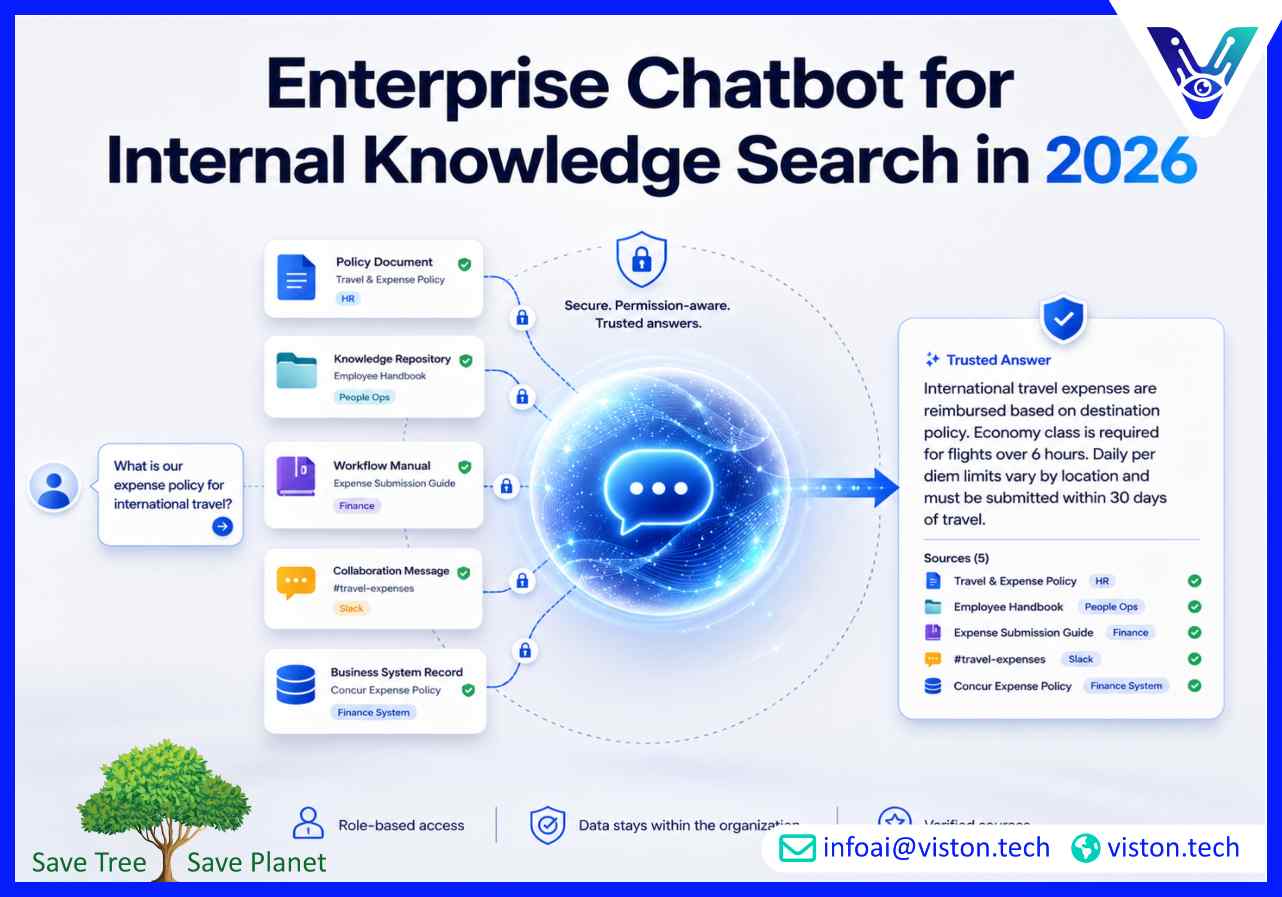
An enterprise chatbot for internal knowledge search helps employees find trusted answers from company documents, policies, systems, and workflows faster. In 2026, this matters because business knowledge is often scattered across tools, teams, files, and platforms, making accurate internal access a serious productivity and governance priority.
An enterprise chatbot for internal knowledge search is a conversational AI assistant designed to help employees ask work-related questions and receive answers grounded in approved company knowledge. Instead of searching through folders, intranet pages, PDFs, helpdesk articles, CRM notes, Slack threads, SharePoint libraries, Confluence spaces, HR portals, or operational manuals, employees can ask a question in natural language and receive a relevant response.
This type of chatbot is different from a basic customer service bot. It is built for internal business use, where the information may be sensitive, role-specific, frequently updated, and spread across multiple systems. A strong enterprise AI chatbot must understand business terminology, retrieve accurate information, respect access permissions, and show employees where the answer came from when source visibility is required.
For example, an employee might ask, “What is the approval process for a vendor above $25,000?” or “Where can I find the latest onboarding checklist for the sales team?” A well-designed internal knowledge chatbot should search the right knowledge sources, identify the most current answer, and avoid exposing information the user is not allowed to access.
Many organizations already have search tools, but employees still struggle to find reliable answers. The problem is rarely a lack of information. The bigger issue is that information is fragmented, duplicated, outdated, poorly tagged, or locked inside different tools. Employees may not know whether the latest process lives in an intranet article, a project workspace, a policy PDF, a ticketing system, or a department drive.
Traditional keyword search also depends heavily on exact wording. If an employee searches for “remote work policy” but the official document is titled “hybrid working guidelines,” the right result may not appear. Enterprise AI chatbots improve this experience by interpreting intent, understanding related language, and retrieving information based on meaning rather than only keywords.
In 2026, internal knowledge search has become a business performance issue, not just an IT convenience. Companies are operating with distributed teams, complex software stacks, growing compliance obligations, and rising expectations for faster decision-making. When employees cannot quickly find trusted information, productivity declines and business risk increases.
Internal knowledge gaps affect many departments. HR teams answer repeated policy questions. IT teams handle basic troubleshooting requests. Operations teams explain processes that already exist in documentation. Sales teams waste time searching for pricing rules, product notes, proposal templates, and customer context. Compliance teams worry that employees may follow outdated instructions. These issues create hidden costs across the business.
An enterprise chatbot for internal knowledge search helps reduce this friction by making institutional knowledge easier to access. Employees can get answers inside the tools they already use, such as Microsoft Teams, Slack, internal portals, service desks, or custom business applications. This improves speed while reducing dependency on subject matter experts for repetitive questions.
The most valuable internal chatbots do more than answer simple questions. They help employees navigate complex knowledge environments, summarize long documents, compare policy versions, suggest next steps, and route unresolved questions to the right team. This turns knowledge search into a practical operational capability.
Enterprise AI Chatbots improve internal knowledge discovery by combining conversational interfaces, natural language processing, retrieval systems, access controls, and business system integration. The goal is not simply to generate answers. The goal is to deliver accurate, useful, permission-aware responses from trusted enterprise knowledge.
Modern internal knowledge chatbots often use retrieval-augmented generation, commonly known as RAG. This approach allows the chatbot to retrieve relevant information from approved internal sources before generating an answer. Instead of relying only on a model’s general training, the chatbot grounds its response in company-specific content.
For business users, this means the chatbot can answer questions about internal procedures, product documentation, compliance requirements, service workflows, technical guides, HR policies, sales enablement materials, and operational instructions. For technology teams, it means the chatbot must be connected to clean, indexed, and permission-managed knowledge sources.
Internal knowledge search must respect who is asking the question. A finance manager, HR executive, sales representative, contractor, and support agent should not automatically see the same information. Enterprise-grade chatbots need role-based access controls, identity integration, audit logs, encryption, and secure retrieval logic.
This is especially important when the chatbot connects to sensitive documents such as compensation policies, legal files, customer contracts, financial reports, internal roadmaps, security procedures, or regulated data. If permissions are not handled correctly, an internal chatbot can create more risk than value.
Business users need confidence that chatbot answers are trustworthy. For internal knowledge search, source visibility is often essential. The chatbot should be able to show which document, policy, ticket, or knowledge base article supported the answer. This helps employees verify information and gives administrators a way to audit performance.
Confidence scoring, fallback handling, and escalation rules also matter. When the chatbot cannot find a reliable answer, it should say so clearly and route the question to the correct owner. A good internal knowledge chatbot does not guess when the business impact of a wrong answer is high.
An effective chatbot should connect with the systems where knowledge actually lives. This may include SharePoint, Google Drive, Confluence, Notion, Slack, Microsoft Teams, ServiceNow, Jira, Zendesk, Salesforce, HubSpot, ERP systems, HRIS platforms, learning management systems, and data warehouses.
The quality of integration directly affects the quality of answers. If the chatbot only reads a small portion of company knowledge, employees will quickly lose trust. If it connects broadly but ignores permissions, security risk increases. The right implementation balances coverage, accuracy, governance, and usability.
Successful implementation begins with knowledge strategy, not chatbot design. Many companies want an AI chatbot before they have organized their internal content. However, messy knowledge creates messy answers. Before deployment, businesses should identify the most valuable use cases, clean critical documents, define ownership, and decide which systems should be connected first.
Companies should begin with use cases where employees ask repeated questions and the answers already exist in documented form. Common starting points include HR policies, IT support, onboarding, sales enablement, procurement procedures, compliance guidance, customer support playbooks, product documentation, and internal operations manuals.
Starting with focused use cases makes the chatbot easier to test, govern, and improve. Once the organization has confidence in accuracy and adoption, the chatbot can expand to additional departments and more complex workflows.
Knowledge quality is one of the biggest success factors. Documents should be current, clearly structured, deduplicated where possible, and assigned to content owners. Outdated information should be archived or marked clearly. Sensitive content should be classified before indexing.
Governance should define who can add knowledge, who approves updates, how often content is reviewed, and how the chatbot handles conflicting information. Without this governance layer, the chatbot may surface inconsistent answers from multiple outdated sources.
An internal chatbot must be easy to use. Employees should be able to ask natural questions, refine answers, open source documents, and continue the conversation without learning special commands. The chatbot should also understand department-specific language, abbreviations, product names, internal acronyms, and workflow terminology.
Placement matters as well. If employees work inside Teams, Slack, or an internal portal, the chatbot should be available there. A separate tool that employees must remember to open may receive low adoption, even if the technology is strong.
Internal knowledge search should be measured using practical KPIs. Useful metrics include answer accuracy, search success rate, fallback rate, employee satisfaction, repeated question reduction, support ticket deflection, average time to answer, source coverage, and escalation quality.
Teams should review failed questions regularly. These failures often reveal missing documents, unclear policies, outdated content, poor tagging, or new employee needs. Continuous optimization is essential because company knowledge changes constantly.
Viston AI is relevant to enterprise chatbot for internal knowledge search because its Enterprise AI Chatbots service focuses on building conversational AI for complex business environments. Its capabilities align with internal knowledge use cases where companies need secure, contextual, and integrated chatbot experiences connected to knowledge bases and enterprise systems.
For internal search, this type of service is valuable because the chatbot must do more than respond conversationally. It needs to connect with business knowledge sources, understand internal terminology, support accurate retrieval, maintain contextual continuity, and fit into existing workflows. Viston AI’s service positioning around enterprise AI chatbots, natural language understanding, knowledge integration, workflow automation, analytics, and business system integration makes it suitable for organizations that want internal AI assistants built around operational needs rather than generic chatbot templates.
Viston AI can support businesses that need employees to access HR policies, IT guides, support playbooks, product documents, onboarding material, process manuals, and department-specific knowledge through a conversational interface. Its enterprise-focused approach is also relevant for companies that require secure access control, auditability, multilingual support, escalation handling, and ongoing chatbot optimization. For global organizations, internal knowledge search can help standardize answers across teams while still respecting role-based permissions and local business requirements.
An enterprise chatbot for internal knowledge search is an AI-powered assistant that helps employees find answers from approved company documents, policies, systems, and knowledge bases using natural language questions.
A regular chatbot may answer general customer questions or follow simple scripted flows. An internal knowledge chatbot connects with enterprise systems, respects employee permissions, retrieves company-specific information, and supports business workflows.
It can connect to tools such as SharePoint, Google Drive, Confluence, Slack, Microsoft Teams, Jira, ServiceNow, CRM platforms, HR systems, helpdesk software, intranet portals, and internal document repositories.
It can be secure when designed with role-based access, identity management, encryption, audit logging, permission-aware retrieval, data classification, and strong governance. Security should be part of the architecture from the beginning.
HR, IT, operations, sales, customer support, finance, compliance, product, and training teams often benefit because they manage high volumes of repeated questions, process documents, policies, and internal instructions.
Viston AI’s Enterprise AI Chatbots service is aligned with internal knowledge search needs because it focuses on enterprise conversational AI, knowledge integration, workflow automation, natural language understanding, and secure business system connectivity.
An enterprise chatbot for internal knowledge search helps businesses turn scattered internal information into accessible, useful, and governed answers. In 2026, this capability is becoming important for productivity, employee experience, onboarding, compliance, and operational consistency. The best results come from combining Enterprise AI Chatbots with clean knowledge sources, secure integrations, role-based access, source visibility, and continuous optimization. For organizations that want employees to find trusted information faster, internal knowledge search is no longer just a search upgrade. It is a practical step toward a smarter, more connected enterprise knowledge environment.
