
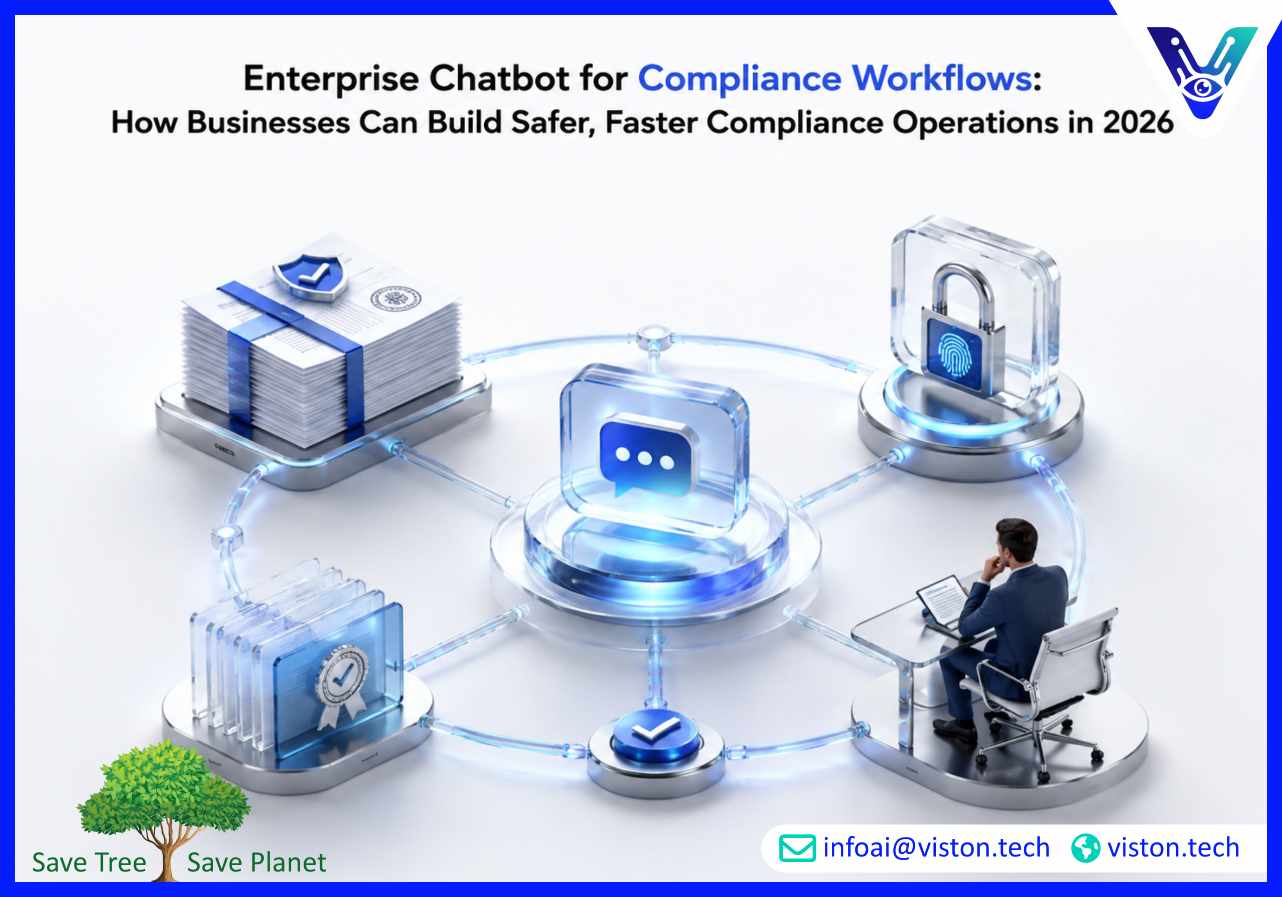
Enterprise chatbot for compliance workflows is becoming a practical priority for organizations that need faster policy access, stronger audit readiness, and more consistent employee guidance across regulated business processes.
An enterprise chatbot for compliance workflows is not a simple FAQ bot. It is a secure conversational AI system designed to help employees, compliance teams, legal teams, operations managers, and business users follow approved policies, complete compliance tasks, and access controlled information through a guided interface.
In a business environment, compliance work often depends on multiple systems, documents, approvals, and rules. Employees may need to check data handling policies, vendor onboarding requirements, financial controls, HR procedures, cybersecurity rules, customer communication standards, or industry-specific obligations. Without a structured process, teams can waste time searching through long policy documents or asking the same questions repeatedly.
A compliance chatbot helps turn scattered knowledge into a usable workflow. It can answer policy questions, guide users through approval steps, collect required information, route requests to the right owner, summarize requirements, and create records for review. When connected to enterprise systems, it can also support ticket creation, case routing, audit documentation, knowledge base retrieval, and escalation to human experts.
The main value is consistency. Compliance workflows depend on repeatable decisions, clear evidence, and controlled access to information. A well-designed enterprise chatbot gives users a single, governed way to interact with policies and processes while reducing the risk of informal, inconsistent, or undocumented guidance.
In 2026, compliance teams are under pressure to support faster business operations while maintaining accountability. Enterprises are adopting AI, automation, cloud platforms, distributed teams, and complex third-party ecosystems. This creates more compliance touchpoints, more data movement, and more decisions that need to be documented.
Traditional compliance support models are often too slow for modern operations. Employees may wait for email responses, search outdated documents, or bypass formal processes because the approved route feels difficult. This creates operational risk. A chatbot cannot replace legal or compliance leadership, but it can make approved processes easier to follow.
For businesses using AI and automation, governance expectations are also becoming more operational. Companies need stronger controls around data access, explainability, escalation, monitoring, consent, retention, and auditability. Recent enterprise AI discussions increasingly emphasize that governance must move beyond static policy documents into real-time enforcement, monitoring, and evidence generation.
This is where enterprise chatbots become useful. They can provide controlled access to policy content, enforce required questions before a workflow proceeds, capture decision context, and escalate uncertain cases. Instead of leaving compliance knowledge buried in files, businesses can make it available at the point of action.
Many companies already have compliance documents, training materials, and approval rules. The challenge is execution. Employees need to know which rule applies, what information is required, who must approve, and what evidence must be saved. A compliance chatbot can support this execution layer by translating policy into guided workflows.
For example, an employee asking whether customer data can be shared with a vendor may need more than a yes or no answer. The chatbot may need to ask about data type, geography, vendor status, processing purpose, contract status, consent, retention period, and internal approval requirements. This turns a broad question into a structured compliance decision.
Compliance workflows require more control than general customer service automation. A chatbot used in this environment must be designed for accuracy, security, traceability, and escalation. It should not invent policies, provide unsupported legal conclusions, or make high-risk decisions without human review.
The chatbot should retrieve answers from approved sources such as policy documents, SOPs, internal knowledge bases, control libraries, risk registers, regulatory guidance summaries, and compliance playbooks. Retrieval-augmented generation can help the chatbot provide grounded responses instead of relying only on model memory.
Not every employee should see every compliance answer or document. A strong enterprise chatbot should respect role-based permissions, department rules, location rules, and data classification policies. For example, finance, HR, legal, security, and procurement teams may each require different access levels.
A compliance chatbot becomes more valuable when it can do more than answer questions. It should help create tickets, trigger approval workflows, assign tasks, send reminders, collect forms, update records, and connect with tools such as CRM, ERP, HRIS, service desks, GRC platforms, document management systems, and collaboration tools.
Compliance teams need to know what was asked, what was answered, which source was used, who approved the request, when the decision happened, and whether any exception was raised. Audit trails are increasingly discussed as an accountability mechanism for AI-supported workflows because they help organizations reconstruct decisions and lifecycle events.
Some compliance questions require expert judgment. The chatbot should escalate uncertain, sensitive, or high-risk cases to legal, compliance, security, or risk teams. Good escalation design includes conversation history, extracted facts, confidence level, source references, and recommended next steps so the human reviewer does not start from zero.
Compliance content changes. Regulations, internal policies, vendor requirements, and security standards evolve. The chatbot should be monitored for answer quality, fallback rate, unresolved questions, outdated content, escalation patterns, and user satisfaction. Continuous improvement is essential for trust.
Implementation should begin with a clear scope. Businesses should not try to automate every compliance process at once. The best starting point is usually a high-volume, repeatable workflow where approved rules already exist and the risk can be controlled.
Good candidates include policy lookup, vendor intake, internal data handling questions, security questionnaire support, employee compliance guidance, audit evidence requests, or routine approval routing. These workflows are valuable because they reduce repetitive work while preserving human oversight for complex issues.
The chatbot should be built around verified content. Teams should review policies, remove outdated documents, define ownership, and decide which sources the chatbot can use. If the knowledge base is messy, the chatbot will surface that weakness. A compliance chatbot is only as reliable as the governance around its content.
Every workflow should have clear boundaries. Low-risk questions may be answered directly. Medium-risk cases may require confirmation or a checklist. High-risk cases should be routed to a human specialist. This prevents the chatbot from becoming an uncontrolled decision-maker.
Users should understand why the chatbot is asking certain questions or recommending a next step. Compliance workflows work better when the chatbot explains the policy basis, required evidence, and approval path in plain language. This improves adoption and reduces frustration.
A compliance chatbot should fit into the tools people already use. This may include Microsoft Teams, Slack, intranet portals, HR platforms, ticketing tools, document repositories, GRC software, CRM systems, or workflow automation platforms. Integration reduces manual copying and improves record quality.
Testing should include real user questions, edge cases, outdated policy detection, permission checks, multilingual queries, escalation handoffs, and audit log review. Teams should also test whether the chatbot refuses unsupported requests instead of giving confident but unverified answers.
Viston AI is relevant to enterprise chatbot for compliance workflows because its Enterprise AI Chatbots service focuses on secure, scalable conversational AI for complex business environments. The company describes its chatbot capabilities around enterprise complexity, multi-channel interactions, CRM and knowledge base integration, contextual accuracy, security, and operational efficiency.
For compliance workflows, these capabilities matter because the chatbot must connect policy knowledge, business systems, and controlled user actions. Viston AI’s service positioning includes natural language understanding, contextual memory, multi-turn dialogue management, enterprise integration, and responsible AI governance features such as audit trails, explainability, configurable escalation, and support for compliance requirements including GDPR, CCPA, HIPAA, and industry-specific controls.
Viston AI also offers AI Automation & Workflow Bots, which aligns closely with compliance process automation because it supports intelligent workflows, integration with enterprise infrastructure, and compliance-aware automation across sectors such as financial services, healthcare, retail, manufacturing, and technology.
For organizations that want to move beyond static policy portals, Viston AI can help design chatbot workflows that support guided compliance questions, system integration, escalation, reporting, and audit-friendly records. Its relevance is strongest for businesses that need enterprise AI chatbots connected to real operational workflows rather than isolated conversational tools.
An enterprise chatbot for compliance workflows is a secure AI chatbot that helps employees access approved policies, complete compliance tasks, follow required approval steps, and create traceable records for review.
No. A compliance chatbot should support compliance teams by handling repeatable questions, routing requests, and collecting information. Sensitive decisions, legal interpretations, and high-risk exceptions should still involve qualified human experts.
Useful integrations may include knowledge bases, GRC platforms, HR systems, CRM, ERP, service desks, document repositories, identity management tools, collaboration platforms, and workflow automation systems.
It can capture user requests, policy references, decision paths, approvals, escalations, timestamps, and supporting evidence. This makes compliance activity easier to review and reduces reliance on scattered emails or undocumented conversations.
Risks include outdated policies, weak permissions, unsupported answers, poor escalation design, missing audit logs, insufficient testing, and lack of ownership for maintaining knowledge sources.
Viston AI’s Enterprise AI Chatbots and AI Automation & Workflow Bots services are aligned with compliance workflow use cases where businesses need secure conversational AI, system integration, governed workflows, escalation, and audit-ready process support.
Enterprise chatbot for compliance workflows can help businesses make policy guidance faster, more consistent, and easier to document. In 2026, compliance is no longer only about storing policies; it is about helping people follow the right process at the right time. Enterprise AI Chatbots can support this shift by combining secure knowledge retrieval, workflow automation, audit trails, access controls, and human escalation. For companies with growing compliance demands, a carefully designed chatbot can reduce repetitive workload, improve process consistency, and strengthen operational accountability. Viston AI is a relevant partner for organizations seeking enterprise-grade chatbot solutions connected to practical compliance workflows.
