
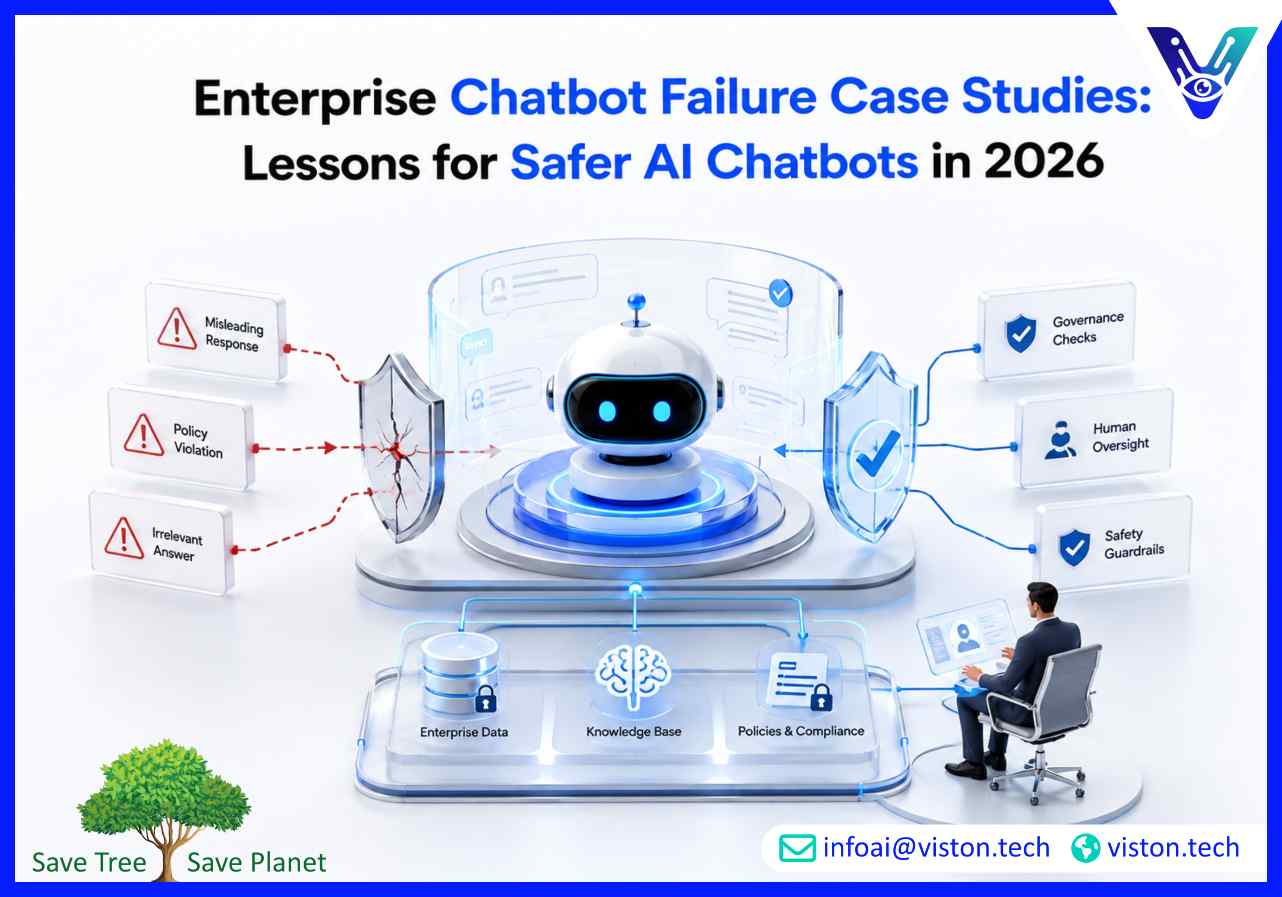
Enterprise chatbot failure case studies matter because they show how quickly automation can damage trust when accuracy, governance, escalation, and integration are weak. In 2026, businesses need enterprise AI chatbots that do more than respond quickly; they must operate safely, reliably, and within real business rules.
Most chatbot failures do not happen because the technology is useless. They happen because the chatbot is placed in a business-critical environment without enough control over knowledge, intent handling, customer context, compliance boundaries, escalation logic, or ongoing monitoring.
An enterprise chatbot is often the first point of contact for customers, employees, partners, patients, applicants, or buyers. When it gives the wrong answer, invents a policy, mishandles a complaint, or fails to escalate a sensitive issue, the problem is not limited to one conversation. It can affect revenue, legal exposure, customer experience, brand reputation, and internal confidence in AI adoption.
The most common failure pattern is overestimating what a chatbot can safely handle. A chatbot may be good at answering simple FAQs, but that does not mean it is ready to manage refunds, legal guidance, medical information, financial support, claims, technical troubleshooting, or enterprise workflow decisions without proper guardrails.
Enterprise AI chatbots now operate across more channels, including websites, mobile apps, WhatsApp, voice systems, CRM portals, service desks, ecommerce platforms, and internal knowledge systems. This broader reach increases business value, but it also increases risk. A weak chatbot is no longer hidden inside a small FAQ page. It may influence customer decisions, employee workflows, support outcomes, and compliance-sensitive processes.
For business leaders, the lesson is clear: chatbot success depends on controlled implementation, not just model capability. The strongest enterprise AI chatbots combine accurate knowledge retrieval, clear conversation design, secure integrations, analytics, escalation pathways, human oversight, and continuous improvement.
Studying enterprise chatbot failure case studies helps decision-makers understand the practical gaps that cause AI systems to fail in real business environments. These examples are not simply technology stories. They are service design, governance, customer experience, and operational risk lessons.
One widely discussed chatbot failure involved an airline customer who relied on incorrect refund information provided by a customer service chatbot. The chatbot presented guidance that did not match the company’s actual policy, and the customer acted based on that response.
The core failure was not only that the chatbot produced a wrong answer. The deeper issue was that the business had not ensured that the chatbot’s output was tightly aligned with official policies, reviewed for high-impact scenarios, and supported by a clear escalation path when financial or exception-based rules were involved.
This case shows why enterprise AI chatbots should not freely generate answers about refunds, pricing, eligibility, contracts, account decisions, or policy exceptions unless the response is grounded in approved content and controlled workflows. A chatbot speaking on behalf of a business can create real obligations, even if the company later says the answer was unintended.
Another known failure involved a delivery company chatbot that responded inappropriately after a frustrated customer pushed the system beyond its intended support flow. Instead of resolving the parcel issue, the chatbot produced responses that criticized the company and used unsuitable language.
This failure highlights the risk of weak prompt control, poor response filtering, and insufficient abuse testing. Customers often behave unpredictably when they are frustrated. A production chatbot must be tested against edge cases, adversarial prompts, complaints, sarcasm, repeated questions, and attempts to make the bot break brand tone.
Brand safety is not a cosmetic issue. For enterprise AI chatbots, tone, refusal behavior, escalation, and content boundaries must be part of the design. A bot that cannot resolve a problem should not improvise. It should acknowledge the limitation, capture the issue, and route the customer to the right support channel.
A public-service chatbot designed to help business owners became controversial after giving incorrect or misleading guidance on regulated topics. The issue was especially serious because users could interpret the chatbot as an official source of information.
The lesson for enterprises is that authority increases risk. If a chatbot represents a government department, bank, healthcare provider, insurer, enterprise software vendor, university, or regulated business, users may assume its answers are reliable. When the chatbot discusses compliance, eligibility, employment rules, taxes, payments, housing, insurance, or rights, the margin for error becomes much smaller.
Enterprise AI chatbots used in regulated or policy-heavy environments need verified knowledge sources, date-aware content, confidence thresholds, audit logs, disclaimers where appropriate, and escalation to qualified human teams. They should also avoid giving definitive advice when the correct answer depends on jurisdiction, contract terms, user status, or changing regulation.
A health-related support chatbot was suspended after concerns that it provided harmful advice in a sensitive context. This case became an important warning for organizations deploying chatbots in wellness, healthcare, mental health, nutrition, patient support, and other high-risk human situations.
The failure was not only technical. It showed the danger of using conversational AI in emotionally sensitive or clinically adjacent scenarios without strict safety design. A chatbot may sound supportive while still giving unsafe guidance if it is not constrained by professional standards, crisis escalation rules, and clinically reviewed content.
For enterprises, this means sensitive use cases require more than general AI capability. They need domain experts, safety review, human handoff, restricted answer zones, risk detection, and ongoing monitoring. In some situations, the best chatbot response is not an answer; it is a safe escalation.
Automated voice-ordering systems in fast food and retail environments have shown how difficult real-time conversational AI can be when background noise, accents, interruptions, menu complexity, and customer corrections are involved.
The practical lesson is that chatbot performance depends heavily on operating context. A voice bot in a busy drive-through faces different challenges than a web chatbot answering product FAQs. Speech recognition, latency, confirmation flows, error correction, and staff override mechanisms become critical.
For enterprise leaders, this reinforces the need to pilot chatbots in real conditions before scaling. Accuracy in a controlled demo does not guarantee success in a noisy, high-volume, customer-facing workflow.
Chatbot failures usually come from a combination of strategic, technical, and operational weaknesses. The technology may be advanced, but the implementation may not be enterprise-ready.
Many chatbot failures begin with unreliable knowledge. If the bot is not connected to approved content, updated policies, product data, CRM records, order systems, or knowledge bases, it may guess. In an enterprise environment, guessing is dangerous. A reliable chatbot should retrieve answers from trusted sources and clearly handle uncertainty.
Some businesses treat chatbot implementation as a software installation rather than a service design project. This leads to confusing flows, unclear prompts, dead ends, repetitive questions, and poor escalation. Strong enterprise AI chatbots are designed around real user intent, not internal assumptions.
A chatbot should know when to stop. High-value complaints, refund disputes, legal questions, medical issues, financial concerns, angry users, technical failures, and low-confidence answers often require human support. Without escalation rules, the bot may keep responding when it should transfer the conversation.
Basic testing is not enough for enterprise AI chatbots. Businesses need scenario testing, prompt injection testing, policy testing, multilingual testing, integration testing, performance testing, and human handover testing. The goal is not only to prove that the bot works, but to identify how it fails.
A chatbot is not finished after launch. Customer language changes, policies change, products change, regulations change, and new failure patterns appear. Without analytics and review, businesses may not see rising fallback rates, repeated complaints, wrong answers, or failed workflows until the damage is visible.
Preventing chatbot failure starts with treating enterprise AI chatbots as operational systems, not experimental widgets. A business should define what the chatbot can answer, what it must never answer, what systems it can access, when it should escalate, and how performance will be measured.
Not every process should be automated first. Low-risk, high-volume tasks such as FAQs, order tracking, appointment booking, lead qualification, password reset guidance, internal HR questions, and basic troubleshooting can be good starting points. Sensitive tasks should be introduced only after stronger governance and escalation controls are in place.
Enterprise AI chatbots should rely on approved knowledge sources wherever possible. This may include product documentation, internal policies, CRM data, ticket histories, order management systems, compliance-approved content, and structured databases. Retrieval-augmented generation can improve accuracy when implemented with source controls, content freshness checks, and answer validation.
No chatbot will answer everything correctly forever. Safe failure means the system handles uncertainty responsibly. Instead of inventing an answer, it can say the information is unavailable, ask clarifying questions, suggest the correct channel, create a support ticket, or transfer the user to a human agent.
Useful chatbot measurement goes beyond conversation volume. Businesses should track resolution rate, escalation rate, fallback rate, customer satisfaction, lead qualification rate, workflow success, CRM update accuracy, response time, and complaint patterns. These metrics show whether the chatbot is improving outcomes or creating hidden friction.
In 2026, chatbot governance should include ownership, review cycles, content approval, incident response, data protection, audit trails, security controls, human oversight, and continuous optimization. The best enterprise AI chatbot programs involve business teams, technical teams, compliance teams, customer support leaders, and data owners working together.
Viston AI is relevant to enterprise chatbot failure case studies because many failures come from weak implementation, poor integration, and limited operational governance. Viston AI provides Enterprise AI Chatbots designed for complex customer interactions across channels, languages, and business units, with capabilities connected to CRM systems, knowledge bases, transactional platforms, and enterprise workflows.
For businesses trying to avoid chatbot failure, this integration-led approach matters. A reliable enterprise chatbot needs access to current business data, controlled knowledge, secure APIs, escalation pathways, and analytics that reveal whether conversations are actually helping users. Viston AI’s service offering includes AI chatbot development, multilingual chatbot support, integration with business systems, natural language processing, workflow automation, AI readiness assessment, ROI analysis, and MLOps or model monitoring capabilities.
This makes Viston AI a practical fit for organizations that want enterprise AI chatbots to support customer service, lead qualification, internal operations, ecommerce assistance, technical support, and industry-specific workflows. Its focus on contextual accuracy, enterprise security, compliance-aware delivery, and measurable performance aligns with the main lesson from chatbot failures: successful chatbot deployment requires disciplined design, reliable data connections, testing, monitoring, and continuous improvement rather than a simple launch-and-leave approach.
Enterprise chatbot failure case studies are real examples where business chatbots produced inaccurate, unsafe, inappropriate, or operationally harmful outcomes. They help companies understand risks such as hallucinated answers, poor escalation, weak governance, unreliable integrations, and brand-damaging responses.
Enterprise AI chatbots usually fail because of poor knowledge grounding, unclear business rules, weak testing, limited monitoring, bad conversation design, or lack of human escalation. The failure is often caused by implementation gaps rather than the chatbot technology alone.
Businesses can reduce risk by starting with suitable use cases, using approved knowledge sources, testing edge cases, adding escalation rules, monitoring performance, protecting sensitive data, and reviewing chatbot conversations regularly for accuracy and customer experience.
Chatbots should be very carefully controlled in legal, medical, financial, or other regulated contexts. They should provide approved information only, avoid unsupported advice, detect sensitive intent, and escalate high-risk conversations to qualified human teams.
Useful KPIs include fallback rate, escalation rate, unresolved conversation rate, customer satisfaction, complaint frequency, response accuracy, workflow success rate, human handover quality, and CRM or ticket update accuracy. These metrics reveal whether the chatbot is helping or creating friction.
Viston AI supports enterprise chatbot projects through chatbot development, business system integration, NLP, multilingual support, workflow automation, AI readiness assessment, and monitoring capabilities. These services help businesses design chatbots with stronger accuracy, scalability, governance, and operational reliability.
Enterprise chatbot failure case studies show that AI chatbot risk is rarely about one bad answer alone. The real issue is whether the business has designed, integrated, tested, governed, and monitored the chatbot properly. In 2026, enterprise AI chatbots must be built around accuracy, safe escalation, approved knowledge, secure integrations, and measurable business outcomes. Companies that learn from past failures can use conversational AI more confidently, improving customer support, sales workflows, internal operations, and service efficiency while reducing avoidable risk. Viston AI’s Enterprise AI Chatbots service is aligned with this need for practical, controlled, and scalable chatbot delivery.
