
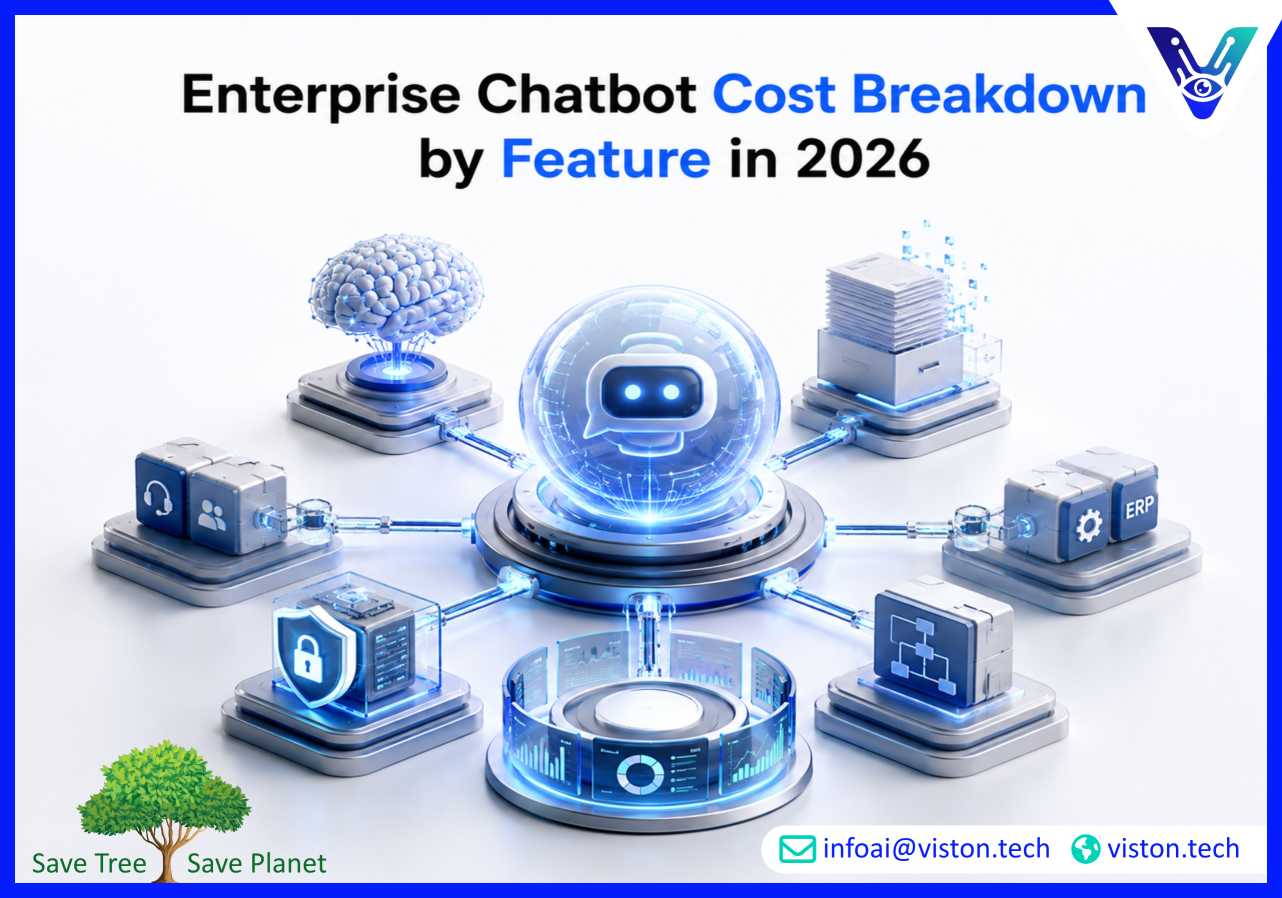
An enterprise chatbot cost breakdown by feature helps business leaders understand what they are really paying for: conversation design, AI capability, integrations, security, reporting, support, and long-term optimization. In 2026, chatbot pricing is less about a simple chat widget and more about building a reliable business automation layer.
Enterprise chatbot cost is shaped by the depth of functionality, the number of business systems involved, the quality of training data, the level of automation required, and the support model behind the solution. A basic chatbot may answer common questions, while an enterprise AI chatbot may qualify leads, retrieve account data, create tickets, update CRM records, support multilingual users, and escalate complex cases to human teams.
This is why pricing can vary significantly between projects. Two companies may both request an enterprise chatbot, but one may need a website-based FAQ assistant while another needs a secure, multilingual, AI-powered chatbot connected to Salesforce, Zendesk, ERP, internal knowledge bases, analytics dashboards, and compliance workflows.
For buyers, the most practical way to estimate budget is to break the chatbot into feature categories. Each feature affects planning, development effort, testing, data preparation, system architecture, maintenance, and long-term operating cost.
Feature-based cost planning also helps procurement teams compare proposals more accurately. A lower quote may exclude integration, maintenance, analytics, multilingual support, or security controls. A higher quote may include architecture, governance, training, and post-launch improvement. The real question is not only how much the chatbot costs, but what level of business reliability it includes.
An enterprise chatbot cost breakdown by feature gives decision-makers a clearer view of where investment usually goes. The following categories explain the major features that influence pricing and why each one matters in real business environments.
The interface is the front-end experience users interact with on a website, portal, mobile app, messaging platform, or internal workspace. A simple web chat interface is usually less expensive than a multi-channel chatbot that works across WhatsApp, Microsoft Teams, Slack, mobile apps, and customer portals.
Costs increase when the interface requires custom branding, rich cards, buttons, file uploads, authentication, embedded forms, voice input, or personalized user journeys. For enterprise teams, interface quality matters because poor design can reduce engagement even when the underlying AI is strong.
Conversation design defines how the chatbot greets users, asks questions, handles unclear requests, guides tasks, and escalates complex issues. Simple FAQ bots need fewer flows. Enterprise AI chatbots need structured workflows for lead qualification, ticket creation, account support, onboarding, employee helpdesk, product guidance, or operational approvals.
This cost often includes user journey mapping, decision trees, fallback handling, escalation logic, tone guidelines, and business process alignment. Strong conversation design prevents confusing interactions and helps the chatbot deliver measurable outcomes instead of generic responses.
AI capability is one of the biggest pricing factors. A rules-based chatbot follows predefined paths. An AI-powered chatbot can understand natural language, classify intent, extract entities, retrieve relevant knowledge, and generate contextual responses.
Costs increase when the chatbot needs advanced natural language processing, custom prompts, domain-specific terminology, intent libraries, multilingual understanding, sentiment detection, or controlled generative AI responses. In 2026, many enterprise buyers prefer AI chatbots that combine generative capability with business guardrails so the chatbot can be helpful without becoming unpredictable.
Many enterprise AI chatbots rely on approved knowledge sources such as help center articles, policy documents, product manuals, SOPs, service pages, training materials, and internal documentation. Preparing this knowledge is a major cost factor because documents must be cleaned, organized, updated, indexed, permissioned, and tested.
Retrieval-based chatbot systems can reduce manual content scripting, but they require proper source control. If the chatbot pulls from outdated or conflicting documents, response quality suffers. Businesses should budget for knowledge preparation, content review, document structuring, and ongoing knowledge maintenance.
Integrations often create the biggest difference between a basic chatbot and an enterprise AI chatbot. A non-integrated chatbot can answer questions. An integrated chatbot can create tickets, update leads, check order status, retrieve customer records, book appointments, trigger workflows, and send data to the correct system.
Integration costs depend on the number of platforms, API complexity, authentication requirements, data mapping, error handling, and workflow logic. Common integrations include CRM systems, helpdesk software, ERP platforms, ecommerce systems, marketing automation tools, payment systems, HR tools, internal databases, and analytics platforms.
Enterprise buyers should not treat integration as an optional extra if the chatbot is expected to support real operations. Without integration, teams may still need manual data entry, duplicate follow-up, and human verification.
Security requirements can significantly affect chatbot cost. Enterprise AI chatbots may need user authentication, role-based access, encryption, audit logs, consent capture, data masking, retention controls, and secure API handling. These features are especially important when the chatbot handles customer data, employee data, account information, contracts, financial details, healthcare-related information, or regulated workflows.
Costs also rise when organizations need compliance review, regional data handling rules, approval workflows, or separate knowledge access for different user groups. Security should be planned early because adding it after deployment can require rework across architecture, integrations, data storage, and user permissions.
Multilingual chatbot support increases cost when the chatbot must understand and respond accurately across languages, regions, terminology, and customer expectations. Simple translation is not enough for enterprise use. The chatbot may need localized intent examples, regional policy differences, language-specific testing, and culturally appropriate conversation design.
Voice-enabled assistants add another layer of cost because they require speech recognition, text-to-speech, voice user experience design, latency management, call routing, and additional testing. Voice is valuable for contact centers, field teams, accessibility, and hands-free workflows, but it should be budgeted separately from text-based chatbot functionality.
Analytics features help businesses measure whether the chatbot is improving performance. Useful reporting may include conversation volume, resolution rate, fallback rate, escalation rate, customer satisfaction, lead capture, lead qualification, conversion rate, ticket deflection, workflow success, and human handover quality.
Dashboard costs depend on whether the business needs standard reporting or custom dashboards connected to CRM, helpdesk, BI tools, or data warehouses. For enterprise teams, analytics are not just a nice feature. They are necessary for governance, optimization, ROI tracking, and executive reporting.
Many chatbot budgets increase because buyers focus only on the visible interface and underestimate the work behind business reliability. The chatbot window may look simple, but the real cost often sits in data preparation, integration logic, exception handling, security controls, testing, and long-term improvement.
Enterprise chatbots depend on accurate business data. If FAQs, product documents, support articles, and internal policies are outdated or inconsistent, the project requires additional preparation before the chatbot can perform well. Data cleanup, document classification, knowledge ownership, and content approval can add time and cost, but they also reduce future risk.
A chatbot that only answers questions is easier to test than one that performs actions. When a chatbot creates tickets, updates records, checks inventory, routes leads, or triggers approvals, every workflow must be tested for success, failure, exceptions, permissions, and handoff scenarios.
For example, a lead qualification chatbot must capture the right information, score the inquiry, avoid duplicate CRM records, assign ownership, send alerts, and preserve conversation context. Each step adds value, but each step also adds development and quality assurance work.
Generative AI can make enterprise chatbots more flexible, but it also introduces risk if not controlled properly. Businesses may need approved answer boundaries, source-based responses, restricted topics, confidence thresholds, escalation triggers, moderation rules, and auditability.
These guardrails require thoughtful design. They protect the business from inaccurate answers, unauthorized claims, compliance issues, and poor customer experiences. In many enterprise projects, this governance layer is one of the most important parts of the investment.
A chatbot is not finished on launch day. After deployment, teams need to review failed conversations, improve intents, update knowledge sources, refine prompts, monitor integrations, analyze user feedback, and adjust workflows based on real behavior.
Businesses that do not budget for optimization may see performance decline over time. Products change, policies change, customer questions change, and internal workflows evolve. Ongoing improvement keeps the chatbot useful, accurate, and aligned with business priorities.
The best budgeting approach starts with business objectives rather than a feature wish list. A chatbot for customer support, sales enablement, employee service, ecommerce, onboarding, or internal knowledge search will each require a different mix of features.
Support-focused chatbot budgets should prioritize knowledge base quality, ticketing integration, escalation logic, customer satisfaction tracking, fallback analysis, and human handover quality. The goal is not to block users from agents, but to resolve repetitive issues faster and route complex cases with proper context.
Sales chatbot budgets should focus on qualification flows, CRM integration, lead scoring, meeting booking, campaign tracking, conversion analytics, and follow-up automation. A lower-cost chatbot that captures incomplete leads may create more work for sales teams. A well-designed chatbot should collect usable data and move qualified prospects to the right next step.
Internal chatbot budgets should account for authentication, role-based access, internal knowledge search, IT or HR workflows, employee permissions, audit logs, and integration with collaboration tools. Internal bots can improve productivity, but only when employees trust the answers and can access the right information securely.
Advanced deployments may require multi-agent workflows, business system integration, multilingual support, voice capability, custom AI models, analytics dashboards, and monitoring. These projects cost more because they support operational execution, not just conversation. They are best planned in phases, starting with high-value use cases and expanding after performance is validated.
These questions help businesses avoid under-scoped chatbot projects. A clear budget should include initial build cost, integration cost, testing cost, platform or model usage cost, monitoring cost, and ongoing optimization cost.
Viston AI is relevant to enterprise chatbot cost planning because its service portfolio includes Enterprise AI Chatbots, AI Chatbot Development, AI Chatbot Integration, Natural Language Processing Solutions, multilingual support, voice-enabled assistants, agent integration services, workflow automation, and MLOps-related capabilities. These services align closely with the features that typically shape enterprise chatbot budgets.
For businesses comparing chatbot costs, this matters because pricing should reflect the complete solution, not only the chat interface. A useful enterprise chatbot may require intent design, knowledge integration, secure system connectivity, CRM or helpdesk workflows, user-friendly conversation design, analytics, testing, and continuous improvement. Viston AI’s broader AI and automation capabilities make it relevant for organizations that want chatbot delivery connected to business operations rather than isolated experimentation.
The company can be positioned as a specialist partner for teams that need practical guidance on which features are essential, which can be phased later, and how chatbot architecture should support scalability. For customer support, sales operations, internal knowledge access, and process automation, Viston AI’s Enterprise AI Chatbots service can help businesses plan feature priorities around measurable outcomes such as faster response handling, better lead routing, improved self-service, cleaner handoffs, and more reliable workflow execution.
The biggest cost drivers are AI capability, enterprise system integrations, knowledge base setup, security controls, multilingual support, workflow automation, analytics dashboards, and ongoing optimization. The more the chatbot connects to real business operations, the more planning, testing, and maintenance it usually requires.
Yes, an AI chatbot is usually more expensive because it requires natural language understanding, prompt design, knowledge retrieval, data preparation, testing, and governance. However, it can handle more flexible user queries and support more complex enterprise use cases than a basic rule-based chatbot.
Yes. Phased deployment is often the most practical approach. A business can start with high-value use cases such as FAQs, lead capture, ticket routing, or internal knowledge search, then add integrations, multilingual support, voice features, and advanced automation after proving performance.
Integrations increase cost because the chatbot must securely connect with systems such as CRM, ERP, helpdesk, ecommerce, HR tools, or internal databases. This requires API setup, authentication, data mapping, workflow logic, error handling, testing, and monitoring.
Yes. Enterprise AI chatbots need ongoing content updates, intent improvements, prompt refinement, integration monitoring, analytics review, and performance optimization. Without maintenance, chatbot accuracy and business value can decline as products, policies, and user needs change.
Viston AI’s Enterprise AI Chatbots and related AI chatbot integration capabilities are aligned with feature-based planning. Its services can help businesses evaluate chatbot scope, prioritize essential features, plan integrations, and connect chatbot investment to practical business outcomes.
An enterprise chatbot cost breakdown by feature gives businesses a clearer way to plan investment, compare vendors, and avoid under-scoped automation projects. In 2026, Enterprise AI Chatbots are expected to do more than answer basic questions. They need secure AI capability, useful conversation design, reliable integrations, accurate knowledge retrieval, analytics, and continuous improvement. The right budget should reflect the chatbot’s role in business operations, not only its interface. For organizations seeking a practical, scalable approach, Viston AI offers relevant enterprise chatbot capabilities that can support feature planning, implementation, integration, and long-term optimization.
