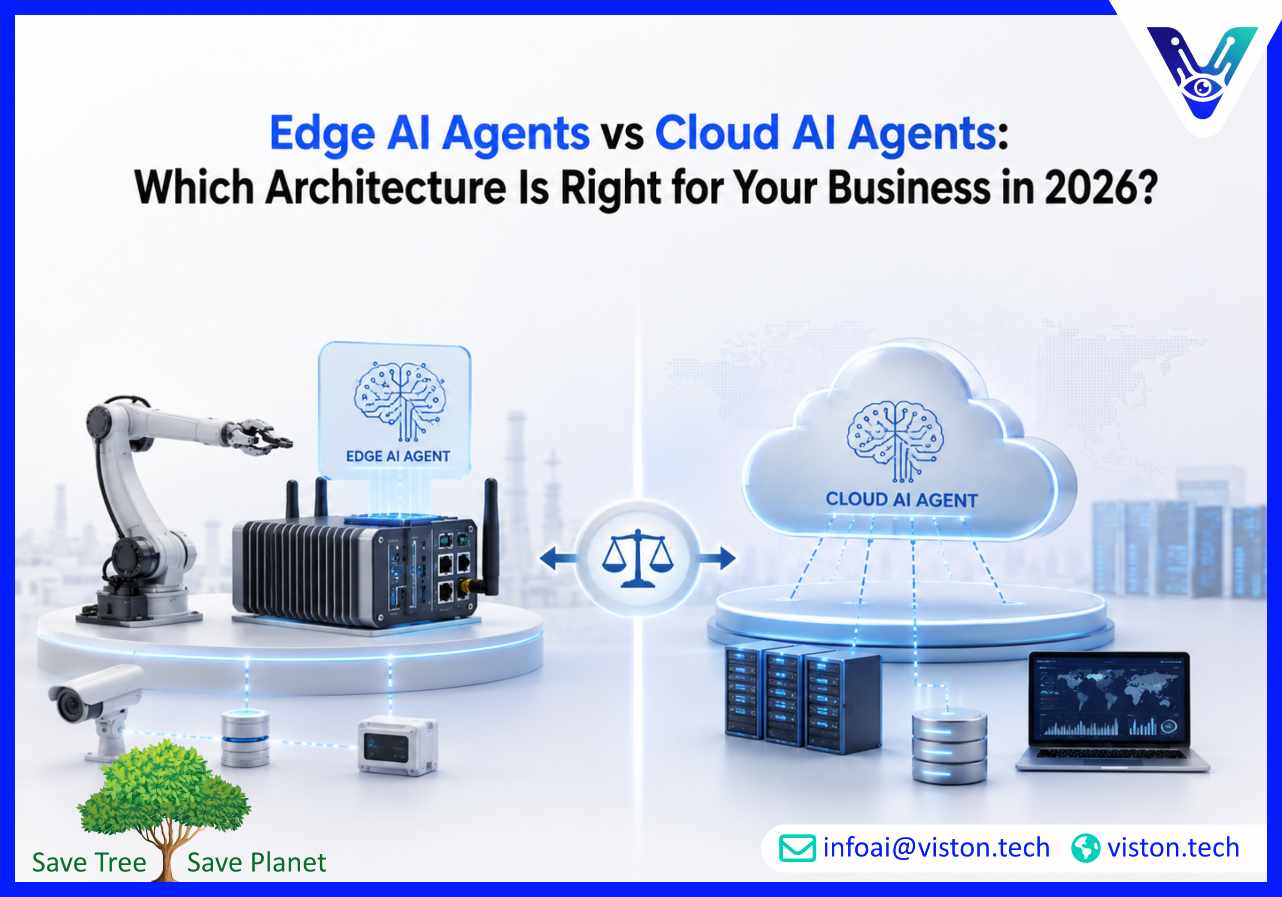
Edge AI Agents vs Cloud AI Agents: Which Architecture Is Right for Your Business in 2026?
Introduction
As AI agents become central to business automation, organizations face an important architectural decision: should AI agents operate at the edge or in the cloud? The answer affects performance, security, scalability, cost, and user experience. Understanding the differences between Edge AI agents and Cloud AI agents is essential for businesses planning successful AI agent development and deployment in 2026.
Understanding Edge AI Agents and Cloud AI Agents
AI agents are autonomous software systems capable of perceiving data, making decisions, and executing tasks with minimal human intervention. Where these agents process data significantly impacts their effectiveness.
What Are Edge AI Agents?
Edge AI agents process data locally on devices, gateways, industrial equipment, smartphones, sensors, robots, or on-premise infrastructure.Instead of sending information to a remote server for processing, the AI agent performs inference and decision-making close to where data is generated.Examples include:
Cloud AI agents rely on centralized cloud infrastructure for processing, decision-making, orchestration, and model execution.Data is transmitted to cloud platforms where AI models analyze information and generate responses.Common examples include:
AI-powered customer service agents
Enterprise workflow automation systems
Virtual assistants
Predictive analytics platforms
Multi-agent enterprise orchestration environments
Cloud-based agents leverage scalable computing resources and access to large language models (LLMs) that may be too resource-intensive for local devices.
Why This Decision Matters in 2026
The AI landscape has evolved significantly. Organizations are no longer simply experimenting with AI agents; they are deploying them across mission-critical operations.Businesses must balance:
Latency requirements
Security obligations
Regulatory compliance
Infrastructure costs
Scalability needs
Data privacy concerns
Operational reliability
Choosing the wrong architecture can create bottlenecks, increase costs, or expose organizations to unnecessary risks.
Edge AI Agents vs Cloud AI Agents: Key Differences
Processing Location
The most fundamental difference lies in where computation occurs.
Edge AI Agents
Process data locally
Minimize external data transfers
Operate even with limited connectivity
Cloud AI Agents
Process data in centralized data centers
Depend on network connectivity
Access large-scale computing resources
Response Speed
Latency is often a critical factor.Edge AI agents typically deliver near-instant responses because data does not need to travel to remote servers.This is especially important for:
Industrial automation
Robotics
Autonomous systems
Medical monitoring
Security applications
Cloud AI agents introduce network latency but remain suitable for applications where milliseconds are not mission-critical.
Scalability
Cloud environments excel at scalability.Organizations can:
Add users quickly
Increase processing capacity
Deploy globally
Access virtually unlimited resources
Edge deployments require additional hardware expansion as workloads grow, making scaling more complex in some environments.
Connectivity Requirements
Edge AI agents can continue operating during network disruptions.This makes them valuable for:
Remote facilities
Manufacturing plants
Transportation systems
Field operations
Offshore locations
Cloud AI agents generally require reliable internet connectivity for continuous operation.
Data Privacy and Security
Data protection has become a major concern in AI deployment.Edge AI agents often reduce privacy risks because sensitive information remains on local infrastructure.Examples include:
Healthcare devices
Financial systems
Government applications
Industrial control environments
Cloud AI agents can still achieve strong security standards, but organizations must carefully manage:
Data transfers
Encryption
Access controls
Regulatory requirements
Third-party infrastructure risks
Benefits of Edge AI Agents
Real-Time Decision Making
Edge AI excels when immediate action is required. Manufacturing equipment, autonomous systems, and industrial machinery often cannot afford delays caused by cloud communication.
Reduced Bandwidth Costs
Organizations processing large volumes of sensor, image, audio, or video data can reduce network expenses by performing analysis locally. Only relevant insights need to be transmitted.
Improved Privacy
Sensitive information remains closer to its source. This can simplify compliance efforts and reduce exposure to external security threats.
Operational Resilience
Edge AI agents can continue functioning even when internet connectivity becomes unreliable. This improves business continuity and reduces downtime risks.
Benefits of Cloud AI Agents
Access to Large AI Models
Modern AI capabilities increasingly rely on advanced foundation models and large language models. Cloud infrastructure provides the computational resources necessary to support these sophisticated systems.
Centralized Management
Organizations can manage multiple AI agents through a unified platform.Benefits include:
Easier updates
Centralized monitoring
Governance controls
Performance analytics
Version management
Lower Initial Infrastructure Costs
Businesses can avoid significant hardware investments by leveraging cloud-based AI services. This often accelerates deployment timelines.
Continuous Improvement
Cloud-based environments simplify:
Model retraining
Data integration
Performance optimization
Feature enhancements
This allows organizations to adapt AI systems more quickly.
Common Business Use Cases for Edge AI Agents
Manufacturing Automation
Production lines often require millisecond-level decision-making.Edge AI agents can:
Detect defects
Monitor machinery
Predict failures
Optimize production workflows
Smart Logistics
Warehouses increasingly deploy edge-enabled AI systems for:
Inventory management
Robotics coordination
Route optimization
Asset tracking
Retail Operations
Retail businesses use edge AI for:
Smart checkout systems
Customer behavior analysis
Loss prevention
Inventory monitoring
Healthcare Devices
Medical systems frequently require local processing to protect patient privacy while enabling rapid decision-making.
Common Business Use Cases for Cloud AI Agents
Customer Support Automation
Cloud AI agents can manage:
Chatbots
Virtual assistants
Help desk workflows
Omnichannel customer interactions
Enterprise Workflow Automation
Organizations use cloud-based agents to automate:
HR processes
Procurement workflows
Finance operations
Compliance tasks
Knowledge Management
Cloud AI agents can access large organizational knowledge bases and deliver intelligent responses across departments.
Multi-Agent Systems
Many enterprise AI ecosystems involve multiple specialized agents collaborating across departments. Cloud infrastructure often provides the orchestration layer required for these environments.
The Rise of Hybrid AI Agent Architectures
For many businesses, the best solution is neither purely edge nor purely cloud. Hybrid architectures are becoming the preferred approach in 2026.In a hybrid model:
Edge agents handle real-time tasks
Cloud agents perform complex reasoning
Centralized systems manage orchestration
Sensitive data remains local when necessary
For example, a manufacturing facility may use edge AI agents for machine monitoring while leveraging cloud AI agents for predictive analytics and strategic optimization.This approach combines the strengths of both architectures.
How to Choose Between Edge AI Agents and Cloud AI Agents
Choose Edge AI Agents When:
Low latency is essential
Connectivity is unreliable
Privacy requirements are strict
Real-time control is necessary
Bandwidth costs are significant
Choose Cloud AI Agents When:
Scalability is a priority
Large language models are required
Centralized management is important
Global deployment is needed
Complex AI workloads must be supported
Consider Hybrid Models When:
Both real-time processing and advanced AI capabilities are required
Regulatory requirements vary across data types
Multiple operational environments exist
Long-term scalability is important
How Viston AI Supports AI Agent Development and Deployment
Organizations evaluating Edge AI agents vs Cloud AI agents often discover that architecture decisions are only one part of successful AI implementation.Viston AI specializes in AI agent development and deployment, helping businesses design, build, integrate, and scale intelligent agent ecosystems aligned with operational requirements. Whether an organization requires edge-based automation for real-time environments, cloud-native AI agents for enterprise workflows, or hybrid architectures that combine both approaches, successful deployment depends on much more than selecting a technology stack.Key considerations include AI model selection, orchestration frameworks, data integration, security controls, governance policies, monitoring systems, and scalability planning. Businesses also need to ensure AI agents interact reliably with existing enterprise applications, databases, APIs, and operational workflows.Viston AI focuses on creating practical AI solutions that align with business objectives rather than applying a one-size-fits-all approach. By evaluating performance requirements, compliance considerations, infrastructure constraints, and long-term growth plans, organizations can implement AI agent architectures that deliver measurable operational value while maintaining security, reliability, and adaptability as AI technologies continue to evolve.
Frequently Asked Questions
What is the main difference between Edge AI agents and Cloud AI agents?
Edge AI agents process data locally on devices or nearby infrastructure, while Cloud AI agents perform processing in centralized cloud environments accessed through network connections.
Are Edge AI agents more secure than Cloud AI agents?
Not necessarily. Edge AI agents can reduce data exposure by keeping information local, but both architectures can be highly secure when implemented with proper security controls and governance practices.
Which option is better for real-time applications?
Edge AI agents are generally better for real-time applications because they minimize latency and can make decisions without relying on cloud communication.
Can businesses use both Edge AI and Cloud AI agents together?
Yes. Hybrid AI architectures are increasingly common in 2026 because they combine the low-latency benefits of edge computing with the scalability and advanced capabilities of cloud infrastructure.
Do Cloud AI agents cost less than Edge AI agents?
It depends on the use case. Cloud deployments often have lower initial infrastructure costs, while edge deployments may reduce long-term bandwidth and cloud processing expenses.
How can Viston AI help with AI agent deployment?
Viston AI helps organizations design, develop, integrate, and deploy AI agents tailored to operational goals, infrastructure requirements, security considerations, and scalability objectives.
Conclusion
The debate around Edge AI agents vs Cloud AI agents is not about finding a universal winner. It is about selecting the architecture that best aligns with business goals, performance requirements, security needs, and operational realities. Edge AI delivers speed, privacy, and resilience, while Cloud AI provides scalability, centralized management, and access to advanced AI capabilities. For many organizations, hybrid architectures offer the strongest long-term strategy. As AI adoption accelerates in 2026, businesses investing in thoughtful AI agent development and deployment will be better positioned to achieve sustainable automation, operational efficiency, and competitive advantage. Viston AI helps organizations navigate these decisions and implement AI agent solutions that support real-world business outcomes.