
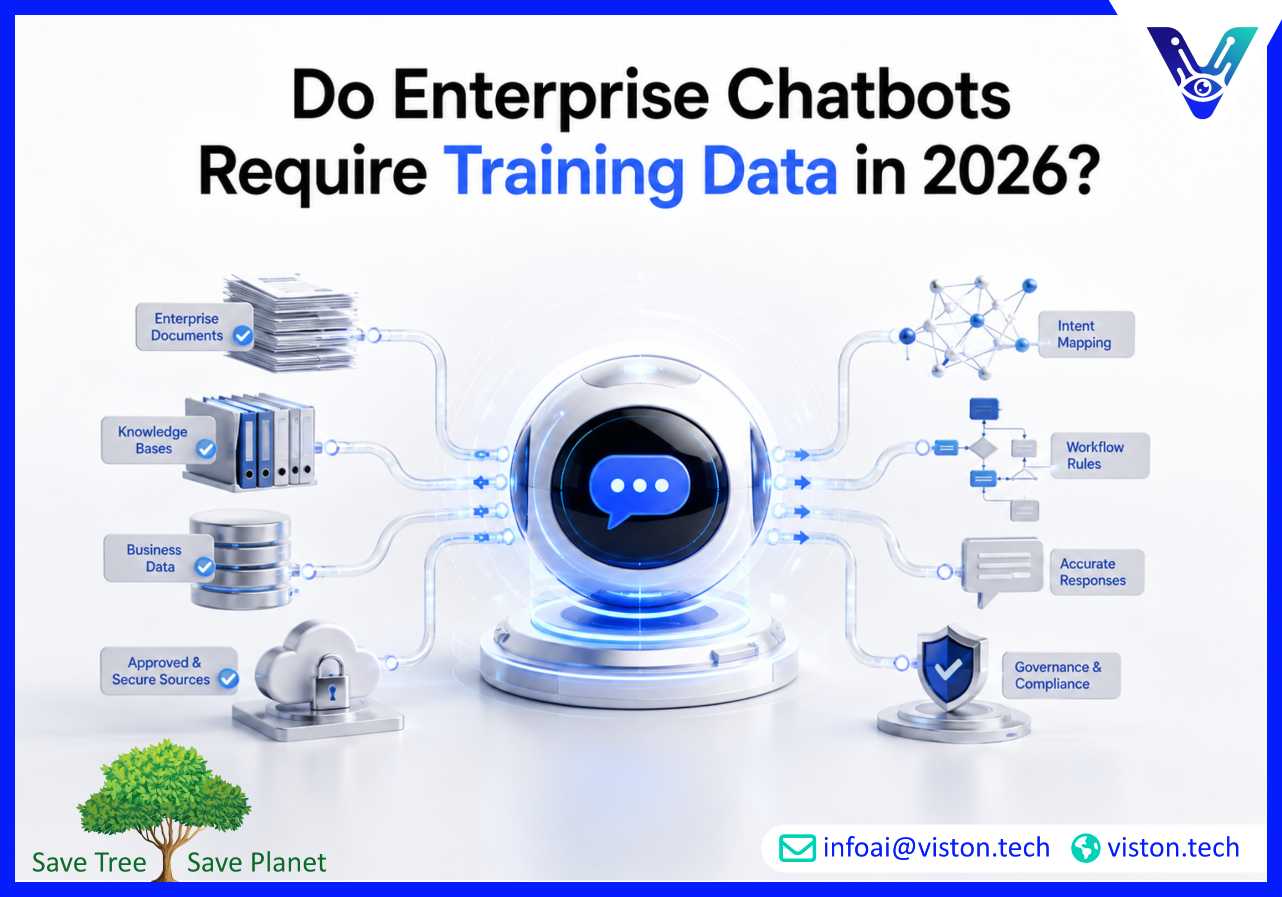
Do enterprise chatbots require training data? Yes, but the type, volume, and structure of training data depend on the chatbot’s purpose, complexity, integrations, and risk level. In 2026, enterprise AI chatbots need trusted business knowledge, user intent examples, workflow rules, and continuous improvement data to perform reliably.
Enterprise chatbots require training data because they must understand how real users ask questions, what information they need, which business rules apply, and when a request should be escalated. Unlike a simple scripted chatbot, an enterprise AI chatbot usually supports customer service, sales, HR, IT, onboarding, compliance, internal knowledge search, or operational workflows. These environments require accuracy, context, security, and consistency.
Training data helps the chatbot recognize user intent. For example, a customer may say “track my order,” “where is my shipment,” “delivery update,” or “package status.” These phrases may all point to the same intent, but the chatbot needs examples and business logic to understand them correctly. Without relevant training data, the system may misunderstand the request, provide a generic answer, or escalate unnecessarily.
Training data also gives the chatbot business-specific knowledge. Enterprise users often ask questions that depend on internal policies, product details, account status, service terms, workflow steps, pricing rules, or support procedures. A general AI model may understand language, but it does not automatically know a company’s approved answers, systems, restrictions, or preferred processes.
The goal is not to overload the chatbot with every company document. The goal is to provide the right data in a structured, governed, and usable way. A well-trained enterprise chatbot should answer common questions, ask clarifying questions when needed, follow business rules, protect sensitive information, and transfer users to the right human team when automation is not appropriate.
The training data required for enterprise AI chatbots depends on the use case. A customer support chatbot needs different data from a sales assistant, HR chatbot, internal IT bot, or compliance workflow assistant. However, most enterprise chatbot projects use a combination of conversation data, knowledge data, workflow data, and performance data.
Intent data teaches the chatbot what users are trying to accomplish. This includes real examples of how people ask for help, search for information, request service, or describe a problem. Historical chat transcripts, support tickets, call center notes, website search queries, email inquiries, and helpdesk requests can all be useful sources.
These examples should be cleaned and classified before use. Poor-quality conversations, outdated responses, incomplete ticket notes, or inconsistent agent replies can weaken chatbot performance. Enterprise teams should group examples by intent, urgency, customer type, product line, language, channel, and resolution outcome.
Enterprise chatbots need access to accurate and approved knowledge. This may include FAQs, help center articles, product documentation, onboarding guides, troubleshooting steps, internal SOPs, HR policies, IT support instructions, pricing explanations, service terms, and compliance guidance.
Knowledge data should be current, clearly owned, and easy to retrieve. If multiple documents give conflicting answers, the chatbot may respond inconsistently. Businesses should define which source is authoritative for each topic. For example, the public help center may guide general customers, while CRM or ERP systems may contain account-specific information.
Enterprise users often use specific terms, abbreviations, product names, department names, process codes, region names, and internal language. Entity data helps the chatbot identify important details inside a conversation. These details may include customer ID, order number, product category, subscription plan, location, department, issue type, contract status, or service tier.
Terminology data is especially important for industries with technical language, regulated processes, or complex product catalogs. If the chatbot does not understand the organization’s vocabulary, it may fail even when the user’s request is simple.
Enterprise chatbots often need to do more than answer questions. They may create tickets, update CRM records, assign leads, check inventory, retrieve order status, schedule appointments, reset passwords, send confirmation messages, or route approvals. These actions require workflow rules and integration logic.
Workflow data tells the chatbot what steps to follow, which fields to collect, which systems to update, when permission is required, and when a human should take over. This is a major difference between a basic chatbot and an enterprise AI chatbot. The chatbot must operate within business processes, not outside them.
A reliable enterprise chatbot must know its limits. Escalation data defines when the chatbot should transfer the conversation to a human. This may include complaints, legal requests, refund disputes, sensitive account issues, security concerns, urgent service failures, emotional language, repeated misunderstanding, or low-confidence answers.
Safety data also includes restricted topics, response boundaries, access rules, compliance language, and privacy requirements. This helps the chatbot avoid exposing sensitive information or giving unsupported guidance.
Enterprise chatbots do not always need massive amounts of data. They need relevant, clean, approved, and well-organized data. Data quality matters more than raw volume. A focused chatbot trained on strong use-case data can perform better than a broad chatbot connected to thousands of unstructured documents.
The amount of training data depends on scope. A chatbot designed to answer 30 common customer service questions may need a smaller training set, clear FAQs, and a limited number of intent examples. A multilingual enterprise chatbot that supports sales, customer support, internal knowledge search, and workflow automation will need broader data coverage, deeper integrations, and continuous improvement cycles.
Many enterprise chatbot projects should begin with a limited set of high-value use cases. These are usually repetitive, measurable, and lower-risk tasks such as order tracking, appointment scheduling, lead qualification, password reset guidance, product FAQs, ticket creation, policy lookup, or internal knowledge search.
Starting small allows teams to validate performance before expanding. It also makes governance easier. The chatbot can be tested against real user questions, fallback patterns, escalation quality, and workflow success before it is allowed to handle more complex processes.
Large volumes of data can improve coverage, but they can also create risk. If the chatbot has access to outdated policies, duplicated documents, conflicting answers, sensitive files, or unapproved internal notes, performance may decline. Enterprise teams should avoid connecting a chatbot to every available document without review.
A better approach is to organize knowledge by source, owner, update frequency, permission level, and use case. This helps the chatbot retrieve trusted answers and prevents users from receiving information they should not access.
Modern AI models can understand general language well, but enterprise performance depends on company-specific context. The chatbot must know what the business sells, how services are delivered, what policies apply, how systems are structured, what customer data can be used, and which workflows must be followed. This context does not appear automatically. It must be supplied through approved knowledge, integration design, prompts, rules, and performance feedback.
Training data has a direct impact on chatbot accuracy, security, customer experience, and ROI. A chatbot with poor data may answer confidently but incorrectly. It may misunderstand users, escalate too often, create incomplete records, or provide outdated instructions. These issues reduce trust and make automation less valuable.
Enterprise chatbot accuracy improves when the system uses approved and current sources. This includes verified knowledge bases, documented workflows, CRM records, support policies, product data, and subject matter expert input. When the chatbot retrieves answers from trusted content, it is less likely to invent or misrepresent information.
Accuracy should also be measured after launch. Useful metrics include intent recognition accuracy, fallback rate, self-service resolution rate, first-contact resolution, escalation rate, customer satisfaction, and human handoff quality. These metrics show whether the training data is helping users complete real tasks.
Enterprise chatbots may interact with sensitive customer, employee, financial, operational, or contractual information. Training data and knowledge access must therefore be controlled. Not every user should receive the same answer or access the same documents.
Strong chatbot training includes role-based access, data segmentation, permission checks, audit logs, and clear handling rules for sensitive requests. For internal chatbots, employees may need different levels of access based on department, role, region, or seniority. For customer-facing chatbots, private account information should only be retrieved after proper verification.
The ROI of enterprise AI chatbots improves when training data enables measurable outcomes. A chatbot that only gives generic answers may reduce a few repetitive questions. A chatbot trained around business workflows can reduce support tickets, qualify leads, improve response speed, route requests, update systems, and help employees find information faster.
Training data should therefore be connected to business goals. If the goal is support efficiency, the chatbot needs ticket data, resolution patterns, knowledge base content, and escalation rules. If the goal is sales growth, it needs qualification questions, CRM fields, buyer intent signals, product information, and routing logic. If the goal is employee productivity, it needs internal policies, SOPs, IT guides, and secure knowledge access.
Viston AI is relevant to this topic because enterprise chatbot training is closely connected to the quality of chatbot design, integration, automation, and long-term optimization. Its Enterprise AI Chatbots service aligns with the needs of businesses that require conversational AI to understand users, access trusted knowledge, support workflows, and operate within enterprise systems.
For organizations asking whether enterprise chatbots require training data, the practical answer is that training is part of a larger delivery process. A successful chatbot needs intent mapping, clean knowledge sources, conversation design, natural language understanding, workflow automation, system integration, testing, analytics, and continuous improvement. Viston AI’s capabilities are aligned with these requirements, including enterprise AI chatbot development, AI chatbot integration, NLP and text analysis, multilingual support, automation workflows, voice-enabled assistants, AI strategy development, and model monitoring.
This matters for businesses that want chatbot performance to be measurable and scalable. Training data must be prepared around real business use cases, connected to systems such as CRM, helpdesk platforms, ERP, knowledge bases, and internal tools, and reviewed regularly after deployment. Viston AI can support companies that need enterprise AI chatbots designed around accuracy, workflow reliability, secure data usage, and practical business outcomes rather than basic scripted automation.
Yes. Enterprise chatbots require training data to understand user intent, business terminology, approved knowledge, workflow rules, and escalation requirements. The amount of data depends on chatbot scope, industry complexity, integrations, and risk level.
Yes, but it still needs structured knowledge and use-case examples. If historical chat data is unavailable, teams can use FAQs, support documents, expert-written intent examples, product guides, workflow maps, and internal SOPs to build the initial training foundation.
The best training data includes approved FAQs, help center content, support tickets, resolved conversation transcripts, product documentation, CRM fields, workflow rules, internal policies, and expert-reviewed responses. The data should be current, accurate, structured, and relevant to real user needs.
Training data should be reviewed continuously. During early deployment, weekly reviews of fallback messages, failed conversations, and user feedback are useful. After stabilization, monthly optimization and quarterly knowledge audits help maintain accuracy and relevance.
No. More data is only helpful when it is clean, accurate, approved, and properly organized. Large volumes of outdated, duplicated, conflicting, or sensitive content can reduce chatbot quality and create security risks.
Yes. Viston AI’s Enterprise AI Chatbots service is aligned with chatbot training needs because it supports intent design, knowledge integration, NLP, workflow automation, system integration, analytics, and continuous optimization for enterprise chatbot deployments.
Do enterprise chatbots require training data? Yes, but successful training is not about collecting the largest possible data set. It is about using accurate, approved, secure, and business-relevant information to help the chatbot understand users and complete useful tasks. In 2026, enterprise AI chatbots need intent examples, trusted knowledge sources, terminology, workflow rules, escalation logic, and performance feedback. Businesses that treat training data as an ongoing governance and optimization process are more likely to build chatbots that improve customer experience, reduce workload, support internal teams, and deliver measurable value. Viston AI offers relevant capabilities for organizations seeking enterprise chatbot development, integration, and long-term performance improvement.
