
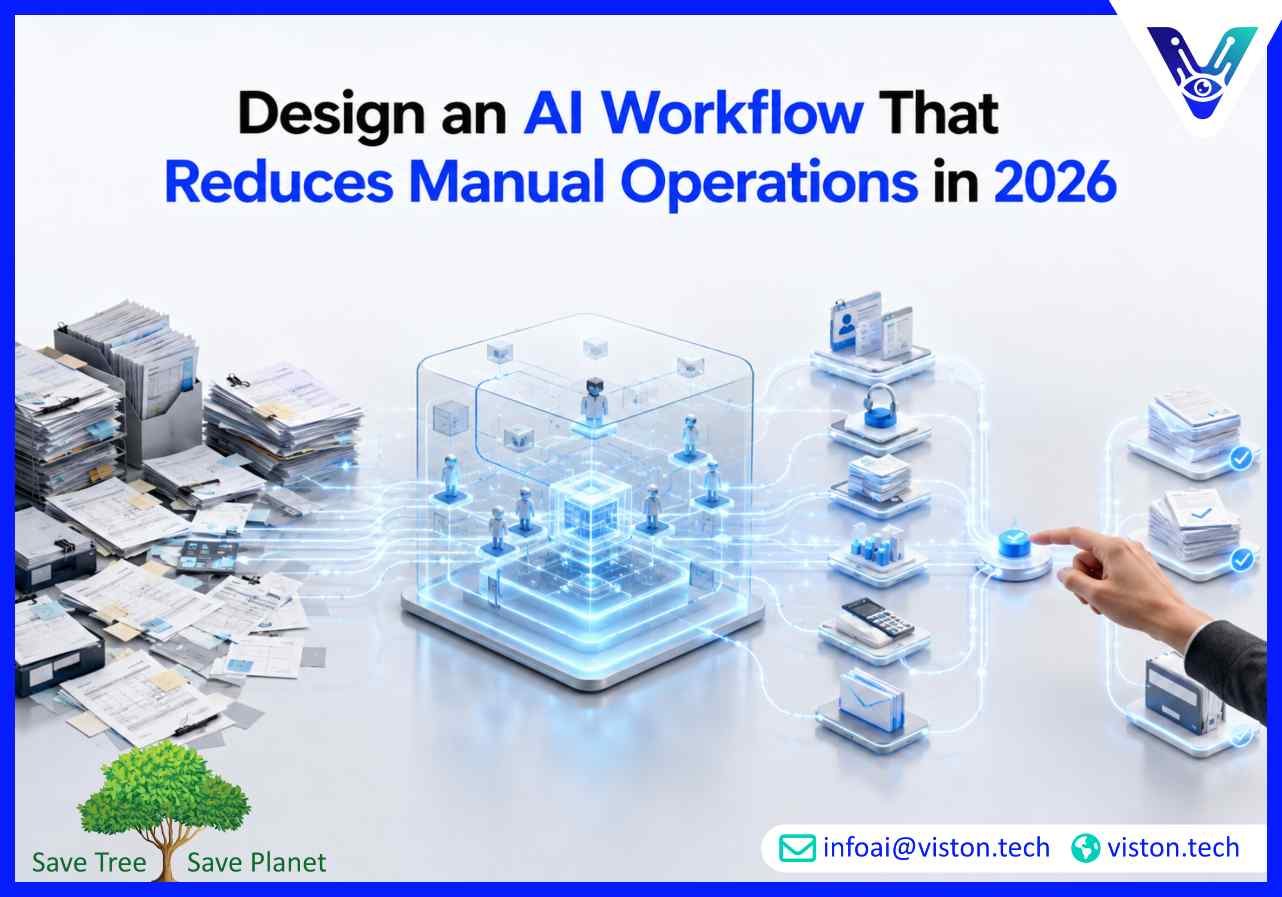
Manual operations slow teams down, increase error rates, and make growth harder to manage. In 2026, businesses are using agentic AI workflows to reduce repetitive work, connect systems, support decisions, and keep human teams focused on higher-value priorities.
To design an AI workflow that reduces manual operations, a business must map repetitive tasks, identify decision points, connect the right systems, and use AI agents to complete structured work with limited human intervention. The goal is not to remove people from the process. The goal is to remove unnecessary handoffs, repeated data entry, manual checking, and slow operational steps.
An agentic AI workflow uses AI agents, automation logic, APIs, business rules, and human approval points to complete multi-step processes. Unlike simple automation, agentic workflows can interpret inputs, choose the next action, use tools, retrieve information, generate outputs, and escalate exceptions when needed.
Manual operations become expensive when teams rely on people to move information between tools, review routine requests, prepare repeated reports, update records, or follow up on predictable tasks. These activities may appear small individually, but they create delays across sales, customer support, operations, finance, marketing, HR, and data teams.
Common problems include duplicated work, inconsistent execution, missed follow-ups, slow approvals, poor visibility, and avoidable errors. As businesses scale, these problems become harder to control because every new customer, employee, vendor, or transaction adds more operational load.
Agentic AI workflows help by turning fragmented manual tasks into coordinated digital processes. They can monitor inputs, classify requests, extract information, update systems, generate summaries, trigger notifications, and prepare decisions for human review.
Many manual tasks exist because teams use separate tools for CRM, email, spreadsheets, project management, analytics, ticketing, finance, and communication. An AI workflow can connect these platforms through APIs and automation layers so information moves without repeated copying and pasting.
AI agents can review structured and unstructured information, classify cases, recommend next steps, and prepare summaries. This is useful for lead qualification, support ticket routing, invoice review, reporting, document processing, and internal operations.
When every task depends on a person checking, updating, or forwarding information, workflows become slow. Agentic AI can handle the predictable parts of a process and only involve people when judgment, approval, risk review, or relationship management is needed.
Manual processes often vary from person to person. AI workflows apply defined rules, prompts, validation checks, and escalation paths consistently, making delivery more reliable across teams and departments.
Start with a workflow that creates visible operational drag. Good candidates include lead research, customer onboarding, support triage, report generation, data cleanup, internal approvals, document review, and task routing.
Before adding AI, document how the process works today. Identify who performs each task, what tools are used, what information is needed, where delays happen, and which decisions require human approval.
Not every task should be fully automated. The best agentic AI workflows separate repeatable operational work from sensitive decisions. AI can prepare, validate, recommend, summarize, and execute approved actions, while humans remain responsible for strategic or high-risk decisions.
A useful workflow must operate inside the tools the business already uses. API integrations with CRM platforms, email systems, databases, helpdesks, analytics tools, and project management software allow the workflow to take action instead of only producing text.
Reliable workflows include checks for missing data, duplicate records, unusual requests, policy conflicts, and low-confidence outputs. When something falls outside the expected pattern, the system should escalate it to a human reviewer.
AI workflows should be measured like operational systems. Businesses should track completion time, error rates, escalation rates, user adoption, cost per task, manual hours saved, and output quality.
Agentic AI workflows are especially valuable in processes that combine data, communication, and repetitive decisions. In sales, they can research leads, enrich CRM records, draft outreach, score opportunities, and alert teams when prospects show buying intent.
In customer support, they can classify tickets, retrieve account history, suggest responses, route issues, and summarize conversations. In operations, they can update records, generate reports, check compliance steps, and coordinate tasks across departments.
In marketing, AI workflows can support campaign planning, content operations, performance reporting, audience segmentation, and lead nurturing. In finance and administration, they can assist with invoice processing, document review, reconciliation support, and approval workflows.
The strongest results usually come from workflows where manual effort is frequent, rules are reasonably clear, data is accessible, and measurable outcomes can be tracked.
Viston AI focuses on custom artificial intelligence solutions for businesses that want practical automation, measurable outcomes, and enterprise-grade implementation. For organizations looking to design an AI workflow that reduces manual operations, this type of service is relevant because successful workflow automation requires more than a chatbot or a single prompt.
A strong agentic workflow needs process analysis, AI agent design, API integration, data handling, workflow orchestration, testing, monitoring, and ongoing optimization. Viston AI’s positioning around custom AI implementation aligns with businesses that need tailored systems rather than generic automation templates.
For teams dealing with repetitive operational work, Viston AI can support the design of workflows that connect business tools, reduce manual handoffs, and create scalable automation paths. This may include lead generation workflows, internal operations automation, customer support systems, reporting workflows, or AI-assisted decision processes.
The value for business decision-makers is practical: fewer repetitive tasks, faster turnaround, improved consistency, better visibility, and more time for teams to focus on work that requires human expertise. In global markets, where companies often operate across tools, teams, and time zones, a structured agentic AI workflow can help improve execution without adding unnecessary operational complexity.
It is a structured process that uses AI agents, automation rules, integrations, and human approval points to reduce repetitive manual tasks such as data entry, routing, reporting, checking, and follow-up work.
Basic automation follows fixed rules. Agentic AI workflows can interpret information, use tools, make context-aware decisions, retrieve data, generate outputs, and escalate exceptions when needed.
The best processes are repetitive, data-heavy, time-consuming, and rule-supported. Examples include lead qualification, customer support triage, reporting, onboarding, document processing, and internal task management.
AI workflows are usually designed to reduce repetitive work, not replace business expertise. They help employees spend less time on routine operations and more time on decisions, client relationships, strategy, and quality control.
Viston AI can help businesses design custom AI workflows that connect tools, automate operational steps, support decision-making, and improve process efficiency through practical agentic AI implementation.
To design an AI workflow that reduces manual operations, businesses need a clear process map, reliable integrations, well-defined AI agent roles, human review points, and measurable performance tracking. Agentic AI workflows are most effective when they solve real operational bottlenecks rather than adding unnecessary complexity. For companies exploring agentic AI workflows in 2026, the priority should be practical automation that improves speed, accuracy, consistency, and scalability. Viston AI is well positioned for businesses seeking custom AI workflow support that connects automation with real operational outcomes.
