
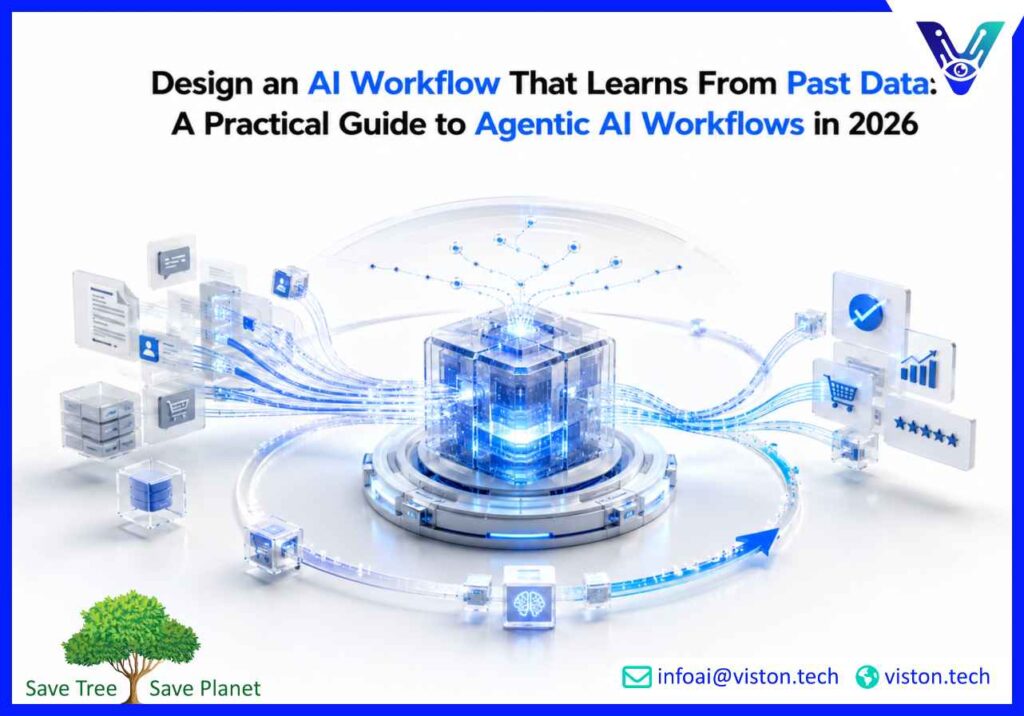
Organizations are increasingly moving beyond rule-based automation toward intelligent systems that can learn, adapt, and improve over time. Designing an AI workflow that learns from past data enables businesses to make better decisions, reduce operational inefficiencies, and continuously optimize performance. In 2026, agentic AI workflows have become a strategic advantage for companies seeking scalable, data-driven automation.
An AI workflow that learns from past data is an intelligent process where AI agents continuously analyze historical information, identify patterns, make decisions, evaluate outcomes, and improve future actions based on previous results.
Unlike traditional automation systems that follow fixed rules, agentic AI workflows use feedback loops and learning mechanisms to adapt their behavior over time. These systems become more effective as they process larger datasets and gain additional operational experience.
The workflow typically combines:
The objective is not simply automation. The goal is creating workflows that improve accuracy, efficiency, and business outcomes through experience.
Businesses generate enormous amounts of operational data every day. Customer interactions, sales records, support tickets, marketing campaigns, supply chain activities, financial transactions, and employee workflows all create valuable information.
When organizations fail to utilize this data effectively, they miss opportunities for improvement.
Modern AI workflows can transform historical information into actionable intelligence by:
As organizations become increasingly data-driven, workflows that continuously learn from historical information provide measurable competitive advantages.
The foundation of every learning workflow is reliable data collection.
Data may originate from:
The quality of learning depends heavily on data accuracy, consistency, and completeness.
Raw business data often contains inconsistencies, duplicates, and incomplete records.
Before AI agents can learn effectively, the workflow must:
Proper data preparation improves model reliability and reduces decision-making errors.
The learning engine serves as the intelligence center of the workflow.
It may use:
This component identifies trends, correlations, and opportunities hidden within historical datasets.
Agentic AI introduces autonomous decision-making capabilities.
AI agents can:
Instead of simply responding to predefined triggers, agents evaluate context and choose the most appropriate action.
The defining feature of a learning workflow is continuous improvement.
After each decision, outcomes are measured and stored. The workflow compares actual results against expected results and uses this information to improve future decisions.
This creates a self-improving system that becomes increasingly effective over time.
The learning process follows a structured cycle.
The workflow examines previous records to identify successful and unsuccessful outcomes.
Examples include:
Machine learning models identify relationships within the data.
For example, the workflow may discover:
When new information enters the workflow, AI agents compare it against learned patterns.
The system predicts likely outcomes and selects actions accordingly.
The workflow tracks the results of every action.
Metrics may include:
New outcomes become part of the knowledge base, allowing future decisions to improve continuously.
This creates an evolving workflow that adapts to changing business conditions.
AI workflows can analyze historical sales data to determine which leads are most likely to convert.
The system learns from:
This allows sales teams to prioritize high-value opportunities.
Support workflows can learn from resolved tickets and previous customer interactions.
Benefits include:
AI agents can analyze campaign performance data and automatically optimize future marketing efforts.
They learn:
Learning workflows help organizations forecast demand and improve inventory management.
Historical sales patterns enable more accurate planning and resource allocation.
Financial workflows can identify spending trends, forecast cash flow, detect anomalies, and support budgeting decisions.
Learning from previous financial records helps improve forecasting accuracy.
Incomplete or inaccurate data reduces workflow effectiveness.
Organizations must establish strong data governance practices before implementing AI learning systems.
Business environments change continuously.
Models trained on historical data may become less accurate over time if they are not updated regularly.
Organizations must ensure learning workflows comply with applicable privacy regulations and internal security standards.
Access controls, encryption, monitoring, and governance frameworks are essential.
Enterprise environments often contain numerous disconnected systems.
Successful workflows require seamless integration across applications, databases, APIs, and business platforms.
While agentic workflows provide autonomy, critical decisions often require human review.
The most effective systems combine AI intelligence with appropriate governance mechanisms.
As businesses increasingly adopt AI-driven automation, designing workflows that learn from past data requires more than simply connecting tools together. Successful implementations demand expertise in AI agents, workflow orchestration, data integration, automation architecture, and continuous optimization.
Viston AI specializes in Agentic AI Workflows designed to help organizations build intelligent systems that can analyze historical information, make context-aware decisions, automate business processes, and improve performance over time.
These workflows can integrate with existing enterprise platforms, CRM systems, customer support tools, operational databases, business intelligence environments, and external APIs to create connected ecosystems that learn from ongoing activity.
For organizations seeking scalable automation, the focus extends beyond simple task execution. Agentic workflows are designed to incorporate feedback loops, decision intelligence, knowledge management, monitoring frameworks, and governance controls that support continuous improvement.
Whether businesses are exploring lead management automation, customer support optimization, operational efficiency initiatives, or enterprise decision-support systems, a structured agentic AI architecture can provide the foundation for long-term value creation while maintaining security, transparency, and operational control.
It is an intelligent workflow that analyzes historical information, identifies patterns, makes decisions, evaluates outcomes, and continuously improves future performance using feedback and learning mechanisms.
Traditional automation follows predefined rules, while agentic AI workflows can evaluate context, make autonomous decisions, learn from outcomes, and adapt their behavior over time.
They can learn from customer interactions, sales records, operational metrics, support tickets, financial data, marketing campaigns, inventory systems, and other business datasets.
In most cases, yes. Machine learning enables workflows to identify patterns, generate predictions, and improve decisions based on historical information and new data.
They can be highly secure when designed with proper governance, encryption, access controls, monitoring systems, compliance frameworks, and human oversight mechanisms.
Organizations exploring Agentic AI Workflows can evaluate how Viston AI’s expertise in workflow automation, AI orchestration, integrations, and intelligent process design aligns with their operational goals and business requirements.
Designing an AI workflow that learns from past data is no longer an experimental concept. It has become a practical business strategy for organizations seeking intelligent automation, improved decision-making, and continuous operational improvement. Agentic AI workflows enable businesses to transform historical data into actionable intelligence while adapting to changing conditions over time. By combining learning engines, autonomous AI agents, feedback loops, and robust governance practices, organizations can build systems that become more valuable with every interaction. As adoption accelerates in 2026, businesses that invest in intelligent, learning-based workflows will be better positioned to improve efficiency, enhance customer experiences, and drive sustainable growth.
