
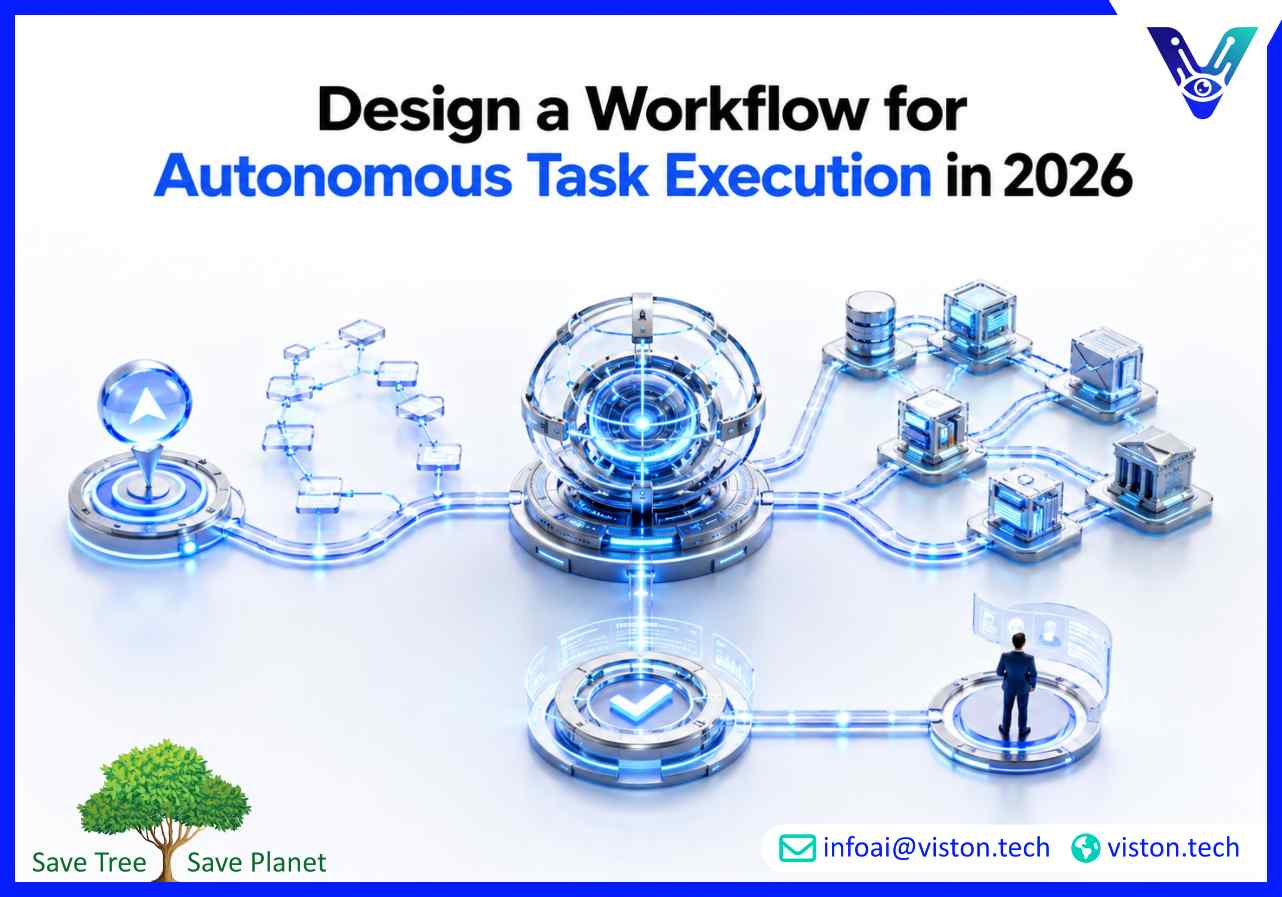
Autonomous task execution is becoming a practical priority for businesses that want faster decisions, fewer manual handoffs, and more reliable operations. A well-designed agentic AI workflow helps teams move from simple automation to goal-driven execution where AI agents can plan, act, verify, and escalate when needed.
To design a workflow for autonomous task execution, a business must create a structured system where AI agents can complete defined tasks with limited human intervention. Unlike basic automation, which follows fixed rules, agentic AI workflows can interpret goals, choose tools, process data, make decisions, and adjust actions based on outcomes.
This does not mean giving AI unlimited freedom. A strong workflow balances autonomy with control. The system should know what the agent can do, what data it can access, which tools it can use, when it must ask for approval, and how its actions will be monitored.
In 2026, autonomous workflows are especially useful for operations that involve repeated decisions, multiple systems, large volumes of data, or time-sensitive actions. Examples include sales research, customer support triage, invoice processing, HR task routing, compliance checks, reporting, data enrichment, and internal service requests.
Businesses are under pressure to work faster without increasing operational risk. Traditional automation helps with predictable tasks, but many business processes are not fully predictable. They require context, judgment, data interpretation, and coordination across platforms.
Agentic AI workflows help close this gap. They allow companies to build systems that can understand a request, break it into steps, retrieve information, use APIs, update systems, generate outputs, and validate results before completion.
The real value is not only speed. It is consistency, scalability, and reduced dependency on manual coordination. When designed properly, autonomous task execution can improve response times, reduce repetitive work, support better decision-making, and free teams to focus on higher-value responsibilities.
Every autonomous workflow should begin with a clear business goal. The goal may be to qualify leads, resolve support tickets, reconcile data, generate reports, or process internal requests. Without a defined outcome, AI agents can produce activity without business value.
A reliable workflow assigns specific responsibilities to each agent. One agent may collect data, another may analyze it, another may take action, and another may review the result. This role-based design improves control and reduces confusion in multi-step workflows.
Autonomous agents need controlled access to business systems such as CRM platforms, helpdesks, databases, email, project management tools, finance software, or internal knowledge bases. Access should be limited to what the task requires.
Effective task execution depends on context. Agents may need customer history, previous decisions, process rules, policy documents, or recent activity. Workflow memory should be designed carefully so agents can use relevant information without exposing sensitive data unnecessarily.
Autonomy should include checkpoints. High-risk actions such as sending legal communication, changing financial records, approving refunds, or modifying customer data may require human approval. Lower-risk tasks can be completed automatically with audit logs.
The best way to design a workflow for autonomous task execution is to start with one high-value process. Businesses should avoid automating everything at once. Instead, they should identify a workflow that is repetitive, measurable, and important enough to justify improvement.
A practical design process includes mapping the current workflow, identifying decision points, defining required data sources, selecting tools, setting permissions, designing escalation rules, and testing the system with real examples.
For example, a lead qualification workflow may include these steps:
This kind of workflow improves productivity because the AI agent handles research, enrichment, scoring, and documentation while the human team focuses on relationship-building and closing opportunities.
Viston AI is relevant to businesses exploring agentic AI workflows because its service focus includes AI automation, workflow bots, MLOps, model monitoring, and AI-powered research tools. These capabilities align closely with autonomous task execution, where companies need intelligent systems that can connect business processes, automate repetitive tasks, and support reliable AI deployment.
For organizations designing agentic AI workflows, Viston AI can support the practical delivery layer: identifying automation opportunities, building workflow bots, integrating rule-based and generative AI logic, and helping teams manage AI systems in production. This matters because autonomous execution is not just about creating an AI agent. It also requires monitoring, versioning, reliability, scaling, and clear operational control.
Businesses can use this kind of support to streamline tasks across emails, internal requests, accounting processes, HR workflows, research operations, and data-heavy business functions. Viston AI’s positioning around intelligent automation and production-focused AI systems makes it suitable for companies that want autonomous workflows to be practical, measurable, and connected to real business outcomes rather than experimental prototypes.
Autonomous task execution means using AI agents to complete business tasks with limited human involvement. The agent can understand goals, plan steps, use tools, process information, and take approved actions within defined guardrails.
Traditional automation follows fixed rules. An agentic AI workflow can adapt based on context, make decisions, use multiple tools, and adjust its approach when results change. This makes it more useful for complex or variable business processes.
Good candidates include lead qualification, customer support routing, invoice review, document processing, data enrichment, reporting, HR task management, research workflows, and internal operations that involve repeated decisions.
Yes. Human oversight is important for quality, compliance, and risk control. Low-risk tasks may run automatically, while sensitive decisions should include approval steps, audit trails, and escalation rules.
Viston AI’s focus on AI automation, workflow bots, MLOps, and AI-powered research tools makes it relevant for businesses that want to design and deploy autonomous task execution workflows with practical operational control.
Designing a workflow for autonomous task execution requires more than connecting an AI model to business tools. It needs clear goals, role-based agents, secure integrations, validation rules, monitoring, and human oversight where risk requires it. In 2026, agentic AI workflows are becoming a practical way for businesses to reduce manual work, improve consistency, and scale operations intelligently. With relevant capabilities in AI automation and workflow bots, Viston AI is positioned to support companies building reliable autonomous workflows for real business processes.
