
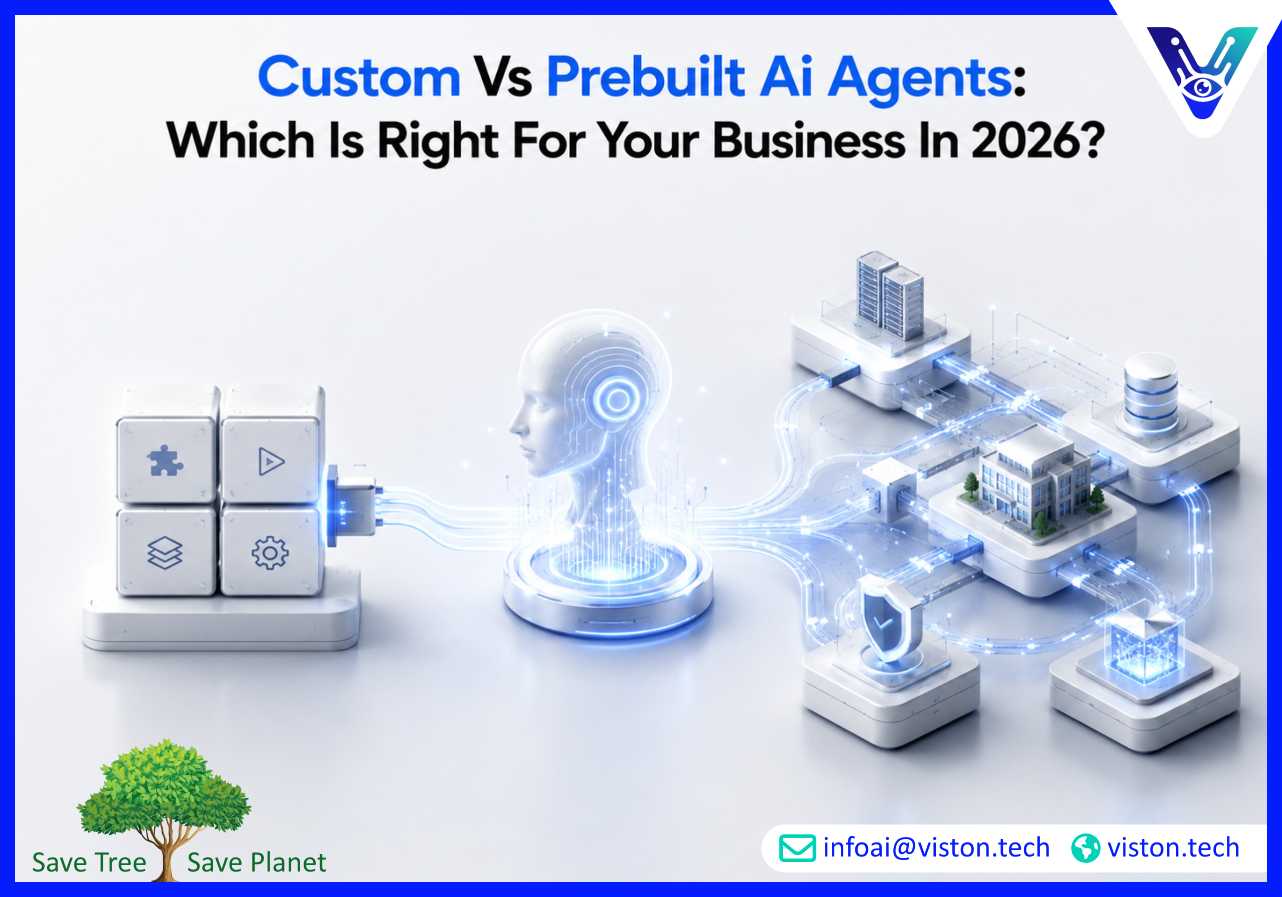
When businesses decide to deploy AI agents, the first major decision rarely gets the attention it deserves: do you build something tailored to your operations, or deploy a ready-made solution and work within its constraints? In 2026, that choice has significant consequences for performance, scalability, and long-term competitive positioning.
Prebuilt AI agents are off-the-shelf solutions designed to handle common, repeatable tasks with minimal configuration. Think customer service chatbots that handle FAQs, scheduling assistants built into productivity suites, or sales agents pre-integrated with CRM platforms
These tools are designed for speed and accessibility. A business can typically activate a prebuilt agent within days, connect it to a standard platform, and achieve a basic level of automation without requiring deep technical expertise.
For low-complexity tasks with well-defined boundaries, they can be genuinely useful. However, their value becomes limited the moment your requirements move beyond what the vendor anticipated when they built the product.
The limitations of prebuilt AI agents become apparent quickly in enterprise environments:
For businesses managing complex workflows, proprietary data environments, or cross-functional automation at scale, these limitations are not minor inconveniences — they are blockers.
Custom AI Agent Solutions are purpose-built autonomous agents designed around a specific organisation’s workflows, data, goals, and technical environment. They are developed using frameworks such as AutoGen Studio, CrewAI, LangGraph, or Vertex AI Agent Builder, and are architected to integrate with your actual systems rather than working around them.
A custom agent is not a template. It reflects the logic, language, priorities, and decision-making requirements of the business it serves. That specificity is exactly what makes it more effective.
Custom AI Agent Solutions unlock capabilities that prebuilt tools are simply not designed to deliver:
Organisations that default to prebuilt agents because of lower initial costs often encounter a more expensive problem later: poor adoption, workaround-heavy operations, and agents that are too limited to scale.
The true cost comparison between custom and prebuilt AI agents needs to account for:
Custom AI Agent Solutions carry higher upfront investment, but for organisations with complex requirements, the return — in operational efficiency, data-driven decision-making, and scalable automation — is typically substantial.
It would be inaccurate to dismiss prebuilt agents entirely. They are a reasonable choice when:
The key is honest assessment. A prebuilt agent that fits the problem will outperform a custom solution that is over-engineered for a simple need. Equally, a prebuilt agent forced into a complex environment will underperform against expectations and slow down the teams it was meant to support.
Before committing to either approach, decision-makers should assess the following:
For organisations that have moved past the exploratory phase and are ready to build AI agents that perform at an enterprise level, Viston AI offers a specialised and structured approach to Custom AI Agent Solutions.
Viston AI builds task-focused autonomous agents using advanced frameworks including AutoGen Studio, CrewAI, and Vertex AI Agent Builder. Their delivery model is designed for organisations that need more than a template — they need agents that integrate with existing infrastructure, operate within defined governance guardrails, and produce measurable outcomes from deployment.
Their “LLMOps in a Box” methodology covers the full lifecycle: building, deploying, and managing AI agents at scale, with responsible AI principles embedded throughout. This is particularly relevant for enterprise clients who need confidence that agent behaviour is auditable, compliant, and controllable.
Viston AI works with Chief AI Officers, VPs of Digital Transformation, and Heads of Data Science across the USA, Europe, and Australia. Their client engagements span financial services, retail, logistics, and other sectors where workflow complexity and data sensitivity make prebuilt solutions insufficient.
What distinguishes their delivery approach is the combination of deep technical capability — including multi-agent orchestration and predictive intelligence — with a strong focus on ROI accountability. Custom agent projects are scoped and measured against business outcomes, not just technical deliverables.
For organisations comparing custom vs prebuilt AI agents and concluding that their requirements demand something purpose-built, Viston AI provides the expertise to architect and deliver solutions that are built to last.
Prebuilt AI agents are ready-made tools configured for common use cases and standard platforms. Custom AI Agent Solutions are purpose-built to match an organisation’s specific workflows, data environment, systems, and business logic, giving significantly greater precision, integration depth, and scalability.
They can support simple, standalone tasks within mainstream platforms. However, enterprises with complex workflows, proprietary data, deep integration needs, or regulatory obligations typically find that prebuilt agents reach their functional limits quickly and cannot be adapted to meet those requirements.
Timelines vary based on complexity, integration requirements, and the number of agents being orchestrated. A focused single-agent build for a well-defined use case can move relatively quickly, while enterprise multi-agent systems involving multiple data sources and governance frameworks require structured planning, development, and testing phases.
Common frameworks include AutoGen Studio, CrewAI, LangGraph, and Vertex AI Agent Builder. The choice depends on the use case, orchestration requirements, and the technical architecture of the target environment.
Viston AI uses its LLMOps in a Box methodology to design, build, deploy, and manage custom AI agents at scale. Their process incorporates responsible AI governance, deep technical integration, and a focus on measurable business outcomes, serving enterprise clients across the USA, Europe, and Australia.
Custom agents should include defined escalation paths, explainability mechanisms, access controls, audit logging, and compliance guardrails appropriate to the industry and jurisdiction. These controls are far easier to implement in a custom-built solution than in a vendor-controlled prebuilt tool.
The custom vs prebuilt AI agents debate ultimately comes down to fit. Prebuilt solutions offer speed and simplicity for contained, low-complexity tasks. Custom AI Agent Solutions deliver the depth, control, integration, and scalability that serious enterprise automation requires. As AI agent adoption matures in 2026, organisations that invest in purpose-built solutions aligned to their actual workflows will outperform those constrained by what a vendor chose to include in a standard product. For businesses ready to move from experimentation to meaningful operational transformation, working with a specialist like Viston AI ensures that Custom AI Agent Solutions are built with the rigour, governance, and business focus that enterprise-grade deployment demands.
