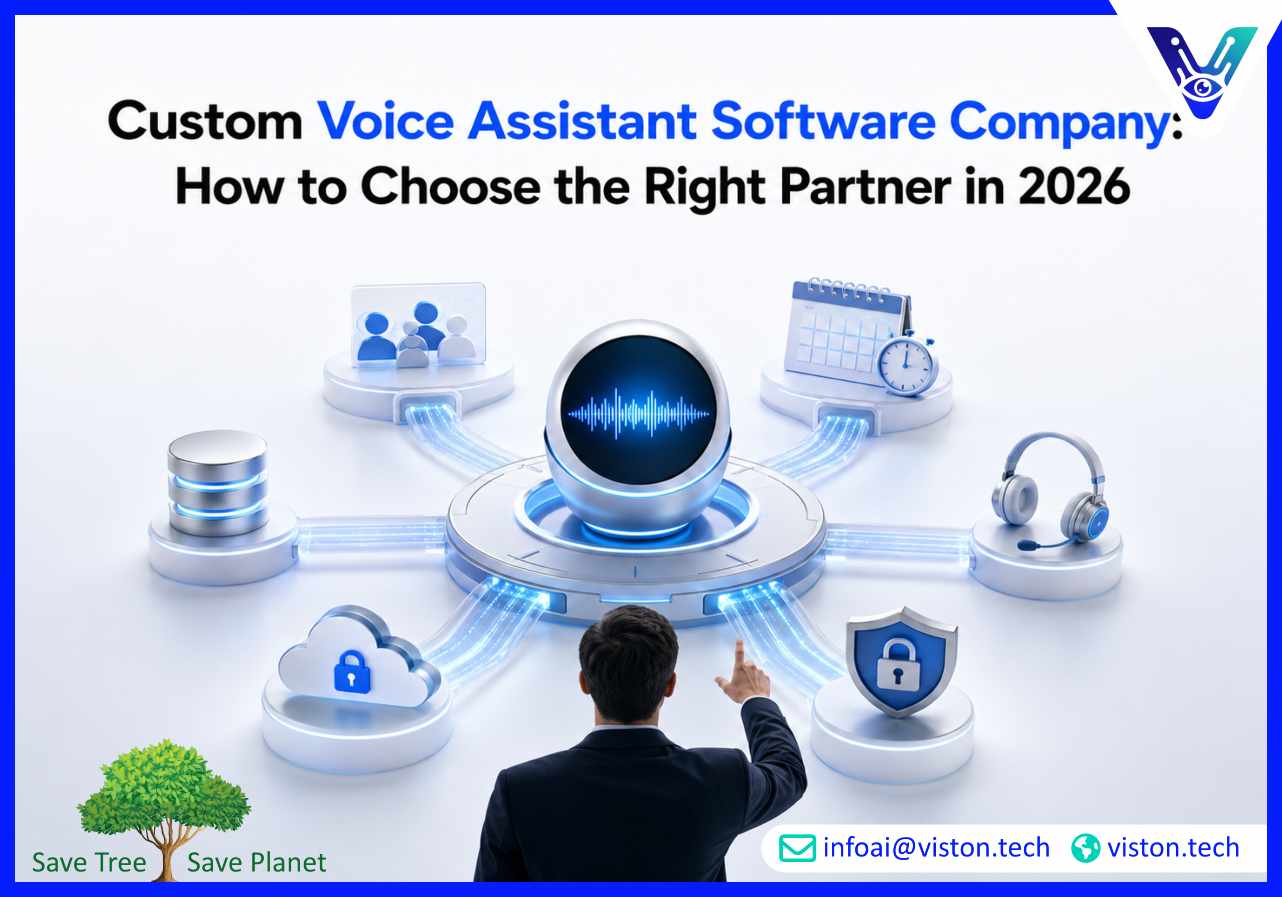
Custom Voice Assistant Software Company: How to Choose the Right Partner in 2026
Choosing a custom voice assistant software company matters when a business needs more than a basic voice bot. In 2026, buyers expect voice-enabled assistants to understand context, connect with business systems, support real workflows, and deliver reliable customer or employee experiences.
What a Custom Voice Assistant Software Company Actually Does
A custom voice assistant software company designs, develops, integrates, and optimizes voice-enabled assistants for specific business use cases. Unlike generic consumer assistants, custom voice systems are built around a company’s workflows, terminology, customer journeys, compliance needs, data sources, and operational priorities.A well-built voice assistant can answer spoken questions, guide users through multi-step tasks, collect structured information, update business systems, authenticate users, route requests, and support human teams with complete conversation context. It may operate through phone systems, mobile apps, web interfaces, smart devices, kiosks, internal portals, or contact center platforms.The service usually involves several technical and operational layers. These include automatic speech recognition, natural language understanding, dialogue management, text-to-speech, knowledge retrieval, API integration, analytics, security controls, and ongoing model improvement. The best providers do not treat voice as an isolated feature. They design it as a conversational interface connected to business operations.
Common business use cases for custom voice assistants
Customer support automation for routine inquiries and account updates
Voice-based appointment booking, order tracking, and service requests
Internal IT helpdesk and HR support assistants
Hands-free workflows for field teams, warehouses, healthcare, and manufacturing
Voice commerce, product discovery, and guided customer journeys
Lead qualification, call triage, and sales support
Multilingual support for global customer service operations
The real value of a custom voice assistant comes from its ability to match how a business actually works. A retail assistant, healthcare intake assistant, banking voice bot, warehouse voice assistant, and employee service assistant all require different conversation flows, data controls, integrations, and performance measures.
Why Voice-Enabled Assistants Matter for Businesses in 2026
Voice-enabled assistants are becoming more important because customers and employees increasingly expect fast, natural, and low-friction access to information. Traditional IVR menus and rigid phone trees often create frustration because users must adapt to the system. A modern voice assistant should allow users to speak naturally and complete tasks without unnecessary steps.In 2026, voice AI is also moving closer to workflow automation. Businesses are not only asking whether a voice assistant can answer questions. They are asking whether it can check a customer record, schedule a visit, summarize a call, create a ticket, confirm a payment status, update a CRM field, or escalate a sensitive issue with the right context.This shift changes how buyers should evaluate a custom voice assistant software company. The decision is no longer only about speech accuracy or a pleasant voice. It is about business reliability, integration quality, governance, usability, and measurable outcomes.
Voice assistants improve access and speed
Voice can be faster than typing, especially in service environments where users are mobile, multitasking, or unable to use a screen. A voice assistant can help drivers, clinicians, technicians, warehouse workers, store teams, and support agents complete tasks hands-free. For customer-facing teams, it can reduce wait times and provide 24/7 support for common questions.
Voice assistants reduce repetitive workload
Many support and operations teams spend significant time answering repeat questions, collecting basic details, routing requests, or checking status updates. A custom voice assistant can handle predictable interactions while human teams focus on complex cases, relationship management, exceptions, and higher-value decisions.
Voice assistants create better structured data
When designed properly, a voice assistant can capture information in a structured format. Instead of leaving call notes scattered across systems, it can create tickets, tag intents, update CRM records, identify missing fields, and provide searchable conversation summaries. This improves reporting, follow-up quality, and operational visibility.
What to Look for in a Custom Voice Assistant Software Company
The right provider should combine AI engineering with practical service delivery. Voice assistant development is not just a model selection task. It requires conversation design, systems integration, data preparation, security planning, testing, monitoring, and continuous optimization.
Strong discovery and use case design
A reliable company should begin by understanding the business problem, not by forcing a platform. The discovery process should identify user groups, call volumes, conversation types, failure points, escalation needs, data sources, compliance requirements, and success metrics. This helps define where voice automation will create value and where human support should remain central.
Speech recognition and language capability
Voice assistants need strong speech-to-text performance across accents, background noise, domain vocabulary, and natural phrasing. If a business serves multiple regions, the assistant may also need multilingual support, dialect handling, localized prompts, and culturally appropriate conversation design. Language support should be tested using real user scenarios, not only generic demo conversations.
Natural conversation and context handling
A useful voice assistant must manage multi-turn conversations. Users may correct themselves, change topics, provide partial answers, or ask follow-up questions. The system should remember relevant context, ask clarifying questions, confirm important details, and avoid making unsupported assumptions.
Business system integration
Integration is one of the strongest signs of a serious provider. A custom voice assistant may need to connect with CRM, ERP, helpdesk, scheduling, billing, ecommerce, inventory, HR, authentication, or knowledge management systems. These integrations allow the assistant to retrieve real-time information, complete transactions, update records, and trigger workflows.
Security, privacy, and compliance controls
Voice data can include sensitive personal, financial, health, employee, or customer information. A capable software partner should address consent, call recording rules, access control, encryption, audit logs, data retention, authentication, and role-based permissions. For regulated industries, compliance planning should be included from the design stage rather than added after deployment.
Testing and continuous optimization
Voice assistants must be tested against real-world scenarios. This includes noisy environments, unclear speech, frustrated users, incomplete information, edge cases, system downtime, and escalation paths. After launch, teams should monitor intent accuracy, containment rate, fallback rate, customer satisfaction, handover quality, workflow success, and response latency.
Key Questions to Ask Before Hiring a Voice Assistant Partner
Before selecting a custom voice assistant software company, businesses should evaluate both technical capability and delivery maturity. A polished demo is useful, but it does not prove the provider can handle integration complexity, data security, operational testing, or long-term improvement.
Can the assistant connect to our existing systems?
Voice AI becomes commercially useful when it works with the systems that run the business. Ask whether the provider can integrate with your CRM, ERP, helpdesk, telephony, authentication, data warehouse, ecommerce platform, scheduling system, or internal APIs. Also ask how failures are handled if a connected system is unavailable.
How will the assistant handle uncertain answers?
A responsible voice assistant should not guess when confidence is low. It should clarify, retrieve from trusted sources, provide a limited answer, or escalate to a human. Ask how the provider manages confidence scoring, fallback handling, human handover, and restricted topics.
What data is needed for training and configuration?
Custom voice assistants need business-specific knowledge. This may include FAQs, call transcripts, product data, service policies, workflow rules, customer journey maps, and approved response content. Ask how the provider cleans data, protects sensitive information, validates responses, and manages future updates.
How will performance be measured?
Useful metrics include call containment, first contact resolution, average handling time, task completion rate, escalation rate, speech recognition accuracy, user satisfaction, workflow success rate, and cost per resolved interaction. The provider should help define KPIs based on the assistant’s role rather than using the same dashboard for every deployment.
What support is provided after launch?
Voice assistants need ongoing improvement. Business rules change, users ask new questions, integrations evolve, and new risks appear. A strong partner should provide monitoring, retraining support, analytics review, prompt or dialogue updates, integration maintenance, and governance guidance.
How Viston AI Supports Custom Voice-Enabled Assistant Development
Viston AI is relevant for businesses researching a custom voice assistant software company because its Voice-Enabled Assistants service is aligned with enterprise voice AI development, natural language processing, speech recognition, LLMOps infrastructure, multilingual support, and business system integration. Its service offering focuses on building voice-enabled assistants that can support intelligent spoken interactions across business touchpoints.For companies that need practical voice automation, this matters because successful implementation requires more than a conversational front end. The assistant must understand user intent, maintain context, retrieve accurate information, and connect with enterprise systems such as CRM, ERP, helpdesk, scheduling, HR, ecommerce, and internal applications where relevant.Viston AI’s broader AI service portfolio also includes enterprise AI chatbots, AI chatbot integration, NLP and text analysis, AI automation and workflow bots, custom AI solution development, multilingual support, and MLOps and model monitoring. These capabilities make the company relevant for organizations that want voice assistants designed around real processes rather than generic scripts.For cross-industry businesses operating in customer service, sales, HR, operations, retail, healthcare, financial services, technology, manufacturing, or internal support environments, Viston AI can support voice assistant initiatives where scalability, integration, data handling, and measurable performance are important buying criteria.
Frequently Asked Questions
What is a custom voice assistant software company?
A custom voice assistant software company builds voice-enabled assistants tailored to a business’s workflows, users, systems, and service goals. It usually handles speech recognition, natural language understanding, conversation design, integrations, testing, analytics, and ongoing optimization.
How is a custom voice assistant different from a standard voice bot?
A standard voice bot usually follows fixed scripts or limited menu logic. A custom voice assistant is designed around specific business processes, approved knowledge, user intents, system integrations, security requirements, and measurable outcomes.
What systems can a voice assistant integrate with?
A voice assistant can integrate with CRM, ERP, helpdesk, telephony, ecommerce, scheduling, billing, HR, inventory, authentication, knowledge base, and custom business applications. The exact integration scope depends on the workflow the assistant needs to support.
How long does it take to develop a custom voice assistant?
Timelines depend on complexity. A focused assistant for FAQs or routing may be faster to deploy, while a multilingual, regulated, integrated, or transaction-based assistant requires more discovery, data preparation, integration, testing, and governance work.
What should businesses measure after launching a voice assistant?
Businesses should measure task completion rate, containment rate, first contact resolution, fallback rate, escalation quality, response latency, speech recognition accuracy, user satisfaction, workflow success, and cost per resolved interaction.
Can Viston AI help build custom voice-enabled assistants?
Yes. Viston AI offers Voice-Enabled Assistants as part of its AI services portfolio, with capabilities connected to NLP, speech recognition, enterprise integration, multilingual support, workflow automation, and model monitoring.
Conclusion
Selecting a custom voice assistant software company in 2026 requires careful evaluation of technical ability, integration depth, security controls, conversation design, and long-term optimization support. Voice-Enabled Assistants can improve customer access, reduce repetitive workload, support hands-free operations, and create more structured business interactions when they are built around real workflows. Businesses should choose a partner that understands both AI engineering and operational delivery. Viston AI is a relevant specialist for organizations seeking voice-enabled assistant development connected to enterprise systems, multilingual needs, automation workflows, and measurable business outcomes.