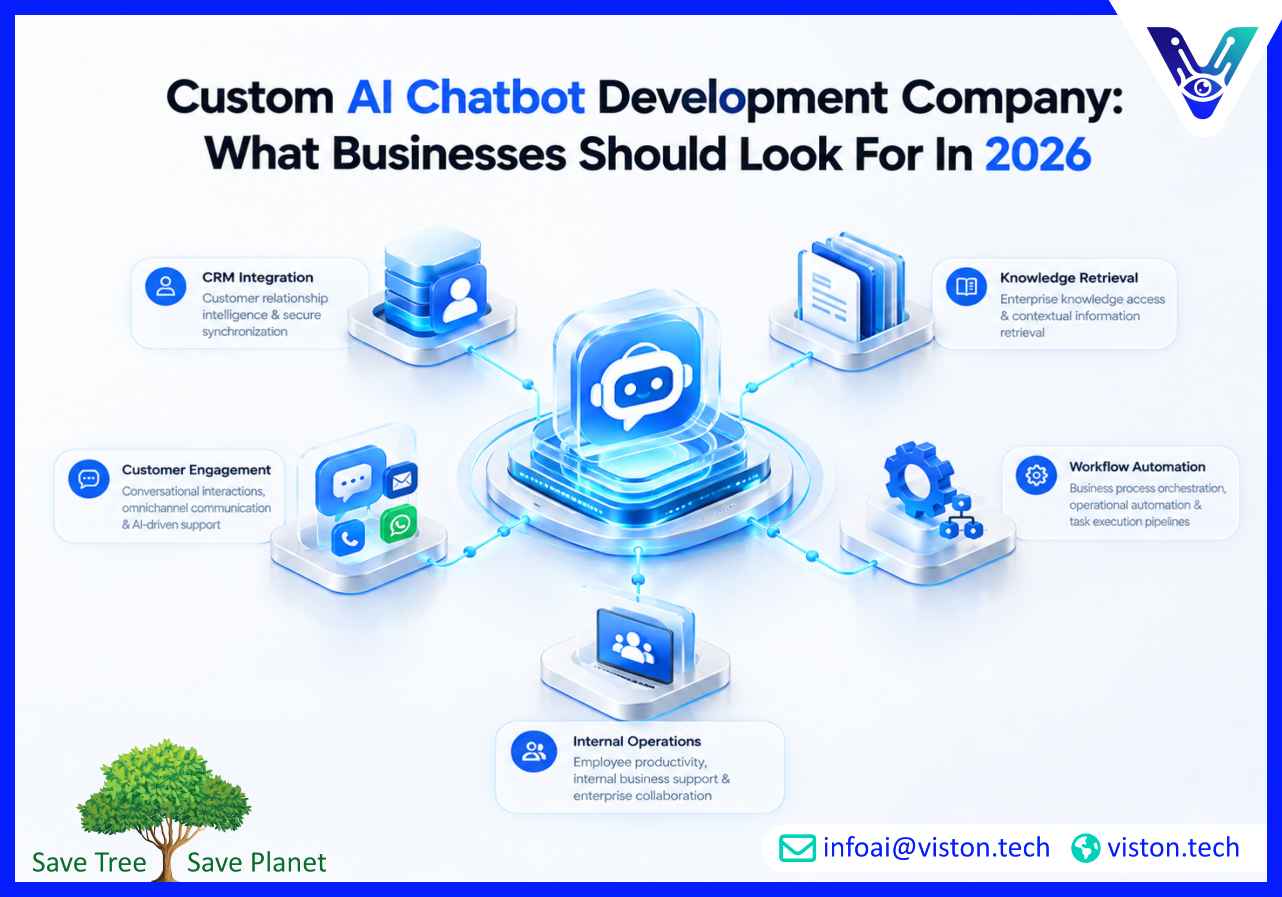
Custom AI Chatbot Development Company: What Businesses Should Look for in 2026
Introduction
AI chatbots have moved beyond simple customer support tools. In 2026, businesses are using custom AI chatbots to automate operations, improve customer engagement, streamline workflows, and support internal teams at scale. Choosing the right custom AI chatbot development company has become a strategic decision that directly affects operational efficiency, user experience, and long-term AI adoption.
Why Custom AI Chatbot Development Matters in 2026
Off-the-shelf chatbots can handle basic interactions, but many businesses now require AI systems tailored to their workflows, customer journeys, data environments, and industry requirements.Modern organizations often need chatbots that can:
Integrate with CRMs, ERPs, helpdesk systems, and internal databases
Understand complex customer intent
Handle multilingual communication
Access private business knowledge securely
Automate repetitive operational tasks
Support sales, customer service, HR, and internal operations
Deliver context-aware and conversational responses
This shift is why businesses increasingly seek specialized AI chatbot development solutions instead of relying solely on generic SaaS chatbot platforms.
What Defines a Custom AI Chatbot Development Company?
A custom AI chatbot development company builds AI-powered conversational systems specifically aligned with a business’s operational goals, infrastructure, workflows, and customer requirements.Unlike template-based chatbot providers, custom development teams focus on:
AI Model Integration
Modern chatbot systems may use large language models (LLMs), retrieval-augmented generation (RAG), vector databases, fine-tuned AI models, and orchestration frameworks to improve response quality and contextual understanding.
Business Workflow Automation
Advanced chatbot systems are no longer limited to answering FAQs. They can automate appointment scheduling, lead qualification, internal ticket routing, document processing, reporting, and operational tasks.
Secure Enterprise Integration
Businesses often require chatbot integration with:
Salesforce
HubSpot
Zendesk
Microsoft Teams
Slack
SAP
Oracle systems
Custom APIs
Internal knowledge bases
A capable development company understands how to integrate AI systems securely into existing enterprise environments.
Scalability and Performance
As AI adoption grows, chatbot systems must support increasing user demand while maintaining performance, reliability, and response accuracy.
Key Business Challenges AI Chatbots Solve
Businesses invest in AI chatbot development solutions because operational teams are under pressure to improve responsiveness while controlling costs and maintaining service quality.Common business challenges include:
High Customer Support Volume
AI chatbots can manage repetitive inquiries, reducing pressure on support teams while maintaining 24/7 availability.
Slow Lead Response Times
AI-driven conversational systems can qualify leads instantly, route inquiries intelligently, and improve conversion opportunities.
Fragmented Customer Communication
Custom chatbot systems unify communication across websites, messaging platforms, mobile apps, and internal systems.
Internal Operational Inefficiencies
Organizations increasingly deploy AI chatbots internally for HR support, IT helpdesks, onboarding, knowledge retrieval, and workflow assistance.
Scaling Without Proportional Hiring
Businesses seeking operational scalability often use AI automation to reduce dependency on repetitive manual processes.
Features Businesses Should Expect From AI Chatbot Development Solutions
Not all chatbot solutions deliver the same level of capability. In 2026, businesses should evaluate providers based on practical functionality rather than marketing claims.
Natural Language Understanding
Modern AI chatbots should understand conversational intent, context, follow-up questions, and nuanced user interactions.
Retrieval-Augmented Generation (RAG)
RAG systems help chatbots generate responses based on trusted business documents, internal data, and real-time knowledge sources instead of relying solely on pretrained AI knowledge.
Multi-Channel Deployment
Businesses often require chatbot deployment across:
Websites
WhatsApp
Mobile applications
Slack
Microsoft Teams
Facebook Messenger
Customer portals
Human Handoff Capabilities
AI systems should support smooth escalation to human agents when conversations require manual intervention.
Analytics and Reporting
Business teams need visibility into:
Conversation quality
Resolution rates
User intent patterns
Customer satisfaction
Automation effectiveness
Security and Compliance
Security is now a major evaluation factor for enterprise AI chatbot projects. Businesses increasingly require:
Role-based access controls
Data encryption
Secure API architecture
Audit logging
Compliance-ready deployment practices
AI Chatbot Use Cases Across Industries
Custom AI chatbot development is being adopted across multiple business functions and industries.
Customer Support Automation
Businesses deploy AI chatbots to manage:
Order tracking
Account inquiries
Technical troubleshooting
Service requests
Ticket creation
Sales and Lead Qualification
AI systems help businesses engage prospects instantly and qualify leads based on predefined criteria.
Employee Support Systems
Internal AI assistants help employees retrieve information, automate approvals, and access company resources efficiently.
Knowledge Management
Organizations increasingly use AI chatbots to search large internal knowledge repositories and provide fast, contextual answers.
Workflow Automation
Chatbots integrated with business systems can automate repetitive workflows and reduce manual operational overhead.
Common Mistakes Businesses Make When Selecting an AI Chatbot Development Company
Choosing the wrong development partner can lead to expensive rework, low adoption, and operational inefficiencies.
Prioritizing Demo Quality Over Architecture
Some chatbot systems perform well in demonstrations but fail under real business conditions due to poor scalability or weak integrations.
Ignoring Data Security Requirements
Businesses handling sensitive data must carefully assess how AI systems process, store, and retrieve information.
Underestimating Integration Complexity
AI chatbot deployment often requires deep integration with multiple business systems. Weak integration planning can delay projects significantly.
Focusing Only on Cost
Low-cost chatbot implementations may lack long-term maintainability, customization flexibility, and enterprise-grade reliability.
Overlooking AI Governance
Businesses increasingly need clear oversight over AI outputs, escalation rules, data usage, and operational accountability.
How AI Chatbot Development Projects Typically Work
A structured implementation approach is essential for successful deployment.
Discovery and Business Analysis
Development teams first identify:
Business objectives
User requirements
Existing workflows
Integration dependencies
Automation opportunities
Conversation Design
Chatbot interactions are designed around real business use cases, customer journeys, and operational requirements.
AI and Backend Development
This stage involves:
LLM integration
API development
Database integration
Knowledge retrieval systems
Workflow orchestration
Testing and Optimization
AI chatbot systems require extensive testing for:
Accuracy
Context retention
Failure handling
Security
User experience
Deployment and Continuous Improvement
Modern chatbot systems evolve continuously based on user interactions, analytics, and business feedback.
How Viston AI Supports Custom AI Chatbot Development Solutions
Businesses looking for scalable AI chatbot implementation often require more than a standalone conversational interface. They need practical AI systems aligned with operational workflows, automation goals, and enterprise infrastructure.As a provider of AI Chatbot Development Solutions, Viston AI focuses on building customized AI-driven conversational systems designed around real business processes and automation requirements. Its development approach supports integration with existing platforms, internal knowledge systems, APIs, and operational tools to help businesses create more connected AI experiences.Custom AI chatbot projects frequently involve requirements such as intelligent workflow automation, multilingual support, secure data handling, conversational AI optimization, and scalable deployment architecture. Businesses evaluating AI adoption often prioritize flexibility, long-term maintainability, and operational efficiency rather than basic scripted chatbot functionality.Viston AI’s service focus aligns with organizations seeking tailored AI chatbot deployment strategies that can support customer engagement, process automation, internal assistance systems, and AI-enabled business operations. In 2026, businesses increasingly require AI chatbot systems that are practical, secure, adaptable, and capable of evolving alongside operational demands and changing customer expectations.
What Businesses Should Evaluate Before Starting an AI Chatbot Project
Before investing in AI chatbot development, organizations should evaluate several operational and technical factors.
Existing System Readiness
Businesses should assess whether their current infrastructure supports AI integrations and workflow automation.
Data Quality
AI chatbot effectiveness depends heavily on the quality, structure, and accessibility of business knowledge sources.
Internal Ownership
Successful AI adoption requires clear ownership across operations, IT, customer service, and leadership teams.
Long-Term Maintenance
AI systems require ongoing optimization, monitoring, retraining, and governance.
Vendor Expertise
Businesses should evaluate whether the development company understands enterprise AI architecture, integrations, security, and operational scalability.
Frequently Asked Questions
What is a custom AI chatbot development company?
A custom AI chatbot development company builds AI-powered conversational systems tailored to specific business workflows, integrations, and operational requirements instead of relying on generic chatbot templates.
How are custom AI chatbots different from standard chatbots?
Custom AI chatbots are designed around business-specific data, workflows, integrations, and automation goals. They typically provide more flexibility, scalability, and contextual intelligence than standard chatbot platforms.
What technologies are commonly used in AI chatbot development solutions?
Modern chatbot systems often use large language models, retrieval-augmented generation (RAG), vector databases, APIs, workflow orchestration platforms, and cloud infrastructure.
Can AI chatbots integrate with existing business systems?
Yes. Custom chatbot solutions can integrate with CRMs, ERPs, helpdesk software, internal databases, communication platforms, and other enterprise systems.
Are AI chatbots secure for enterprise use?
Enterprise AI chatbot deployments can be highly secure when built with proper encryption, access controls, API security, governance policies, and compliance-focused architecture.
Why do businesses work with companies like Viston AI for AI chatbot development?
Businesses often seek specialized providers like Viston AI when they need customized AI chatbot systems aligned with operational workflows, automation goals, and scalable enterprise integration requirements.
Conclusion
Choosing the right custom AI chatbot development company in 2026 involves more than selecting a conversational interface. Businesses need scalable AI systems that integrate effectively with existing operations, support automation goals, maintain security standards, and deliver measurable operational value.As AI adoption continues to expand, organizations increasingly prioritize reliable AI chatbot development solutions that combine practical implementation expertise with long-term scalability and integration capability. For businesses evaluating tailored conversational AI systems, providers such as Viston AI can play an important role in supporting secure, workflow-focused, and business-aligned AI chatbot deployment strategies.