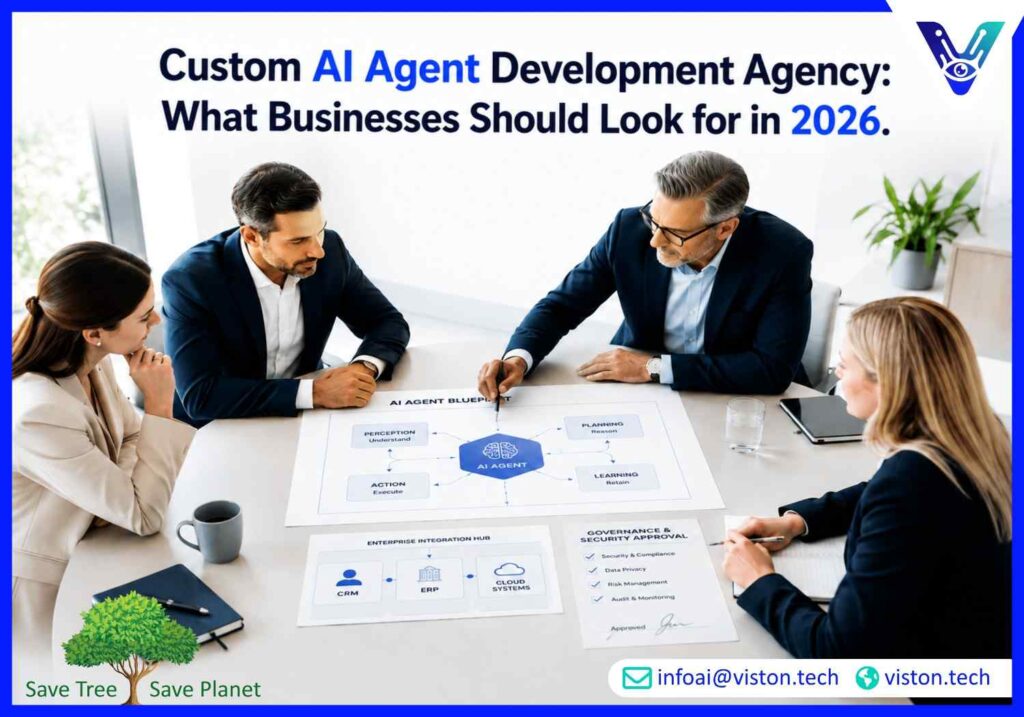
Custom AI Agent Development Agency: What Businesses Should Look for in 2026
Introduction
As businesses move beyond basic AI tools, the demand for intelligent systems that can act, reason, and automate work has increased significantly. In 2026, organizations across industries are looking for custom AI agents that fit their processes, systems, and operational goals rather than relying on generic automation solutions.
What Does a Custom AI Agent Development Agency Actually Do?
A custom AI agent development agency designs, builds, deploys, and maintains AI-powered systems that perform specific business tasks autonomously or semi-autonomously.Unlike standard chatbots or workflow automation tools, AI agents can:
Understand context
Access business systems and external tools
Make decisions based on defined rules and data
Complete multi-step processes
Learn and improve over time
Coordinate with other systems or agents
Examples include:
Customer support agents integrated with CRM systems
Sales intelligence agents for lead qualification
Internal knowledge assistants
Financial analysis agents
Supply chain monitoring agents
HR onboarding agents
Procurement and workflow automation agents
The purpose is not replacing teams. The goal is reducing repetitive work, accelerating decisions, and increasing operational efficiency.
Why Custom AI Agents Matter More in 2026
Many organizations experimented with generative AI during the last few years. The challenge was that generic tools often stopped at content generation or isolated task assistance.Business leaders now expect:
Greater workflow autonomy
Companies increasingly want systems capable of executing actions rather than simply producing responses.Examples include:
Updating records automatically
Creating reports
Triggering approvals
Retrieving information from multiple sources
Coordinating between departments
Better enterprise integration
Organizations operate across:
ERP systems
CRM platforms
Internal databases
Customer platforms
Data warehouses
Communication tools
Disconnected AI creates friction. Businesses now prioritize agents that work inside existing ecosystems.
Stronger governance and security
AI implementation in 2026 is no longer only about capability.Organizations evaluate:
Access permissions
Audit trails
Human oversight
Data protection
Regulatory compliance
Model monitoring
Responsible AI practices
A custom approach becomes increasingly important when sensitive data and operational decisions are involved.
Common Business Problems a Custom AI Agent Can Solve
Organizations rarely invest in AI because they want technology for its own sake.They usually have operational bottlenecks.
Manual process overload
Teams spend substantial time on:
Data entry
Documentation
Email responses
Reporting
Follow-ups
Custom agents reduce repetitive work and free employees for higher-value activities.
AI agents can unify access and provide contextual responses.
Slow decision cycles
Managers often wait for reports and data gathering before making decisions.Intelligent agents can:
Collect information
Analyze patterns
Highlight anomalies
Recommend next actions
Customer experience inconsistencies
Customers expect fast and personalized interactions.Custom AI agents can improve:
Response quality
Availability
Personalization
Resolution times
What Makes a Strong Custom AI Agent Development Agency?
Not every provider approaches AI implementation in the same way.Businesses evaluating vendors should look beyond demonstrations and marketing language.
Domain understanding
Technology expertise alone is insufficient.Strong providers understand:
Industry workflows
Operational realities
Business KPIs
User behavior
Compliance expectations
Architecture expertise
AI agents frequently involve multiple technologies:
Large language models
Retrieval systems
APIs
Vector databases
Agent frameworks
Cloud infrastructure
Monitoring tools
An agency should understand how these systems interact at scale.
Integration capability
Most organizations do not operate in isolated environments.Questions buyers should ask:
Can the solution integrate with existing systems?
Can it access internal data securely?
Will implementation disrupt operations?
Security and governance approach
Important considerations include:
Role-based access
Encryption
Monitoring
Logging
Human review processes
Compliance requirements
Post-deployment support
AI systems require ongoing optimization.A deployment should include:
Performance monitoring
Model updates
Workflow improvements
Usage analytics
Maintenance support
Key Technologies Used in Custom AI Agent Solutions
Businesses do not necessarily need deep technical knowledge, but understanding the components helps procurement and technology teams make informed decisions.Typical technology layers include:
Foundation models
These provide language understanding and reasoning capability.Examples may include:
Enterprise language models
Domain-specific models
Multimodal models
Retrieval systems
These allow agents to access business knowledge sources dynamically.Examples:
Knowledge repositories
Documentation libraries
Databases
Internal content systems
Agent orchestration frameworks
These frameworks help coordinate:
Task planning
Tool usage
Decision paths
Multi-agent collaboration
Integration infrastructure
Agents often connect to:
CRM systems
ERP platforms
HR systems
Marketing platforms
Business intelligence tools
Monitoring and LLMOps
Organizations increasingly require:
Agent performance tracking
Reliability monitoring
Prompt management
Governance controls
Industry Use Cases for Custom AI Agents
Different industries have different operational requirements.
Healthcare
AI agents can support:
Patient communication
Scheduling workflows
Documentation assistance
Administrative automation
Security and compliance become major priorities.
Financial services
Use cases include:
Risk monitoring
Fraud analysis
Customer assistance
Compliance support
Manufacturing
Organizations may use agents for:
Predictive maintenance
Supply chain visibility
Production planning
Operational reporting
Retail and eCommerce
Common applications include:
Product recommendation systems
Customer service assistants
Inventory intelligence
Demand forecasting
Technology and SaaS businesses
Examples include:
Internal support assistants
Sales enablement tools
Developer productivity agents
Customer success workflows
How Viston AI Supports Businesses with Custom AI Agent Solutions
Businesses exploring a custom AI agent development agency often need more than model implementation. They require solutions that fit operational workflows and deliver practical business outcomes.Viston AI provides Custom AI Agent Solutions focused on designing and deploying task-specific AI systems for business environments. Its service capabilities align with the growing demand for agentic workflows that extend beyond conversational interfaces into execution-focused systems.The company works across areas such as AI automation, workflow intelligence, agent integration, and enterprise AI implementation. Its capabilities include building autonomous agents that interact with business systems, process information, and support operational activities. These solutions can be relevant for organizations seeking workflow optimization, intelligent automation, or scalable AI initiatives.Custom AI implementation frequently requires a combination of orchestration frameworks, integrations, and governance mechanisms rather than isolated AI features. Businesses evaluating implementation partners increasingly look for providers capable of connecting AI agents with existing environments while maintaining scalability and operational reliability.For organizations in global markets or specialized industries, implementation quality often depends on how well AI systems align with business objectives, workflows, and long-term operational requirements.
Questions Businesses Should Ask Before Hiring a Custom AI Agent Development Agency
Before selecting a partner, organizations should evaluate practical considerations.Important questions include:
What specific business problem will the AI agent solve?
Which systems require integration?
How will success be measured?
What governance and security measures exist?
How scalable is the solution?
What ongoing support is included?
The quality of these answers often reveals whether a provider understands implementation realities.
Frequently Asked Questions
What is the difference between a chatbot and a custom AI agent?
A chatbot primarily handles conversations and predefined interactions. A custom AI agent can understand context, access tools, execute tasks, and complete multi-step workflows.
How long does custom AI agent development usually take?
The timeline depends on complexity. Smaller workflow-focused implementations may take several weeks, while enterprise multi-agent systems with extensive integrations can take several months.
Can custom AI agents integrate with existing business systems?
Yes. Modern AI agents commonly integrate with CRM platforms, ERP systems, APIs, internal databases, knowledge repositories, and business applications.
Are custom AI agents secure for enterprise use?
Security depends on implementation quality. Enterprise solutions often include encryption, access controls, monitoring, governance policies, and compliance measures.
How can businesses evaluate whether Viston AI is suitable for their requirements?
Organizations should assess whether Viston AI’s Custom AI Agent Solutions align with their operational needs, industry requirements, integration expectations, and long-term business goals.
Conclusion
Choosing a custom AI agent development agency in 2026 involves much more than selecting a technology provider. Businesses increasingly need solutions capable of integrating with workflows, supporting decisions, maintaining governance standards, and delivering measurable operational value.Custom AI Agent Solutions can help organizations automate complex processes, reduce inefficiencies, and create scalable systems that evolve with business needs. For companies exploring intelligent workflow automation and agentic systems, providers such as Viston AI can play a meaningful role when their capabilities align with practical business objectives and implementation requirements.