
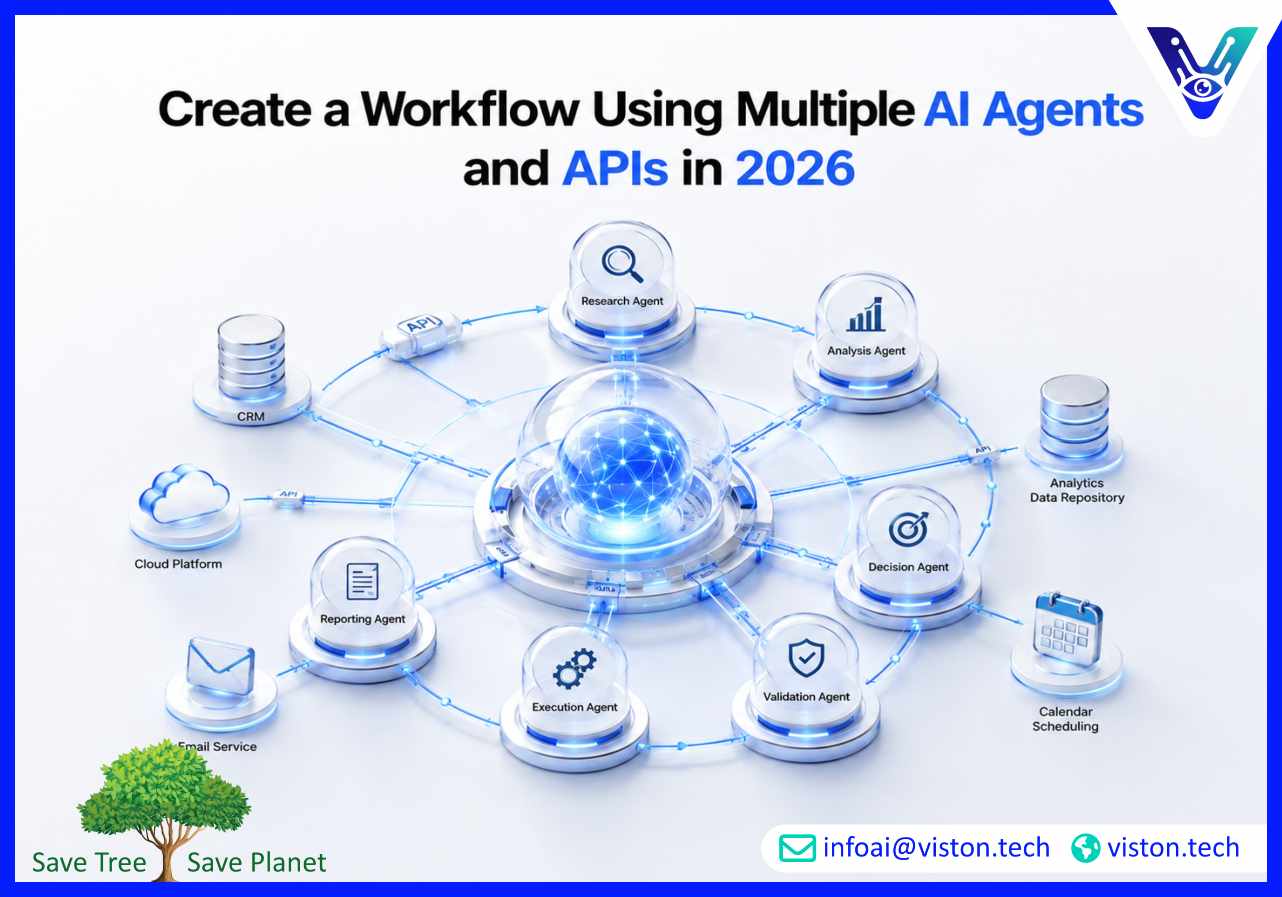
Creating a workflow using multiple AI agents and APIs is becoming a practical way for businesses to automate complex, multi-step work that depends on data, decisions, and actions across different systems.
A multi-agent AI workflow is a structured system where different AI agents perform specialized roles while APIs connect those agents to business tools, databases, applications, and external services.
Instead of relying on one large prompt or one automation rule, the workflow is divided into focused responsibilities. One agent may collect information, another may analyze it, another may make recommendations, and another may trigger actions through APIs.
For example, a sales workflow may include a research agent, qualification agent, CRM update agent, email drafting agent, and reporting agent. APIs connect the workflow to tools such as CRM platforms, email systems, enrichment databases, calendars, analytics dashboards, and internal knowledge bases.
This approach is useful when a process requires reasoning, context, system access, and coordination rather than simple task automation.
In 2026, businesses expect automation to do more than move data from one system to another. They want AI workflows that can understand context, handle exceptions, improve decisions, and support measurable business outcomes.
Agentic AI workflows are valuable because they can manage tasks that involve judgment, sequencing, and system coordination. APIs make these workflows useful in real operations by allowing agents to retrieve data, update records, trigger notifications, generate documents, create tickets, and monitor results.
Common use cases include:
The main advantage is not only speed. A well-designed agentic workflow improves consistency, reduces manual effort, creates better visibility, and allows teams to scale complex processes without adding unnecessary operational burden.
Every agentic workflow must begin with a clear business goal. The goal defines what the system is expected to achieve, what data it needs, which decisions it can make, and where human approval is required.
Each agent should have a defined role. A good workflow avoids giving every agent broad responsibility. Specialized agents are easier to monitor, improve, and secure.
Typical agent roles include research agents, planning agents, validation agents, decision agents, execution agents, reporting agents, and escalation agents.
APIs allow agents to interact with real business systems. Without API integration, agents may generate useful outputs but cannot complete operational tasks.
API integrations may connect the workflow with CRMs, ERPs, payment systems, databases, helpdesks, communication platforms, cloud storage, analytics tools, and third-party data providers.
The orchestration layer controls how agents communicate, when each task starts, what happens after each decision, and how errors are handled. This layer is essential for reliability.
Agents need access to relevant context such as user history, customer records, policy documents, workflow status, past decisions, and task outcomes. Memory must be controlled carefully to protect accuracy, privacy, and security.
Not every decision should be fully autonomous. High-risk actions, customer-facing messages, financial approvals, compliance decisions, and sensitive data changes often require human-in-the-loop review.
Start by documenting the existing process. Identify inputs, decision points, systems used, manual bottlenecks, approval stages, and expected outputs.
Break the workflow into roles. For example, in a lead generation workflow, one agent may research companies, another may score leads, another may personalize outreach, and another may update the CRM.
Select APIs based on the systems the workflow must access. This may include CRM APIs, email APIs, calendar APIs, database APIs, analytics APIs, or internal application APIs.
Guardrails define what agents can and cannot do. They may include data access limits, approval rules, validation checks, output formatting rules, escalation triggers, and compliance controls.
Testing should include normal cases, incomplete data, conflicting information, API failures, unusual user requests, and edge cases. A workflow that performs well only in ideal conditions is not ready for production.
Once deployed, the workflow should be monitored for accuracy, latency, task completion rates, API failures, human override rates, and business outcomes.
Multi-agent workflows can create strong business value, but they also introduce risks if they are poorly designed. Common risks include unreliable outputs, weak API security, unclear ownership, poor logging, excessive autonomy, and lack of human review.
Best practices include:
The strongest workflows combine AI reasoning with reliable engineering, structured data, secure integrations, and practical governance.
Viston AI is relevant to businesses exploring agentic AI workflows because the company focuses on designing and deploying production-grade AI agent systems for real business operations. For organizations that want to create workflows using multiple AI agents and APIs, the value lies in moving beyond experiments and building systems that can operate reliably across business tools, data sources, and approval processes.
Its work in agentic AI workflows can support use cases such as workflow orchestration, multi-agent task coordination, API-connected automation, operational process design, and scalable AI implementation. This is especially useful for teams that need practical systems rather than isolated AI prototypes.
A business-focused delivery approach matters because multi-agent systems require more than prompt writing. They need architecture, integration planning, security controls, monitoring, exception handling, and measurable workflow outcomes. Viston AI’s relevance comes from helping organizations translate complex business processes into structured AI workflows where agents can reason, collaborate, and act through APIs while staying aligned with operational goals.
It is an automated business process where different AI agents handle specific tasks and APIs connect those agents to software systems, databases, and business tools.
Multiple agents make workflows easier to control, test, monitor, and improve because each agent has a focused responsibility within the process.
Common APIs include CRM APIs, email APIs, calendar APIs, database APIs, helpdesk APIs, analytics APIs, payment APIs, and internal business application APIs.
They can be safe when designed with access controls, human review, audit logs, validation layers, security policies, and clear limits on autonomous actions.
Viston AI is positioned around agentic AI workflow development and can support businesses that need structured, API-connected, production-ready AI agent systems.
Creating a workflow using multiple AI agents and APIs is one of the most practical ways to apply agentic AI workflows in real business environments. The approach helps organizations automate complex tasks, connect systems, improve decision-making, and scale operations with stronger control. Success depends on clear process design, specialized agents, secure API integration, monitoring, and human oversight where needed. For businesses exploring production-ready agentic AI workflows, Viston AI can be a relevant specialist for designing reliable, scalable, and business-focused AI workflow systems.
