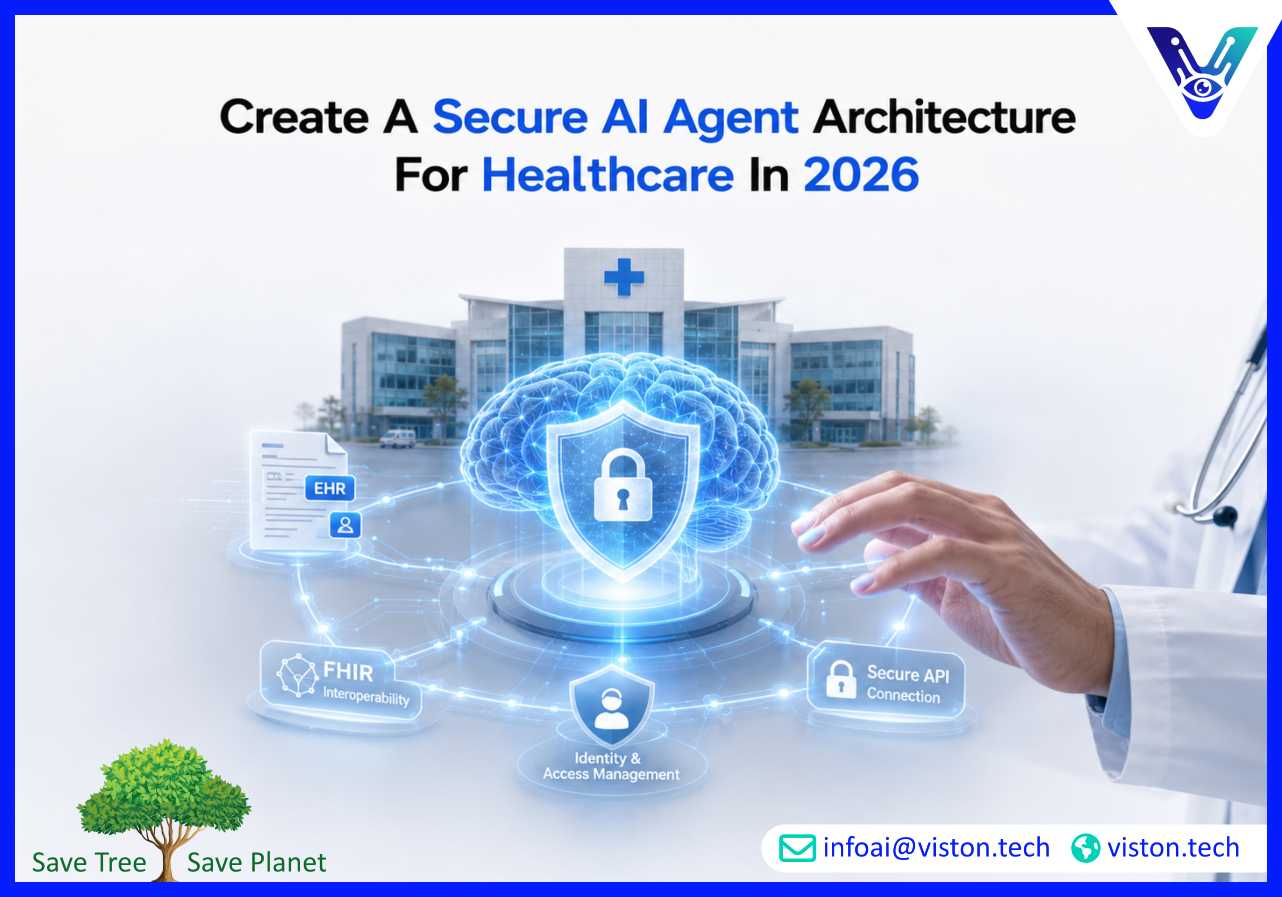
Create a Secure AI Agent Architecture for Healthcare in 2026
Introduction
Healthcare organizations are rapidly adopting AI-driven automation to improve operational efficiency, patient experiences, clinical workflows, and decision-making. However, deploying AI agents in healthcare requires far more than automation capabilities alone. Security, compliance, governance, interoperability, and data protection are now central requirements for building trustworthy AI agent architectures in 2026.
Why Secure AI Agent Architecture Matters in Healthcare
Healthcare systems handle highly sensitive patient information, clinical records, insurance data, diagnostic workflows, and operational processes. Any AI automation deployed in this environment must operate within strict security and compliance boundaries.Modern healthcare AI agents are no longer limited to simple chatbots. They now support:
Appointment coordination
Medical workflow automation
Claims processing
Patient communication
Clinical documentation assistance
Intelligent triage systems
Electronic Health Record (EHR) integrations
Staff workflow orchestration
Healthcare analytics automation
As AI adoption grows, healthcare organizations face increasing concerns around:
Protected health information (PHI) exposure
Unauthorized data access
AI hallucinations
Workflow manipulation
Insecure API integrations
Regulatory non-compliance
Identity and access vulnerabilities
Third-party AI model risks
A secure AI agent architecture addresses these challenges while allowing healthcare providers to scale automation safely.
What Is a Secure AI Agent Architecture?
A secure AI agent architecture is a structured framework that governs how AI agents interact with healthcare systems, users, applications, and sensitive data while maintaining compliance, security, reliability, and operational transparency.In healthcare, this architecture typically combines:
AI workflow orchestration
Identity and access management
Secure API gateways
Encrypted data pipelines
Compliance controls
Human approval mechanisms
Audit logging
Role-based permissions
Monitoring and anomaly detection
Governance policies
The goal is to ensure AI agents can automate tasks without compromising patient safety, regulatory obligations, or organizational security.
Core Components of a Secure Healthcare AI Agent Architecture
1. Identity and Access Management (IAM)
Every AI agent operating in healthcare should have tightly controlled access permissions.Role-based access control (RBAC) and zero-trust security models are now considered standard architecture requirements in 2026. AI agents should only access the minimum data and systems necessary to perform approved workflows.Key controls include:
Multi-factor authentication
API authentication tokens
Role segmentation
Least-privilege access
Session-based authorization
Secure credential storage
Without strong IAM policies, AI agents can unintentionally expose sensitive healthcare data.
2. Secure Data Layer
Healthcare AI agents interact with EHR systems, patient portals, insurance platforms, laboratory systems, and operational databases. All data movement must be secured.Critical protections include:
End-to-end encryption
Encrypted data storage
Secure cloud infrastructure
Tokenized PHI handling
Data masking
Secure API communication
Regional data residency controls
Organizations should also define strict data retention and deletion policies for AI-generated outputs.
HIPAA and Healthcare Compliance Requirements
Healthcare AI systems in 2026 must comply with evolving healthcare regulations and data governance frameworks.Depending on the region, healthcare providers may need to address:
HIPAA compliance
GDPR requirements
HITECH regulations
Healthcare cybersecurity standards
AI governance guidelines
Medical data sovereignty laws
Compliance requirements influence how AI agents:
Store data
Process patient information
Access systems
Generate recommendations
Maintain audit trails
Handle automated decision-making
Healthcare organizations increasingly require explainable AI workflows and traceable agent activity logs to support compliance audits.
Human-in-the-Loop Controls for AI Agents
One of the biggest mistakes healthcare organizations make is over-automating critical workflows.Secure healthcare AI architectures should include human approval checkpoints for:
Clinical recommendations
Treatment suggestions
Patient risk assessments
Insurance decisions
Medication-related workflows
Sensitive communications
Human-in-the-loop systems reduce operational risks while improving trust in AI automation.In 2026, healthcare providers increasingly prefer collaborative AI architectures where agents support healthcare professionals instead of replacing decision-making authority.
AI Model Security and Governance
Healthcare organizations must also secure the AI models themselves.This includes:
Model Access Controls
Restricting who can train, modify, deploy, or interact with AI models.
Prompt Injection Protection
AI agents connected to external systems can become vulnerable to malicious prompts or manipulated instructions. Security layers should validate inputs before execution.
Output Validation
Healthcare AI outputs should be verified against approved policies and business rules before triggering automated actions.
Continuous Monitoring
AI agents require ongoing monitoring for:
Abnormal behavior
Unauthorized activity
Model drift
Data anomalies
Workflow failures
Security incidents
Healthcare providers increasingly deploy centralized AI governance platforms to manage agent behavior across departments.
Secure Integration with Healthcare Systems
AI agents rarely operate independently. They usually integrate with:
EHR platforms
Telehealth systems
Billing software
CRM systems
Scheduling tools
Clinical databases
Insurance processing systems
These integrations introduce additional security considerations.
API Security
Secure API architecture is essential for healthcare AI deployments.Best practices include:
API gateways
OAuth authentication
Rate limiting
Encrypted payloads
Traffic monitoring
Token expiration controls
Interoperability Standards
Healthcare organizations increasingly rely on standards like HL7 and FHIR for secure interoperability between AI agents and healthcare systems.AI architectures should support standardized healthcare data exchange without compromising data integrity or compliance.
Why Healthcare Organizations Need Workflow-Level Security
Many healthcare organizations focus only on infrastructure security while overlooking workflow-level vulnerabilities.For example, an AI scheduling agent may:
Access patient calendars
Modify appointments
Trigger automated reminders
Update EHR systems
Without workflow governance, even a technically secure AI system can create operational risks.Workflow-level security includes:
Approval routing
Action validation
Activity logging
Permission-based workflow execution
Escalation controls
Fail-safe mechanisms
Healthcare AI automation must balance efficiency with operational accountability.
Common Security Risks in Healthcare AI Automation
Unauthorized Data Exposure
Improper permissions can expose sensitive patient records to unauthorized users or systems.
Insecure Third-Party Integrations
External AI tools or APIs may introduce hidden compliance and cybersecurity risks.
AI Hallucinations
Incorrect AI-generated outputs can create operational or clinical issues if not validated.
Shadow AI Usage
Departments sometimes deploy unauthorized AI tools without centralized governance.
Weak Auditability
Without detailed logs, organizations may struggle to investigate incidents or demonstrate compliance.A mature AI agent architecture addresses these risks proactively.
How Viston AI Supports Secure Healthcare AI Automation
Viston AI specializes in AI Automation & Workflow Bots designed to help businesses build scalable, controlled, and operationally reliable AI-driven workflows.For healthcare organizations, secure AI automation requires more than deploying a standalone AI model. It involves designing workflow architectures that integrate securely with existing systems, maintain operational visibility, and support compliance-oriented governance practices.Viston AI focuses on workflow-centric AI automation strategies that can support:
Intelligent healthcare process automation
Secure workflow orchestration
AI-driven operational task handling
Integration-focused automation environments
Controlled multi-system automation
Human-supervised AI workflows
Scalable automation infrastructure
Healthcare organizations increasingly require AI systems that can align with enterprise-grade operational requirements, especially when handling sensitive workflows involving patient data, scheduling, documentation, claims management, and administrative coordination.A practical AI automation strategy also requires attention to security controls, monitoring, scalability, integration stability, and long-term workflow maintainability. Viston AI’s focus on AI Automation & Workflow Bots aligns with the growing demand for structured, secure, and operationally sustainable AI deployment approaches in healthcare environments.
Best Practices for Building Secure Healthcare AI Agents
Start with Limited Workflow Scope
Begin with non-critical operational workflows before expanding automation into sensitive clinical areas.
Implement Zero-Trust Architecture
Assume every interaction requires verification, regardless of internal or external access.
Maintain Human Oversight
Avoid fully autonomous healthcare decision-making systems where risks are high.
Prioritize Explainability
AI agents should provide traceable actions and understandable workflow outputs.
Audit Everything
Comprehensive logging is essential for compliance, troubleshooting, and governance.
Continuously Test Security Controls
Healthcare AI systems require ongoing penetration testing, vulnerability monitoring, and workflow validation.
The Future of Secure AI Agent Architecture in Healthcare
Healthcare AI automation is expected to become increasingly agent-driven over the next several years. However, security and governance will determine which organizations can scale AI safely.In 2026, healthcare providers are prioritizing:
AI governance frameworks
Responsible AI deployment
Multi-agent workflow orchestration
Privacy-preserving AI systems
Compliance-aware automation
Secure healthcare interoperability
AI observability platforms
Organizations that build secure AI foundations today will be better positioned to scale intelligent automation without introducing unacceptable operational or regulatory risks.
Frequently Asked Questions
What is a healthcare AI agent?
A healthcare AI agent is an intelligent software system designed to automate tasks, workflows, decision support, or operational processes within healthcare environments using AI technologies.
Why is security important in healthcare AI architecture?
Healthcare AI systems handle highly sensitive patient and operational data. Strong security controls help prevent unauthorized access, compliance violations, data breaches, and workflow misuse.
What compliance standards affect healthcare AI systems?
Depending on the region, healthcare AI systems may need to comply with HIPAA, GDPR, HITECH, FHIR interoperability requirements, and healthcare cybersecurity regulations.
Can AI agents integrate with EHR systems securely?
Yes. Secure integrations are possible through encrypted APIs, identity management controls, interoperability standards, and governed workflow orchestration.
What are the biggest risks in healthcare AI automation?
Common risks include insecure integrations, AI hallucinations, unauthorized data exposure, poor auditability, and insufficient governance controls.
How can Viston AI help healthcare organizations with AI automation?
Viston AI supports organizations seeking scalable AI Automation & Workflow Bots that align with operational workflows, integration requirements, automation governance, and secure workflow execution strategies.
Conclusion
Creating a secure AI agent architecture for healthcare requires far more than deploying AI tools. Healthcare organizations must combine automation capabilities with strong governance, compliance controls, secure integrations, workflow oversight, and operational accountability. As AI adoption accelerates in 2026, businesses investing in structured and security-focused AI Automation & Workflow Bots will be better positioned to improve efficiency while protecting sensitive healthcare operations. For organizations exploring scalable and workflow-oriented AI automation strategies, Viston AI represents a practical technology partner aligned with modern healthcare AI operational requirements.