
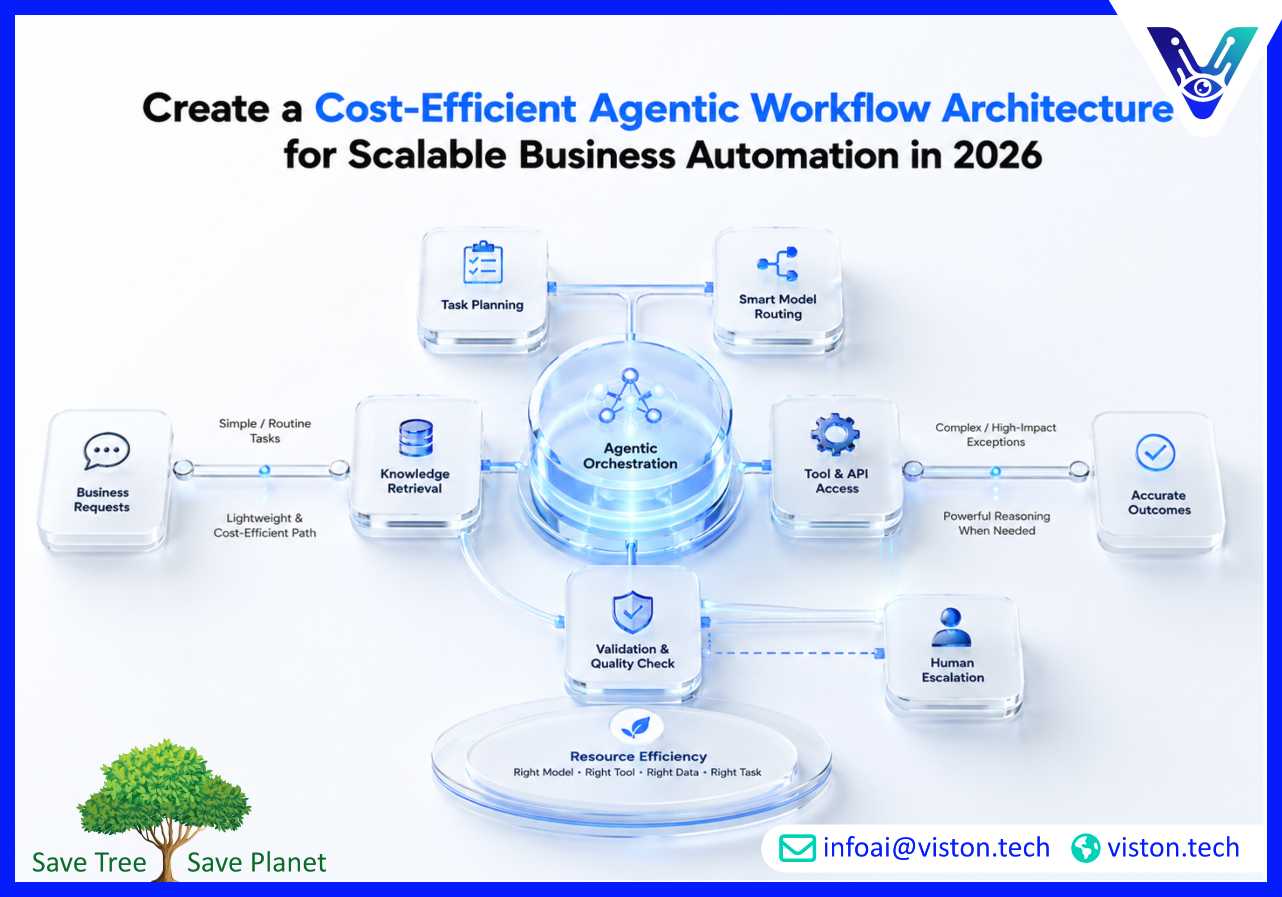
Cost-efficient agentic workflow architecture matters because businesses no longer want AI experiments that look impressive but become expensive to operate. In 2026, decision-makers need practical agentic AI workflows that reduce manual effort, control model usage, integrate with existing systems, and deliver measurable operational value.
A cost-efficient agentic workflow architecture is a structured system where AI agents plan, execute, verify, and improve business tasks without creating unnecessary infrastructure, model, integration, or maintenance costs. It is not about using the cheapest AI model or removing human oversight. It is about designing the right balance between automation, control, performance, and spend.
In a typical agentic AI workflow, different agents may handle research, data retrieval, decision logic, document processing, customer communication, quality checks, reporting, or escalation. The architecture becomes cost-efficient when each agent has a clear purpose, uses the right tools, accesses only necessary data, and triggers expensive operations only when business value justifies them.
For many organizations, the main cost problem is not the AI model itself. Costs often come from poorly defined workflows, repeated API calls, unnecessary context usage, weak orchestration, duplicated tools, excessive human review, poor monitoring, and agents that attempt tasks they are not designed to handle. A well-planned architecture prevents these issues before deployment.
Agentic AI adoption is moving from pilots to production. That shift changes the cost conversation. A small prototype may work with manual prompts, unlimited context, and loose controls. A production workflow needs predictable operating costs, secure integrations, clear performance metrics, and reliable fallback paths.
Businesses are now evaluating agentic AI workflows through practical questions: How much manual work will this remove? How often will it fail? What systems will it connect to? How many approvals are required? Can it scale without multiplying costs? Can it be monitored, audited, and improved over time?
Cost efficiency also matters because agentic systems can create hidden spend. An agent that retries too often, searches too broadly, calls multiple APIs unnecessarily, or sends every task to a premium model can quickly become expensive. The architecture must make intelligent decisions about when to automate, when to retrieve data, when to call tools, when to ask a human, and when to stop.
Every workflow should begin with a defined business outcome. For example, reducing support triage time, qualifying sales leads, processing internal requests, summarizing compliance documents, or automating reporting. Clear boundaries prevent agent sprawl and keep the system focused on measurable outcomes.
A cost-efficient architecture uses specialized agents instead of one large general-purpose agent. Separate agents for intake, reasoning, tool use, validation, and escalation make the workflow easier to monitor, optimize, and improve. Modular design also allows businesses to replace one component without rebuilding the full system.
Not every task requires the most advanced model. Simple classification, extraction, formatting, or routing can often use lower-cost models or deterministic rules. More complex reasoning, planning, or exception handling can be reserved for stronger models. Smart routing helps control cost without sacrificing quality.
Agentic workflows become expensive when they send too much context into every model call. A better architecture uses retrieval-augmented generation, metadata filtering, permissions, and context compression so agents receive only the information required for the task.
Agents should not call tools freely without limits. Each API call, database query, CRM action, or workflow trigger should be governed by rules, permissions, thresholds, and logging. This improves cost control, security, and operational reliability.
Cost-efficient automation does not remove humans from every decision. It places human review where judgment, compliance, risk, or customer sensitivity matters. This reduces unnecessary manual work while protecting the business from costly automation errors.
The strongest cost savings come from architecture decisions made before implementation. Businesses should avoid building agentic workflows around vague goals such as “automate operations” or “use AI for productivity.” Instead, they should map specific tasks, identify repeatable decisions, define failure conditions, and estimate the cost of each automation step.
A practical cost-efficient workflow may include rule-based automation for predictable steps, lightweight AI for classification, retrieval systems for knowledge access, stronger reasoning models for exceptions, and human approval for high-risk actions. This layered approach avoids overusing AI where traditional automation is cheaper and more reliable.
Monitoring is equally important. Teams should track model usage, token consumption, task completion rate, escalation rate, retry frequency, API cost, latency, and business outcome metrics. Without monitoring, businesses may not know whether the workflow is saving money or simply shifting cost from employees to infrastructure.
Another important practice is continuous optimization. Agentic workflows should be reviewed after deployment to identify unnecessary calls, repeated failures, poor prompts, redundant tools, and tasks that can be simplified. Cost efficiency is not a one-time design decision. It is an operating discipline.
Viston AI is relevant to this topic because its service focus aligns with designing, building, and deploying agentic AI workflows for businesses that need practical automation rather than disconnected AI experiments. For organizations exploring cost-efficient agentic workflow architecture, the key value is not simply creating agents, but designing systems that can operate reliably across real business processes.
Viston AI can support businesses by helping define workflow scope, agent responsibilities, orchestration logic, integrations, monitoring requirements, and governance controls. This matters for teams that want agentic AI workflows connected to operational systems such as CRMs, internal databases, support platforms, analytics tools, documentation repositories, or API-driven business applications.
A specialized delivery approach is important because agentic workflows involve more than prompt design. They require architecture planning, tool access control, data handling, fallback logic, testing, deployment, performance review, and ongoing optimization. For businesses with limited internal AI engineering capacity, working with a focused agentic AI workflow provider can reduce trial-and-error costs and improve the chance of building workflows that are scalable, measurable, and commercially useful.
It is an AI workflow design that uses agents, models, APIs, data, and human oversight in a controlled way to achieve business outcomes without unnecessary operating cost, complexity, or infrastructure waste.
Businesses can reduce cost through modular agent design, smart model routing, limited context usage, workflow monitoring, reusable components, API controls, and clear escalation rules for human review.
No. Some workflows work better with one focused agent and strong orchestration. Multi-agent systems are useful when tasks require separate roles such as planning, execution, validation, reporting, and escalation.
Common cost drivers include excessive model calls, large prompts, repeated retries, poor retrieval design, unnecessary API usage, weak monitoring, unclear task boundaries, and overuse of premium models.
Yes, when the requirement involves agentic AI workflow planning, architecture, automation logic, integrations, deployment, and optimization, Viston AI is positioned to support practical workflow development.
Creating a cost-efficient agentic workflow architecture is about building AI systems that are useful, controlled, measurable, and scalable. The goal is not to automate everything, but to automate the right work with the right agents, models, tools, and governance. For businesses investing in agentic AI workflows in 2026, cost efficiency should be designed from the beginning through clear scope, modular architecture, smart routing, monitoring, and continuous improvement. Viston AI can support organizations that want practical, production-ready workflow systems instead of expensive AI experiments.
