
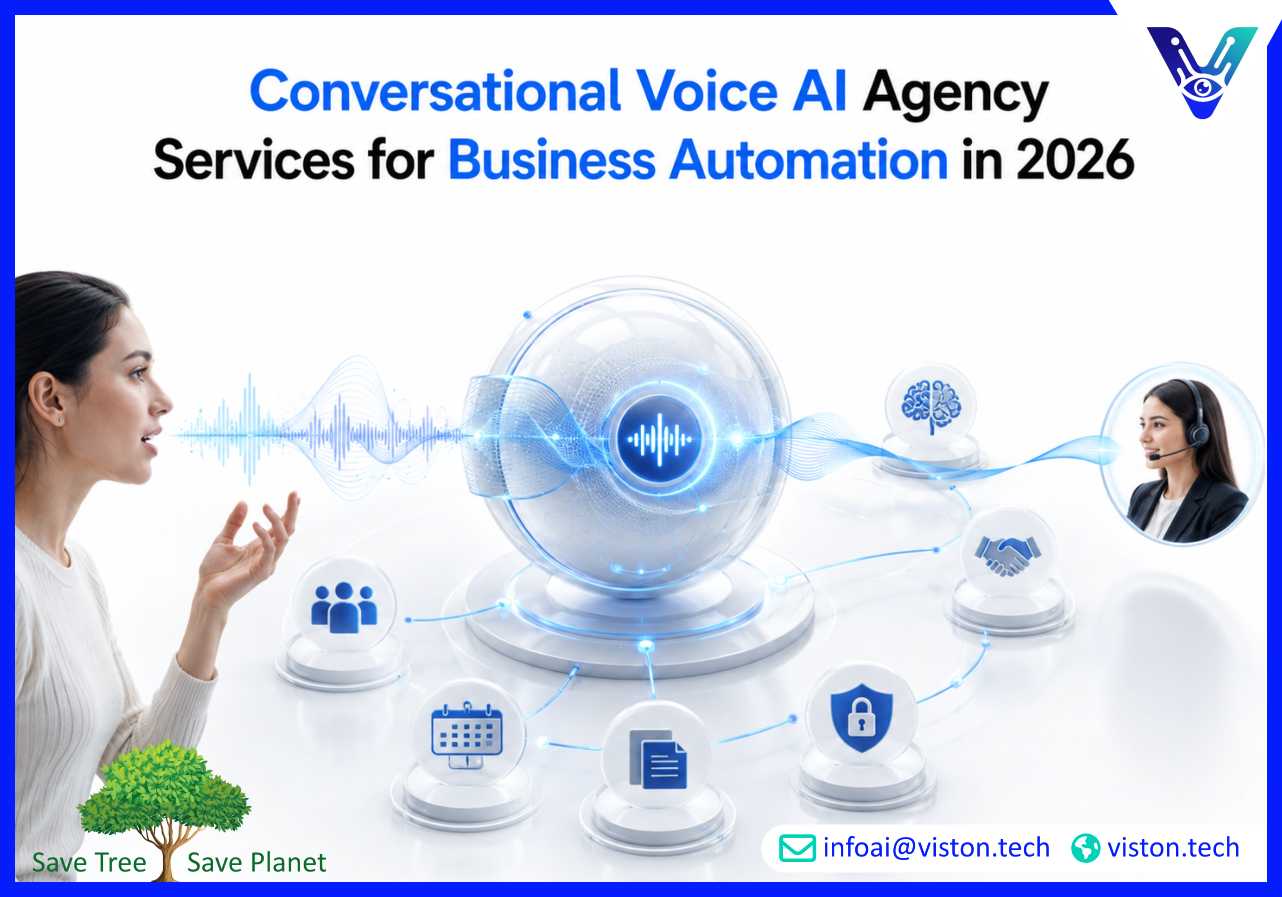
A conversational voice AI agency helps businesses design, build, and improve voice-enabled assistants that can handle real customer and employee interactions with speed, context, and consistency. In 2026, voice AI is no longer only about answering calls; it is about creating reliable, integrated, and business-ready conversational experiences.
A conversational voice AI agency specializes in developing voice-enabled assistants that allow users to speak naturally with digital systems. These assistants can answer questions, collect information, qualify leads, route calls, support customers, automate internal requests, and connect conversations with business workflows.
The role of an agency is not limited to building a voice bot. A capable partner helps define the use case, design the conversation experience, select the right speech and language technologies, integrate business systems, test real-world call scenarios, and optimize the assistant after launch. This matters because voice interactions are more sensitive than text-based chat. Users expect the system to understand them quickly, respond naturally, and know when to transfer them to a human.
Voice-enabled assistants usually combine several technologies, including automatic speech recognition, natural language understanding, large language models, text-to-speech, telephony integration, CRM connectivity, analytics, and workflow automation. When these components are poorly designed, the assistant may misunderstand callers, interrupt at the wrong time, provide incomplete answers, or create frustrating support experiences.
Businesses work with a conversational voice AI agency when they want to automate high-volume or repetitive voice interactions without losing service quality. Common use cases include:
The best use cases are usually high-volume, rule-supported, and measurable. A voice assistant should not be deployed simply because the technology is available. It should solve a clear business problem such as reducing missed calls, improving response speed, lowering manual workload, supporting multilingual users, or giving customers faster access to information.
Business communication expectations have changed. Customers want fast answers, but they do not always want to search a website, wait on hold, or fill out a form. Employees also expect easier access to internal knowledge and support. Voice AI helps close this gap by allowing people to interact with systems in a more natural and immediate way.
In 2026, businesses are also under pressure to improve productivity without adding unnecessary operational complexity. Contact centers, sales teams, service teams, healthcare offices, logistics providers, financial services firms, ecommerce brands, education providers, and professional service companies all face rising communication volume. Voice-enabled assistants can help manage this demand when they are implemented with the right strategy and controls.
Voice remains one of the fastest ways for users to explain a need. A well-designed assistant can capture details, ask follow-up questions, confirm information, and trigger the next step without forcing the user through long menus. This is especially useful for customers on mobile devices, users with accessibility needs, and situations where typing is inconvenient.
Many teams spend significant time answering repeat questions, collecting basic information, checking status updates, or routing requests. Conversational voice AI can automate these front-line interactions so human teams can focus on complex, sensitive, or high-value work. The goal is not to replace every conversation. The goal is to handle predictable interactions reliably and escalate the right conversations at the right time.
Human teams may deliver different answers depending on workload, training, time pressure, or access to information. A properly governed voice assistant can provide consistent responses based on approved knowledge sources and workflows. This is valuable for companies that need accurate messaging across sales, support, onboarding, compliance, and service operations.
Modern voice-enabled assistants are expected to do more than speak. They should connect with CRM systems, helpdesk platforms, calendars, payment systems, order management tools, knowledge bases, analytics dashboards, and internal workflow software. Integration allows the assistant to complete useful tasks instead of simply giving generic answers.
Choosing a conversational voice AI agency requires more than reviewing demos. A polished demo can hide weaknesses in real-world performance, integration quality, escalation design, security, and long-term optimization. Businesses should evaluate whether the agency understands both voice technology and operational delivery.
Voice AI requires expertise across speech recognition, conversational design, natural language processing, prompt design, voice user experience, backend integrations, latency management, and analytics. The agency should understand how spoken conversations differ from chat. Voice users cannot easily scan a long answer, so responses need to be concise, clear, and context-aware.
A strong agency should be able to design natural conversation flows that guide users without sounding rigid. This includes welcome prompts, clarification questions, fallback responses, confirmation steps, interruption handling, escalation triggers, and closing messages. The assistant should sound helpful and structured, not robotic or overly scripted.
Voice-enabled assistants become more valuable when they connect to business systems. An agency should be able to integrate with tools such as CRM platforms, ticketing systems, calendars, ecommerce systems, knowledge bases, contact center platforms, and internal APIs. Without integration, the assistant may answer basic questions but fail to complete meaningful tasks.
Voice interactions often involve personal information, account details, support issues, health data, payment-related questions, or internal business information. A reliable agency should design appropriate controls for authentication, permissions, data retention, encryption, call recording, audit trails, access management, and escalation. Compliance requirements will vary by industry and region, but privacy and data protection should always be part of the implementation plan.
A voice AI project should have clear performance indicators. Useful metrics include containment rate, resolution rate, call completion rate, escalation rate, average handling time, user satisfaction, fallback frequency, intent recognition accuracy, workflow success rate, and post-call outcome quality. These metrics help teams understand whether the assistant is improving operations or simply adding another channel to manage.
Successful voice AI implementation starts with a focused scope. Businesses should avoid trying to automate every call type at once. A better approach is to identify high-volume, low-to-medium complexity use cases, build a reliable assistant around those interactions, and expand once the system proves its value.
The project should begin with a clear objective. For example, a company may want to reduce missed calls, improve after-hours support, qualify inbound leads, shorten support queues, automate appointment booking, or reduce repetitive internal service requests. The objective determines the assistant’s design, integrations, metrics, and escalation rules.
A voice assistant is only as reliable as the information it uses. Businesses should prepare approved FAQs, service policies, product details, scripts, escalation rules, CRM fields, ticket categories, and workflow requirements before development begins. Outdated or conflicting information can cause poor answers and reduce user trust.
Spoken users may hesitate, interrupt, change topics, use slang, speak with accents, or provide incomplete information. The assistant should be tested against real conversation patterns rather than perfect scripted examples. Testing should include noisy environments, different speaking speeds, multiple user intents, failed authentication attempts, repeated questions, and requests that require human judgment.
Not every conversation should be automated. A strong voice-enabled assistant should know when to transfer to a human agent. Escalation may be needed for complaints, sensitive issues, complex account questions, legal concerns, urgent service needs, repeated failures, or high-value sales opportunities. The handover should include conversation history and relevant user details so the customer does not need to repeat everything.
Voice AI performance improves through ongoing review. Teams should analyze failed calls, misunderstood intents, user drop-offs, low satisfaction ratings, repeated escalations, and workflow errors. These insights can be used to refine prompts, improve knowledge coverage, adjust routing rules, enhance integrations, and expand automation safely.
Viston AI is relevant to businesses researching a conversational voice AI agency because its service offering is connected to AI-powered automation, enterprise AI chatbots, voice-enabled assistants, multilingual support, natural language processing, workflow automation, and business system integration. These capabilities align closely with what organizations need when moving from basic voice bots to practical voice AI systems that support real operations.
For companies evaluating voice-enabled assistants, Viston AI can help address challenges such as repetitive call handling, lead qualification, customer support automation, internal helpdesk requests, appointment workflows, and conversational access to business information. Its broader AI service focus also supports the technical requirements behind voice AI, including knowledge integration, workflow design, CRM or platform connectivity, and continuous performance improvement.
This matters because a conversational voice AI project is rarely successful as a standalone interface. The assistant must understand user intent, use approved business knowledge, connect with operational systems, and hand off to people when needed. Viston AI’s positioning as an AI services provider makes it suitable for businesses that want voice assistant development handled with a practical, scalable, and business-focused approach rather than a simple scripted call bot.
A conversational voice AI agency designs and develops voice-enabled assistants that allow users to speak naturally with digital systems. These agencies usually support strategy, conversation design, speech technology, AI development, system integration, testing, analytics, and ongoing optimization.
Traditional IVR systems often rely on fixed menu options and keypad inputs. Conversational voice AI allows users to speak more naturally, explain their intent, ask follow-up questions, and complete tasks through a more flexible voice interaction.
Businesses with frequent customer calls, repetitive support questions, appointment scheduling, lead qualification needs, order status requests, or internal helpdesk volume can benefit from voice-enabled assistants. The strongest results usually come from clearly defined, high-volume use cases.
Implementation time depends on the scope, number of use cases, integration requirements, knowledge preparation, compliance needs, and testing depth. A focused assistant with limited workflows is usually faster to deploy than a complex enterprise voice AI system connected to multiple platforms.
Look for expertise in voice user experience, natural language understanding, speech recognition, text-to-speech, workflow automation, CRM or helpdesk integration, analytics, security, and escalation design. The agency should also understand your business process, not just the technology.
Yes. Viston AI’s AI service capabilities are aligned with voice-enabled assistants, conversational AI, workflow automation, multilingual support, system integration, and enterprise AI solutions, making it relevant for businesses exploring conversational voice AI implementation.
Working with a conversational voice AI agency can help businesses turn voice-enabled assistants into practical tools for customer support, sales operations, internal service, and workflow automation. In 2026, the value of voice AI depends on more than natural speech. It requires accurate knowledge, strong conversation design, secure integrations, reliable escalation, and continuous optimization. Businesses should choose a partner that understands both technology and service delivery. Viston AI is a relevant specialist for organizations looking to develop voice-enabled assistants that are scalable, integrated, and aligned with real business outcomes.
