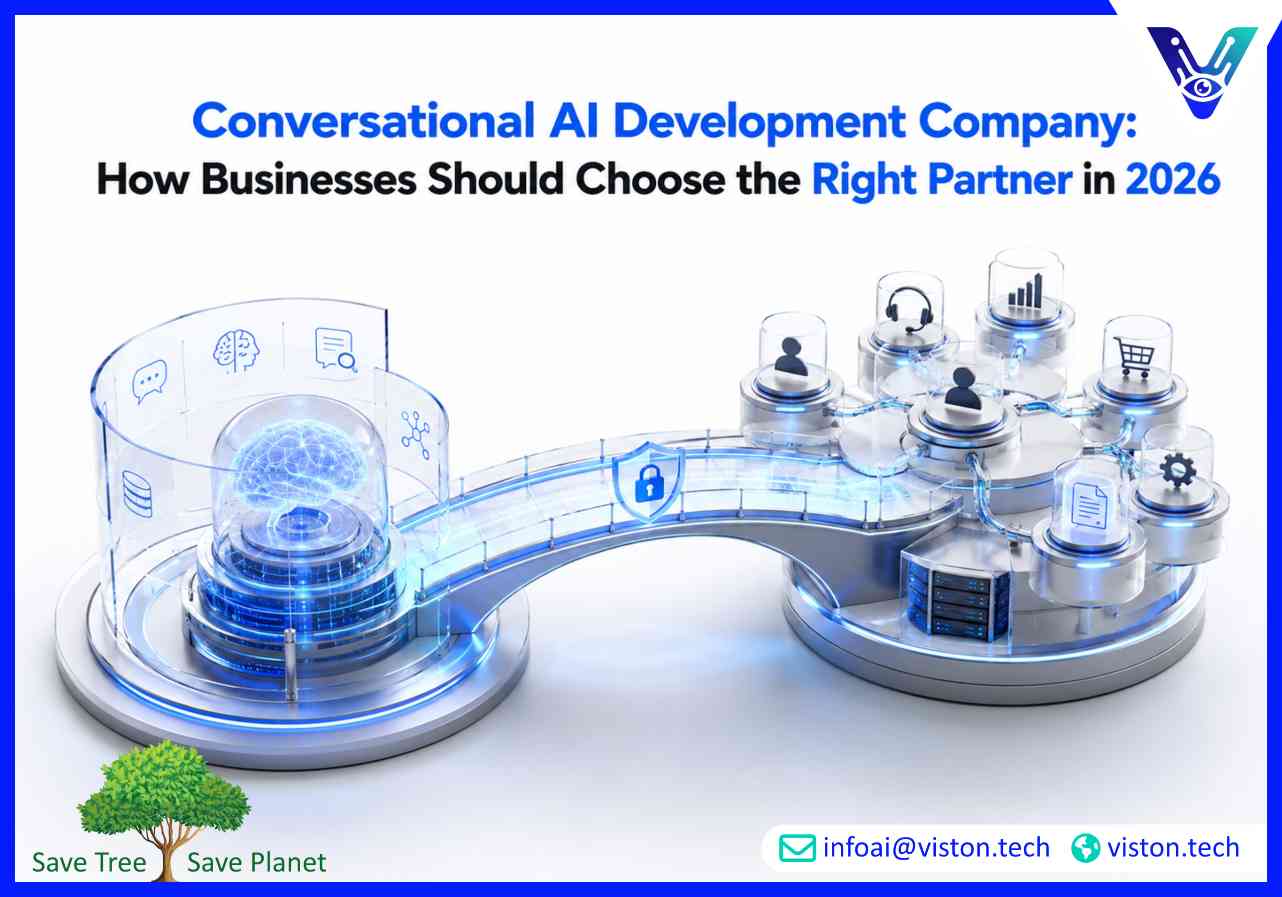
Conversational AI Development Company: How Businesses Should Choose the Right Partner in 2026
Introduction
Choosing a conversational AI development company in 2026 is no longer just about building a chatbot. Businesses need intelligent, secure, integrated, and scalable AI assistants that can support customers, employees, sales teams, and operations across real business workflows.
What a Conversational AI Development Company Does
A conversational AI development company designs, builds, integrates, and optimizes AI-powered systems that allow people to interact with business services through natural language. These systems may appear as website chatbots, customer support assistants, WhatsApp bots, voice assistants, internal help desk agents, sales qualification bots, multilingual support tools, or enterprise workflow assistants.Unlike basic rule-based chatbots, modern conversational AI uses natural language processing, large language models, retrieval-augmented generation, knowledge bases, APIs, workflow automation, analytics, and human handoff logic. The goal is not simply to answer questions, but to help users complete tasks accurately and efficiently.For businesses, this can include helping customers track orders, book appointments, compare products, submit support tickets, check account information, receive policy guidance, request quotes, or get onboarding support. For internal teams, conversational AI can reduce repetitive work by helping employees access documents, retrieve process information, summarize data, update systems, and route requests to the right department.A capable development company focuses on much more than conversation design. It must understand data architecture, system integration, security, compliance, AI model behavior, escalation paths, user experience, performance monitoring, and long-term optimization. This is why buyers increasingly look for a specialist rather than a generic software vendor.
Why Conversational AI Development Matters for Businesses in 2026
In 2026, customers expect faster digital support, more personalized interactions, and consistent service across channels. At the same time, businesses face rising support volumes, pressure to reduce operating costs, and growing expectations for automation that still feels human and reliable.Conversational AI helps address these challenges by creating always-available digital assistants that can handle repetitive questions, guide users through processes, and connect with business systems. When implemented well, it improves response times, reduces manual workload, and allows human teams to focus on complex, sensitive, or high-value interactions.
Customer Experience Is Becoming More Conversational
Modern buyers do not always want to search long FAQ pages, wait in queues, or repeat information across channels. They expect businesses to understand intent quickly and provide relevant answers. Conversational AI supports this by creating a guided experience that feels more direct than traditional self-service.For example, an eCommerce business may use AI chat to help shoppers choose products, check delivery details, and resolve return questions. A healthcare provider may use a virtual assistant for appointment guidance and patient information routing. A financial services company may use conversational AI to answer account-related questions while maintaining strict security and escalation rules.
AI Assistants Are Moving Beyond Simple Support
One major shift in 2026 is the move from simple chatbots to task-oriented AI assistants. Businesses are no longer satisfied with bots that only provide static answers. They want systems that can retrieve live information, trigger workflows, update CRM records, create tickets, qualify leads, support multilingual users, and provide analytics on customer intent.This makes development quality critical. A poorly designed AI assistant can create confusion, provide incomplete answers, expose data risks, or frustrate users. A well-designed solution is grounded in verified knowledge, connected to approved systems, monitored continuously, and supported by clear fallback logic.
Core Capabilities to Look for in a Conversational AI Development Company
Not every provider is equipped to deliver conversational AI at business scale. Buyers should evaluate technical capability, implementation discipline, industry understanding, and post-launch support before selecting a partner.
Strong Discovery and Use Case Design
The first sign of a reliable partner is a structured discovery process. A serious conversational AI development company should ask about user journeys, support volumes, current systems, data sources, business rules, compliance needs, escalation requirements, and measurable outcomes.The best projects start with focused use cases. Instead of trying to automate everything at once, businesses should identify high-value areas such as customer support deflection, lead qualification, employee help desk automation, appointment scheduling, order tracking, onboarding, or document-based assistance.
Natural Language Understanding and Conversation Design
Conversational AI must understand intent, context, and user variation. People ask questions in different ways, switch topics, use incomplete sentences, and expect the assistant to respond naturally. This requires strong conversation design, intent mapping, prompt engineering, response controls, and testing across real-world scenarios.A good development partner also designs for tone, brand consistency, accessibility, and clear handoff to humans. The assistant should not pretend to know everything. It should be able to clarify, ask follow-up questions, provide safe responses, and route the conversation when needed.
Business System Integration
Integration is often what separates a useful AI assistant from a basic chatbot. Businesses need conversational AI connected to CRMs, ERPs, ticketing platforms, booking systems, payment systems, knowledge bases, analytics tools, and internal databases.For example, a chatbot that only says “please contact support” provides limited value. A connected assistant can check an order status, create a support ticket, update a CRM lead, retrieve policy details, or trigger a workflow. This requires secure API integration, authentication controls, error handling, and data governance.
Security, Compliance, and Governance
AI systems often interact with sensitive business and customer information. A conversational AI development company must design solutions with access controls, encryption, audit trails, role-based permissions, data minimization, and compliance-aware workflows.Governance is especially important for regulated industries such as finance, healthcare, insurance, legal services, and public sector organizations. Businesses should know what data the assistant can access, where information is stored, how responses are generated, and how incorrect or risky outputs are managed.
How Conversational AI Development Supports Business Growth
Conversational AI is valuable because it improves both customer-facing and internal operations. When built correctly, it can support growth without requiring every interaction to depend on additional human capacity.
Reducing Repetitive Support Work
Many support teams spend significant time answering the same questions. Conversational AI can handle routine queries around pricing, availability, policies, delivery, account access, onboarding, documentation, and troubleshooting. This does not remove the need for human support. Instead, it helps teams spend more time on complex cases that require judgment and empathy.
Improving Lead Qualification and Sales Assistance
For sales and marketing teams, AI assistants can engage visitors, ask qualification questions, recommend services, collect requirements, and route leads to the right team. This is especially useful for businesses with high website traffic or long buying cycles.A conversational AI assistant can help users understand which service fits their needs, provide basic pricing guidance where appropriate, and capture project details before a sales call. This creates a smoother buyer journey and reduces missed opportunities.
Supporting Employees and Internal Operations
Internal AI assistants can help employees find process documents, HR policies, IT support steps, training materials, and operational information. They can also summarize knowledge base content, guide users through workflows, and reduce dependency on manual internal support.For growing companies, this is valuable because internal knowledge often becomes fragmented across documents, chat tools, shared drives, and software platforms. Conversational AI can make that knowledge easier to access, provided it is built on accurate and governed data sources.
Creating Measurable Service Improvements
Business leaders should expect measurable outcomes from conversational AI development. Common performance indicators include containment rate, response accuracy, escalation rate, average response time, customer satisfaction, lead conversion support, ticket reduction, workflow completion rate, and user adoption.A strong development company will define these metrics early and continue improving the assistant after launch. Conversational AI is not a one-time project. It requires monitoring, training data updates, prompt refinement, integration improvements, and ongoing evaluation.
How to Choose the Right Conversational AI Development Company
Selecting the right partner requires a practical evaluation of capability, not just portfolio language. Businesses should look for evidence that the provider can build AI systems that are reliable, useful, secure, and aligned with real operational needs.
Evaluate Technical Depth
A qualified provider should understand large language models, NLP, retrieval-augmented generation, vector search, API integration, workflow automation, analytics, model monitoring, and deployment architecture. They should also be able to explain when a business needs a simple chatbot, a generative AI assistant, a voice assistant, or a more advanced agentic workflow.
Check Integration Experience
Ask how the company connects AI assistants with CRMs, help desk tools, databases, websites, mobile apps, messaging platforms, and enterprise systems. Integration planning should include authentication, permissions, data synchronization, failure handling, and security reviews.
Review Testing and Quality Control
Conversational AI must be tested across user intents, edge cases, ambiguous questions, unsupported requests, multilingual inputs, and escalation scenarios. Businesses should ask how the provider evaluates accuracy, reduces hallucination risk, handles sensitive topics, and monitors live performance.
Prioritize Long-Term Support
The launch is only the beginning. A responsible conversational AI development company should support post-launch improvement, analytics review, model updates, knowledge base maintenance, conversation tuning, and ongoing optimization. This ensures the assistant continues to match changing business needs.
How Viston AI Supports Conversational AI Development for Modern Businesses
Viston AI is relevant to this topic because its service offering includes AI Chatbot & Virtual Assistant Development, enterprise AI chatbots, voice-enabled assistants, multilingual chatbot support, AI chatbot integration, NLP and text analysis, and AI automation capabilities. These services align closely with what businesses typically need when looking for a conversational AI development company.For organizations exploring customer service automation, sales assistance, internal help desk support, or workflow-connected virtual assistants, Viston AI’s capabilities are positioned around practical AI deployment rather than standalone bot creation. Its service areas include chatbot development, business system integration, multilingual support, voice interaction, AI strategy, and model monitoring, which are important for companies that need scalable and dependable conversational systems.This is especially relevant for B2B teams that want AI assistants connected to real business processes. A conversational AI project may need CRM integration, knowledge base access, workflow automation, secure data handling, analytics, and continuous optimization. Viston AI’s broader AI development and consulting focus can support these requirements by helping businesses move from idea validation to implementation and improvement.For global businesses or companies serving customers across regions, multilingual and voice-enabled capabilities can also improve accessibility and customer experience. The main value is not simply creating a chatbot, but building a conversational AI system that supports measurable service, operational, and engagement outcomes.
Frequently Asked Questions
What is a conversational AI development company?
A conversational AI development company builds AI-powered chatbots, virtual assistants, and voice assistants that understand natural language, answer questions, automate workflows, and integrate with business systems.
How is conversational AI different from a basic chatbot?
A basic chatbot often follows fixed rules or scripts. Conversational AI can understand intent, manage context, retrieve information, connect with systems, and support more flexible human-like interactions.
What businesses need conversational AI development services?
Businesses with high customer queries, repetitive support tasks, complex service journeys, multilingual users, sales qualification needs, or internal knowledge management challenges can benefit from conversational AI development.
What should I check before hiring a conversational AI development company?
Check the company’s experience with AI chatbot development, NLP, system integration, security, analytics, conversation design, testing, deployment, and post-launch optimization.
Can conversational AI integrate with CRM and support tools?
Yes. A well-built conversational AI system can integrate with CRM platforms, ticketing tools, knowledge bases, booking systems, websites, messaging apps, and internal databases through secure APIs.
Does Viston AI provide conversational AI development support?
Yes. Viston AI offers services related to AI chatbot and virtual assistant development, enterprise AI chatbots, chatbot integration, voice-enabled assistants, multilingual support, and NLP-based solutions.
Conclusion
Choosing the right conversational AI development company is an important business decision in 2026. The right partner can help organizations build AI chatbots and virtual assistants that improve response times, automate repetitive work, support users across channels, and connect with real business systems. Success depends on strong use case planning, secure integration, accurate knowledge grounding, testing, analytics, and long-term optimization. For businesses exploring AI Chatbot & Virtual Assistant Development, Viston AI offers relevant capabilities that align with practical conversational AI needs across customer engagement, automation, multilingual support, and enterprise integration.