Compare NLP APIs for Developers in 2026: Features, Use Cases, and Selection Criteria
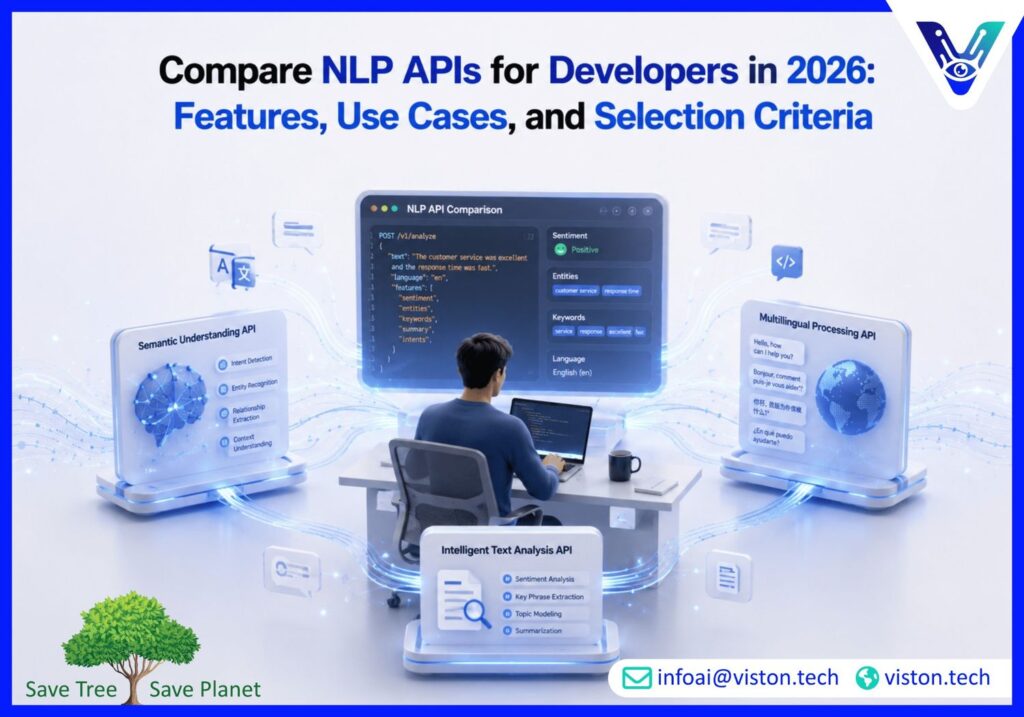
Natural language processing has become a core component of modern software products, customer experiences, analytics platforms, and automation initiatives. For developers building AI-powered applications, choosing the right NLP API can significantly influence performance, scalability, integration complexity, and long-term costs. Understanding how different NLP APIs compare helps organizations make informed technology decisions aligned with business goals and technical requirements.
What NLP APIs Mean for Developers and Businesses
An NLP API allows developers to integrate language understanding capabilities into applications without building complex machine learning models from scratch. These APIs provide access to functions such as text classification, sentiment analysis, entity extraction, summarization, language detection, document processing, conversational AI, and semantic search.In 2026, organizations increasingly rely on NLP APIs to automate customer support, analyze large volumes of text data, improve search experiences, process documents, monitor customer sentiment, and support intelligent business workflows.For developers, NLP APIs reduce development time while providing access to continuously improving language models and infrastructure managed by specialized providers.
Key Factors to Compare When Evaluating NLP APIs
Language Understanding Accuracy
The effectiveness of an NLP API depends heavily on how accurately it interprets user intent, context, entities, and sentiment. Accuracy becomes particularly important for customer-facing applications, healthcare systems, financial services platforms, and enterprise knowledge management solutions.Developers should evaluate:
Context awareness
Entity recognition quality
Multilingual capabilities
Industry-specific language understanding
Performance on complex queries
Supported Features
Different NLP APIs offer varying capabilities. Some focus on basic text analytics, while others support advanced generative AI and conversational experiences.Common NLP capabilities include:
Sentiment analysis
Named entity recognition
Text summarization
Language translation
Topic classification
Question answering
Document extraction
Semantic search
Intent detection
Conversational AI
Developers should prioritize APIs that align with actual business requirements rather than selecting solutions based solely on feature quantity.
Scalability and Performance
Applications that process thousands or millions of requests daily require reliable performance and predictable response times.Important considerations include:
API uptime guarantees
Latency performance
Request throughput limits
Global infrastructure availability
Enterprise-grade reliability
Organizations deploying customer-facing applications often place scalability among their top evaluation criteria.
Developer Experience
Well-designed APIs reduce implementation effort and accelerate product development.Developers typically evaluate:
Documentation quality
SDK availability
API consistency
Testing environments
Code examples
Community support
A strong developer experience can significantly reduce onboarding and maintenance costs.
Comparing Popular NLP API Categories in 2026
General-Purpose AI Language APIs
General-purpose language APIs provide broad language understanding and generation capabilities. These solutions are commonly used for chatbots, content generation, document analysis, semantic search, and workflow automation.Strengths typically include:
Advanced contextual understanding
Large language model capabilities
Flexible use cases
Continuous model improvements
Broad language support
These APIs are often suitable for organizations seeking a single platform capable of supporting multiple NLP applications.
Cloud Provider NLP Services
Major cloud platforms offer NLP services tightly integrated with their broader ecosystems.Advantages commonly include:
Enterprise infrastructure integration
Security and compliance controls
Scalable deployment options
Identity and access management integration
Data governance capabilities
Organizations already invested in a specific cloud ecosystem often benefit from simplified deployment and management.
Industry-Specific NLP Solutions
Some NLP APIs focus on specialized industries such as healthcare, legal services, financial services, insurance, or ecommerce.These solutions may offer:
Domain-specific terminology recognition
Specialized compliance support
Industry-focused training data
Higher accuracy for niche use cases
Custom workflow capabilities
Industry-focused APIs can deliver greater precision when business requirements involve highly specialized language.
How Developers Should Choose the Right NLP API
Define the Business Objective First
The best NLP API depends on the problem being solved. Customer service automation, document intelligence, semantic search, sentiment monitoring, and analytics projects often require different capabilities.Before evaluating vendors, organizations should define:
Business goals
Expected outcomes
Required features
Success metrics
Data requirements
Assess Integration Requirements
Integration complexity affects implementation timelines and ongoing maintenance.Key questions include:
Will the API integrate with existing systems?
Are real-time responses required?
Is batch processing needed?
How much customization is necessary?
What security controls are required?
Understanding integration requirements early helps avoid costly implementation challenges.
Consider Compliance and Security Needs
Data protection remains a major concern in 2026. Businesses processing customer information, financial records, legal documents, or healthcare data must evaluate security and compliance capabilities carefully.Important areas include:
Data encryption
Access controls
Audit logging
Data residency options
Privacy regulations
Industry-specific compliance requirements
Evaluate Long-Term Costs
Pricing structures vary significantly between providers. While some charge per request, others use token-based pricing, subscription tiers, or enterprise agreements.Organizations should estimate:
Expected monthly usage
Growth projections
Storage requirements
Additional infrastructure costs
Support and maintenance expenses
Evaluating total cost of ownership often provides a more accurate picture than comparing API request costs alone.
Common NLP API Use Cases Across Industries
Customer Support Automation
Businesses use NLP APIs to power intelligent chatbots, automate ticket routing, analyze support conversations, and improve response quality.
Document Processing
Organizations increasingly automate extraction of information from contracts, invoices, forms, reports, and business records.
Customer Sentiment Analysis
NLP APIs help companies understand customer feedback from surveys, reviews, support interactions, and social media discussions.
Knowledge Management
Semantic search and intelligent retrieval systems allow employees to locate information more efficiently across enterprise knowledge bases.
Content and Data Analysis
Businesses leverage NLP to identify trends, classify content, detect topics, and generate actionable insights from large datasets.
How Viston AI Supports Businesses Seeking NLP Solutions
As organizations continue expanding their use of AI-powered language technologies, selecting and implementing the right Natural Language Processing Solutions becomes increasingly important. Viston AI helps businesses evaluate, design, and deploy NLP-driven systems that align with operational goals, customer expectations, and scalability requirements.Rather than focusing solely on API access, successful NLP implementation often requires integration planning, workflow design, data preparation, automation strategies, performance monitoring, and ongoing optimization. Businesses frequently need support connecting NLP capabilities with existing applications, business processes, analytics platforms, and customer-facing systems.For organizations exploring Natural Language Processing Solutions, Viston AI can help address practical challenges such as document processing automation, intelligent customer engagement, semantic search implementation, language analytics, and workflow optimization. This approach enables companies to move beyond experimentation and build solutions that deliver measurable operational value.As NLP technologies continue evolving in 2026, organizations increasingly benefit from implementation strategies that balance technical performance, business objectives, scalability, security, and long-term sustainability.
Frequently Asked Questions
Which NLP API is best for developers in 2026?
The best NLP API depends on your specific use case, scalability requirements, budget, integration needs, and desired language capabilities. Organizations should evaluate providers based on business objectives rather than popularity alone.
What features should developers prioritize when comparing NLP APIs?
Important factors include language understanding accuracy, supported features, scalability, latency, security, compliance, pricing, and developer experience.
Are cloud-based NLP APIs suitable for enterprise applications?
Yes. Many cloud-based NLP services provide enterprise-grade reliability, security controls, compliance features, and scalable infrastructure suitable for large-scale deployments.
How much do NLP APIs typically cost?
Pricing varies by provider and usage model. Costs may be based on API calls, processed tokens, subscription tiers, or enterprise agreements.
Can NLP APIs support multilingual applications?
Most modern NLP APIs offer multilingual capabilities, although language coverage and performance quality vary between providers.
How can Viston AI help with NLP implementation?
Viston AI supports organizations evaluating and implementing Natural Language Processing Solutions, helping align NLP capabilities with business objectives, workflows, integration requirements, and long-term operational goals.
Conclusion
Comparing NLP APIs requires more than reviewing feature lists. Organizations must evaluate language understanding quality, scalability, integration requirements, security controls, pricing models, and long-term business fit. As Natural Language Processing Solutions become increasingly central to automation, analytics, customer engagement, and knowledge management, selecting the right API can significantly influence project success. Businesses seeking to implement NLP effectively should focus on practical outcomes, technical compatibility, and sustainable growth. For organizations exploring these opportunities, Viston AI provides expertise that helps translate NLP capabilities into meaningful business value.

 Natural language processing has become a core component of modern software products, customer experiences, analytics platforms, and automation initiatives. For developers building AI-powered applications, choosing the right NLP API can significantly influence performance, scalability, integration complexity, and long-term costs. Understanding how different NLP APIs compare helps organizations make informed technology decisions aligned with business goals and technical requirements.